IN THIS ISSUE...
SUMMER 2022 VOLUME 68 NUMBER 2
PLANT SCIENCE
BULLETIN
A PUBLICATION OF THE BOTANICAL SOCIETY OF AMERICA
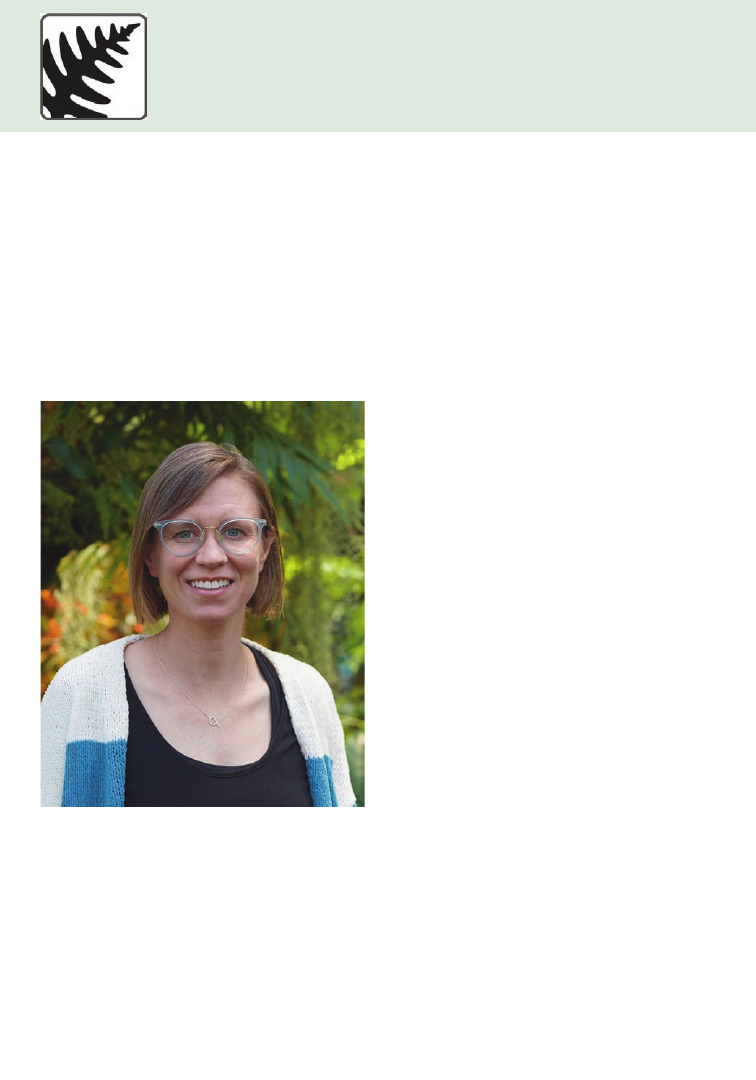
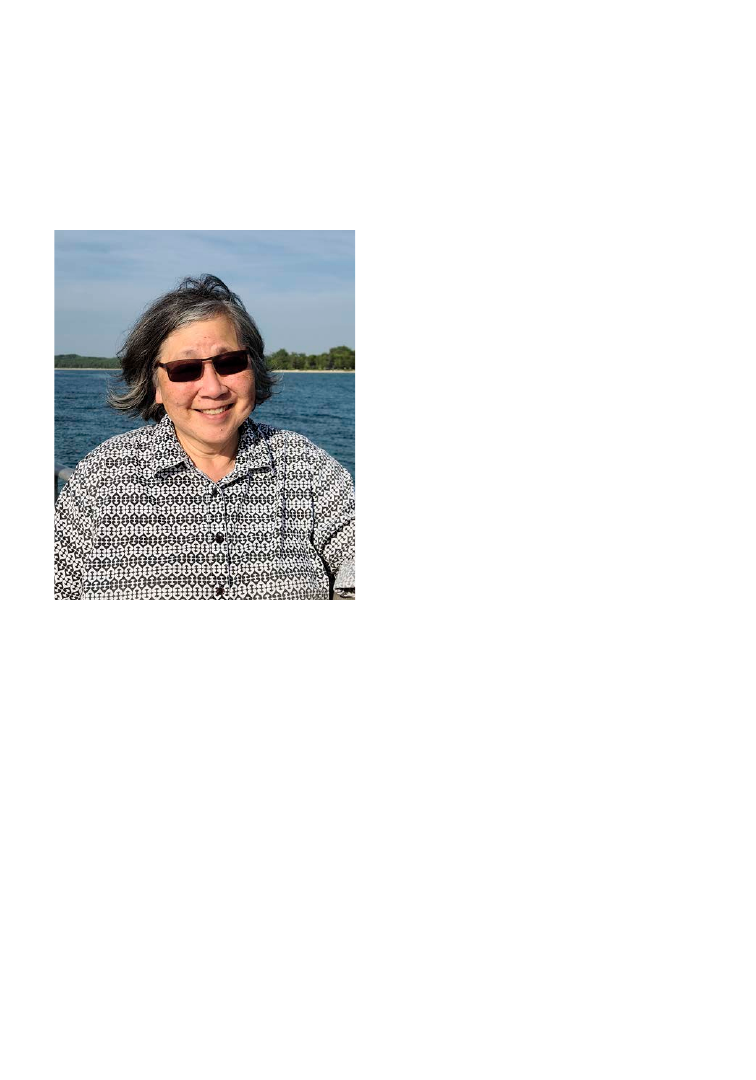
Get to know Sarah Sims, BSA’s New
Diversity, Equity, & Inclusion Outreach
Programs Coordinator... p. 99
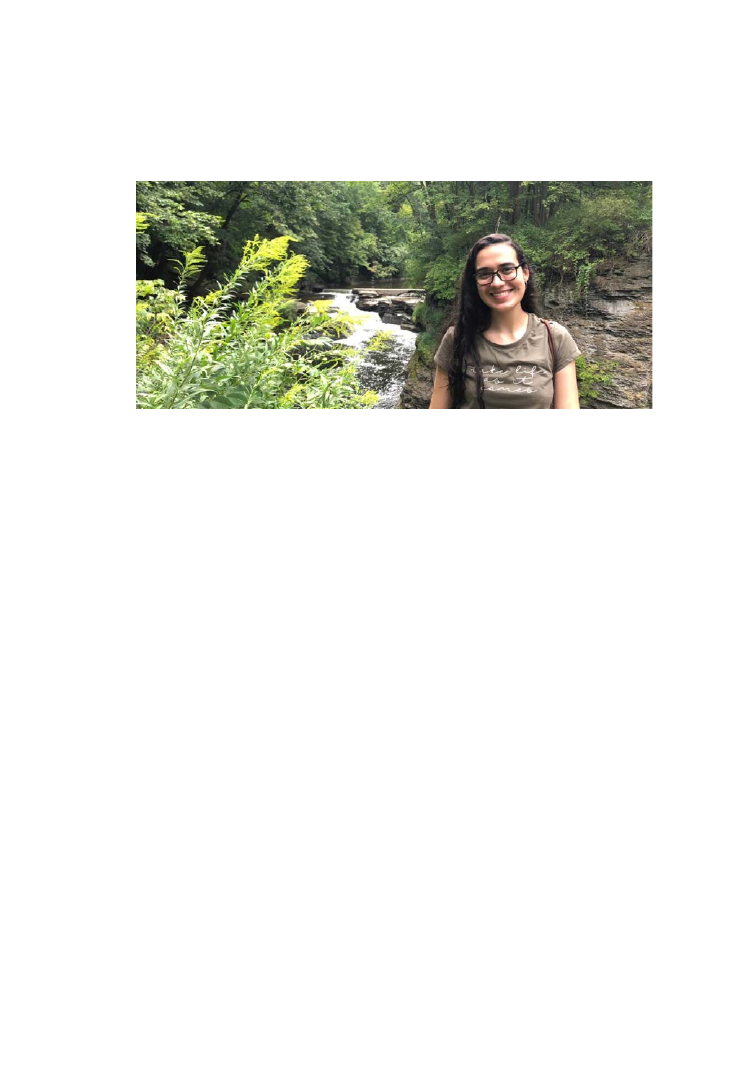
Meet Eli Hartung, the new
BSA Student Representative!... p. 139
Demystifying the Manuscript
Submission Process by BSA Publications
Manager Amy McPherson... p. 102
BSA
Announces
2022
Award
Winners!
See p. 110
Summer 2022 Volume 68 Number 2
PLANT SCIENCE BULLETIN
Editorial Committee
Volume 68
FROM THE EDITOR
James McDaniel
(2022)
Botany Department
University of Wisconsin - Madison
Madison, WI 53706
jlmcdaniel@wisc.edu
Seana K. Walsh
(2023)
National Tropical Botanical
Garden
Kalāheo, HI 96741
swalsh@ntbg.org
Greetings,
This summer finds us in the leadup to the BSA’s first-ever hybrid
meeting. It will be a learning experience for everyone, I’m sure.
In this issue we include information about Botany 2022, as well
as the first part of our spotlight on awards. If you are a student, be
sure to check out the student section for a description of several
upcoming events and resources.
In this issue, we will begin to list notices of death for members who have passed
away, but whom do not yet have an In Memoriam article prepared. An obituary
may be in preparation and will appear in a later issue. However, if you would be
interested in preparing an In Memoriam for someone listed, please contact me
at mackenzietaylor@creighton.edu. Similarly, if you become aware of the death
of a member, please let me or the BSA staff know.
As always, Plant Science Bulletin depends on member submissions. If you have
an idea for a potential article, please reach out!
Sincerely,
99
SOCIETY NEWS
We would like to welcome Sarah Sims (she/her/
hers) in the newly created position of Diversity,
Equity and Inclusion Outreach Programs
Coordinator for the BSA! She comes to us from
a background in art and history museums.
Her career spans diversity, equity, accessibility,
and inclusion programming and training;
museum education; inquiry-based teaching;
Introducing Sarah Sims:
BSA’s New Diversity, Equity, and
Inclusion Outreach Programs
Coordinator
teacher, staff, and volunteer professional
development; and trauma-informed practices.
She has a decade of experience in the non-
profit and culture sectors, including prior work
with member societies. Sarah will spend the
majority of her time working on our Botany
and Beyond: PLANTS III grant as well as on
other BSA diversity initiatives. We wanted to
introduce Sarah to the BSA community!
Sarah, what motivated you to apply for the
DEI position at the BSA?
Most of my professional experience has been
within the field of museum education (art and
history museums, specifically.) As my career
grew, I sought out a lot of my own professional
development. I’ve always been a big believer
in the value of professional growth, and I
specifically wanted to learn more about issues
of diversity, equity, accessibility, and inclusion
(DEAI); my own racial identity and how that
affects my presence in work settings; as well
as how institutions, programs, and groups
are affected by the legacies of colonialism,
white supremacy, and hetero patriarchy.
These experiences with self-reflection
and growth led me to seek involvement
PSB 68 (2) 2022
100
in more DEAI projects, to take on formal
responsibilities for implementing DEAI
at the institutional level, and eventually to
provide DEAI trainings for others. The more
I’ve done this work, the more I’ve realized its
broad application across different fields and
job functions. I am a firm believer that no
one person, discipline, or organization can be
neutral—we all operate with lenses informed
by biases. I really enjoy being able to connect
with people whose content area expertise and
job responsibilities are completely different
from mine to help them understand how DEAI
concepts not only fit into, but are essential to,
their work. Plus, I have a soft spot for plants, so
I was very excited when this opportunity came
along for me to help support and implement
DEAI in an entirely new (for me) field!
One of the first things you’ve been work-
ing on since starting here is the Botany and
Beyond-Plants III grant. Can you briefly de-
scribe the grant and what it aims to achieve?
The Botany & Beyond PLANTS III (Preparing
Leaders and Nurturing Tomorrow’s
Scientists) grant is funded by the National
Science Foundation (DEB-2138730) and
encompasses three programs that take place
at or around the annual Botany conference.
The first is a conference mentoring program
for undergraduates that are underrepresented
in science called PLANTS, which has been
around for over a decade. The second
program is a faculty professional development
workshop called the Inclusive Teaching
Initiative. And the third is a science identity
workshop for undergraduates. All three
programs aim to engage, support, and sustain
a diverse community of emerging scientists;
foster inclusive practices across the BSA and
botanical sciences; increase plant awareness;
and advance research and training for a more
diverse, inclusive, and accessible 21st-century
botanical science workforce. My position helps
to coordinate and administer the various arms
of the grant, and supports the three principal
investigators.
Over the past couple of years, many
organizations have launched DEAI
initiatives that look strong “on paper.” What
do you think are the best ways to turn words
into meaningful action?
I think you’re right, and we often then see
those efforts fizzle out after a given project is
completed. In my experience, DEAI initiatives
need to include plans for culture change and
sustainability in order for the words on paper
to be transformed into lasting, meaningful
action.
Culture change could look like developing
shared definitions and goals. The terms
“diversity,” “equity,” “accessibility,” and
“inclusion” get thrown around a lot, but if you
asked 10 different people what those words
mean, theoretically and operationally within
an organization, you would get 10 different
answers. It’s important for people to get on
the same page. Being on the same page doesn’t
mean there isn’t room for ongoing dialogue.
But too often we use these terms without
defining what we really mean, and we end up
talking past each other. Having a common
definition serves as a jumping off point for
setting clear goals and a road map for reaching
them.
I think that culture change also looks like
ensuring everyone at the organization (all
employees/volunteers/members, not just the
one committee or one person hired to support
DEAI work), are receiving ongoing support
and professional development. A mentor once
told me that “racial equity and other justice
work is not a line with a starting and ending
PSB 68 (2) 2022
101
point, but rather a circle: you’re never done
learning, and many times its useful to come
back to old lessons and reflect again with
each new life experience.” Too often, there is
only one anti-bias training for all staff, which
also tends to be facilitated in a one-size-fits-
all way. We need to give support more often
and recognize that folks have different entry
points into this work.
When it comes to sustainability, again, I think
you have to look at the whole organization,
not just the DEAI person. What are the
specific ways that each person or department
can advance DEAI? How do DEAI goals and
measures get baked into standard operating
procedures and policies? How is DEAI woven
into the recruitment, hiring, and retention
process? And where is DEIA showing up in
the budget?
The BSA’s Strategic Plan contains quite a
few DEAI initiatives. Which of these are you
most eager to work on?
Y
es! The level that DEAI is infused into the
BSA’s current strategic plan was another
reason I was so excited to apply for this job!
I think the one that excites me the most
is the strategy to offer DEAI leadership
training opportunities to members, in
support of the goal to become an anti-racist
and anti-discriminatory society. As I’ve said,
I believe that quality, ongoing professional
development opportunities that meet people
where they are is an essential component of
real culture change. I’ve benefited so much
from professional development in my career
and have many experiences developing goals,
promoting, and sourcing facilitators for such
trainings.
Before we wrap up, tell us a little about
yourself! What are your interests outside of
work?
Well, normally I would answer with “plants
and gardening!”—but I suppose that is now
very much related to my work. I also love to
run and hike, explore new restaurants with
my spouse, and indulge my toddler’s ever-
changing obsessions (which currently include
The Princess Bride, light sabers, and the upright
bass).
And how can BSA members reach you?
I would love to hear from members via email
at ssims@botany.org or phone at 314-577-9404
(although with hybrid work at home and the
office, you’ll get a faster response with email).
PSB 68(2) 2022
102
By Amy McPherson
Botanical Society of America
ORCID id: 0000-0001-7904-242X
Navigating the peer review process in scientific
journals can be mysterious. Standards for
manuscript submission, peer review, and
responding to reviewers aren’t always formally
taught and can be difficult to understand.
Those navigating the review process for the
first time often must rely on a network of
mentors to maneuver a manuscript from
submission to acceptance.
To shed some light, a panel of journal editors
and authors (Brittany Sutherland, Briana
Gross, Pamela Diggle, and myself) provided
a behind-the-scenes look at the peer-review
process and offered tips for the various stages
of publication, from pre-submission through
post-acceptance. These sessions focused on
BSA-affiliated journals (American Journal of
Botany and Applications in Plant Sciences) but
are broadly applicable across most biological
publications. The event recordings and
supporting documents are available on the
Botany360 homepage (https://botany.org/
home/resources/botany360.html).
PART 1: WHAT SHOULD
HAPPEN BEFORE YOU
SUBMIT YOUR PAPER TO
A JOURNAL?
Publishing your work is vital to science.
You publish to share your work with other
researchers, the public, the funders who
support research, and government agencies—
and to move science forward and to advance
your career, among other reasons.
If you need advice on writing the paper,
there are lots of resources available (see, e.g.,
Heard, 2022; and supporting resources for
the workshop). But as you collect and analyze
your data and begin thinking of the story you
want to tell, and who will be an author and
what the order of authors will be, decide on a
data management plan; begin organizing your
references; and start thinking about possible
journals.
Keeping your Data
Organized
Take it from early career researcher Brittany
Sutherland: Keeping your data organized
saves you time and effort! Her sage advice,
gleaned from experience, is to clearly and
consistently label all files and data columns;
keep metadata with original data; and don’t
Demystifying the Manuscript
Submission Process
Highlights from the Botany360 Workshops
presented in May 2022
PSB 68(2) 2022
103
touch the raw data. Also, back up your data
frequently in a different physical location and
consider the many options for depositing
your data in a public repository (e.g., Dryad,
Zenodo, FigShare). Not only is it a good
thing to do for reasons of transparency and
replicability, but it may also be required by
the journal you are submitting your paper to
or the funding organization supporting your
research.
As well as managing your data, you will need
to organize your references. It’s likely that you
will accumulate thousands of papers quickly,
so have a system in place early on. There are
many reference managers available, some of
which are free, subsidized by your university,
or available at minimal cost (see, e.g., Dr.
Sutherland’s slides and Perkel [2020]).
Selecting a Journal
Many people decide on where to submit
their manuscript after they have collected
and analyzed the data, and before they have
started to write the paper. The website Jane
(Journal/Author Name Estimator, https://
jane.biosemantics.org/) can help identify a
number of possible journals. Authors must
weigh several criteria, including:
• The reputation/prestige of the journal
(often based on the journal’s Impact Fac-
tor or H5-index, or the recommendation
of an advisor)
• The appropriateness of the journal (does
your study topic fit within its aims and
scope? is it the journal your peers read
and cite and/or where interested people
will find it?)
• The speed of publication;
• The cost; and
• The community (is it important to you to
support a Society journal that re-invests
in its members?).
It’s also important to avoid “predatory
journals” (see Culley, 2018).
The Editor-in-Chief of Applications in Plant
Sciences (APPS), Briana Gross, spoke about
maximizing your publication power by
choosing the right fit for your research. If
you’re working with a novel method, protocol,
or software package, or have developed a new
genomic resource, you may want to consider
publishing a separate, stand-alone manuscript
in a methods journal such as APPS. There are
numerous advantages for doing so:
• APPS is a fully open-access Society jour-
nal, with professional copyediting, index-
ing, and support throughout the publish-
ing process
• It offers competitive Article Processing
Charges (APCs), with discounts for BSA
members and waivers for authors from
eligible countries, as well as transforma-
tional deals between the publisher Wiley
and institutions worldwide
• The BSA helps promote your research on
social media and through other outreach
once it is published.
Once you’ve chosen a journal, it is important to
consult the author guidelines that are available
on the journal’s website. The guidelines will
help you shape your manuscript and ensure
that you are satisfying requirements needed
for consideration and eventual acceptance
(as well as saving time, possible frustration,
and effort later in the process). They will also
indicate whether the journal editor wants to
see a cover letter, and what should be included
PSB 68 (2) 2022
104
in the cover letter—your first opportunity to
make a case for your manuscript to be sent out
for review. You are also strongly encouraged
to suggest appropriate reviewers, in the cover
letter and/or in the manuscript submission
system. This is a huge help to the editors, as
long as you do not suggest people who may
have a conflict of interest (e.g., co-authors,
collaborators, or lab members).
PART 2: WHAT HAPPENS
AFTER YOU SUBMIT
YOUR PAPER TO A
JOURNAL?
An electronic manuscript submission system
(e.g.,
Editorial Manager, ScholarOne, OJS,
eJournal Press, Bench Press)
may be your first
direct contact with a journal editorial office.
The systems may be easy or frustrating to
navigate, but they’re designed to help curate
and structure the ever-important metadata
of your article. Keep in mind that there are
people on the other end of the system who
are there to help when you need it—so don’t
be afraid to reach out. Once the required
items have been uploaded and submission
questions have been answered, you should
receive confirmation that the paper arrived
safely. If you do not receive confirmation,
double-check that you have approved the
submission.
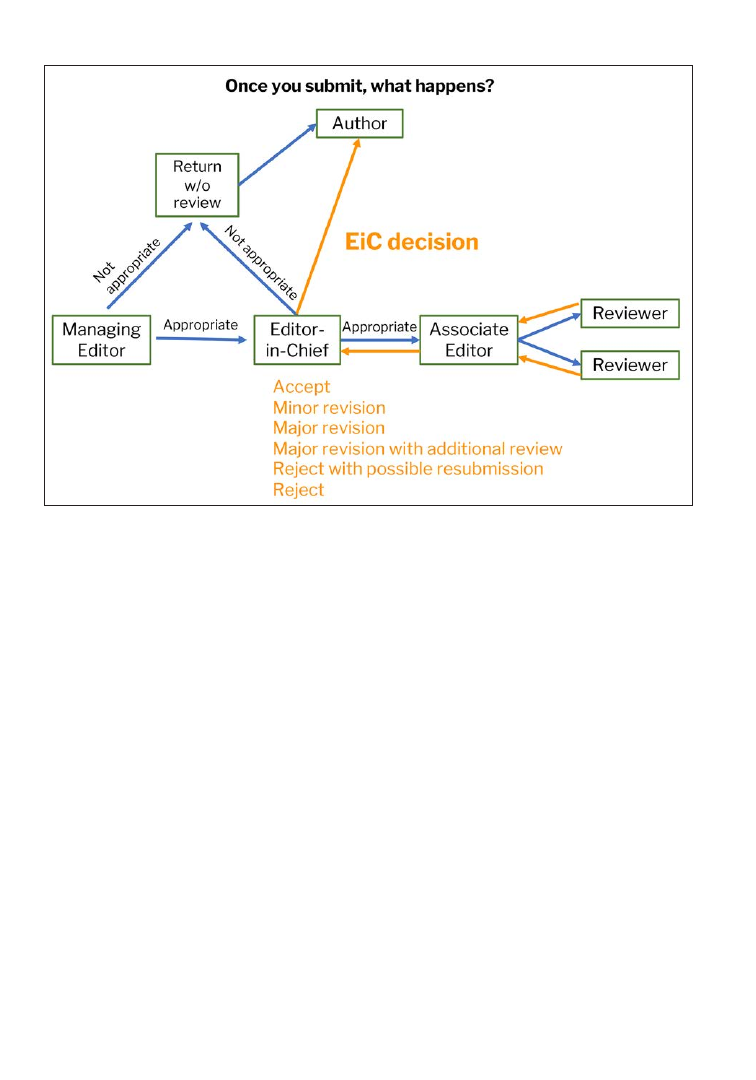
The titles and numbers of editors may
vary from journal to journal, but there is
some universality in the process. A paper is
submitted to a journal and is given an initial
evaluation: Is the subject matter appropriate
for the journal? Are all the pieces there (figures,
tables, cover letters, author agreements)? If
no, the paper may be returned to the author.
If yes, the manuscript moves to the next stage.
For the American Journal of Botany (AJB),
this means the submission goes to the Editor-
in-Chief (EiC), Pamela Diggle, who will read
the abstract and consider whether the topic
will likely be of interest to readers, addresses
a timely topic, and clears the bar for making
a significant contribution to the field. A well-
written abstract will make the case, but the
cover letter can also convince the Editor of the
paper’s appropriateness. If after reading the
abstract and cover letter, it is still not clear,
the Editor may read part of the manuscript
introduction or the conclusion. If the answer is
no, the paper will be returned without review.
While this is disappointing for the author, it
does mean they can turn the paper around
for another journal. If the answer is yes, the
EiC will send the paper to an Associate Editor
(AE) with appropriate subject-area expertise
(the author is free to request a particular AE).
The AE decides whether they agree that the
paper potentially meets or exceeds journal
standards and that the research is within their
area of expertise. If the answer is no on either
account, they will return the manuscript to
the EiC: If the issue is with appropriateness
or standards, the AE will often provide
feedback for the author to consider whether
resubmitting to AJB or sending to another
journal. If yes, the AE will begin thinking of
potential reviewers and sending out invitations
(your suggestions can be helpful!). Up until
this point, your paper has likely not been read
in detail: Most of the critical decisions have
been made based on the title, abstract, and
cover letter. Make these count!
The Reviewers read the title and abstract of
the paper in the invitation letter and accept
or decline to review the paper, within a given
PSB 68(2) 2022
105
timeframe. They do not see your cover letter,
but once they accept the invitation, they have
access to your paper, figures, appendices, and
they may request access to the data underlying
the research (see data management, above).
After their evaluation, they provide comments
and a recommendation to the AE.
When the reviews (usually two) are received,
the AE reads the comments and makes a
recommendation to the EiC, with suggestions,
based on the reviews and their own reading
of the paper. The EiC reads all the reviews
and recommendations and makes a decision
that is conveyed to the author. The AE and
Reviewers receive a copy of the decision letter.
Author Receives the
Decision Letter Containing
the Reviews,
What Happens Next?
It’s human nature to be nervous, so our advice
is to take a deep breath. Reviewers are, as a
rule, trying to help make your science as clear
and impactful as possible, but it’s hard to
receive criticism of your own work. Read the
reviews carefully, set them aside for a day or
two if necessary, ask for clarification if needed,
and revise as you see fit. When you are ready
to submit your revision, prepare a detailed
response to reviewers, providing line numbers
and explanations of what changes were made
(or why a change was not made). Make it easy
for the AE and, if necessary, the reviewers to
understand what you have done.
Decision process for manuscripts submitted to a journal (courtesy of Pamela Diggle, Editor-in-
Chief of the American Journal of Botany).
The revised manuscript is again checked
for completeness, and a Similarity Check is
run for the manuscript through iThenticate
against other published articles. If all looks
good, the manuscript goes back to the AE
(sometimes also reviewers), who makes a
recommendation to the EiC, potentially with
comments for the authors. When everyone
is satisfied, a tentative accept/provisional
acceptance decision is made and the paper
goes to the Content Editor, who inspects the
paper for journal requirements (figure/table
formatting, confirmation that data have been
deposited, funding sources are acknowledged,
etc.) This is also a good time to try to take
an objective look at the title, key words, and
abstract: will interested people be able to
find my paper among the many thousands of
papers published every day? Is the title clear,
brief, and informative? If I place my key words
in a search engine, would I find appropriate
papers? Does my abstract reinforce my main
takeaways, while remaining within the word
limit?
When all the minor issues are resolved, you
will receive an acceptance letter and be given
an opportunity to post your accepted article
online as-is. Whether you choose this option
or not, your paper will be placed in the
copyediting queue; once queries have been
resolved, the paper will be formatted and you
will receive page proofs with a short (usually
3-day) turnaround time before the article
appears in Early View, then slotted into an
issue of AJB. Congratulations!
Discoverability and
Accessibility
A lot of hard work goes into doing the research
and writing up the results. A point that long-
time AJB Managing Editor Amy McPherson
stressed was that understanding how people
and machines—in the form of search engines
and other algorithms/Artificial Intelligence,
and screen readers or other assistive devices—
interact with your paper can ensure that your
research is accessible and discoverable.
For accessibility, it’s worth considering from
the outset that the structure of your paper,
including the text, headings, tables, and
figures, affects how someone relying on a
screen reader will be able to comprehend what
you’re trying to convey. It’s worth your time
to write clearly, in a well-structured format;
create images that are useful, but not overly
complicated or heavily reliant on color alone;
and structure tables clearly and as simply as
possible.
As a researcher, author, and reviewer (and
maybe an editor), you want your work to be
discoverable and you need acknowledgment
for your contributions. One of the ways you
can ensure this is through persistent digital
identifiers, or PIDs. It’s highly recommended
when you start publishing that you sign up
for an ORCID, or Open Researcher and
Contributor ID (https://orcid.org/). This is
a unique number that you own and control
and that distinguishes you from every other
researcher; it also allows you to connect with
all your professional information, including
publications, grants, affiliations, peer review,
etc. As part of publishing in a journal, you may
also be asked to assign CRediT, the Contributor
Roles Taxonomy (https://casrai.org/credit/),
to your list of authors. Because you settled
authorship early on (hint; see above), this just
confirms to the reader the roles of everyone
involved. As a reviewer of manuscripts,
you may also be given the opportunity to
receive credit through Publons, a Reviewer
Recognition Service (https://publons.com/),
which is integrated with the Web of Science,
ORCID, and scholarly journals and allows
you to track and demonstrate service to the
scholarly community.
Another way you can make your work
discoverable is to promote it! This can be
done through presenting talks and posters
at conferences, through social media (e.g.,
“Science Twitter”), Public Information
Officers at your institution, newsletters, blogs,
and podcasts. When you publish with a BSA
journal, your article will be promoted on social
media via Twitter (@Botanical_), Facebook (@</p>
BotanicalSocietyofAmerica), and Instagram
(@botanicalsocietyofamerica). We have over
54,000 followers on these platforms.
Other ways to attract attention to your
article are through graphical abstracts—a
concise visual representation of the presented
research; Plain Language Summaries—jargon-
free, short summaries for the general public;
abstracts in languages in addition to English;
and submitting an image for the cover of the
journal.
Research Integrity and Ethics
No discussion of publishing is complete
without touching on research integrity and
ethics. The topics may be covered in one’s
scientific training, but then again, it’s worth
being reminded that the submission of a
manuscript to a journal is both an ethical and
a legal undertaking. Issues of concern include
intellectual copyright; plagiarism; redundant
publishing; fabrication, falsification, or
obfuscation of data; and misappropriation of
information. The Committee on Publication
Ethics, COPE (https://publicationethics.org/),
is available as a resource for authors, editorial
offices, and publishers worldwide, and Wiley
offers guidance for authors as well (https://
authorservices.wiley.com/ethics-guidelines/
index.html).
The Botany360 publishing sessions wrapped
with a few pieces of advice: The publishing
process is not meant to be scary or
mysterious. Behind the electronic systems
are people who want to work with you.
• Always be respectful—it’s a small world.
• Don’t be afraid to ask questions, includ-
ing if you’re worried a step in the process
is taking too long.
• If you are really pleased with the feedback
you received, don’t be shy about express-
ing that; if you are concerned that some
of the feedback was not constructive,
point that out, too.
• Share your science with the broader com-
munity.
• Go out there and make a difference in the
world!
And send your next paper to a Society journal!
REFERENCES
Culley, T. M. 2018. How to avoid preda-
tory journals when publishing your work,
Plant Science Bulletin 64: 96–111. https://bit.
ly/2OOBos6
Heard, S. B. 2022. The Scientist’s Guide to
Writing: How to write more easily and effec-
tively throughout your scientific career, ed 2.
Princeton University Press.
Perkel, J. M. 2020. Streamline your writing—
and collaborations—with these reference
managers. Nature 585: 149-150. https://doi.
org/10.1038/d41586-020-02491-2
PSB 68 (2) 2022
108
To find out more about the free
Botany360 webinars currently
available online, see the
Membership News article in this
issue on
p. 130---or go to
https://botany.org/home/re-
sources/botany360.html!
LATEST NEWS ON
APPLICATIONS IN PLANT SCIENCES
AND
AMERICAN JOURNAL OF BOTANY
APPS Special Issue Call for
Papers: “Resilient Botany:
Innovation in the Face of
Limited Mobility and
Resources”
Proposal Submission Dead-
line: September 16, 2022
We are pleased to announce a call for papers
for a special issue of APPS, “Resilient botany:
Innovation in the face of limited mobility and
resources.” This special issue aims to showcase
a collection of articles describing how
botanists have creatively leveraged resources
at hand to continue their research in the face
of restricted mobility, limited funding, and
disrupted supply chains. Our intent is for
the issue to span diverse topics and scales
across botanical research; we welcome novel
laboratory, field, herbarium techniques, new
software, and mini-reviews.
More information is available here: https://
botany.org/home/publications/apps/
apps-call-for-papers-advances-in-plant-
imaging-across-scales.html, or contact apps@</a>
botany.org with questions.
APPS Special Issue Call for
Papers: “Advances in Plant
Imaging across Scales”
Proposal Submission Dead-
line: August 5, 2022
Proposals are now being accepted for a
special issue of APPS “Advances in Plant
Imaging across Scales.” The goal of this
special issue is to explore how new imaging
PSB 68 (2) 2022
109
APPS Virtual Issue: Methods
for Plant Leaf Measurements
The editors at APPS have curated a collection
of articles showcasing the diverse methods
to measure and analyze living and preserved
leaves published in the journal. The featured
papers include well-known and established
methods, like Easy Leaf Area, and new
approaches leveraging machine learning and
3D reconstruction of cellular layers. View
the issue here: https://bsapubs.onlinelibrary.
wiley.com/doi/toc/10.1002/(ISSN)2168-0450.
leafmethods.
AJB/APPS Virtual Issue:
Exploring Angiosperms353
Collection
This virtual issue brings together papers
from the American Journal of Botany and
Applications in Plant Sciences that focus on
studies using the Angiosperms353 toolkit for
target sequence capture in flowering plants.
The heart of the collection is two special issues,
each titled “Exploring Angiosperms353:
a Universal Toolkit for Flowering Plant
Phylogenomics.” Additional articles published
in the two journals that relate to this topic
are being added on a continual basis. The
universal nature of Angiosperms353 is
creating new opportunities for systematists
and evolutionary biologists. This collection
of articles shares the many ways in which the
toolkit is already being used, celebrates new
discoveries, and improves our understanding
of its properties and limitations. View the
issue here: https://bsapubs.onlinelibrary.
wiley.com/doi/toc/10.1002/(ISSN)1537-2197.
angiosperms353.
technologies are enabling novel research into
plant form and function, genomics, ecology,
and evolution. The issue will highlight novel
imaging and image processing techniques
targeted to plants at any scale of organization.
We encourage the submission of new tools,
techniques, protocols, software/pipelines,
and reviews of imaging techniques or image
processing.
More information is available here: https://
botany.org/home/publications/apps/apps-
call-for-papers-advances-in-plant-imaging-
across-scales.html, or contact apps@botany.
org with questions.
New and Upcoming
APPS Special Issues
The March–April issue of APPS explores
“Methodologies in Gametophyte Biology.”
Guest editors Sally Chambers, Jerald Pinson,
and Susann Wicke have curated a diverse group
of papers that provide a valuable resource for
understanding this minute, sometimes cryptic,
and often overlooked part of the plant life
cycle. Despite their obscurity, gametophytes
are vital to our understanding of biodiversity
and to the successful implementation of
conservation strategies. See the full issue
here: https://bsapubs.onlinelibrary.wiley.com/
toc/21680450/2022/10/2.
Be on the lookout for two more APPS special
issues publishing later this year: “Advances,
Applications, and Prospects in Aquatic
Botany” and
“Meeting the Challenge of
Exceptional Plant Conservation: Technologies
and Approaches.”
PSB 68 (2) 2022
110
Dr. Pamela Diggle
University of Connecticut
Dr. Pamela Diggle is a world-class scientist,
teacher, mentor, Editor, and leader in the
field of botany, and has provided invaluable
service to the Botanical Society of America
(BSA) throughout her impressive career. She
is a world leader in plant morphology, de-
velopment and evolution (“devo-evo”) and is
a recognized authority on the integration of
developmental ideas into plant reproductive
biology. Her research focuses on the evolution
of morphological diversity among plants with
particular emphasis on understanding how
features of development shape the dynam-
ics of evolutionary change. Her approaches
range from analyses of developmental re-
sponses of individuals to contrasting envi-
ronmental conditions, to understanding how
development has evolved over time in groups
of closely related plants, and to understand-
ing differences across all of flowering plants.
Dr. Diggle’s classic work on labile sex expres-
sion in the Tomato genus (Solanum) demon-
strated that plants can regulate whether they
produce hermaphroditic or male flowers,
depending on the extent of fruit production
within a single blooming period. This remark-
able developmental plasticity in sex expres-
sion is now known to be a general phenom-
enon across flowering plants. Dr. Diggle has
also made important contributions to several
other outstanding problems in plant biology,
including how plant architecture influences
sexual dimorphism in gender dimorphic spe-
cies, the role of development in shaping phe-
BOTANICAL SOCIETY OF AMERICA’S
AWARD WINNERS (PART 1)
Distinguished Fellow of the Botanical Society of America
The Distinguished Fellow of the Botanical Society of America is the highest honor our Society
bestows. Each year, the award committee solicits nominations, evaluates candidates, and selects those
to receive an award. Awardees are chosen based on their outstanding contributions to the mission
of our scientific Society. The committee identifies recipients who have demonstrated excellence in
basic research, education, public policy, or who have provided exceptional service to the professional
botanical community, or who may have made contributions to a combination of these categories.
PSB 68 (2) 2022
111
nological responses to temperature variation
(particularly warming due to climate change),
and the ecological importance of preforma-
tion of meristems in alpine species. Her work
is regularly funded by the US National Sci-
ence Foundation (NSF), including for “mi-
croMORPH: Microevolutionary Molecular
and Organismic Research in Plant History,”
meetings that bring together faculty and grad-
uate students to focus on plant morphology
and related areas.
Dr. Diggle is currently the Editor-in-Chief of
the BSA’s flagship journal, the American Journal
of Botany (term 2015-2025). Since she assumed
the Editorship, several positive changes to the
journal are evident that enhance the profile
of botany, its relevance, and diversity. She has
spearheaded several initiatives, including the
“On the Nature of Things” essays, the recently
formalized series of invited reviews and topic-
specific special issues, and the increased
diversity and international representation
of Associate Editors—all actions that have
noticeably raised the journal’s impact (and
its impact factor). In addition, Dr. Diggle has
been actively involved with the BSA in other
areas, serving on several committees, and on
the Board, first as Council Representative,
then as Secretary, and lastly as President-Elect,
President, and Past-President. She has offered
workshops for authors, held focus groups with
grad students and postdocs, and reached out
to BSA sections to encourage members to
contribute to their Society journals. Dr. Diggle
is widely respected as having sound judgment,
an even-handed approach to problems, and
loyalty to the institutions and societies she has
worked for. BSA has greatly benefited from
her service and expertise over the years.
PSB 68 (2) 2022
112
Dr. Ann Sakai
University of California Irvine
It is a pleasure and an honor to announce
that the first recipient of the BSA’s Impact
Award is Dr. Ann Sakai, Professor Emeritus
from the University of California Irvine. In
addition to being an excellent scientist, with
research interests in evolutionary ecology
and conservation biology, Dr. Sakai has been
steadfast in promoting diversity and inclusivity
during her entire career. Dr. Sakai attended
SACNAS for several years on behalf of the BSA,
reaching out to underrepresented students
and promoting our botanical community
and the PLANTS program to early career
researchers while also judging countless talks
BSA
Impact
Award
The Botanical Society of America Impact Award recognizes a BSA member or group of members
who have significantly contributed to advancing diversity, accessibility, equity, and/or inclusion in
botanical scholarship, research and education.
at those meetings. Ann also served as BSA’s
first Director-at-Large for Human Diversity
on the BSA Board of Directors.
Notably, along with a dedicated team, Dr. Sakai
directed the NSF-funded PLANTS (Preparing
Leaders and Nurturing Tomorrow’s Scientists)
outreach program for its first 11 years
beginning in 2011. The PLANTS program
provides undergraduates from diverse
backgrounds with travel grants and mentors so
that they can attend the national meetings of
several societies focused on the plant sciences.
This experience provides these students the
opportunity to explore their academic and
research interests in the plant sciences and to
broaden their career opportunities.
Ann was tireless in her dedication to the
program and her hands-on support of each
and every student (over 100) that came to
BOTANY through the PLANTS program.
Scholars in the PLANTS program say that from
the very first morning meeting with the rest of
the PLANTS cohort, Dr. Sakai “set a tone of
inclusivity and welcomeness” that has become
a signature of the program. Not only did she
support students during the meetings, making
sure they had what they needed, attending their
talks, and introducing them to other botanists,
she provided support and encouragement as
they subsequently developed their interests
and career goals. She kept in touch with many
of them throughout the years, helping to edit
their CVs and their grant proposals, writing
letters of recommendation and tracking their
career paths. The personal connection, feeling
PSB 68 (2) 2022
113
that she has been “in their corner” throughout their botanical journey, has been as important
for many students as the program itself.
According to one of the 2011 PLANTS recipients, who is currently an Associate Professor, “Ann
is quite literally changing the makeup of our BSA meetings and the field of botany as a whole,
one undergraduate at a time”—and thus is fully deserving of the BSA’s first-ever Impact Award.
BSA EMERGING LEADER AWARD
The Emerging Leader Award of the Botanical Society of America is given annually in recognition
of creative and influential scholarship as well as impact in any area of botany reflecting the breadth
of BSA. Awardees have outstanding accomplishments and also have demonstrated exceptional
promise for future accomplishments in basic research, education, public policy, exceptional service
to the professional botanical community, or a combination of these categories.
Dr. Karolina Heyduk is currently Assistant
Professor in the School of Life Sciences at the
University of Hawai'i at Mānoa and the Direc-
tor of the Joseph F. Rock Herbarium. Her re-
search integrates plant ecophysiology, evolu-
tionary biology, and genomics to understand
the ways plants adapt to harsh environments,
with a particular focus on photosynthetic
pathway evolution, especially Crassulacean
acid metabolism (CAM).
Karolina’s research requires a high level
of computational skills, a thorough
understanding of the biology and metabolism
involved, and the ability to conduct
experiments that are meaningful in terms
of the ecology and physiology of the species
under investigation. Such an integrated
approach is rare in plant science research. She
has been influential in her early adoption of
target sequence capture, a method that allows
researchers to “efficiently plumb the depths of
the nuclear genome for a range of comparative
purposes.” Dr. Heyduk developed protocols
and an accompanying probe set for target
Dr. Karolina Heyduk
University of Hawai'i
PSB 68 (2) 2022
114
sequence capture in palms, which are now
universally known as “Heyduk baits.” She
has received numerous grants (including for
funding that will improve the herbarium’s
infrastructure and utility), has an impressive
list of publications, serves on the editorial
boards of Applications in Plant Sciences and
Annals of Botany, and has been invited to give
talks at institutions around the world.
Dr. Heyduk is recognized as an exceptional
community builder, uplifting those whose
voices have been marginalized, excluded, or
entirely absent from the conversation through
her work in the classroom, collections
management, research, and service. She
recruits students from diverse backgrounds,
particularly Pacific Islanders and Native
Hawaiians, to participate in research and
herbarium activities. Through her interactions
on Twitter, she is the “rare scientist who is
simultaneously rigorous in their scholarly
sharing and their advocacy for inclusivity
and awareness.” She is active on BSA’s Early
Career Development Committee, tasked
with providing opportunities for early career
members; has been a longtime mentor in the
PLANTS program; and is co-organizing a
symposium and colloquium at Botany 2022
on colonialism in botany and Indigenous
perspectives. Although Karolina is early in her
career, she is already making a huge difference
as a leader in the community.
Charles Edwin Bessey
Teaching Award
(BSA in association with the Teaching Section
and Education Committee)
Dr. Stefanie (Steffi) Ickert-Bond
University of Alaska
Museum of the North and University
of Alaska Fairbanks
Dr. Stefanie (Steffi) Ickert-Bond (University of
Alaska Museum of the North and University of
Alaska Fairbanks) is a well-respected botanist
with a passion for fieldwork, collections, and
natural history, combined with skills in active
learning and evidence-based pedagogy—as
well as a conviction for offering equitable
access to science learning. Long before the
Covid pandemic hit, she created online
courses that allowed students to participate in
hands-on, two-way communicative learning
from any location.
PSB 68 (2) 2022
115
Donald R. Kaplan Memorial Lecture
This award was created to promote research in plant comparative morphology, the Kaplan family
has established an endowed fund, administered through the Botanical Society of America, to
support the Ph.D. research of graduate students in this area.
Lena Hileman, University of Kansas, Patterns and processes of floral diversification in the
wildflower genus Penstemon.
The BSA Developing Nations Travel Grants
Maribel Arenas-Navarro, Universidad Nacional Autónoma de México, Mexico
João Iganci, Federal University of Pelotas, Brazil
Funmilola Mabel OJO, Olusegun Agagu University of Science and Technology
Yesenia Madrigal Bedoya, Universidad de Antioquia, Colombia
Sebastián Martínez-Salazar, Universidad De Antioquia, Colombia
Malka Saba, Quaid-i-Azam University, Islamabad, Pakistan
Olubunmi Sharaibi, Lagos State University, Ojo Campus, Nigeria
Hugo A. Valdebenito, Universidad San Francisco de Quito / Herbarium QUSF, Ecuador
Aleena Xavier, Indian Institute of Science Education and Research Bhopal, India
In early March 2020, she offered her course
"BIOL F195-F02; Introduction to Alaska’s
Flora” to be made freely available on the
“BotanyDepot” website, thereby offering a
lifeline to botany educators around the world
who suddenly found themselves scrambling to
build virtual experiences and online resources
to teach systematic botany, plant anatomy, and
local floristic courses. The course materials
are a series of short video modules, grouped
into topics, plus additional reading materials
and fun, creative activities that are designed
to deepen students’ understanding of the
concepts—and encourage them to go outside
and explore the plants in their area. In the
“Learning Glass” presentations, Dr. Ickert-
Bond speaks to the camera while drawing,
labeling, and describing aspects of plant form
and structure. She guides the viewer through
complex aspects by creating a basic foundation,
a step-by-step pedagogical scaffolding—and
then proceeds to add clear examples and
visual explorations. She is continuing to build
new course content, including for winter
bud identification and for fundamentals of
museum studies.
Dr. Ickert-Bond is a trailblazer in botany
education, not only in teaching, but also in
diversity and inclusion in botany education. As
one person from the nomination committee
wrote, “Through inclusive pedagogy that uses
innovative technology combined with an
artistic and creative vision to engage students
in critical learning about plants, habitats and
biodiversity science, Dr. Steffi Ickert-Bond
embodies the action and spirit of the Bessey
Award.”
PSB 68 (2) 2022
116
The BSA Professional Member Travel Grants
Irene Cobo Simón, University of Connecticut
Kyra N. Krakos, Maryville University
Benjamin Lee, Carnegie Museum of Natural History
Ellie Mendelson, Arnold Arboretum of Harvard University
Maria Cristina Rengifo Faiffer, Michigan Technological University
Mathew Sharples, Independent/Contractor
Carolina Siniscalchi, Mississippi State University
Qiang Sun, University of Wisconsin-Stevens Point
Brittany Verrico, University of Vermont
Cheng-Chiang Wu, National Taiwan University
Botany Advocacy Leadership Grant
This award organized by the Environmental and Public Policy Committees of BSA and ASPT aims
to support local efforts that contribute to shaping public policy on issues relevant to plant sciences.
To learn more about the winning projects, go to https://botany.org/home/awards/special-funds-
and-awards/botany-advocacy-leadership-grant.html.
Sara E. Hansen, PhD Student, Earth and Ecosystem Science, Central Michigan University
Rhea Ewing, Visual artist, RheaEwing.com

Anna K. Monfils, Professor and Director of CMU Herbarium, Department of Biology,
Central Michigan University
For the proposal: Creating Inclusive Resources for Botanical Science Education
BSA Public Policy Award
The Public Policy Award was established in 2012 to support the development of tomorrow’s leaders
and a better understanding of this critical area.
Brendan Kosnik, Arkansas State University
Zack Quirk, University of Washington
PSB 68 (2) 2022
117
Donald R. Kaplan Award in Comparative Morphology
This award was created to promote research in plant comparative morphology, the Kaplan
family has established an endowed fund, administered through the Botanical Society of
America, to support the Ph.D. research of graduate students in this area.
Yesenia Madrigal Bedoya, University of Antioquia (Colombia)
For the Proposal: A morpho-anatomical characterization of the vegetative-to-reproductive
meristematic transition in terrestrial and epiphytic neotropical orchids
The BSA Graduate Student Research Award
The BSA Graduate Student Research Awards support graduate student research and are
made on the basis of research proposals and letters of recommendations. Within the award
group is the Karling Graduate Student Research Award. This award was instituted by the
Society in 1997 with funds derived through a generous gift from the estate of the eminent

mycologist, John Sidney Karling (1897-1994), and supports and promotes graduate student
research in the botanical sciences.
The J. S. Karling Graduate Student Research Award
Jessie Pelosi, University of Florida
For the Proposal: Beyond the genome: methylomics of the alternation of generations
The BSA Graduate Student Research Awards
Sam Anderson, University of Wisconsin Madison

For the Proposal: The Forgotten Forest Layer: A multivariate gradient analysis and physiologi-
cal comparison of understory shrubs in northern mesic forests
Juan Angulo, City University of New York
For the Proposal: The evolution of dioecy and its consequences on plant diversification: phy-
logenetic and comparative studies on neotropical Miconia section Cremanium (Melastomata-
ceae)
PSB 68 (2) 2022
118
Derek Denney, University of Georgia
For the Proposal: Evaluating selection induced by climate change on water-use efficiency in
Boechera stricta
Trinity Depatie, University of South Carolina
For the Proposal: Understanding the Genetic Basis of Personate Flowers in Penstemon
Erin G. Eichenberger, North Carolina State University
For the Proposal: Population vital rates and pollinator community of an endangered South-
eastern prairie perennial, Echinacea laevigata (Boynton & Beadle) Blake
Rosemary Glos, Michigan State University
For the Proposal: Trichome-mediated defense in Mentzelia (Loasaceae)
Kaleb Goff, North Carolina State University
For the Proposal: A functional trait perspective on alpine plant community responses to rapid
climate change in a xeric mountain range
Hansika Herath, University of Kentucky
For the Proposal: Intraspecific variation of acquired thermotolerance in the liverwort March-
antia inflexa
PSB 68 (2) 2022
119
Hossein Madhani, University of Nevada, Las Vegas
For the Proposal: The role of immune system incompatibilities in the evolution of isolating
barriers within an ongoing adaptive radiation
Kathleen Madsen, Ohio University
For the Proposal: The Fitness Consequences of Gypsum Endemsim
Sylvie Martin-Eberhardt, Michigan State University
For the Proposal: Insect signaling by anthocyanins in the carnivorous plant Sarracenia purpurea
Sebastián Martínez-Salazar, Universidad de Antioquia
For the Proposal: Molecular basis underlying nectar spur development in tropaeolaceae
Jared B. Meek, Columbia University
For the Proposal: Towards a comprehensive phylogeny of North American Delphinium (Ra-
nunculaceae)
Nicole Mitidieri Rivera, University of Wisconsin-Madison
For the Proposal: Evolutionary pathways to becoming a fig: a phylogenetic comparative approach
Oluwatobi Oso, Yale University
For the Proposal: Developmental Anatomy and Evolution of Overwintering Buds in Viburnum
Evan Perkowski, Texas Tech University
For the Proposal: The influence of nitrogen fixation and soil nutrient availability on leaf and
whole plant acclimation to elevated CO2
Rebecca Rooney, University of Minnesota - Duluth
For the Proposal: Coordination of Phloem Function and Anthocyanin Accumulation in Young
and Senescing Leaves of Quercus rubra
Kyle Rosenblad, University of California, Berkeley
For the Proposal: Climate change and evolutionary potential in a montane meadow-dependent species
Catherine Sherry, North Carolina State University
For the Proposal: How Does Fire Kill Trees? Impacts of Stem Heating on Plant Hydraulics
Abrianna Soule, Michigan State University
For the Proposal: Evolution of the chemical defense of aspen (Populus tremuloides) and spe-
cialist herbivores (Chrysomela) across latitude
Kailin Sun, Ludwig-Maximilians University, Munich
For the Proposal: Phylogeny and biogeography of the genus Myricaria
Keana Tang, University of Kansas
For the Proposal: Fossil flowers and their role in uncovering the evolutionary and biogeo-
graphic history of Lauraceae
PSB 68 (2) 2022
120
Piotr Tuczapski, University of Georgia
For the Proposal: Specificity of mycorrhizal symbionts in four sympatric Lepanthes species
(Orchidaceae) and the possible role of symbionts in driving orchid diversification
Mackenzie Urquhart-Cronish, University of British Columbia
For the Proposal: Testing the influence of historical range expansion on contemporary plant
mating system evolution
Alyson Van Natto, Queen’s University
For the Proposal: Evolutionary genomic consequences of invasion of Mimulus guttatus into
New Zealand
Susana Vega Betancur, Universidad de Antioquia
For the Proposal: Understanding the diversity of spikemosses in the Neotropics: taxonomy of
Selaginella (Selaginellaceae) for Antioquia, Colombia
Leah Veldhuisen, University of Arizona
For the Proposal: Facilitation & Phylogenetic Structure of Montane Plant Communities
Christopher Waters, Tennessee Technological University
For the Proposal: Documenting effective pollinator species and metabarcoding pollinator en-
vironmental DNA across the range of Physaria globosa (Brassicaceae)
Katherine Wolcott, University of Miami
For the Proposal: 3D pollination biology of Theobroma cacao and its relatives, Ayenia euphrasi-
ifolia, Guazuma microphylla, Herrania umbratica (Byttnerioideae)
Rieka Yu, University of Missouri - St. Louis
For the Proposal: Differences in pollinators as drivers of plant population genetic change in
disturbed landscapes
The BSA Undergraduate Student Research Awards
The BSA Undergraduate Student Research Awards support undergraduate student research and
are made on the basis of research proposals and letters of recommendation.
Caroline Bendickson, The University of Alabama in Huntsville
For the Proposal: Building a Molecular-based Phylogeny for the Genus Trillium Using Angio-
sperms353 Bait Capture Sequencing
Cesar Galan, Cornell University
For the Proposal: Travel to Harvard University Herbaria Collections; Access to Additional
Sample Specimens
Jack Hatajik, University of Pittsburgh
For the Proposal: Mapping the population dynamics of the invasive Alliaria petiolata (garlic
mustard) in response to climate
PSB 68 (2) 2022
121
Isabeau Lewis, Queen’s University
For the Proposal: Kin discrimination and plastic responses in growth and flowering in a clonal plant
Nicholas Rocha, Cornell University
For the Proposal: The Attractiveness of visual traits of Calochortus venustus to insect pollinators
Erika Sipos, Hobart and William Smith Colleges
For the Proposal: A Phylogenetic and Biogeographical Study of Parsonsia (Apocyanceae)
The BSA Young Botanist Awards
The purpose of these awards is to offer individual recognition to outstanding graduating
seniors in the plant sciences and to encourage their participation in the BSA.
Christina Andreski, Plymouth State University, Advisor: Diana Jolles
Anais Barnes, Bucknell University, Advisor: Christopher Martine
Charles Boissavy, Oberlin College, Advisor: Michael Moore
Caroline Brose, Colorado College, Advisor: Rachel Jabaily
Emma Cooley, Fort Lewis College, Advisor: Ross McCauley
Carmen David, University of California, Davis, Advisor: Jennifer Gremer
Adalie Duran, Connecticut College, Advisor: Rachel Spicer
Norbaya Jameela Durr, Elmhurst University, Advisor: Kasey Pham
Josh Felton, Colorado College, Advisor: Rachel Jabaily
Tori Ford, University of Florida, Advisor: Makenzie Mabry
Stephanie Kate, San Francisco State University, Advisor: Jason Cantley
Kaitlin Schieuer, South Dakota State University, Advisor: Maribeth Latvis
Caroline Shaw, Abraham Baldwin Agricultural College, Advisor: Benjamin Gahagen
Edward J. Spagnuolo, Pennsylvania State University, Advisor: Peter Wilf
Sharon Haley Spiess, Abraham Baldwin Agricultural College, Advisor: Benjamin Gahagen
Kayla Warner, Barnard College, Columbia University, Advisor: Hillary Callahan
Adam Wilson, Creighton University, Advisor: Mackenzie Taylor
Talia Zeidner, Connecticut College, Advisor: Rachel Spicer
PSB 68 (2) 2022
122
The BSA PLANTS Grant Recipients
The PLANTS (Preparing Leaders and Nurturing Tomorrow’s Scientists: Increasing the diversity
of plant scientists) program recognizes outstanding undergraduates from diverse backgrounds
and provides travel grant.
Luigie Alequín, Haverford College, Advisor: Nathalie Nagalingum
Victoria Clements, Tennessee Technological University, Advisor: Shawn Krosnick
Adalie Duran, Connecticut College, Advisor: Rachel Spicer
Josh Felton, Colorado College, Advisor: Rachel Jabaily
Tori Ford, University of Florida, Advisor: Pam Soltis
Cesar Galan, Cornell University, Advisor: Alejandra Gandolfo
Mayra Hernandez, CSU Dominguez Hills, Advisor: Helen I. Holmlund
Amelie LeTierce, University of Massachusetts, Amherst, Advisor: Jessamine Finch
Karina Mendez, Chabot College, Advisor: Mackenzie Mabry
Aadia Moseley-McCloud, Howard University, Advisor: Janelle Burke
Austin Nguyen, University of Kansas, Advisor: Kelly Matsunaga
Inti Quinchiguango Archuleta, SUNY Environmental Science and Forestry, Advisor: Suzy Strickler
The BSA Student and PostDoc Travel Awards
Winners were selected by lottery
Juan Angulo
Andrea D. Appleton
Antigone Burke
Robert P. Comito
Diana Gamba
Elyssa Garza
Michelle Gaynor
Samuel Lockhart
Jess Shamik
Caroline Siegert
Meredith Zettlemoyer
PSB 68 (2) 2022
123
Vernon I. Cheadle Student Travel Awards
(BSA in association with the Developmental and Structural Section)
This award was named in honor of the memory and work of Dr. Vernon I. Cheadle.
Benjamin Ajayi, University of Lagos, Advisor: Professor Akeem Babalola
For the Presentation: Dumpsite aftereffects on structural and functional integrity of three crop
weeds
Kelly Pfeiler, University of Kansas, Advisors: Kelly Matsunaga & Brian Atkinson,
For the Presentation: Anatomically preserved cheirolepidiaceous pollen cones from the Creta-
ceous of western North America. Co-authors: Brian Atkinson, Kelly Matsunaga
Keana Tang, University of Kansas, Advisor: Brian Atkinson
For the Presentation: Crown group Lauraceae in the Late Cretaceous: new evidence from fos-
sil flowers. Co-authors: Kelly Matsunaga, Brian Atkinson
Elizabeth Wilson, William Jewell College, Advisor: Nathan Jud
For the Presentation: Revising the description and diagnosis of the Late Pennsylvanian medul-
losan Neuropteris lindahli White based on new fossil material. Co-author: Nathan Jud
Brandi Zenchyzen, University of Alberta, Advisor: Jocelyn Hall
For the Presentation: Exploring nectary diversity in Cleomaceae. Co-authors: Jaymie Martin,
Stacie Weissner, Ainsley Lopushinsky, Ida John, Ishnoor Nahal, Jocelyn Hall
AWARDS FOR STUDENTS - GIVEN BY THE SECTIONS
Southeastern Section Student Presentation Awards
The following winners were selected from the Association of Southeastern Biologists meeting that
took place at the end of March 2022.
Rachel A. Jessup, North Carolina State University
Ryan Long, Jacksonville State University
Bryological and Lichenological
Section Student Travel Awards
Hansika Herath, University of Kentucky, Advisor: Nicholas McLetchie
For the Proposal: Testing for long-term acquired thermotolerance in the tropical plant
Marchantia inflexa. Co-author: Nicholas McLetchie
Rho Kackley, Bard College at Simon’s Rock, Advisor: Donald McClelland
For the Proposal: A Partial Checklist of the Bryophytes of Montserrat, West Indies
PSB 68 (2) 2022
124
Evita Oļehnoviča, Daugavpils University, Advisor: Anna Mežaka,
For the Proposal: Bryophyte functional traits in black alder swamp forests along forest age
chronosequence in Latvia. Co-authors: Anna Pastare-Skutele, Anna Mežaka, Ligita Liepiņa
Developmental & Structural Section Student Travel Awards
Cesar Galan, SIPS Plant Biology, Advisor: Alejandra Gandolfo
For the Presentation: Epidermal morphology of the subfamily Athrotaxoideae (Cupressaceae).
Co-authors: Ana Andruchow Colombo, Maria Gandolfo
Vandana Gurung, University of Connecticut, Advisor: Pamela Diggle
For the Presentation: The curious case of CUC in corolla tube formation in Mimulus. Co-authors:
Pamela Diggle, Yaowu Yuan
Sarita Munoz-Gomez, University of Connecticut, Advisor: Yaowu Yuan
For the Presentation: Creation of novel pigmentation patterns in monkeyflowers (Mimulus).
Co-author: Yaowu Yuan
Deannah Neupert, Miami University, Advisor: Richard Moore
For the Presentation: The evolution of structural novelty: A morphological analysis of
development in Mimulus and its implications for plant architecture and reproduction.
Co-authors: Robert (Rob) Baker, Rich Moore, Jonathan Bauer
Ecological Section Student Travel Awards
Haley Branch, University of British Columbia, Advisor: Amy Angert
For the Presentation: Transgenerational plasticity and maternal effects alter drought responses
in scarlet monkeyflower. Co-authors: Dylan Moxley, Amy Angert
Veronica Gibson, University of Hawaii at Manoa, Advisor: Celia Smith
For the Presentation: Integrated physiological response by four red algae species and analysis
of benthic community structure across an environmental gradient of tidally-driven submarine
groundwater discharge conditions. Co-author: Celia Smith
Jill Wilson, University of Georgia, Advisor: Megan DeMarche
For the Presentation: Herbarium specimens underestimate phenological shifts in wild popu-
lations. Co-authors: Megan DeMarche, Meredith Zettlemoyer
Economic Botany Section Student Travel Awards
Kristen Nolting, University of Georgia
For the Presentation: Do crops have reduced stress tolerance compared with their wild pro-
genitors? Evidence from a comprehensive meta-analysis. Co-Authors: Emily Dittmar, Lisa
Donovan, John Burke
PSB 68 (2) 2022
125
Maya Shamsid-Deen (Allen), University of New Mexico
For the Presentation: A Germination of Freedom: How Blackdom, New Mexico Grew Its Roots
through Dry-Farming Crops of the African Diaspora. Co-Authors: Gary Ivan Stafford, and
Nokwanda Makunga
Genetics Section Student Travel Awards
Gracy Buckholtz, University of British Columbia, Advisor: Jeannette Whitton
For the Presentation: Tracking a Cryptic Invader: The Morphology and Genetics of Fraser
River Estuary Cattails.
Trevor Faske, University of Nevada, Reno, Advisor: Thomas Parchman
For the Presentation: Determinants of mixed-ploidal variation and hybridization in big sage-
brush (Artemisia tridentata) across the landscape. Co-authors: Alison Agneray, Bryce Rich-
ardson, Elizabeth Leger, Thomas Parchman
Talieh Ostovar, San Diego State University, Advisor: Amy Litt
For the Presentation: Impacts of allopolyploidy on gene expression in Nicotiana section Repan-
dae. Co-authors: Jacob Landis, Elizabeth McCarthy, Jason Stajich, Elizabeth Waters, Amy Litt
Connor L. Purvis, Francis Marion University, Advisor: Jeremy Rentsch
For the Presentation: Regulation of the Dhurrin Biosynthetic Pathway in Sorghum halepense
seedlings. Co-authors: Jeremy Rentsch, Elizabeth Jones
Alyson Van Natto, Queen’s University, Advisor: Jannice Friedman
For the Presentation: Mating system and hybridization combine to effect range-wide genetic
structure in a coastal endemic plant. Co-author: Chris Eckert
Physiological Section Student Travel Awards
Veronica L. Gibson, University of Hawaii at Manoa, Advisor: Celia Smith
For the Proposal: Integrated physiological response by four red algae species and analysis of
benthic community structure across an environmental gradient of tidally-driven submarine
groundwater discharge conditions. Co-author: Celia Smith
Thomas Hennessey, Western Carolina University, Advisor: Beverly Collins
For the Proposal: Restoring the Roan: Red Spruce Forest Understory Response to Canopy
Gaps at Roan Mountain, NC.
Marissa Ochoa, University of California, Los Angeles, Advisor: Lawren Sack
For the Proposal: How does stomatal anatomy influence leaf conductance from minimum to
maximum? Causal relationships and meta-analysis. Co-authors: Lawren Sack, Thomas N.
Buckley, Christian Henry, Camila Medeiros, Ruihua Pan, Grace Patricia John
PSB 68 (2) 2022
126
Phytochemical Section Student Travel Awards
Tomi Lois Adetunji, North-West University, South Africa, Advisor: Frances Siebert
For the Proposal: Sceletium tortuosum: A review on its phytochemistry, pharmacokinetics,
biological, pre-clinical and clinical activities. Co-authors: Frances Siebert, Ademola Adetunji,
Brian Harvey, J. Gericke, JH Hamman, Frank Van der Kooy
David Henderson, Washington University in St. Louis, Advisor: Jonathan Myers
For the Proposal: Testing the Role that Biotic Interactions Play in Shaping Elevational-Diversi-
ty Gradients: An Ecological Metabolomics Approach. Co-authors: Sebastian J. Tello, Brian Se-
dio, Jonathan Myers
Gordon Younkin, Cornell University, Advisor: Georg Jander
For the Proposal: Comparative transcriptomics of 48 Erysimum species guides discov-
ery of cardiac glycoside biosynthetic genes. Co-authors: Martin Alani, Mahdieh Mirzaei,
Georg Jander
Primarily Undergraduate Institutions (PUI)
Section Student Travel Awards
Sarah Allen, Penn State Altoona
Jennifer Blake-Mahmud, Hope College
Cecilia Ezeanya, University of Ibadan
Elizabeth McCarthy, SUNY Cortland
Pteridological Section & American Fern Society
Student Travel Awards
Lacey E. Benson, San José State University, Advisor: Susan Lambrecht
For the Presentation: A morphometric analysis of western sword fern (Polystichum munitum)
pinnae and pinnae scales across the coast redwood forest ecological gradient. Co-Author: Su-
san Lambrecht
Bertrand Black, University of Vermont, Advisor: Michael Sundue
For the Presentation: A phylogenetic revision of the Athyrium filix-femina clade (Athyriaceae)
in the Americas. Co-Author: Michael Sundue
Alexandria Quinlan, National Taiwan University, Advisor: Li-Yaung Kuo
For the Presentation: Ferns on ferns: an exploration of low-trunk epiphytic fern gametophytes
growing on tree ferns in Taiwan. Co-Authors: Li-Yaung Kuo, Jer-Ming Hu
Gregory J. Pec, University of Nebraska at
Kearney
Qiang Sun, University of
Wisconsin-Stevens Point
Susana Wadgymar, Davidson College
Yingying Xie, Purdue University
PSB 68 (2) 2022
127
Jacob Suissa, Harvard University, Advisor: William E. Friedman
For the Presentation: The hydraulic implications of rhizomatous growth and the homorhizic
habit. Co-Authors: William Friedman, Andrews Agbleke
Zane Walker, Oregon State University, Advisor: Gar Rothwell
For the Presentation: A permineralized osmundaceous fern sporeling from the Lower Cretaceous
of western Canada. Co-Authors: Gar Rothwell, Ruth Stockey
Botany 2022 Plenary Speaker!
DR. CASSANDRA QUAVE
Medical Ethnobotanist and
Professor at Emory University
Author of
The Plant Hunter: A Scientist's Quest
for Nature's Next Medicines
Sunday, July 24th - 7:30 PM
Alaskan Time
Join us in person or virtually!
Register Now!!
www.botanyconference.org
PSB 68 (2) 2022
128
PSB 68 (2) 2022
129
ARE YOU REGISTERED?
Can't make it to Alaska?
Join us as a virtual registrant!
Participate in live-streamed and pre-recorded events such as the Symposia, Colloquia, Contributed
Talks, Lightning Talks, and Special Lectures during the week the conference is happening in Anchorage.
Enjoy the conference on the Pathable platform—the same conference platform that has been used for the
past two years. You will have easy access to the schedule, be able to connect to other conference goers,
and get to watch live and prerecorded presentations throughout the conference right on the platform.
Access all of the recorded content after the conference is over, for up to one year!
Register before the conference starts to save on registration. You do not want to miss the first hybrid
Botany Conference!
REGISTER NOW!
https://2022.botanyconference.org
130
By
Amelia Neely
BSA Membership &
Communications
Manager
E-mail: ANeely@</a>
botany.org
MEMBERSHIP NEWS
Botany360 (https://botany.org/home/resources/
botany360.html) is a series of programming that
connects our botanical community during the
360 days outside of Botany conferences. The
Botany360 event calendar is a tool to highlight
those events. The goal of this program is
to connect the plant science community
throughout the year with professional
development, discussion sessions, and
networking and social opportunities. To see
the calendar, visit botany.org/calendar.
Botany360 Event Recordings
Now Available
We are excited to now offer the following event
recordings from our Spring 2022 Botany360
events:
• Ace It! - Write a Better Title
(March 2, 2022)
Workshop presented by Dr. Bruce Kirchoff,
University of North Carolina at Greens-
boro, and Dr. Eliezer Cocoletzi, University
of Veracruz
[https://www.youtube.com/watch?v=e2_
CkFtBcI4]
• Ace It! - Write a Better Abstract
(March 23, 2022)
Workshop presented by Dr. Bruce Kirchoff,
University of North Carolina at Greens-
boro, and Dr. Eliezer Cocoletzi, University
of Veracruz.
[https://www.youtube.com/
watch?v=dbPGAr9_GyE]
• De-mystifying the MS submissions pro-
cess: Before you submit (Part 1)
(May 11, 2022)
Part 1 of a two-part workshop to help
navigate all stages of the peer review
process. This workshop was presented by
Dr. Briana Gross, University of Minnesota-
Duluth, Editor-in-Chief, Applications in
Plant Sciences, and Dr. Brittany Suther-
land, George Mason University.)
[https://www.youtube.com/
watch?v=NIAM4TQK6iI]
PSB 68(2) 2022
131
• De-mystifying the MS submissions pro-
cess: Before you submit (Part 2)
(May 18, 2022)
Part 2 of a two-part workshop to help
navigate all stages of the peer review
process. This workshop was presented by
Dr. Pamela Diggle, University of Connecti-
cut, Editor-in-Chief, American Journal of
Botany, and Amy McPherson, Director of
Publications, Botanical Society of America
and Managing Editor, American Journal of
Botany.
[https://www.youtube.com/
watch?v=UBylHDG2mts]
• So you want to get involved with section
leadership...
(June 5, 2022)
Presented by Kyra N. Krakos, Maryville
University, 2022 Chair of the BSA Teach-
ing and Outreach Section. A walkthrough
of the roles, responsibilities, and benefits
of being in section leadership: Have you
thought about section leadership? How
does one get elected? What is involved in
the different positions? How can it benefit
your professional development? During
this session the group walked through the
different roles and responsibilities and an-
swered questions about the process.
[https://www.youtube.com/
watch?v=sVkkSbqfuyo]
BSA LEGACY SOCIETY
Thank you to all of our Legacy Society members
for supporting BSA by including the Society
in your planned giving. We look forward
to hosting you at this year’s Legacy Society
Reception at Botany 2022 in Anchorage,
Alaska. If you are interested in joining the
Legacy Society, you are welcome to come to
the event and sign up in person or by filling
out this form at any time: https://crm.botany.
org/civicrm/profile/create?gid=46&reset=1.
The intent of the BSA's Legacy Society is
to ensure a vibrant society for tomorrow’s
botanists, and to assist all members in
providing wisely planned giving options.
All that is asked is that you remember the
BSA as a component in your legacy gifts. It’s
that simple—no minimum amount, just a
simple promise to remember the Society. We
hope this allows all BSA members to play a
meaningful part in the Society’s future. To
learn more about the BSA Legacy Society, and
how to join, please visit: https://botany.org/
home/membership/the-bsa-legacy-society.
html
PSB 68(2) 2022
132
• Dr. Andrea Berardi,
Postdoctoral Fellow, OEB and Harvard University Herbaria, Harvard
University (https://botany.org/home/careers-jobs/careers-in-botany/bsa-spotlight-series/
andrea-berardi.html)
• Dr. Rocio Deanna, Postdoctoral Fellow, Ecology and Evolutionary Biology, University
of Colorado, Boulder (
https://botany.org/home/careers-jobs/careers-in-botany/bsa-spot-
light-series/rocio-deanna.html
)
• Danielle Gafford, Undergraduate Student, Biological Sciences, University of Missouri
(https://botany.org/home/careers-jobs/careers-in-botany/bsa-spotlight-series/danielle_
gafford.html)
• Luiza Teixeira-Costa, Postdoctoral Fellow, Functional Ecology of Plants and Ecosystems,
Vrije Universiteit, Brussel (https://botany.org/home/careers-jobs/careers-in-botany/bsa-
spotlight-series/luiza-teixeira-costa.html)
• Shawn K. Thomas, Graduate Student, Biological Sciences, University of Missouri (https://
botany.org/home/careers-jobs/careers-in-botany/bsa-spotlight-series/shawn_thomas.html)
Would you like to nominate yourself or another early career scientist to be in the Spotlight
Series? Fill out this form: https://forms.gle/vivajCaCaqQrDL648.
BSA SPOTLIGHT SERIES
The BSA Spotlight Series highlights early career scientists in the BSA community and shares
both scientific goals and achievements, as well as personal interests of the botanical scientists,
so you can get to know your BSA community better.
Here are this year’s Spotlights so far:
PSB 68(2) 2022
133
DID YOU KNOW?
Do you want to know more about what the
BSA has to offer you as a member? Each month
a new BSA resource will be highlighted in the
BSA Membership Matters newsletter in the
“Did You Know” section. Below are the three
most recent resources. Visit botany.org
and browse the website to find even more
great information.
• Did you know that BSA has a Careers
in Botany Profiles page that high-
lights diverse careers that BSA mem-
bers have in the field of botany?
The BSA Student Representatives update this
page each year. If you want to be highlighted,
contact them at studentrep1@botany.org and
imenavaldes2020 @u.northwestern.edu.
[ h t t p s : / / b o t a n y. o r g / h o m e / c a -
reers-jobs/careers-in-botany/ca-
re e r s _ i n _ b ot a ny _ prof i l e s . ht m l ]
• Did you know that you can volunteer to re-
view books for the Plant Science Bulletin?
Books for review are available to BSA mem-
bers. To find the current list of books, and
instructions on how to request to review
the books, go to https://botany.org/books-
forreview/view/reviewrequests/. Books
go quickly, so check out the list today!
• Did you know that the BSA’s
website houses Botany Confer-
ence websites, abstracts, pho-
tos, and more going back to 2000?
Simply click on “BOTANY Conference”
in the website menu of botany.org
and then click any conference year for a
sub-menu with that year’s meeting web-
site, submitted abstracts, and presentation
videos!
Make sure to check out the Membership
Matters eNewsletter for more great
information, events, and news. Not receiving
the eNewsletter? Email me at aneely@botany.org.
BSA GIFT MEMBERSHIPS
This is a reminder that BSA Gift Memberships
are a great way to introduce students and
Developing Nations’ Colleagues to the BSA
community. You can purchase one-year
($10) or three-year ($30) gift memberships
by visiting: https://crm.botany.org and
choosing “Give a Gift of Membership.”
Don’t have anyone specific for whom to
purchase a gift membership? Not a problem!
You can put your own name and email in the
gift membership fields and I will add that
donation to a list of memberships that we
offer to those who need financial assistance.
Questions about gift memberships or other
ways to donate? Email me at aneely@botany.org.
PSB 68 (2) 2022
134
FROM THE
PSB
ARCHIVES
60 years ago
“In the course of the last decennia the income from the endowment which Henry Shaw left to the
Missouri Botanical Garden could not keep up with the increasing costs of maintaining such a garden,
and at first it was tried to keep expenditures within the limits of the endowment income. When it
became obvious that this resulted in deterioration of the once so beautiful Garden, the Trustees adopted
a new policy, namely, that of temporary deficit budgeting. It was believed that if only the Garden could
be brought into a physically attractive condition and would again provide inspiration and beauty to the
visitors, then contributions from the visiting public and from the community could be obtained. With
the exception of research projects financed by the National Science Foundation, the Missouri Botanical
Garden has never received support from tax money, and as long as it remains a private institution it
cannot receive any state or city funds for its operation.
". . . Therefore, this deficit budgeting was adopted not just to close financial gaps, but it was rather incentive
money used in the amelioration of Garden and public facilities. This resulted in an unprecedented increase
in the attendance by the public and this in turn was the basis for an increase in our operational income.
"For persons who believe that such an increase in public interest can only come by cheapening the
type of displays and by catering to the lower instincts of the public, such as the television interest
seems to have done with the greatly increased crime and fight programs, it should be stated here that
our educational work has been increased and deepened, that more and more educational exhibits
accompany the popular flower shows, and that our newest green-house, the Climatron, is used in part
for research purposes. I am thoroughly convinced that the public is interested in any type of scientific
information which can be given to them, and they enjoy being considered as grown-ups. Yet our new
educational exhibits find perhaps even more appreciation in the eyes of children than grown-ups."
Went, Fritz W. 1962. Notes from the Missouri Botanical Garden. PSB 8(2): 1-4
50 years ago
“The present emphasis on the environment and its relation to society gives botanists a far greater
opportunity than they have had recently to educate college students, including future teachers,
concerning plants as a basic resource. While it is apparent to most of them that green plants are the
foundation of all biotic communities and food chains, much of society, including some scientists, fail
to understand the critical nature of this relationship. This emphasis provides opportunities to seek
greater support, not only for general botany, but also for interdisciplinary courses and programs which
interpret the various interactions between society, vegetation, and biotic communities. Such courses
should involve not only botanists, but also colleagues from other disciplines as diverse as engineering,
economics, sociology, zoology, nutrition, psychology, philosophy, architecture.”
Sharp, A. J. and A. S. Heilman. 1972. Present Opportunities in Botany. PSB 18(2):15
40 years ago
The slide exchange program, sponsored by the BSA Teaching Section, will be expanded this year.
The membership is encouraged to submit slides to be added to the collection. Slides in several new
categories are being solicited, Economic Plants, Non-vascular Plant Morphology, and “Slides that
tell a story” (small sets of slides illustrating a single principle or theme). Additional slides for last
year’s categories, Vascular Plant Morphology and Plant Geography (S.E. U.S. was particularly weak)
would also be appreciated. We would also like to expand Plant Geography to worldwide coverage.
Contributions should be sent to Dr. Marshall D. Sundberg . . .They will be duplicated, and the originals
returned. The copies will be placed on exhibit at the annual meeting at Penn State and members will
be offered the opportunity to purchase duplicates, for the cost of reproduction, to be used in teaching.
We hope to make this program even more successful with greater contributions by the membership.
Teaching Section Slide Exchange. 1982. PSB 28(2): 10
135
SCIENCE EDUCATION
By Dr. Catrina Adams,
Education Director
Jennifer Hartley,
Education Programs
Supervisor
If the COVID-19 pandemic taught us
anything, it’s that we work with some amazing
teachers and scientists. Despite the fact that
many K-12 schools are still working through
a regrouping phase, we had a solid spring
session that served nearly 700 students. All
together, they completed 190 investigations
with nearly every available Investigation
Theme represented! Interestingly, the theme
that drew the most attention from teachers
and students this session was our Agronomy
Feeds the World theme, perhaps reflecting the
Next Generation Science Standards’ emphasis
on human reliance on the environment and
effects on biodiversity. In the end, 30 projects
received nominations for Star Project awards,
of which 10 were selected to receive honors.
Check out the winning projects in our new
Spring 2022 PlantingScience
Session Recap
Star Project gallery at: https://plantingscience.
org/psprojects/starprojectssp22.
Of course, none of this could have happened
without the generous support of our wonderful
donors, mentors, and Master Plant Science
Team (MPST) members. Our thanks go out
to those who willingly gave their resources,
time, and attention to our student teams,
giving them the opportunity to discover
firsthand what wonderful people you are! We
hear regularly from our teachers how much
they and their students love PlantingScience,
and how effective the program has been in
capturing students’ interest in plants. Thank
you for being a part of this effort!
PSB 68 (2) 2022
136
THANK YOU
2021-22 MASTER
PLANT SCIENCE TEAM!
As we close out the 2021-22 school
year, we’d like to take this opportunity
to recognize the following BSA-spon-
sored PlantingScience MPST members:
Claudia Anca Barcu
Israel Borokini
Yanni Chen
Dani Davis
Kelsey Fisher
Ana Flores
Sara Johnson
Brooke Kern
Josh Kraft
Guadalupe Maldonado Andrade
Jill Marzolino
Chelsea Pretz
Lydia Tressel
Renate Wuersig
Shan Wong
Aleena Xavier
These PlantingScience participants not only
mentor student groups directly; they also
serve as our teachers’ guides by assisting
with mentor recruitment, monitoring
student project progress, and ensuring that
communication is flowing smoothly. Please
join us in applauding the contributions of
these important PlantingScience members
and thanking them for playing a vital role in
the program’s success.
Recruitment is now underway for the 2022-23
Master Plant Science Team! If you or someone
you know could benefit from an opportunity
to grow as a mentor and leader, visit https://
plantingscience.org/mentorjoin/mpstinfo to
learn more about this unique and meaningful
experience.
PAST PLANTINGSCIENCE
PARTICIPANTS,
WE WANT TO HEAR
FROM YOU!
As the PlantingScience team looks forward
to the coming school year, we’re seeking
input from our past participants to ensure
we’re prioritizing features and improvements
that make the program the best it can be
for all. If you’ve served as a PlantingScience
MPST member or mentor (or both!), we’d
love to hear more about what aspects of the
program worked well for you and where you
encountered challenges. Consider completing
our Participant Feedback survey—this survey
is completely anonymous, and takes about
5 minutes to complete: https://bit.ly/PS-
Survey-2022.
PLANTINGSCIENCE
AT BOTANY 2022
Attending Botany2022 in Anchorage (either
in person or virtually)? Consider joining us
for our PlantingScience discussion session, or
come visit our table.
137
STUDENT SECTION
By Imeña Valdes and Ioana Anghel
BSA Student Representatives
Are you excited about our first-ever hybrid
Botany conference?! We definitely are and are
so looking forward to seeing you in Anchorage!
We have some great events planned and we
hope you can join us. If you have any questions
or need any assistance in navigating Botany,
please email us (Imeña: imenavaldes2020@&nbsp;
u.northwestern.edu; Ioana: studentrep1@</p>
botany.org) or connect with us on Twitter
(@imenarv and @ioana_anghel).
PLANTING THE SEEDS
OF SCIENCE
COMMUNICATION
WORKSHOP
Sunday, July 24, 10:00 AM–12:00 PM
Where do we start when we want to share
our science with our broader communities?
Which social platform is the best medium for
the topics we want to amplify to engage the
audience we want to reach with our preferred
style of communication? Join us for a two-
hour workshop to:
Getting Ready for Botany 2022
•
Meet a panel of plant science communi-
cators who reach people through varied
media and platforms: community out-
reach, museums and botanical gardens,
social media, video, and writing
• Hear their advice on how to effectively
talk about plant science to diverse audi-
ences
• Ask questions about how to get started
• Connect with other scicomm enthusiasts
In this workshop, a panel of science
communicators will introduce themselves and
their work, and share some actionable advice.
Then we will chat in small groups where
you can learn directly from the panelists
who best align with your scicomm interests.
You will leave the workshop with ideas for
developing an action plan for your science
communication strategy.
Panelists: Taran Lichtenberger, Budburst;
Molly Edwards, Harvard University; Teressa
Alexander, University of the West Indies;
Chris Martine, Bucknell University; Tanisha
Williams, Bucknell University; Brandon
Corder, University of Wisconsin-Madison;
Sarah Jacobs, California Academy of Sciences;
Loy Xingwen, Southeastern Center for
Conservation; and Kathryn Parsley, Donald
Danforth Plant Science Center.
PSB 68(2) 2022
138
CAREERS IN BOTANY
LUNCHEON
Monday, July 25,
12:00 PM–1:30 PM
We are still working on organizing this, but
we plan to have over 20 professionals from a
variety of academic disciplines and job titles
that you will be able to interact with! We
will have rotating small-group discussions
so everyone has a chance to speak with our
panelists. Check out the Careers in Botany
Profiles (https://botany.org/home/careers-
jobs/careers-in-botany/careers_in_botany_
profiles.html) from last year’s conference and
the tweets below to see some of the positive
feedback we received!
This event costs $10.00 for students and has
limited space, so register today!
STUDENT SOCIAL
Monday, July 25, 9:00 PM–11:59 PM
After the full first day of a lot of cool plant
information, please join us to wind down,
network, and socialize with other students.
This is a great opportunity to make friends
that you can explore Botany and Anchorage
with! [Event sponsored by Wiley]
CV REVIEWING
Monday, July 25, 4:00 PM–5:00 PM
Tuesday, July 26, 4:00 PM–5:00 PM
Wednesday, July 27, 2:00 PM–3:00 PM
We will hold daily CV reviewing sessions for
18 students during the Botany conference.
Each student will send their CV to their
reviewer prior to the conference and will
have 30 minutes to talk through it on their
scheduled date and time. Unfortunately, we
cannot coordinate for more students, but stay
tuned to the Botany360 calendar for future
CV reviewing events by the Early Career
Professional Development Committee!
BSA OFFICER MIXER
Wednesday, July 27, 6:30 PM–7:00 PM
Join us as well as other BSA Officers to learn
more about how to get involved with the
Society by making contributions to BSA
publications or taking active roles in leadership
positions. Come with your questions and we’ll
have answers!
PSB 68(2) 2022
139
PAPERS TO READ FOR
FUTURE LEADERS
As we continue in our careers, we hope
to see the academic culture shift to be
more inclusive and equitable. We hope
to share papers with student members to
help support this goal. This form (https://
forms.gle/K P Wha e PD i 1 h 6 Uf p 2 A ) is
available for sharing papers with us. These
recommendations will be included in the
student section of the Plant Science Bulletin.
Thank you for your help!
Montgomery, B. L. and J. A. Whittaker. 2022.
The Roots of Change: Cultivating Equity and
Change across Generations from Healthy
Roots. The Plant Cell koac121. https://doi.
org/10.1093/plcell/koac121.
Woolston, C. 2022. PhD students face cash
crisis with wages that don’t cover living costs.
Nature 605: 775–777. https://doi.org/10.1038/
d41586-022-01392-w.
Check out this thread by Dr. Beronda
Montgomery for a great reading list!
(Available at https://twitter.com/BerondaM/status/12199777
65027340288?s=20&t=lW342jyy7VyZlvbMbabBUQ)
GETTING TO KNOW
YOUR NEW STUDENT
REPRESENTATIVE!
Eli Hartung
(Kansas State University)
When did you join BSA and what motivated
you to do so? Will you encourage other
students to become members and participate
in the Society as well?
I joined BSA in 2020. Most of my lab mates
and my undergrad advisor were BSA members
so it just made sense for me to join too. I will
absolutely encourage other students to join
BSA. I think it is a great organization for
anyone interested in plants.
PSB 68(2) 2022
140
What motivated you to run for the position
of Student Representative to the Board of
Directors, and what do you plan to do as the
student representative of BSA?
I love plants and sharing my love for plants,
and I really wanted to get involved with
an organization like BSA that shares my
passions for the plant sciences. As the student
representative of BSA, my biggest goal is to
help students connect with and get involved
with more established plant scientists and vice
versa. It can be really hard for students to find
labs to get involved with. It can also be hard
for labs to find interested students. I hope I
can bridge this gap.
What have you gained from being a
student member of BSA, and why would
you encourage other students to become
members and participate in the Society?
I think the most important thing I’ve gained
from being a BSA member is the access to
current plant research. Whether it’s from
the annual meetings, the newsletters, or just
the social media pages, I always have access
to what’s going on in the plant world and I
get to keep learning about what other plant
scientists are doing. I think students should
join BSA because it is a great organization and
a great opportunity for anyone to expand their
knowledge and passion for plants.
What’s your research about and how did you
discover your research interest?
My current research is focused on how big
bluestem (Andropogon gerardii) responds to
local and foreign soil microbial communities
and how these communities influence big
bluestem success and productivity. I learned
about my research interests from getting
involved in different labs at my undergraduate
university. By getting involved in a variety of
research areas, I was better able to choose a
research project that fit my interests.
What sorts of hobbies do you have?
I enjoy hiking and camping, especially in the
springtime when things start to flower again.
I also enjoy playing the piano in my free time.
141
Announcements
IN MEMORIAM
Maya Angelou wrote that when great souls
die, “Our reality, bound to them, takes leave
of us….” It has felt that way for many at Centre
College with the unfathomable news that
Professor of Biology Anne Lubbers had died.
Surrounded by the love of her two sisters,
Jane and Julie, and several of her close friends
from Centre, she died on March 4, 2022 after
a stroke.
A native of Wisconsin, Anne earned a B.S.
from the University of Wisconsin-Green Bay,
and her Ph.D. from Duke University. She
ANNE LUBBERS
(1954–2022)
Anne in the field with a favorite plant.
[Photo courtesy: Jim McGraw]
came to Centre in 1993 and was teaching her
last course, Plant Biology, before retiring from
Centre. Her research on factors affecting seed
production in wild ginseng has appeared in
Ecology, American Journal of Botany, and The
Canadian Journal of Botany, and numerous
other publications.
Anne was a member of the Botanical Society
of America, the Kentucky Native Plant Society,
the Ecological Society of America, and the
Southern Appalachian Botanical Society. She
served on the board of the Kentucky Wildlife
Refuge and took part in the Audubon Society’s
annual bird count.
Among Anne’s proudest accomplishments
was her work on the development of the
environmental studies minor, now the ENS
major. She was also on the committee that
developed Centre’s natural science curriculum,
and she taught NSC courses for years.
Anne’s love for the natural world stems from
early walks in the woods near home with her
sisters Jane and Julie and her brother John.
In Memoriam Mentions
We have learned of other recent
passings of plant scientists; obituaries
for these may appear in upcoming
issues of the
PSB.
Jon Giddens
Adriana Hoffmann
David Spooner
Gary Wallace
PSB 68(2) 2022
142
They’d explore until they’d find frogs and
salamanders, examining every characteristic
before returning them to their habitat. Early
on, Anne could identify individual plants and
birds, but she was fascinated by larger patterns
and interactions as well. Anne and Jane
believed it was significant that Jane became an
artist and Anne an ecologist, each approaching
the beauty of the world through a different
lens; each one examining, interpreting,
capturing, and sharing that beauty in unique
but interconnected ways. When Anne found
snake skins in the crawlspace of her home, she
sent them to Jane as a potential medium for
her artwork. Anne knew that art and science
are sisters, and that made her the ideal biology
professor for a liberal arts institution.
To some, it just made her delightfully odd. For
office art, she had a framed picture of a hawk
eviscerating a squirrel (using the verb literally
here)—a picture she took on Centre’s campus
in utter glee at this thrilling display of “nature,
red in tooth and claw” (a reality she evaluated
more positively than Tennyson).
Anne loved guiding her students in summer
research projects with field work in plant
biology and ecology.
“Anne Lubbers’ devotion to teaching and to her
students was an essential aspect of all she did,”
said Centre President Milton Moreland. “She
especially enjoyed her summer research with
students studying wild ginseng populations in
Kentucky and showing students how exciting
research could be. She will be deeply missed.”
In the classroom, her passion for the natural
world was contagious. Cristin Palmer
Rieskamp ’15 wrote: “Josh [’15] and I had
BIO 110 with her our first year at Centre. One
of our fondest memories is that during one
lecture she got really excited about hornworts
and she did this cute little dance when she
described finding them. It was so pure.”
Meghan Langley ’04 graduated with a major
in BIO and minor in ENS and went on to get
a Ph.D. in wetland plant ecology. She credits
Anne for being “the first person to introduce
me to a love of native plants.” Professor of
Biology Peggy Richey remembers Anne’s
delight over an unusual dandelion root. “All
scientists are curious,” Richey adds, “but
Anne was in a league of her own. She was
curious about everything—not just ‘nature’,
but people, places, anything. This genuine
curiosity made her unafraid to show delight,
surprise, confusion, enthusiasm, whatever the
emotion when she learned/saw/discovered
something new.”
Anne was passionate about teaching in a
close community of learning. Biologist Mike
Barton served on the search committee
that brought Anne to campus. “I remember
the relief we felt when we realized that we
had finally been rewarded with someone
who really understood the mission of the
college—someone who would go on to
become one of our closest colleagues and
friends.” Biochemistry colleague Stephanie
Dew recalls, “One of my fondest teaching
memories was when we team-taught biology
Senior Seminar. Our teaching interests and
areas of expertise could not be further apart,
but we finally came up with a topic to suit us
both: Carnivorous Plants and Blood-Sucking
Animals. Only Anne would have done such
a crazy topic with me. Her enthusiasm for
all things plants, her love of teaching and her
students, and her huge heart are going to be
deeply missed.”
PSB 68(2) 2022
143
Another signature course, Plant-Herbivore
Interactions, shaped students’ ability to look
at individual adaptations to larger patterns,
an approach rooted in those walks in the
Wisconsin woods. Mark Galatowitsch, her
colleague in BIO and ENS, remembers,
“Anne accompanied me in New Zealand
when I taught my first study abroad course
about invasive species. As a fellow ecologist
she couldn’t resist contributing to lectures,
student discussions, and helping with our
research projects. Having her support made it
a much richer experience for the students, but
also for me.”
Anne’s innovative CentreTerm class on The
Lawn examined the cultural significance of
middle-class American yards, including a
whimsical look at yard art in central Kentucky.
But it was also a primer on the ecological
dangers of monoculture.
Her friends received such instruction outside
the classroom. When I bought six Euonymus
alatus plants (burning bush) for a small
ornamental hedge on one side of my house,
she was shocked that her patient instruction
on invasive species had been for naught.
There were words; I returned the plants. I
once got home late for our planned evening at
a restaurant and Anne had already arrived. I
found her in my backyard, dressed for dinner,
but uprooting honeysuckle plants along the
fence. Lasting tributes to my dear friend
include the many (native) trees I’ve planted
in my yard and the wildflower meadow that
replaced a fourth of the back lawn.
A tireless advocate for native plant landscaping,
Anne turned her own property into a natural
forest and wildlife refuge. On campus, the
native plant garden adjacent to Young Hall
presents a small model of her vision. Professor
Anne Lubbers in New Zealand with Associate Professor of Biology Mark Galatowitsch’s
class discussing invasive species. [Photo courtesy: Mark Galatowitsch]
PSB 68(2) 2022
144
of Biology Peggy Richey admired “the way
she lived her life (no one recycles more than
Anne), her home and landscape—all inspiring
examples of living her values.” Chemistry
Professor Joe Workman agrees: “I love that
Anne lived her passion for sustainability
in the car she drove, the materials she used
to renovate her house, her solar panels, and
the mug she brought to every on-campus
function. She helped me to become a better
person.”
She loved the campus canopy and used it as
a branch of her classroom. Whenever new
buildings were announced, Anne spoke for
the trees. She spearheaded the “Regeneration”
project that resulted in the sculpture near the
central staircase of Young (pictured below),
created from the majestic beech tree that
once stood between Young and Crounse. In
its place, three beeches were planted in front
of Young. “Anne was not afraid to speak up
and act,” Richey adds, “whenever she saw an
opportunity to advocate for the natural world,
for BIO and ENS programs that challenge
students to explore all aspects of these
disciplines, and for a campus that proactively
‘walks the talk’ about sustainability,
environmental stewardship, and campus
ecology. Her combination of passion and
intellect was inspirational, and hard to beat as
advocacy.” Workman adds, “Anne is probably
in a Garden Paradise right now making plans
to get rid of all of the non-native species.”
But Workman was inspired by her approach:
“Anne could be optimistic no matter how dark
the situation. And when she saw a problem,
she offered solutions instead of criticisms.”
Protector though she was, Anne once hit a
tree behind Crounse with her car (and it was
not invasive). Galatowitsch recalls that in
New Zealand, “We did all our own driving,
and the students who rode in her van fondly
wrote “Lub Tub” in the dust on the side of the
van. And they were still fond of her when she
drove on the wrong side of the road.” Even in
such instances, former Associate Dean Keith
Dunn remembers, “Her willingness to laugh
at herself, dust herself off, and keep getting
better at simply being human—and this
wonderful human had an amazingly generous
spirit.”
That generosity of spirit made a difference for
Anne’s colleagues—colleagues who became
lifelong friends. She cared deeply about the
Centre community and was as faithful and
caring a friend as one could hope for. “From
my first day at Centre, more than 27 years
ago,” Dew says, “Anne has been my closest
friend, professional colleague, and all-around
sounding board.” Richey adds, “She was
always there for people when they needed
help, comfort, and a shoulder to cry on. Her
compassion was deep and long-lived.”
PSB 68(2) 2022
145
She was a mentor to new colleagues, both
formally and informally. Galatowitsch says that
“she was an invaluable mentor for teaching,
guiding student research, and how to serve
our college.” Biology colleague Amanda Falk
recalls that “Anne was always there, ready to
answer a question or offer advice about courses
or the campus or the natural world. She was
always there to listen…. I thought she would
always be there. Centre has lost more than just
a professor. We’ve lost an activist for ecology
and conservation, a mentor and supporter
of students and new faculty members, and a
genuinely kind soul who just cared so much.”
Workman admired that Anne “always kept
striving to be a better teacher.” Colleagues
noted that she was usually the first one in and
the last one out of the office. Of course, as with
all teachers, perhaps more is caught than is
taught. Classics Professor Danielle LaLonde
reflected, “My own love of the natural world is
so much richer for her willingness to show me
its beauty.” For Professor of Psychology Aaron
Godlaski, Anne had been “a participant in the
emerging connection to nature in my work,
which pleased us both. That was Anne, always
excited to share the love and knowledge of
nature.”
And Anne was just fun. As Richey put it, “It
made my heart sing whenever Anne laughed.
She had a delightful sense of humor (I say that
not just because she laughed at my jokes) and
was quick to see the humor in just about any
situation. What a gift her humor and laughter
were.” She enjoyed hiking and exploring new
places; loved holidays, movies, and desserts.
She loved the Green Bay Packers and NPR.
She adored being with family, and she adored
her cats (named, of course, after famous
ecologists).
Recent graduate Cruz Avendaño-Dreyfus ’20
wrote that of all the notes in the book written
to the class of 2020 in lieu of their postponed
commencement, “Dr. Lubbers wrote the most
impactful farewell. I’ve kept it above my desk
and refer to it daily.” Anne would have wanted
to say goodbye to us. So, I think it’s fitting
to close this remembrance with Anne’s own
parting words to the class of 2020, and to all
of us:
“No matter what you encounter in the years
to come, do not forget to look above at the
sky and marvel at the clouds and the stars.
Shift your gaze downward and discover the
tiny organisms making a living in ways you
had never imagined. Look about and note the
individuality of every tree—the architecture
of its branches, texture of its bark, venation of
its leaves. All these things may be oblivious of
us, but we do not need to be oblivious of them.
This is what we belong to, and what grounds
our sense of self.”
Anne now belongs to the earth and sky she so
loved. And to our grateful memory. Farewell,
dear friend.
By Rick Axtell, College Chaplain and Stodghill
Professor of Religion
March 7, 2022
[Originally published at https://www.centre.
edu/centre-college-mourns-anne-lubbers-
professor-of-biology/.]
PSB 68(2) 2022
146
EAGLE HILL INSTITUTE’S 2022 VASCULAR
PLANT SEMINARS
The Eagle Hill Institute is offering in-person week-long seminars in 2022. Eagle Hill is
right on the coast of Eastern Maine, between Acadia National Park and Petit Manan
National Wildlife Refuge,
July 10–16
Grass Identification: An In-depth Review — Dennis Magee
August 7–13
Field Botany of the Maine Coast: Learning to Network with the iNaturalist
Community — Robert Wernerehl
August 21–27
Ferns and Lycophytes: Identification, Biology, and Natural History — Robbin Moran
and Carl Taylor
For general information, the registration form, seminar flyers, and a complete calendar,
see: https://eaglehill.us/programs/sems-weeklong/calendar-weeklong.shtml.
If a seminar you are interested in is full, and you would like to be put on the waitlist,
please fill out the application form.
If you have any questions about registering for the seminar, please contact us at office@</a>
eaglehill.us.
*Please note that proof of full COVID-19 vaccination (including booster) is required for
acceptance into our seminars.
147
Drosera of the New Jersey Pinelands, U.S.A ..............................................................................................147
The Four Dimensions of Terrestrial Plants: Reproduction,
Structure, Evolution and Ecology .............................................................................................................148
Plant, Soil and Microbes in Tropical Ecosystems .....................................................................................149
BOOK REVIEWS
Drosera of the New Jersey
Pinelands, U.S.A.
Alvin Liu, and Daniel DiPietro
2020. ISBN 13-978-1889878-56-0
US$42.00, 156 pp.
Botanical Research Institute of
Texas, Fort Worth, Texas, U.S.A
This is probably one of the more unique field
guides I have seen given its laser focus on a few
species. This book includes acknowledgements
and photo credits, introduction, background
and goals, and organization and methodology.
The sundews are a relatively small group
of carnivorous plants that includes five
species within New Jersey. The first species
covered is Drosera filiformis followed by D.
intermedia, D. rotundifolia, D. x eloisiana,
and D. x hybrida with their own introduction,
botanical structure, distribution, and habitat
and ecology.
The descriptions are more thorough than any
other guide I have seen. D. intermedia and
D. rotundifolia are included in several other
guides that I own including bogs and fens and
wetland plants of the upper Midwest (Chadde,
2019; Davis, 2016). Those guides include field
characters, drawings, and measurements but
can’t match the level of detail of having entire
chapters dedicated to each species. The figure
on p. 116 shows a side-by-side comparison
of three species but not all five, which would
have been a welcome addition. The table
on that page also discusses the differences
between those three species. With the amount
of photos included in this guide, one could
argue that comparisons could be made within
the guide itself.
The book concludes with winter dormancy,
conservation, cultivation and sourcing plants,
glossary, bibliography, and about the authors.
Some of these species are locally rare and
the authors do a good job of suggesting that
people reference their state and local laws
before trying to bring plants into cultivation
or collect them from the wild, since this may
be illegal in your area. There are ways to get
plants outside of collecting them yourself
that have been collected and propagated
responsibly. A very detailed and well-planned
guide for anyone whom wishes to work with
these species but probably not for the casual
observer.
REFERENCES
Chadde, S. W., 2019. Wetland plants of the upper
Midwest: A field guide to the aquatic and wetland
plants of Michigan, Minnesota, and Wisconsin.
Stephen W. Chadde, Middletown, DE. 579 pp.
Davis, R. B. 2016. Bog and Fens. The University of
New England Press, Lebanon, NH. 296 pp.
-David W. MacDougall, CWB®, PWS Con-
sulting Biologist
PSB 68(2) 2022
148
The Four Dimensions of
Terrestrial Plants: Repro-
duction, Structure, Evolu-
tion and Ecology
Veit M. Dörken, Dianne
Edwards, Philip G. Ladd &
Robert F. Parsons
2021.
ISBN: 978-3-945941-80-5
Kessel Publishing House, Remagen-Oben-
winter, Germany
.
This volume summarizes the morphology of
some early land plants, extant bryophytes,
and vascular plants (including pteridophytes,
gymnosperms, and angiosperms). I very
much liked the layout of figures, going
from overviews to detailed morphology to
anatomical light micrograph sections and
on occasion to SEMs. The line diagrams of
life cycles are simple and clearly drawn and
labelled in an easy-to-use manner. The book
provides an up-to-date bibliography that I
found particularly useful in tracking down
recent contributions.
The book is divided into two main sections;
the first half is the morphology of major
extant plant groups and the second half and
discusses their ecology and is illustrated to
show the plants in their habitats. The authors
cover details of the vegetative adaptations
of plants for their respective habitats, their
dispersal mechanisms, and generally how
they operate in the world.
The book is an attractive paperback that
is well worth the purchase for the wealth
of information it contains. There are some
particularly nicely laid-out plates, such
as one (Fig. 67) showing comparison of
gymnosperm seed cones. However, low-
magnification photographs of anatomy have
poor contrast and some are out of focus (e.g.,
Fig. 3E, p. 21; Fig. 35F, p. 105). Photographs
in the first part of the book are a rather pale
green. These issues could be corrected easily
in a subsequent addition.
This volume partially fills a niche that hasn’t
been filled in recent years, in the level of detail
it treats each major group. In this manner it
is reminiscent of the Ken Sporne books and
to some extent Gifford and Foster. It is always
good to see a volume that provides details
on the members of the land plants that are
not angiosperms, that stands back and takes
into account all of the major groups of extant
bryophytes, pteridophytes and gymnosperms.
Given the good things about this volume
there are also some areas that caused me some
concern:
1. The lack of inclusion images of fossil
plants (except for the Rhynie chert plants).
The newly named “eophytes,” early land
plants, are detailed and there are beautiful
photographs of the Rhynie chert plants.
However, this is as far as the illustrations of
fossils go and the characterization of fossil
record is only perfunctory. There is no
mention of trimerophytes or zosterophylls,
and progymnosperms and fossil lycopsids,
horsetails, ferns, pteridosperms and early seed
plants are given only a fleeting reference. This
is a book about extant plants, but you can’t
tell the evolutionary stories of plant evolution
without reference to the fossil record. This is
the fallacy of the PPG I classification scheme
that is currently in vogue. A statement
mentioning that not all researchers accept this
classification scheme would be in order.
2. Disregard for homology and incomplete
statements. For example, the horsetails are
said to have sporophylls (p. 96). Structures
PSB 68(2) 2022
149
each bearing a whorl of sporangia on peltate
heads are traditionally called sporangiophores
to indicate their homology with branching
systems, not leaf homologues. Table 1 (p. 11)
equates microspores with pollen, whereas
pollen includes both the microspore during
development and the microgametophyte
when mature and functional.
3. Odd statements. On p. 8: “In aquatic
nonvascular plants assignment of gender is
arbitrary relative to the size of the sex cells,
large female cells and smaller mostly motile
male cells with flagella.” I don’t understand
why the authors think this, since larger cells
even among algal groups are tending to
produce more nutrients and are therefore
fulfilling the “female” role.
4. There need to be qualifiers in some
statements. On p. 11: “The diaspore of algae
is the diploid zygote which is released.” This is
true of some algae—i.e., those with a dominant
haploid life cycle—but there are many algae
with other types of life cycles. I also find it
interesting that except for a brief mention of
zygnemetales as sister to land plant origin,
there is little discussion about which group
of green algae are thought to give rise to the
land plants, nor anything about important
synapomorphies such as the distinctive
flagellar apparatus. Coleochaete and Chara are
mentioned briefly, but not much about their
potential evolutionary significance.
Also on p. 11, seed plants are said to have the
embryo “embedded in a more or less well-
developed nutritional tissue (nucellus or
endosperm)” and, on p. 17, “... the nucellus
surrounds one functional megaspore are
containing abundant nutrients.” In both cases
it’s the megagametophyte, not the nucellus
nor the megaspore that provides the nutrients
for the embryo.
5. Some obscure and unusual terminology.
For example, the authors use the macro- prefix
in place of the mega- prefix, and the suffix
-thallus instead of gametophyte. This leads
to the rather unwieldy “macroprothallus” for
“megagametophyte.”
6. Some omissions. In Chapter 2, references
to the Rhynie chert plants are not included.
In the fern section, marattialean ferns are
mentioned (pp. 76, 77) but not described.
In conclusion, this is a nice volume for
introducing the broader plant world to
audiences who often are only given the briefest
of glimpses to the rich diversity of land plants
along with the angiosperms. I only ask for
some caution in the details discussed above.
-Kathleen B. Pigg, Arizona State University,
Tempe
Plant, Soil and Microbes
in Tropical Ecosystems
Suresh Kumar Dubey and
Satish Kumar Verma (eds)
2021. ISBN: 978-981-16-
3364-5
US$199.99 (hardcover);
US$149.00 (e-book);
Springer Singapore
In editing Plant, Soil and Microbes in Tropical
Ecosystems, Suresh Kumar Dubey and Satish
Kumar Verma hoped that their book would
“develop a better understanding of how the
soil types and abiotic factors influence the
plant-soil-microbe interactions in tropics”
(p. vii). We think that the text successfully
highlights plant-microbe interactions in
agroecosystems by providing readers with
glimpses of basic and advanced techniques
PSB 68(2) 2022
150
designed for understanding rhizosphere
biology and its importance in agricultural
systems. Consisting of 17 independently
written chapters, the book delves into a
basic concept of plant-microbe interactions
in the rhizosphere, extending out into a
more advanced and direct understanding of
methods and applications. Overall, we feel
that this book would be beneficial to students
interested in using these techniques and/or
interested in going into more applied fields in
sustainable agriculture.
We would first like to point out that we found
the title of the book to be a bit misleading. Most
of the chapters primarily focus on agricultural
systems (agroecosystems) with very few
examples of rhizospheric microbial impacts
on plant host species in nature. Chapters that
focused on tropical soils and plant ecology
would have been helpful. Secondly, most
chapters use case studies, examples, and
paper citations primarily from India, and
many of the crops discussed in chapters (e.g.,
wheat, rice, corn) are not exclusively tropical
species. Because of these reasons, we believe
that the title is a bit misleading and would
therefore suggest that, if another edition is to
be published, a focus on additional tropical
ecosystems or a change in the title to more
appropriately reflect the book’s content would
be helpful.
We believe that many similar overlapping
chapter topics contributed to some
redundancy in the book. For example,
Chapters 3 and 4 both cover rhizospheric
cyanobacteria, while Chapters 1, 2, and 12 all
discuss plant-rhizobacterial interactions and
mechanisms of suppressing stress/disease with
varying specificity. In our collective opinion,
these can be reduced to a single chapter of
their respective topics by the editors. Other
examples might be topics on abiotic and biotic
stressors in Chapter 1, section 2.3 and Chapter
10; herbicides and fertilizers discussed in
Chapters 5, 15, and 17, and section 7.3; or
similar concepts covered in Chapters 11 and
14. Chapters on particular crops such as wheat
(Chapter 8) and millet (Chapter 12) could be
paired. Overall, we would be excited to read
another edition of this book in the hopes that
the editors restructure concepts and chapters
to reduce content redundancy.
As is currently organized, we might suggest a
rearrangement of the book into five sections:
(1) The impacts of abiotic stressors on plant-
microbe interactions (e.g., Chapters 1, 2,
8, 9, and 10); (2) the impacts of pathogens
(e.g., Chapters 6, 8, and 12); (3) harnessing
microbes to maximize productivity in
agroecosystems (e.g., Chapters 7, 11, and
12); and (4) the negative effects of herbicides
and the promising impacts of biofertilizers
in sustainable agriculture (e.g., Chapters 5,
15, 16, and 17); (5) methods and techniques
that can be used to characterize and quantify
impacts of microbes (e.g., Chapters 11, 13, and
14). This is merely a suggestion; however, we
believe that dividing the book into particular
sections would aid in topic organization
and furthermore eliminate concepts that
were discussed multiple times in the current
version.
Overall, we feel that authors from some
chapters could have promoted synthesis from
the primary literature in a more effective
way. For example, rather than synthesize the
importance or mechanisms in which plant
growth-promoting rhizobacteria (PGPR)
function, the authors of Chapter 10 simply
listed over 20 genera/species of plant growth
promoting rhizobacterial at the end of the
chapter abstract. Authors of numerous
chapters compiled tables, which were helpful
in summarizing current trends and topics in
the literature, and we would have liked to see
more chapters on the specific mechanisms
PSB 68(2) 2022
151
and methods of applications for use in
agroecosystems (e.g., as described in Figures
15.2 and 16.1). It also would have been effective
for at least some chapters to publish raw data
from current studies, but there unfortunately
were no examples.
We found that many of the citations included
a geographic bias and failed to include more
global, up-to-date papers. For example, in
Chapter 5, the authors cited a nearly 21-year-
old paper (Oerke, 2005) to discuss the effects
of weeds on crop yield. Later, in section 5.2 on
production and consumption of herbicides,
the authors cite a paper from 1985 about the
global use of herbicides. We would suggest
newer citations such as a recent review by
Vila et al. (2021) in Environmental Research
Letters on the effects of weeds on crop yields
and a review paper by Sharma et al. (2019) on
worldwide pesticide usage in Springer Nature
Applied Sciences. Additionally, citations were
also missing in many places. In Chapter 6, the
authors wrote the following sentence without
citation: “About 40% of the geographical
area of the Indian subcontinent is utilized
for agriculture, thus playing a crucial role in
comprehensive socioeconomic development”
(p. 102). In Chapter 7, only two citations
(both >15 years old) were used in an entire
review section entitled “Microbial Functions
in Soil” (section 7.2). Similar instances occur
in other chapters, and we encourage authors
to exhibit good scholarship in synthesizing
the literature.
We reviewed Plant, Soil, and Microbes in
Tropical Ecosystems as a graduate-level
seminar course. Overall, aside from some
organizational and housekeeping issues
mentioned, we thought this book was helpful
and informative to an audience interested
in how rhizobacteria and other microbes
could be beneficial in primarily Indian
agroecosystems. Authors of the independent
chapters did a nice job at bringing many
different views from different experiments
to explain how agroecosystems benefit from
microbe-plant relationships. We particularly
enjoyed a synthetic chapter on pathogenic
microbes (Chapter 6), as well as chapters that
outlined future directions and suggestions on
improving agricultural productivity (Chapters
15 and 16). In all, we would like to see the
editors update this book in the future.
-Eric A. Griffin
1,2
(ericgriffin742@gmail.com),
Michelle Cadwell
2
, Joseph Lee Estrada
2
, Anai
Hernandez
2
, Wilfred Herrera
2
, Joaquin Luce-
ro
2
, Johnchrist A. Osuji
2
, Andrea Manzanares
2
,
and Faith E. Valencia
2
1
Department of Environmental Studies, War-
ren Wilson College, 701 Warren Wilson Rd.,
Swannanoa, NC, 28778
2
Department of Biology, New Mexico High-
lands University, 1005 Diamond St., Las
Vegas, NM, 87701
PSB 68(2) 2022
152
PSB 68(2) 2022
153
Botany
from
Chicago
THE UNIVERSITY OF CHICAGO PRESS
www.press.uchicago.edu
Tropical Arctic
Lost Plants, Future
Climates, and the
Discovery of Ancient
Greenland
<
p style="position: absolute; top: 256px; left: 196px; white-space: nowrap;" class="ft586"><
p style="position: absolute; top: 272px; left: 196px; white-space: nowrap;" class="ft586">
“Tropical Arctic is a story
about how plants—the fun-
damental underpinnings of
terrestrial ecosystems—weathered the Triassic-Jurassic
mass extinction event.”—Current Biology
CLOTH $30.00
Extraordinary
Orchids
“Knapp’s lucid text emphasiz-
es the orchid family’s inven-
tive adaptations in both form
and function. Illustrated
with rare prints and paint-
ings from archival sources,
many known only to collectors, the book, like its subject
matter, is elegance incarnate.”—Natural History
CLOTH $30.00
Darwin’s Most
Wonderful Plants
A Tour of His Botanical
Legacy
“In this quietly riveting study,
plant biologist Ken Thompson
reveals Charles Darwin as a
botanical revolutionary.”
—Nature
CLOTH $25.00
Now in Paperback
The Wardian Case
How a Simple Box Moved
Plants and Changed the
World
“Keogh is to be congratulated
on bringing the story of this
humble, but world-changing,
box to greater prominence and
adding to the debate about
botanical Imperialism.”
—Botany One
PAPER $26.00
Now in Paperback
Amber Waves
The Extraordinary
Biography of Wheat,
from Wild Grass to World
Megacrop
“This book is recommended
to everyone who wants to dis-
cover that wheat is much more
than just the basis of regular
bread.” —Economic Botany
PAPER $17.00
From the
Missouri Botanical
Garden Press
Driven by
Nature
A Personal Journey from
Shanghai to Botany and
Global Sustainability
“I highly recommend it to all those who wish to know
more about the person behind so many profound con-
tributions to our fi eld.”—Systematic Botany
CLOTH $35.00
Plant Science Bulletin
The Botanical Society of
America is a membership soci-
ety whose mission is to: pro-
mote botany, the field of basic
science dealing with the study
& inquiry into the form, func-
tion, development, diversity,
reproduction, evolution, & uses
of plants & their interactions
within the biosphere.
ISSN 0032-0919
Published 3 times a year by
Botanical Society of America, Inc.
4475 Castleman Avenue
St. Louis, MO 63166-0299
Periodicals postage is paid at
St. Louis, MO & additional
mailing offices.
POSTMASTER:
Send address changes to:
Botanical Society of America
Business Office
P.O. Box 299
St. Louis, MO 63166-0299
bsa-manager@botany.org
The yearly subscription rate
of $15 is included
in the membership
Address Editorial Matters (only) to:
Mackenzie Taylor, Editor
Department of Biology
Creighton University
2500 California Plaza
Omaha, NE 68178
Phone 402-280-2157
psb@botany.org
Plant Science Bulletin
Summer 2022 Volume 68 Number 2
FEATURED SPEAKERS AT
BOTANY 2022
Visit www.botanyconference.org
for details.
Register to be part of this
amazing conference.
Cassandra Quave
Carolyn Parker
Rachel Spigler
Eric Roalson
Jessica Hernandez
Vivian Negron-Ortiz Lena Hileman
Brian Atkinson
LI-600 Porometer/Fluorometer
Rapidly survey plants in ambient conditions.
Visit
licor.com/600 to learn more.
•
Measure stomatal conductance and
chlorophyll a fluorescence
•
Determine leaf angle relative to the sun
•
Track measurement locations
•
Generate and scan barcodes
•
Manage configurations and data