IN THIS ISSUE...
FALL 2022 VOLUME 68 NUMBER 3
PLANT SCIENCE
BULLETIN
A PUBLICATION OF THE BOTANICAL SOCIETY OF AMERICA
Developing a Self- and
Community-Care Practice,
by Sarah Sims....p. 172
Advice from the Careers in Botany Luncheon,
collected by Student Reps Eli Hartung and
Ioana Anghel...p. 215
Examining the Contributions of John Henry
Reisner, by Song Shi and Lee B. Kass.... p. 186
Plants, Science,
and the
Endangered
Species Act
Presidential Address at Botany 2022
by Dr. Vivian Negrón-Ortiz

Fall 2022 Volume 68 Number 3
FROM the EDITOR
Greetings,
In this issue of Plant Science Bulletin, you will find various summaries and
recaps from Botany 2022. This includes the excellent address by Vivian
Negrón-Ortiz, “Plants, Science, and the Endangered Species Act”. The address
of the President-elect is one of my favorite features of PSB, as it records the
diverse array of issues and topics that BSA leaders have chosen to bring before
the entire Society. As far as I can tell, PSB began regularly publishing the
address of the President-elect in 2003. In the 1950s and ‘60s, the address of
the “retiring” president was typically published. The first presidential address I
can find in the archives was published in PSB’s first year of publication. “Plant
Idioblasts: Remarkable Examples of Cell Specialization,” by Adriance S. Foster,
is included in the winter 1955 issue. I invite you to browse through the PSB
archives (https://botany.org/psbarchive/view/issues/lct/user/) to enjoy all
these contributions.
Sincerely,

156
TABLE OF CONTENTS
SOCIETY NEWS
Plants, Science, and the Endangered Species Act - Address of the President Elect .............................157
Botanical Society of America’s Award Winners (Part 2) ..........................................................................................165
Gifts to the BSA Endowment Support Student Research .....................................................................................171
Nurturing Botanists: Developing a Self- and Community-Care Practice:
A Botany360 Recap............................................................................................................................................................172
Botany 2022 in Your Words and Pictures.........................................................................................................................180
ARTICLES
John Henry Reisner (1888-1965): Contributions to Agricultural Improvement Efforts
In China and the Development of The College of Agriculture and Forestry
at University of Nanking ....................................................................................................................................................186
MEMBERSHIP NEWS
BSA Spotlight Series....................................................................................................................................................................205
Thank You, Teressa Alexander! .............................................................................................................................................206
Did You Know? ................................................................................................................................................................................206
Botany360 Continues to Grow................................................................................................................................................207
New BSA Award! Graduate Student Dissertation Award in Comparative Plant Biology.......................207
It’s Renewal Season!.....................................................................................................................................................................208
SCIENCE EDUCATION
PlantingScience Welcomes the 2022-2023 Master Plant Science Team.....................................................211
PlantingScience’s Fall 2022 Session is Underway!.....................................................................................................212
Digging Deeper {F2} is Recruiting Teachers! .................................................................................................................212
Life Discovery Conference 2023...........................................................................................................................................213
STUDENT SECTION
Botany 2022 Review.....................................................................................................................................................................215
Advice from the Careers in Botany Luncheon ..............................................................................................................218
Heard at the
Planting the Seeds of Science Communication Workshop........................................................219
Papers to Read for Future Leaders ......................................................................................................................................220
ANNOUNCEMENTS
In memoriam - Jon Giddens (1986 - 2021).....................................................................................................................221
BOOK REVIEWS..............................................................................................................................................223
Logo designed by Johanne Stogran
Background image credit: Xiao-Xue Mo and Lian-Bin Tao
www.botanyconference.org

157
SOCIETY NEWS
[Editor’s Note: Dr. Vivian Negrón-Ortiz spoke
at Botany 2022 for the Presidential Address.]
The topic for this address is a subject that I
have devoted time and effort to for the past
15 years. For this address, I do not intend
to explain technical details, but rather give
a general overview of how plants have been
treated under the Endangered Species Act
(ESA) of 1973, as amended, with some new
information collected from several interviews
with various leaders of the U.S. Fish and
Wildlife Service (FWS).
It is evident that science for the ESA is
an essential starting point for preventing
the extinction of many species, and that
combined with policies and full partnership,
it can help solve many conservation problems.
Conservation is complex and can be defined
in multiple ways, but it is the persistence of
Plants, Science, and the
Endangered Species Act
a species, plants in particular, in their native
habitat that we strive to maintain—and this is
of importance for the current and foreseeable
future. To illustrate how science is used under
the ESA, I’m going to present an example from
my own research.
In the early 1990s I was invited to collaborate
on a research project to investigate why seed
set is very low or non-existent in an extremely
rare cactus geographically restricted to the
Florida Keys. This rare species, Consolea
corallicola Small (Opuntioideae), is a tree-
like cactus about 2 m tall, with a dense
cluster of branches near at the top of the stem
and bearing bright red flowers. Only one
population of 13 caged plants was left in the
wild in 1995, one population discovered in
1919 was extirpated, and a second population
consisting of a few adult plants was found in
2001 (https://ecos.fws.gov/docs/candidate/
assessments/2011/r4/Q3HT_P01.pdf). To
answer the seed set question, I did hand
pollination experiments with the 13 caged
plants, involving 173 manipulated and control
flowers, resulting in the production of a
single fruit by agamospermy. Pollen grains
were observed germinating on the stigma of
abscised ovaries, but tubes failed to enter and
fertilize the ovules (Negrón-Ortiz, 1998).
By Dr. Vivian Negrón-Ortiz
President of the Botanical Society of America
PSB 68 (3) 2022
158
Given that this information didn’t answer the
question, we embarked on a research project
involving all nine species in this genus,
geographically restricted to the Caribbean
region. Direct observations of individual
plants in the field, dissection of flowers at
anthesis, and embryological studies revealed
that most species in this genus are composed
of females, males, and, in a few species, fruiting
males (Strittmatter et al., 2002; Negrón-
Ortiz, 2007). We then carried out similar
investigations on C. corallicola; our results
showed that this species is composed of males
and fruiting males. We inferred there are no
females remaining in the population (Negrón-
Ortiz and Strittmatter, 2004); therefore, C.
corallicola is a functional extinct species.
This information along with other research
studies conducted between the 1990s to
early 2000s were integral components to help
inform the final listing rule of 2013. Listing,
the process by which a species is determined
to meet the ESA definition of endangered
or threatened, requires a thorough scientific
evaluation and public review before a final
decision is made. While research studies on C.
corallicola were conducted, multiple internal
documents were simultaneously generated
(https://ecos.fws.gov/ecp/species/4356) to
assess the status of the species since 1985
(50 FR 39526), when the species was first
recognized as a candidate species. Therefore,
listing is a multi-faceted process.
The ESA approaches its 50th anniversary in
2023. This law, written mostly by a group of
lawyers and scientists and enacted with little
controversy, is considered the most powerful
environmental legislation for saving species
from extinction. It has evolved over the last
49 years by defining many phrases and words,
but it remains a source of legal interpretations.
Many stakeholders and scientists are not
content with ESA’s performance, based on
the limited number of species delisted to date
(Greenwald et al., 2019). Of the total 1638
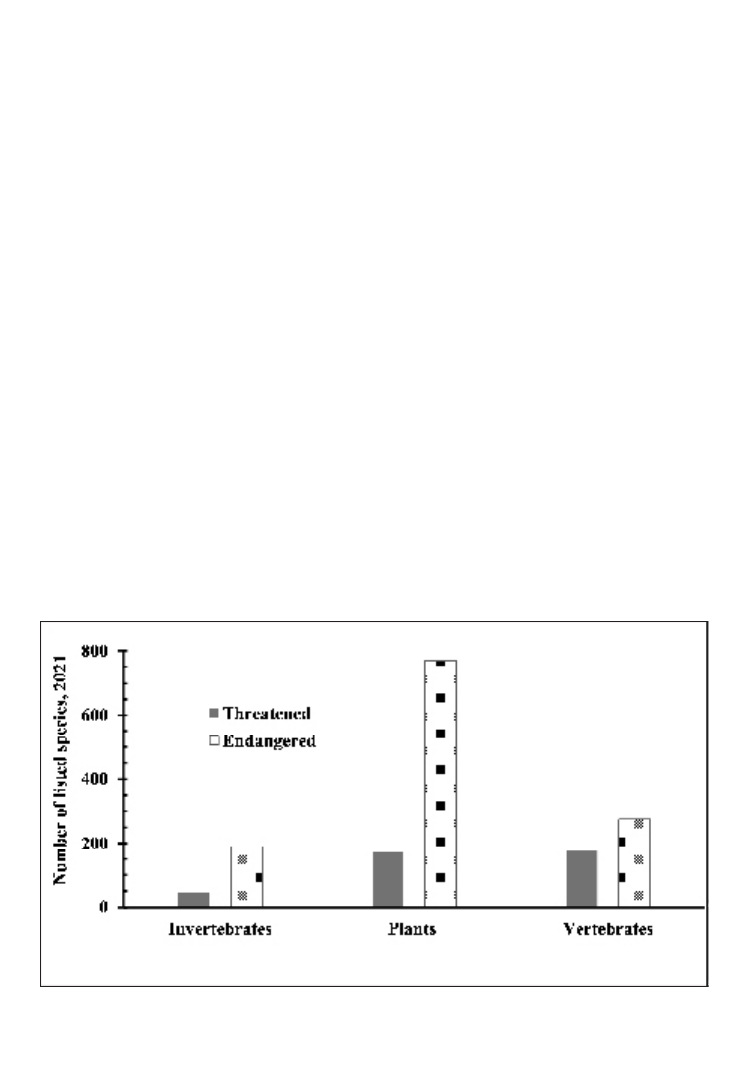
domestic species listed as of 2021 (941 plants,
451 vertebrates, 276 invertebrates; Figure 1),
only 4% (N = 69 species: 48 vertebrates, 1
Figure 1. Number of species by taxonomic group and listing status.
PSB 68 (3) 2022
159
invertebrate, 20 plants) have been removed
from the list due to recovery, which is the goal
of the ESA.
But using this metric solely to evaluate the
ESA success is not effective, since delisting is
only one purpose of the ESA. The recovery
process takes on average 24-40 years (years
for: birds, 40; fishes, 31; mammals, 24; plants,
27; reptiles, 30) if we have all the ‘means’
and a suit of partners working continuously
on a species. Preventing extinction to keep
endangered species stable, however, provides a
better measure of the effectiveness of the ESA.
Although the ESA doesn’t have a definition for
‘extinction’, and rates of extinction are difficult
to quantify, determination of whether a species
is extinct is based on analyses including
detectability of the species, adequacy of
survey efforts, and time since last detection.
With these three criteria, only 11 species (all
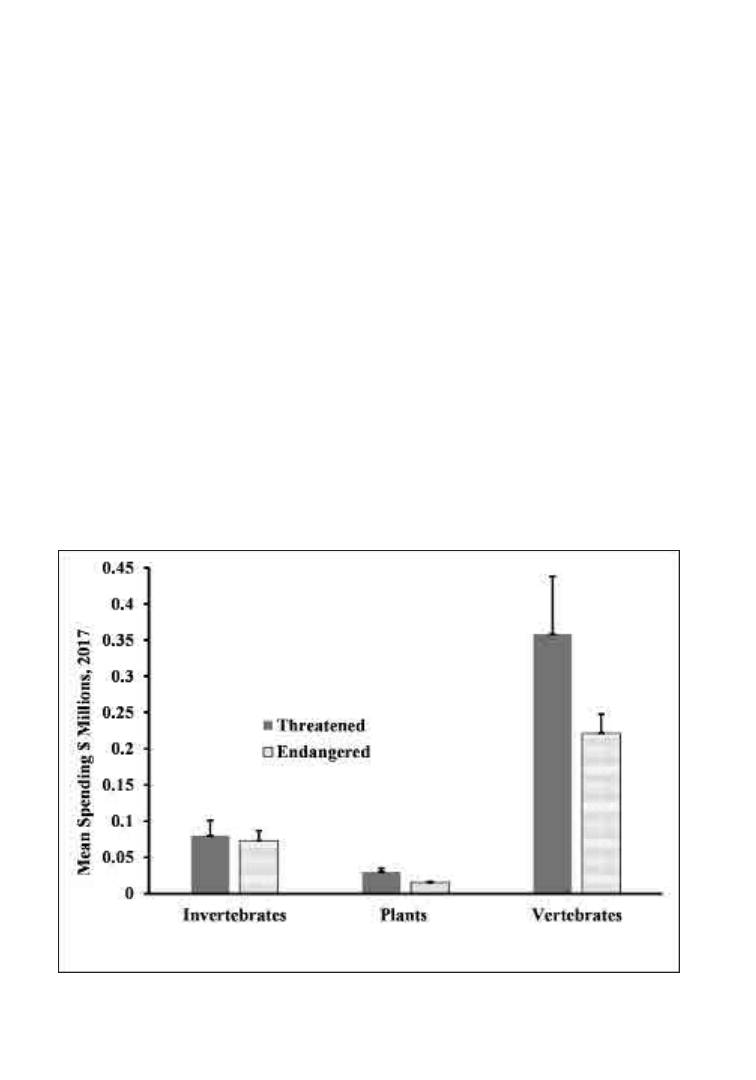
Figure 2. Average recovery spending per species by taxonomic group and listing status. The
error bars represent the standard error of the mean.
animals) have been determined as extinct
after listing (https://ecos.fws.gov/ecp/). One
main impediment to delisting plant species is
the limited funding (Figure 2) available for the
implementation of recovery actions of species
at risk of extinction (Figure 1). An additional
concern is the steady decline of personnel
dedicated to the conservation of threatened
and endangered species due to the “trend in
agencies to hire generalists or persons with a
degree in biology or ecology and expect them
to cover all taxonomic groups” (L. Smith, 2022
interview).
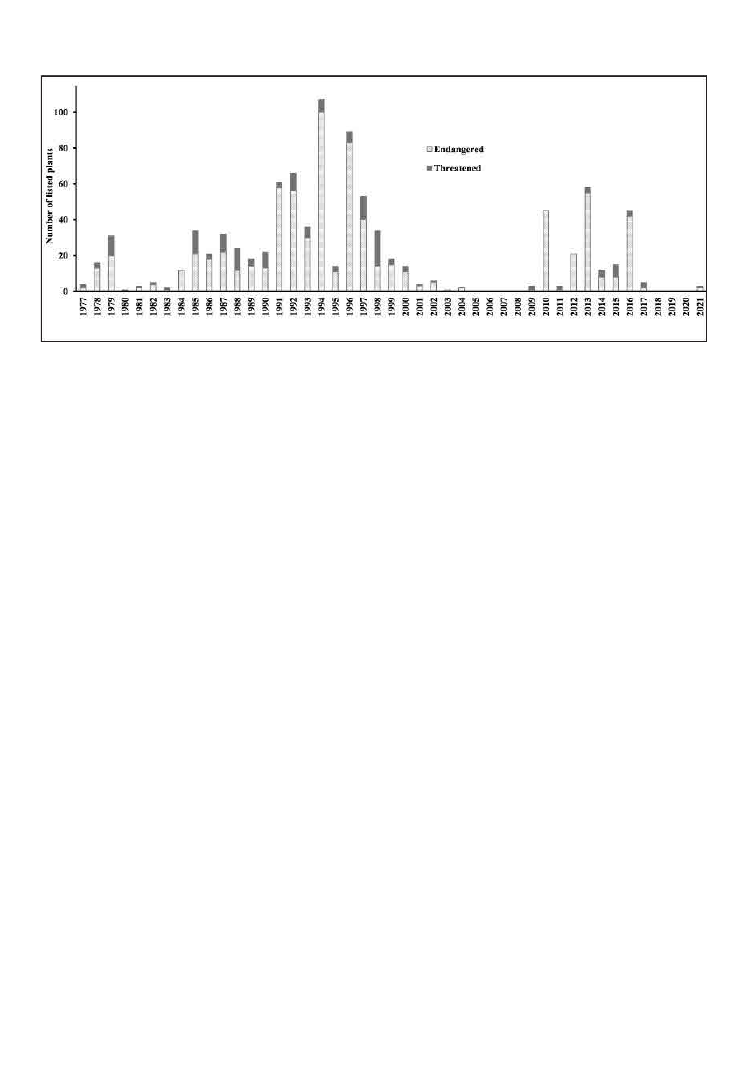
The first four plants were listed under the
ESA in 1977 (Figure 3). These four species
(endemics to the San Clemente Island,
CA) were listed as threatened [Acmispon
dendroideus var. traskiae (Fabaceae) and
Castilleja grisea (Scrophulariaceae)] and
endangered [Delphinium variegatum
PSB 68 (3) 2022
160
ssp. Kinkiense (Ranunculaceae) and
Malacothamnus clementinus (Malvaceae)],
and successfully recovered 44 years post-
listing, in 2021. Since 1994, plants are the
taxonomic group most listed, comprising 58%
of all federally listed species to date (Figure
1). Federal expenditures, however, are not
commensurate (Figure 2; Negrón-Ortiz, 2014)
and most funding is allocated to vertebrates.
This pattern is not likely to change, as an FWS
leader expressed when I interviewed him in
2022, “Funding is not equal across species,
and will not be equal, ever!”
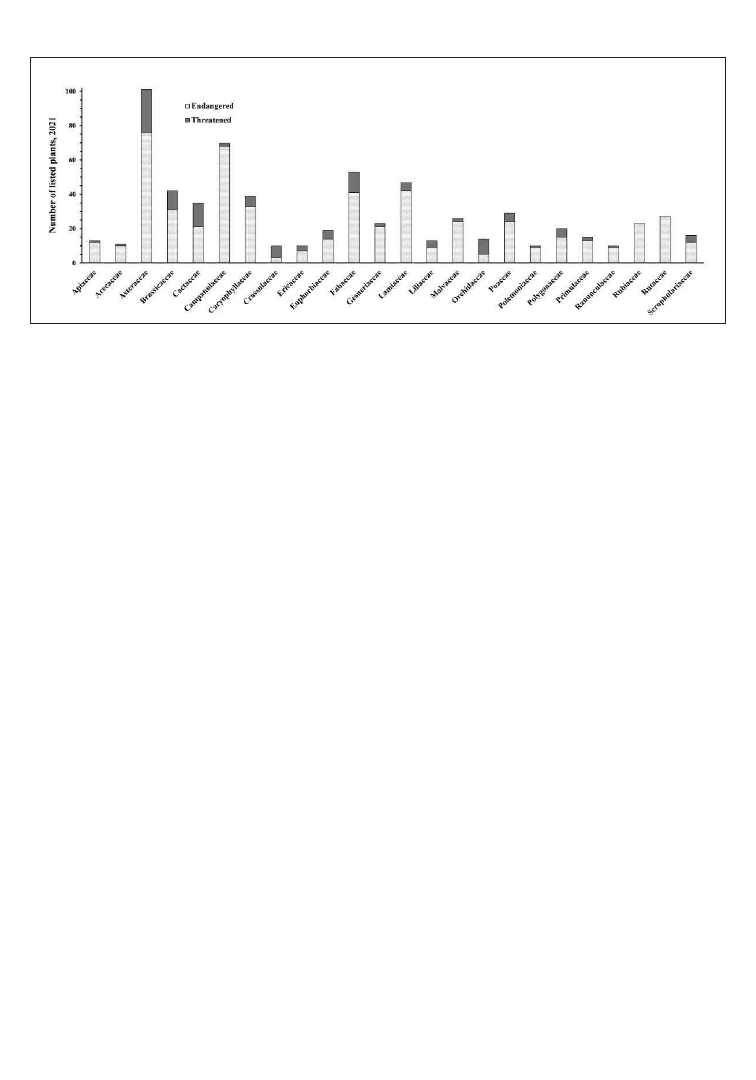
Federally listed plants are represented by
394 genera and 941 species within 118
families (Figure 4). About 59% of these
genera are represented by one species, while
only 2% of the genera (Astragalus, Cyanaea,
Cyrtandra, Euphorbia, Melicope, Phyllostegia,
Pritchardia, and Schiedea) include ≥11
species with the Hawaiian endemics
Cyanaea (Campanulaceae) and Schiedea
(Caryophyllaceae) possessing the most listed
(51 and 28 species, respectively). Overall,
more than 80% of the listed plants have an
endangered status (Figure 3). Many are found
in the Pacific (49%), Pacific Southwest (20%),
Figure 3. Number of species listed per year and listing status.
and Southeast regions (18%); and belong to
the Asteraceae (11%), Campanulaceae (9%),
Fabaceae (6%), and Lamiaceae (5%) (Figure
4). Of the 271 listed plants within these
four families, 155 are found in the Pacific
(particularly the Campanulaceae), 227 are
listed as endangered, and 165 possess high
degree of threats. The recovery potential of 110
of species with high threats is low, suggesting
that these species are vulnerable to extirpation
and possibly extinction.
Federally listed plants are primarily protected
on public lands. The only public land
managed by FWS are the National Wildlife
Refuges (NWRs), where about a third of
all the listed species occur in 444 of the 568
NWRs (Defenders of Wildlife, 2020). While
23,086 native plant species have been reported
in 396 NWRs, only 207 are federally listed
and documented in 93 NWRs. The species
requiring federal protection may increase
in the near future, since more than 2000 are
currently assessed by NatureServe as critically
imperiled (G1) and imperiled (G2)—thus,
NWRs remain important for preserving
biodiversity. The numbers of species projected
to require federal protection are greatest
PSB 68 (3) 2022
161
Figure 4. Families with ≥10 listed plant species. Most families (94) possess < 10 listed plant spe-
cies, totaling 265.
in Hawaii, California, and the Southeast.
Although there are other federal, state, and
local areas home for many of our threatened
and endangered species, unfortunately, most
of our plants are located on privately owned
lands where they do not receive protections
under the ESA.
KEY MILESTONES FROM
1973 TO PRESENT
I am going to switch gears and rely on the
interviews and discussions with 10 FWS
leaders and botanists nationwide to document
key milestones within three timelines about 20
years apart that marked significant decisions
for species protection, science, and policies
under the ESA.
1973 to 1995
• The listing process was solely per-
formed at the FWS headquarters
(HQ) from 1973 to 1985, and then it
was transferred to the regions until
1992 when it finally was delegated to
the field offices.
• Gail Baker, Bruce MacBryde, John
Fay, and LaVerne Smith were the only
FWS botanists hired between 1975 to
1978. They were stationed at HQ and
worked nationwide on a proposed
rule to list several hundreds of plants
(Baker’s recollection is 800 plant spe-
cies). They gathered information on
these plants by contacting state offices
to inquire about their plant conser-
vation efforts and providing funding
agreements to botanists around the
country to inform listing on specific
plants.
• Science
0
The immediate actions for these
plants were surveys and uncov-
ering new locations, as basic sci-
ence was scarce or lacking.
0
Research was transferred in 1993
to the National Biological Ser-
vice, now U.S. Geological Science
(Wagner, 1999).
• The driver in the 1980s was to list spe-
cies “just to be on the safe side,” (J.
Herrington, 2022 interview), and it
was done with minimal data.

PSB 68 (3) 2022
162
• A total of 509 plants were listed within
22 years, of which 80% were assessed
as endangered (Figure 3).
1996 to 2015
• The external drivers during this period
were trust and partnership. Research
was no longer an action to be imple-
mented by the FWS staff; thus, trusting
was crucial as partners had the task to
collaborate on research projects and
get the best available information for
the recovery process.
• The internal driver during much of
this period was the high volume of
lawsuits and their consequences.
0 Lawsuits. Between 2005 and 2015,
the FWS received about 141 suits,
involving 1441 species, to take
actions within deadlines under
Section 4 of ESA. In addition, two
mega-petitions (formal requests
to list species under the ESA)
were received: one in 2007 to list
674 species in the Southwest and
Mountain-Prairie regions and the
other in 2010 to list 404 species
in the Southeast region (GAO,
2017).
0 Consequences. Re-assigning
FWS staff to work on those litiga-
tions delayed the recovery work
but conversely, as G. Carmody
(2022 interview) stated, “Certain
things were done in a way that
they would not have been done
otherwise.” She also stated that
“funding was redirected to com-
pensate lawyers’ salary and to es-
tablish agreements to get the new
workload done.”
• The overall driver between 2000 and
2009 was “more listing, but not recov-
ery” (J. Herrington, 2022 interview),
although no plants were listed from
2005 to 2008 (Figure 3).
• Science
0 Population viability analyses be-
came the ideal approach to esti-
mate the probability of extinction
of populations or species and was
frequently used as a framework
for recovery.
0 Basic science continued to be
scarce for most listed plants and
for all species in general, and the
structured decision-making ap-
proach (Runge et al., 2020) was
used to explicitly address am-
biguity or uncertainty due to
knowledge gap.
0 A key issue that marked this peri-
od was listing of the polar bear in
2008 (L. Smith, 2022). It triggered
the importance of addressing the
long-term projection of species
vulnerability and extinction risk
under climate change scenarios
(i.e., forecasting).
0 Management was considered
more active and less idealistic as
“we don’t have the luxury to go
as we did in the past” (L. Smith,
2022 interview).
• A total of 378 plants were listed within
these 20 years, with 83% of them clas-
sified as endangered (Figure 3).

PSB 68 (3) 2022
163
2016 to the present and future
• Science and Policy decisions
0 Greater scientific understanding
of species’ viability is anticipated
to improve because an analytical
framework called Species Status
Assessment (Smith et al,. 2018)
is in place to inform decision-
making including processes such
as listing and recovery.
0 Better baseline data and research
on survival, reproduction, and
other vital rates are expected
through collaboration with ex-
perts outside FWS, as well as an
improved assessment of the cur-
rent and future trajectory of the
species.
0 Greater technical participation
by experts outside of the FWS is
also anticipated to help us inte-
grate and apply the best available
data to inform decisions, by char-
acterizing uncertainty and filling
data gaps.
Significant scientific advances had been made
in understanding the biology and ecological
needs of many of listed plant species during
the 49 years of the ESA implementation, yet
basic science remains scarce. Three areas of
research (population genetics, reproductive
and seed ecology, and demographic modeling)
have considerably contributed to guide efforts
to protect populations and prevent extinction
of endangered and threatened species. But
many questions remain to be answered, and
the following collective themes emerged
through discussions with FWS botanists:
What is the life history profile for each
species? Are they able to adapt to changing
environmental conditions and catastrophic
events? How should a “population” be defined?
What constitutes a plant vs. a clone? What
are the types of soil seed bank? What are the
longevity of ex-situ seeds? What are the overall
patterns of in-situ seedling recruitment? Is
low recruitment sufficient to maintain stable
populations? What solutions are needed to
conserve species at risk from climate change?
Overall, the reality is that many of our species
are not improving, current threats are and
will be exacerbating species endangerment,
and science alone will not lead to prevention
of many species’ extinctions—but it may help
slow down extinction.
In closing, I would like to finish with several
quotes that have specific meanings at certain
time periods within the 49 years of the
ESA implementation. A common phrase
constantly being said by botanists since the
inception of the ESA to present days is, “Do
not forget the plants”—a reminder to the
FWS leadership that plants are also listed
and need to be included in documents such
as strategies, during public speaking, and
outreach media. The phrase “The past was a
predictor of the future, but not now” refers to
how we cannot go back to how species and
habitat were previously managed because
changes and degradation are happening faster
due to the consequences of climate change,
and the past management data will not help
restore current lands. “Science will prevail”
was a quote commonly verbalized during
the polar bear listing process and certain
key periods (1980s and 2000s) associated
with presidential administrations. Finally,
Mrs. Gail Baker said during a 1976 interview
with a National Public Radio reporter, “It’s
not love that makes the world go round, it’s
photosynthesis.” A few days later, she received
a message from a college student in Boston
praising her story and quote!

PSB 68 (3) 2022
164
TERRITORIAL
ACKNOWLEDGMENTS
I want to acknowledge the traditional territory
and ancestral lands of many indigenous
people (https://native-land.ca/). My work area
occurs across the NW Florida home of the
traditional and ancestral lands of the Mvskoke
(Muscogee/Creek) and Apalachees, and since
this year the conference was in Anchorage,
Alaska, I would like to pay my respect to
Elders both past, present, and future.
ACKNOWLEDGMENTS
I wish to acknowledge 10 participants
representing FWS leadership and botanists
across the nation for their contribution during
interviews: Gail Baker (former FWS botanist,
1976-1977, HQ), Sean Blomquist (former
Supervisor, Branch of SSA Science Support,
HQ), Tara D. Callaway (Washington State
Plant Recovery Coordinator, Washington
State), Gail Carmody (former Field Supervisor,
NW Florida), Craig Hansen (Listing
Coordinator, Region 6, CO), Jay Herrington
(former Field Supervisor, N Florida), Mark
Madison (Historian, National Conservation
Training Center, WV), Erin Rivenbark
(Listing Biologist, Region 4, Atlanta, GA),
LaVerne Smith (former FWS botanist, 1978-
1983, HQ), Lauren Weisenberger (Plant
Recovery Coordinator, Honolulu, HI), and
Marion (Scott) Wiggers (botanist,
Mississippi
Field Office, MS)
. Specifically, I was thrilled
to interview Gail Baker and LaVerne Smith,
who were part of the beginning the ESA
implementation. My appreciation is also
extended to 10 other FWS staff members
for providing many plant images that were
featured in this talk at Botany 2022.
REFERENCES
Greenwald N., K. F. Suckling, B. Hartl, and L.
A. Mehrhoff. 2019. Extinction and the U.S. En-
dangered Species Act. PeerJ 7: e6803. https://doi.
org/10.7717/peerj.6803
Negrón-Ortiz, V. 2014. Pattern of expenditures for
plant conservation under the Endangered Species
Act. Biological Conservation 171: 36-43. https://
doi.org/10.1016/j.biocon.2014.01.018
Negrón-Ortiz, V. 2007. Chromosome numbers,
nuclear DNA content, and polyploidy in Consolea
(Cactaceae), an endemic cactus of the Caribbean
Islands. American Journal of Botany 94: 1360-
1370.
Negrón-Ortiz, V., and L. Strittmatter. 2004. Em-
bryology of floral dimorphism and gender system
of Consolea corallicola (Cactaceae), a rare spe-
cies of the Florida Keys. Haseltonia 10: 1-10.
Negrón-Ortiz, V. 1998. Reproductive biology of
a rare cactus, Opuntia spinosissima (Cactaceae),
in the Florida Keys: why is seed set very low?
Sexual Plant Reproduction 11: 208-212.
Runge, M. C., S. J. Converse, J. E. Lyons, and
D. R. Smith. 2020. Structured Decision Making:
Case studies in natural resource management.
Johns Hopkins University Press.
Smith, D. R, N. L. Allan, C. P. McGowan, J. A.
Szymanski, S. R. Oetker, and H. M. Bell. 2018.
Development of a Species Status Assessment Pro-
cess for decisions under the U.S. Endangered Spe-
cies Act. Journal of Fish and Wildlife Manage-
ment 9: 302-320.
Strittmatter, L. I., V. Negrón-Ortiz, and R. J. Hick-
ey. 2002. Subdioecy in Consolea spinosissima
(Cactaceae): breeding system and embryological
studies. American Journal of Botany 89: 1373-1387.
U.S. Government Accountability Office (GAO).
2017. Environmental litigation: Information on
Endangered Species Act deadline suits. Website:
https://www.gao.gov/assets/gao-17-304.pdf.
Wagner, F. H. 1999. Whatever happened to the
National Biological Survey? BioScience 49: 219–
222.

PSB 68 (3) 2022
165
Botanical Society of America’s
Award Winners (Part 2)
AWARDS FOR ESTABLISHED SCIENTISTS
GIVEN BY THE SECTIONS
MARGARET MENZEL AWARD
(Genetics Section)
The Margaret Menzel Award is presented by the Genetics Section for the outstanding paper
presented in the contributed papers sessions of the annual meetings.
Caroline Dowling, University College Dublin, For the Presentation: It’s Been a Long Day:
Uncovering the genetic control of flowering in Cannabis sativa. Co-authors: Jiaqi Shi, Susanne
Schilling, Rainer Melzer
SAMUEL NOEL POSTLETHWAIT AWARD
(Teaching Section)
The Samuel Noel Postlethwait Award is given for outstanding service to the BSA Teaching Section.
Dr. Melanie DeVore, Georgia College & State University
MICHAEL CICHAN PALEOBOTANICAL
RESEARCH GRANT
(Paleobotanical Section)
The Award is to provide funds for those who have completed a PhD and are currently in a post-
doctoral position or non-tenure track position.
Nareerat Boonchai, Florida Museum of Natural History, University of Florida. For
the paper titled: “Insights into the Wyoming’s Blue Forest: Filling a knowledge gap
in diversity of Eocene woody vegetation, paleoenvironment, and paleoclimate.”

PSB 68 (3) 2022
166
Andres Elgorriaga, University of Kansas. For the paper titled: “Reconstructing ginkgoalean
macroevolutionary patterns through time within a phylogenetic context.”
AWARDS FOR STUDENTS
DONALD R. KAPLAN AWARD IN
COMPARATIVE MORPHOLOGY
This award was created to promote research in plant comparative morphology, the Kaplan family
has established an endowed fund, administered through the Botanical Society of America, to
support the Ph.D. research of graduate students in this area.
Yesenia Madrigal Bedoya, University of Antioquia (Colombia). For the Proposal: A mor-
pho-anatomical characterization of the vegetative-to-reproductive meristematic transition in
terrestrial and epiphytic neotropical orchids
THE BSA GRADUATE STUDENT RESEARCH AWARD
INCLUDING THE J. S. KARLING AWARD
The BSA Graduate Student Research Awards support graduate student research and are made on the
basis of research proposals and letters of recommendations. Withing the award group is the Karling
Graduate Student Research Award. This award was instituted by the Society in 1997 with funds
derived through a generous gift from the estate of the eminent mycologist, John Sidney Karling (1897-
1994), and supports and promotes graduate student research in the botanical sciences.
THE J. S. KARLING
GRADUATE STUDENT RESEARCH AWARD
Jessie Pelosi, University of Florida. For the Proposal: Beyond the genome: methylomics of the
alternation of generations

PSB 68 (3) 2022
167
AWARDS FOR STUDENTS GIVEN BY THE SECTIONS
STUDENT PRESENTATION AND POSTER AWARDS
ECOLOGICAL SECTION
STUDENT PRESENTATION AWARD
Michael Peyton, University of Wisconsin – Madison. For the Presentation: An investigating
into the role of functional traits and spatial scale in Hawaiian understory responses to pig
disturbance. Co-author: Sara Hotchkiss
ECOLOGICAL SECTION POSTER AWARDS
Blaire Kleiman, Florida International University. For the Presentation: How weeds affect
insects in mango, Mangifera indica, cultivation of South Florida.
DEVELOPMENTAL & STRUCTURAL POSTER AWARD
(Best Student Poster)
Deanna Neupert, Miami University. For the Poster: The evolution of structural novelty: A
morphological analysis of development in Mimulus and its implication for plant architecture
and reproduction. Co-authors: Robert Baker, Rich Moore, Jonathan Bauer
ISABEL COOKSON AWARD
(Paleobotanical Section)
Established in 1976, the Isabel Cookson Award recognizes the best student paper presented in the
Paleobotanical Section.
Kelly Pfeiler, University of Kansas. For the Presentation: Anatomically preserved
cheirolepidiaceous pollen cones of western North America. Co-authors: Brian Atkinson, Kelly
Matsunaga

PSB 68 (3) 2022
168
KATHERINE ESAU AWARD
(DEVELOPMENTAL AND STRUCTURAL SECTION)
This award was established in 1985 with a gift from Dr. Esau and is augmented by ongoing
contributions from Section members. It is given to the graduate student who presents the
outstanding paper in developmental and structural botany at the annual meeting.
Heather Phillips, Cornell University. For the Presentation: To fuse or not to fuse: Investigating
the evolution and development of floral fusion in the Zingiberales. Co-authors: Jacob Landis,
Chelsea Specht
LI-COR PRIZE
(PHYSIOLOGICAL SECTION)
Each year, the Physiological Section presents the Li-COR prize to acknowledge the best presentation
made by any student, regardless of subdiscipline, at the annual meeting. The Li-COR prize is
presented annually at the BSA Banquet.
Best Student Oral Presentations
Claudia Garnica Diaz, University of Florida. For the Presentation: Intra-canopy leaf
variation in deciduous oaks (genus Quercus): from leaf construction to energy return. Co-
Authors: Siddarth Machado, Raiza Castillo-Argaez, Nicholas Ash Smith, Daniel J. Johnson,
Grace Patricia John
Ana Flores, University of Hawaii at Manoa. For the Presentation: Trait variation as plants
grow up: simultaneous effects of ontogeny and phenotypic plasticity. Co-author: Kasey Barton
Best Student Poster
Jordyn Regier, Pepperdine University. For the Presentation: Substrate type affects the drying
speed and desiccation tolerance of fern gametophytes. Co-Authors: Mayra Hernandez, Camille
Kilayko Sicangco, Stephen Davis, Helen Holmlund

PSB 68 (3) 2022
169
MAYNARD MOSELEY AWARD
(Developmental & Structural and Paleobotanical Sections)
The Maynard F. Moseley Award was established in 1995 to honor a career of dedicated teaching,
scholarship, and service to the furtherance of the botanical sciences. Dr. Moseley, known to his
students as “Dr. Mo”, died Jan. 16, 2003 in Santa Barbara, CA, where he had been a professor
since 1949. He was widely recognized for his enthusiasm for and dedication to teaching and his
students, as well as for his research using floral and wood anatomy to understand the systematics
and evolution of angiosperm taxa, especially waterlilies. (PSB, Spring, 2003). The award is given
to the best student paper, presented in either the Paleobotanical or Developmental and Structural
sessions, that advances our understanding of plant structure in an evolutionary context.
Keana Tang, University of Kansas. For the Presentation: Crown group Lauraceae in the Late
Cretaceous: new evidence from fossil flowers. Co-Authors: Kelly Matsunaga, Brian Atkinson
PHYSIOLOGICAL SECTION
STUDENT PRESENTATION AND POSTER AWARDS
Best Student Oral Presentation
Maria Cristina Rengifo Faiffer, Michigan Technological University. For the
Presentation: Phenotypic plasticity of Syntrichia caninervis in novel climates. Co-
authors: Matthew Bowker, Anita Antoninka
Best Student Poster
Marissa Ochoa, University of California, Los Angeles. For the Presentation: How does stomatal
anatomy influence leaf conductance from minimum to maximum? Causal relationships
and meta-analysis. Co-authors: Lawren Sack, Thomas N. Buckley, Christian Henry, Camila
Medeiros, Ruihua Pan, Grace Patricia John

PSB 68 (3) 2022
170
PHYTOCHEMICAL SECTION
PRESENTATION AWARDS
Best Presentation
Gordon Younkin, Cornell University. For the Presentation: Comparative transcriptomics of 48
Erysimum species guides discovery of cardiac glycoside biosynthetic genes. Co-authors: Martin
Alani, Mahdieh Mirzaei, Georg Jander
Best Presentation Honorable Mention
Luis Santiago-Rosario, Louisiana State University. For the Presentation: Contrasts among
cationic phytochemical landscapes in the southern United States. Co-author: Kyle Harms
Best Poster
Gemma Takahashi, University of California, Irvine. For the Poster: Differential expression,
genome annotation, and enzyme discovery in Drosera capensis. Co-authors: Omar Akbari,
Ulysses Castelan, Mark Hadadian, Jonathan Le, Jessica Kelz, Elizabeth Diessner, Elliott Einstein,
Megha Unhelkar, Ashley Kwok, Marc Sprague-Piercy, Sofiya Woodcock, Allison Pineda, Pauniz
Shabakesaz, David Einstein, Alexandra Garabedian, Aden Alemayhu, Jose Uribe, Rachel
Martin, Carter Butts
Best Poster Honorable Mention
Anna Ferraro, High Point University. For the Poster: Characterizing plant biochemical
responses to pathogenic stress: a spotlight on red leaf spots. Co-authors: Maggie Salley, Bailey
McCormick, Andrew Wommack, Nicole Michelle Hughes

In 2021, the Botanical Society of America
(BSA) revised its strategic plan, updating
the mission, goals, and areas of impact
for the Society. A gift or planned financial
commitment to the BSA will enable the
Society to achieve its goals as outlined in the
updated strategic plan and to achieve long-
term sustainability for BSA. Support for
diverse student inclusion and participation
emerged as a priority for the continued work
of the Society. Among other areas of focus
outlined in the strategic plan, making student
participation and success a key priority will
ensure the overall long-term sustainability
and global impact of the BSA.
In 2021, the Society received a large and
generous gift from an anonymous donor to
endow a new Graduate Student Research
Award in Comparative Plant Biology. The
first research award for $10,000 from this
fund will be offered in 2023. This award
significantly increases the support that the
Society can provide to graduate students
By
Jennifer Cruse-Sanders
BSA Director at Large for Development
Gifts to the BSA Endowment
Support Student Research
in plant biology. The Society also offers the
prestigious Kaplan Dissertation Award in
Comparative Morphology, in its third year of
funding, which provides a $10,000 research
award annually.
You, too, can help by making a donation of any
amount to BSA or consider giving a legacy gift
to BSA. The intent of the Botanical Society of
America’s Legacy Society is to ensure a vibrant
BSA for tomorrow’s botanists, and to assist all
members in providing wisely planned giving
options. All that is asked is that you remember
the BSA as a component in your legacy gifts—
no minimum amount. We hope this allows all
BSA members to play a meaningful part in the
Society’s future.
Giving a legacy gift to the BSA is simple:
https://crm.botany.org/civicrm/profile/
create?gid=46&reset=1. To contact us with
your questions, e-mail bsa-manager@botany.
org.

PSB 68 (3) 2022
172
The mental health crisis in this country, and
its implications for students and workers, has
been well documented. Burnout, work-life
balance, and self-care are terms and topics
that are now commonly used by many, and
the botanical community is no exception.
But these very serious issues are at times
misunderstood or dismissed as overexposed,
temporary, or self-indulgent. And self-care
has been irresponsibly commercialized and
offered as a simple panacea to structural
problems. So, what are the nuances of good
mental health in the workplace? What are
the specific challenges to and opportunities
for self- and community-care in the
botanical community? In August 2022, the
BSA offered a free Botany360 webinar—
“Nurturing Botanists: Developing a Self- and
Community-Care Practice”—to explore these
questions.
As the BSA Diversity Equity Inclusion and
Outreach Programs Coordinator, I provided
participants with information, ideas, and
concrete skills to help them build a practice
of care for themselves and others in their
communities, universities, and workplaces.
The workshop interrogated some of the
harmful approaches to mental health and
instead offered a more nuanced and trauma-
informed view of when, how, and why to
develop a self- and community-care practice.
I’d like to offer a recap of that workshop here
in the Plant Science Bulletin so that more of
our botanical community can take steps to
better care for ourselves and one another.
WHAT IS YOUR
PROFESSIONAL QUALITY
OF LIFE?
Before jumping into self- and community-
care practices, the workshop explored
mental health challenges in the workplace
and introduced the Professional Quality of
Life measure as a way to deconstruct and
understand our complex feelings about and
relationship with our work.
The Professional Quality of Life measure, or
ProQOL, is a self-assessment tool that has
been used for over 15 years to help individuals
understand their level of work satisfaction,
fatigue, and burnout. Historically, it was
Nurturing Botanists:
Developing a Self- and Community-
Care Practice: A Botany360 Recap
By Sarah Sims
BSA Diversity Equity Inclusion and
Outreach Programs Coordinator
PSB 68 (3) 2022
173
primarily used in the “helping professions,”
but many different types of workplaces and
workers are now using the tool to understand
the complexities around what makes us feel
good and bad in our careers and what we can
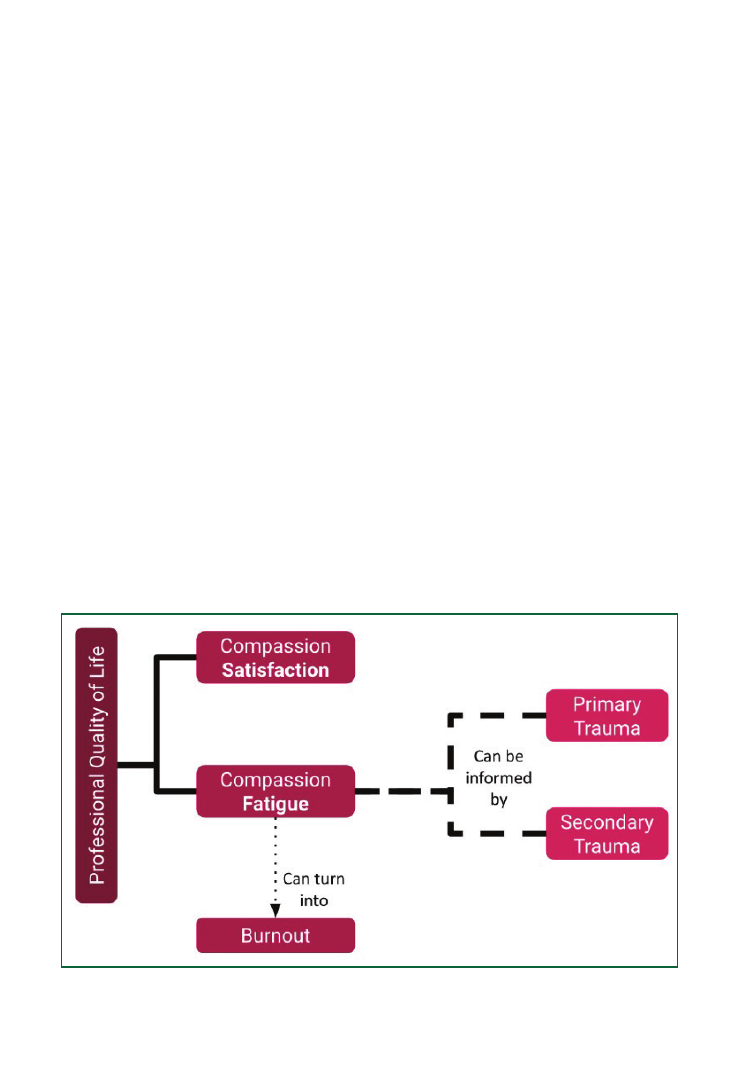
do about it. The ProQOL determines your
professional quality of life as a balance of the
compassion satisfaction and the compassion
fatigue you feel. (Note: To learn more about
how the the ProQOL defines and measures
professional quality of life, or to take your own
self-assessment, visit https://proqol.org/.)
Compassion satisfaction is the pleasure you
derive from doing your work or that you get
from external sources at your workplace. The
specifics of what makes you feel satisfied at and
with your work will be different for everyone
depending on personality, identities, approach
to work, etc. Here are some of the factors that
our colleagues in botany said make them feel
a sense of compassion satisfaction:
• Workplace flexibility
• Seeing our students and colleagues
have successes
• Having a sense that you and your col-
leagues are working together toward a
common goal
• Having peers who share some of your
marginalized identities
• Having lab mates or co-workers who
you can vent to and who in turn will
listen to you
Do any of these ring true for you? What makes
you feel satisfied with your work?
Compassion fatigue is exhaustion, emotional
distress, frustration, anger, or apathy resulting
from caring a lot about your work and having
negative feelings about your workplace. It can
also be influenced by traumatic experiences you
PSB 68 (3) 2022
174
might have either at work or in your personal
life. Compassion fatigue, if unchecked, can
turn into burnout. Burnout can show up as
complete mental and/or physical exhaustion,
a cynical detachment from your work, or a
reduced sense of self-efficacy (https://hbr.
org/2021/04/your-burnout-is-unique-your-
recovery-will-be-too). Like compassion
satisfaction, what makes you feel fatigued or
burnt out is also individual. Here’s what some
in the botanical community struggle with:
• Unrealistic and increasing workloads
and high focus on productivity
• The pressure to give free or underval-
ued labor
• Unsupportive leaders and/or institutions
• Issues related to the COVID-19 pandemic
• Monotony of work and/or recurring
problems with no solutions
• Feeling under-appreciated
Have you ever experienced burnout? What
makes you feel compassion fatigue at work?
We often think about burnout specifically
as a state of mind that might lead us to drop
out of school, quit our job, or find a new
profession entirely. These impacts on our
careers are certainly true, but perhaps a more
insidious consequence of burnout is what it
does to our bodies and long-term health if
unchecked for too long. Our bodies react in
automatic ways to stress, releasing adrenaline
and other hormones that can cause changes to
blood sugars, heart rates, and blood flow. A
short-term change helps us get safely through
a stressful or even dangerous situation. But
when this is happening all the time, it can
lead to heart conditions, metabolic diseases,
sleep disorders, harmful coping mechanisms,
and more. Thus, the very essential need for
self- and community-care: it’s not just about
keeping us at our jobs and satisfied with our
jobs—it’s about preserving our health!
SELF-CARE:
IT’S MORE NUANCED
THAN YOU THINK!
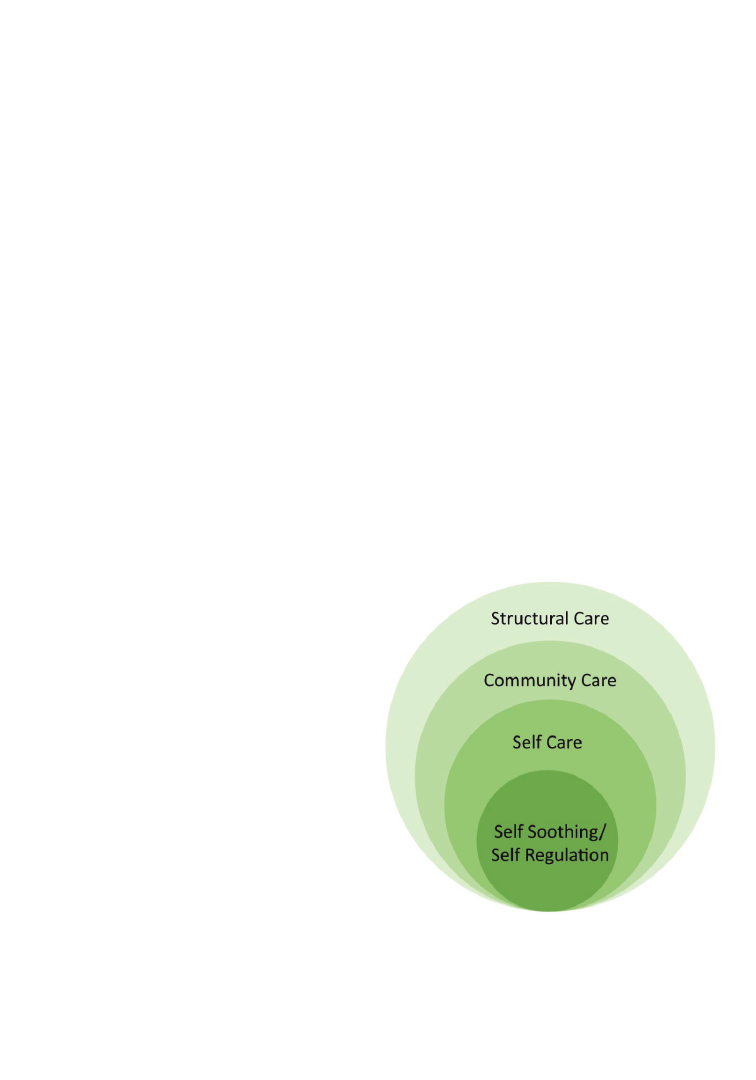
There are a lot of harmful myths about self-
care, and one of the biggest ones is that it is all
on you. Unfortunately, self-care is often used
as a catch-all term for what is (or should be)
a layered approach to supportive care, which
starts with self-soothing or self-regulation,
then self-care, followed by community-care,
and all of which would (in a perfect world)
be enveloped by comprehensive and inclusive
structural care.

PSB 68 (3) 2022
175
SELF-SOOTHING/SELF-
REGULATION: DO IT NOW!
Self-soothing or self-regulation are reactive
activities that are easy for you to engage
in and provide distraction and/or comfort
during a stressful time. The key phrase in the
previous sentence is “easy for you.” Often,
self-care and self-soothing are confused or
used interchangeably. As we’ll discuss further
below, a self-care practice that you’ve taken
time and intention to cultivate and get better
at over time can become one of your go-to self-
soothing techniques—but it doesn’t always
automatically start that way. Consider this:
have you ever been in a stressful situation, and
someone tells you, “Let’s just take a break to
meditate”? You try, but the stress doesn’t go
away, and then your stress increases because
you become acutely aware that you don’t know
what you’re doing or that you aren’t doing it
right. And now you are more stressed that you
wasted time unsuccessfully trying to destress.
Well, meditation wasn’t the right self-soothing
technique for you, but something else is!
Let’s dig a little deeper into the science of how
self-soothing works. A good self-soothing
technique is one that makes you feel calm. How
does that work? Let’s take a look at the other
term used for self-soothing: self-regulation.
When we are stressed, we are dysregulated.
Dysregulation happens in our bodies. Those
stress hormones, mentioned above, make our
muscles tense up, or our heart rate increase,
or our breathing to become irregular. You
likely know what stress or dysregulation looks
like in your body. So, to re-regulate (or self-
soothe), you need to provide your body with
the opposite of the dysregulation symptom
you are experiencing. If you feel yourself
getting hot and sweaty, enjoying a favorite iced
drink may be your go-to. If you experience
the stress as body aches, maybe a brisk walk or
a session at the boxing gym is what you need.
Because dysregulation is unique to you, self-
regulation techniques also need to be unique
to you.
Personalization—got it! But why does it
need to be easy? When you’re dysregulated,
your body reacts, but so does your brain.
Specifically, as you become more stressed, key
executive functions of your brain, such as your
ability to plan ahead, follow multiple complex
steps, and even language, become harder
to access. On the flip side, you begin to rely
more on your limbic system where emotions,
memories, and habits live, and your brainstem
and cerebellum, which is the autopilot section
of your brain where your fight–flight or freeze
responses live. This means that if a regulation
technique is new or highly complicated, you
likely won’t be able to perform it successfully.
TRY IT!
5, 4, 3, 2, 1 SENSORY
GROUNDING
During the workshop, a couple of self-
regulation techniques were explained
and practiced. Here’s one that you can do
anywhere and in any amount of time: find a
comfortable place to sit or stand in any type
of environment. Take a few deep breaths.
Look around and name five things you can
concretely see. Take some more deep breaths.
Physically use your hand to touch four things
and name how they feel. More deep breaths.
Name three things you can hear; closing your
eyes may help. More deep breaths. You may
need to really concentrate this time: name two
things you can smell. A final deep breath. Now
name one emotion you have.

PSB 68 (3) 2022
176
So, why does this work? Oftentimes when we
are dysregulated, we lose an attachment to our
body; in other words, we become overtaken
by our thoughts or feelings. A great way to
reconnect with our bodies and break that
dysregulatory cycle is to focus on our senses.
Also, if you practice this technique and are
currently living without certain disabilities,
you’ll notice that it starts with the easier to
access sense—sight—and then progressively
asks you to pay close attention. You’ll recall
from above that when we are dysregulated,
our higher-level thinking skills begin to go
offline—so the simpler the task, the easier it
is to soothe yourself. This technique slowly
reintroduces your executive functions. Next
time you’re feeling stressed, give it a try!
SELF-CARE:
PLAN AND PRACTICE
Self-care is really about cultivating your future
well-being. As opposed to self-regulation,
which you would engage in when you start to
feel dysregulated, you really need to practice
self-care when you already feel calm (and when
you have full access to all of those executive
functions of your brain). It is proactive and
intentional. While self-regulation involves
activities that purely make you feel soothed,
calm, and good, self-care should encompass a
more holistic definition of good health. Self-
soothing often focuses only on your physical,
mental, and emotional well-being. With
self-care, we want to expand that to include
financial, spiritual, social, occupational,
environmental, and intellectual health.
This inevitably means that self-care requires
some level of commitment. This might
mean creatively carving out time to practice
something new. Or, and perhaps more difficult
for some, it might mean figuring out how to
say “no” and stick to your boundaries. It might
mean trusting others to fill in for you at work
or at home so that you have more time for self-
care. It might mean leaning into a new practice
that seems hard or awkward at first. For the
botanical community, and specifically those
in academia, we might need to interrogate
the implicit and explicit pressures within
our discipline to adhere to scientific, rational
thinking and reject anything that might
incorporate intuition, emotion, or reflective
thinking. This attitude can be at odds with our
need to prioritize self-care.
STRUCTURAL CARE
(A GOAL TO ADVOCATE
FOR) AND COMMUNITY-
CARE (WORKING
TOGETHER TO CREATE
WORKAROUNDS)
Finally, we turn to structural and community-
care. Structural care consists of systems
that support our holistic health and make
it possible for individuals to engage in
meaningful self-care. These are things like
comprehensive universal healthcare, efficient
and accessible public transportation, a living
wage, paid family leave, etc. They might be
mandated by governments or provided by a
place of employment. In short, structural care
is all the things that would make life just a bit
easier.

PSB 68 (3) 2022
177
But we know that structural care is not a
universal reality, so cue community-care.
Community-care is what we develop together
in our various communities to provide relief
and support when the systems we operate
within fail to do so. These can be highly
structured, such as worker-owned co-ops
or student unions. They can be small and
informal, such as childcare collectives, or buy-
nothing groups on social media. They can be
as simple as the relationships you form with
others who share your identities, perspectives,
or needs.
Within the workplace setting specifically,
communities of care build a culture that
normalizes conversations about mental health
and the prioritization of self-care. This means
actively rejecting language and practices
that stigmatize attention to mental health
and supporting DEI (diversity, equity, and
inclusion) values and ethical behavior more
broadly (https://bit.ly/3zkWYOu and https://
bit.ly/3N6aWcE). Workplace communities
of care establish practices that honor and
support each other’s self-care preferences
and provide opportunities for colleagues to
engage in self-care. So what could a botanical
community of care look like? First, workshop
participants identified some of the barriers we
face, including:
• Workloads prohibiting us from taking
the time to intentionally build these
supports or even think about them
• Being out of practice interacting with
our colleagues in a meaningful way af-
ter so long in pandemic isolation
• A lack of trust in the larger system to
allow communities of care to take place
• Lack of inclusivity within the botani-
cal community
What barriers to creating a community of care
do you face in your lab, at your university,
or in your place of employment? Identifying
the barriers can be a good first step to
brainstorming workarounds where care and
connection are perhaps the most needed.
Despite the barriers, some supportive
community practices are already taking place
in pockets across our discipline:
• Normalizing the sharing of pronouns
and visual symbols on labs, class-
rooms, and offices that indicate wel-
come and inclusivity
• Regular social gatherings for labs or
departments
• Conferences and unions providing
childcare
• “Pause” days for mental health
• Open acknowledgement of the need to
give and receive grace
Many of these community-care practices are
small, but like plants, they can and will grow
if cultivated. Who is in your communities?
Where is care needed the most? What can you
do to start or contribute to a community of
care at your school or workplace?

PSB 68 (3) 2022
178
“Art and the Botanical Sciences:
Past, Present, and Future”
The Plant Science Bulletin (PSB) is organizing
a special issue titled “Art and the Botanical
Sciences: Past, Present, and Future.”
Artistic expression has served a critical role in
botanical science since its inception, but the
accepted formats and perceived value of botanical
art have shifted over time. Many contemporary
botanists are engaging with art and creativity
as a means of being better scientists, improving
their scientific communication, and exploring
experiences and lenses beyond the traditional
academic scope.
This special issue will include a collection of
articles and visual media that (1) celebrate
and critically re-examine the historical role
of art in botany, (2) showcase the complex
(and sometimes challenging) experiences of
contemporary artist–scientists who seek to
bridge the gap between disciplines, and (3)
present visions for the future integrations of
art and the botanical sciences.
We are interested in compiling a wide variety
of submissions, spanning diverse topics and
formats, including essays, illustrations, comics,
and project showcases. We are committed to a
frank examination of the past, present, and future
state of art in the botanical sciences. As such, we
welcome submissions that reflect all aspects of
the author’s experience unifying art and science:
what works, what doesn’t, and what could change.
Our scope for this special issue is broad, including:
• Historical art-science intersections
• Recent botanical sci-art initiatives
• Artist and scientist perspectives on the in-
terplay between the disciplines
• Future directions of sci-art integration
• Art as an avenue for self-actualization
0 Feeding the mind and spirit
0 Forging connections to the world
and our study systems
How to submit: Authors interested in
contributing to this special issue should email a
proposal consisting of a tentative title, proposed
author list, and a 200–300-word abstract to the
special issue editors at sciartcollective@gmail.
com.
The deadline for proposal submission is
February 1, 2023. Proposals will be reviewed by
the Editor and the special issue editors. Authors
will be notified by March 1st as to whether their
proposal was accepted.
The Botanical Society of America and its
publications are committed to inclusive science
that reflects disciplinary, human, and geographic
diversity. Proposal submissions from students
and other early-career researchers are particularly
encouraged.
Authors whose proposals are accepted should
submit their contribution by May 1. The target
date for publication of the special issue is Fall
2023.
Any questions may be sent to the special issue
editors at sciartcollective@gmail.com.
Special Issue Editors:
• Nicolette Sipperly, Stonybrook University
• Patricia Chan, University of Wisconsin-
Madison
• Kasey Pham, University of Florida
• Rosemary Glos, University of Michigan
PLANT SCIENCE BULLETIN
SPECIAL ISSUE CALL FOR PAPERS
PSB 68 (3) 2022
179

PSB 68 (3) 2022
180
One of the undergrads told me, after
presenting her poster, that she had never
felt so confident in herself as a botanist.
The diversity of attendees was fantastic,
and the meeting truly felt like a place
where our identities as humans were being
celebrated, and everyone was encouraged
to share who they are as people. I've never
felt that so strongly at Botany before, and
it was transformative.
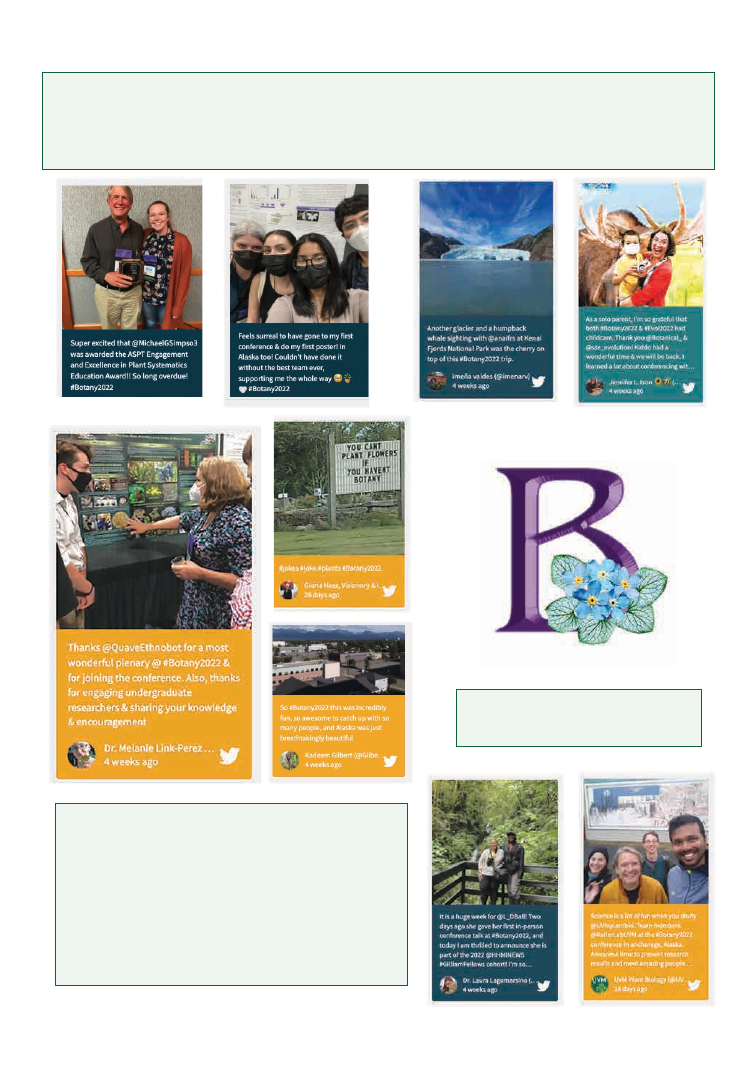
Botany 2022 was a challenging undertaking! An amazing venue - Anchorage, Alaska!
Our first in-person conference in our changing world!
Our first venture into a hybrid conference and not without complications.
All of you enjoyed the time spent with your colleagues IRL!!
BOTANY 2022
IN YOUR WORDS AND PICTURES!
It was great to be back in person. I know
that behind the scenes things were
somewhat chaotic and I want to thank
the BSA staff for their patience and
professional conduct. Also, thank you to
Melanie Link-Perez.
I love these conferences, I love the environment, how friendly it is to students, and I will continue
going as I am able. I have been critical of these hybrid models, but Botany will always be my #1
conference and I do appreciate all the effort that has gone into organizing this hybrid meeting.
I appreciate all your effort! Thank you for all you do!
Botany is always a pleasure to attend.
PSB 68 (3) 2022
181
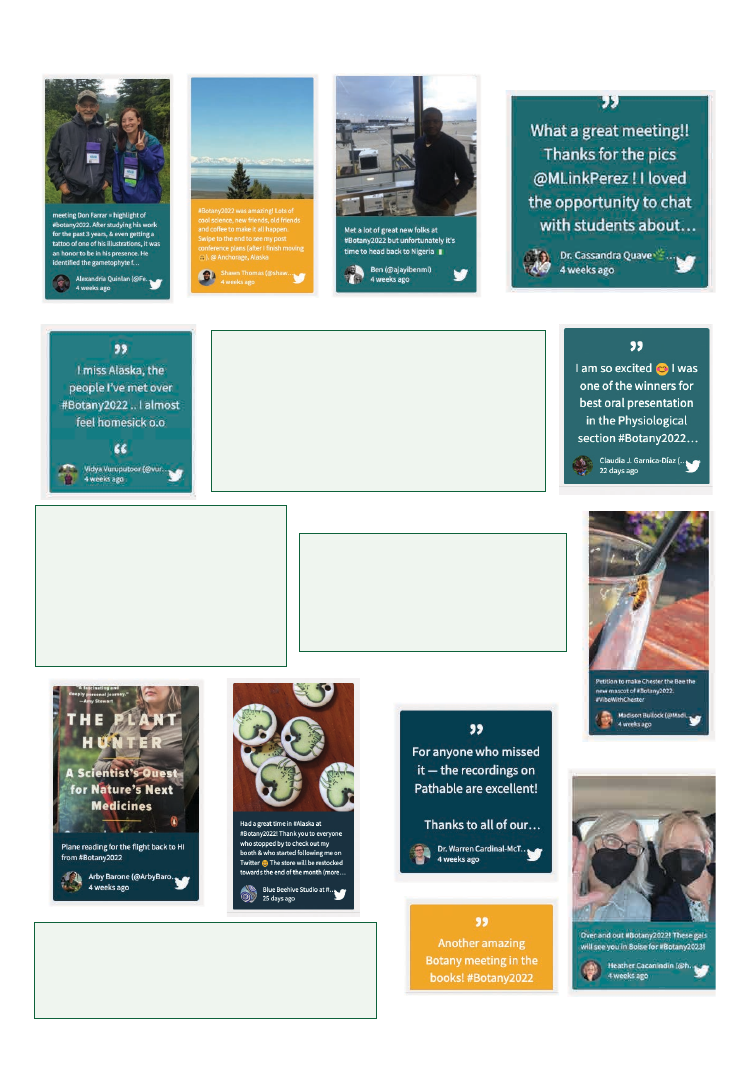
The networking opportunities were phenomenal and overall I had a great experience. As
a graduate student, the conference was an unparalleled opportunity for me. However, the
technical glitches in both live and virtual presentations, separation of talks and events across
two buildings not particularly close to one another, was disappointing.
Compliments on a great meeting! And thank
you for opening up another field trip on Sunday!
Thank you! I think everyone would have
preferred all events at one location, but the walk
was a great way to connect and get some fresh air.
The meeting was a huge success for me in terms
of networking and balancing the Alaskan site
and the friendly BSA Staff.
This is my go-to conference
and it is the best!!!!
PSB 68 (3) 2022
182
I had an amazing time meeting
new people and it made me
excited to continue in research!
I loved the opportunity to
volunteer because I got to see
how the conference was run and
make new friends.
This was my first in-person conference and I
had a wonderful time!
Thank you very much for the great
conference!
I am very appreciative of the hard work
everyone did. There were a few flaws here
and there: many cancellations (which you
presumably had no control over), but,
overall, this conference was very, very good.
I’m quite glad I attended, and look forward to
Boise next year.
Botany is one of my favorite
meetings. I think it is always well
organized, and I appreciate all of
the ongoing efforts to promote
inclusivity and belonging.

PSB 68 (3) 2022
183
Join us in Boise, Idaho, July 22-26, 2023
for Scientific Talks - Posters -
Special Lectures - Networking - Symposia and Colloquia - Receptions - Exhibits
Support Our Conference Exhibitors & Sponsors
PSB 68 (3) 2022
184
Botany 2023 will be presented by these Scientific Societies:
PSB 68 (3) 2022
185
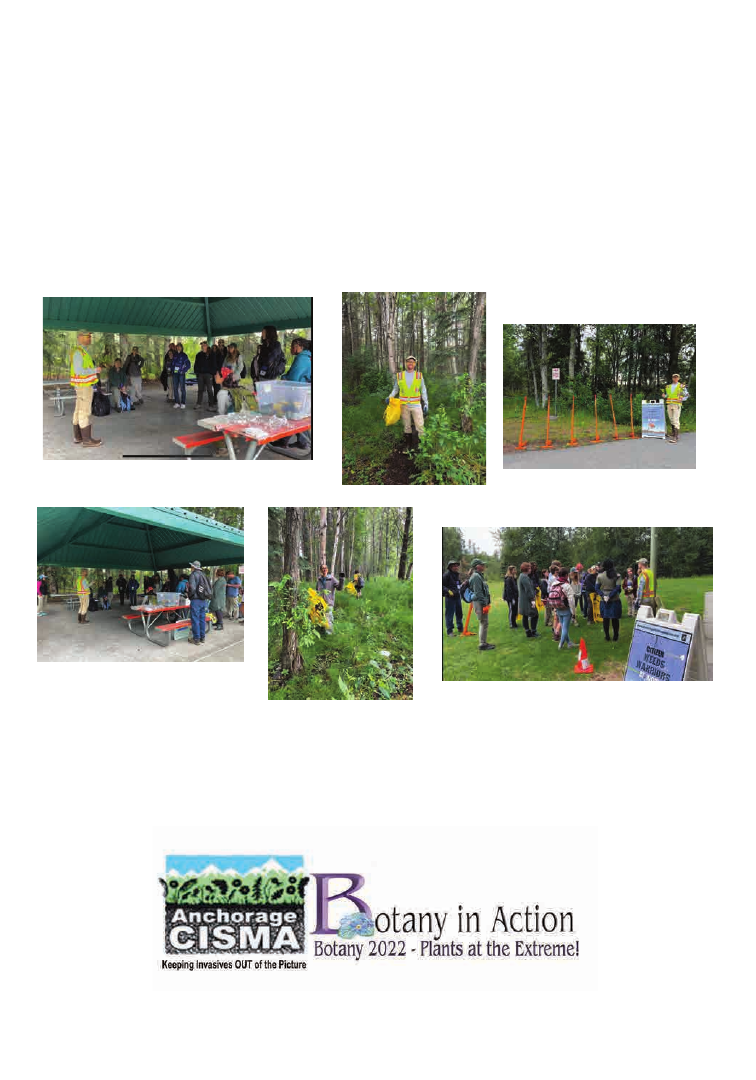
BOTANY IN ACTION!
Each year, the Botany conference sponsors a service project in the city that the conference is
held—a form of corporate responsibility and an opportunity to give back to our hosts.
This past year in Anchorage, a group of volunteers went to the Taku Lake Park on Sunday
morning and helped the U.S. Forest Service to rid the park of the invasive offender: Prunus
padus, Bird Cherry!
Consider joining us in Boise for Botany 2023's Botany in Action! You get a t-shirt, breakfast,
lunch, and a feeling of doing something good! Watch the conference website and social media
for more information!

186
SPECIAL FEATURE
ABSTRACT
John H. Reisner came to the Republic of China in 1914
with a graduate education in the field of agriculture
and helped establish the College of Agriculture at the
University of Nanking. Applying his personal knowledge
and ability, Reisner made positive contributions to the
preliminary formation and development of China’s
modern higher education in agriculture, and promoted
the distribution and extension of advanced western
agricultural science and technology in Republican
China. Our study offers a documented perspective,
adding to previous research that had overlooked these
aspects of Reisner’s early contributions.
John Henry Reisner (1888-1965):
Contributions to Agricultural Improvement Efforts in China
and the Development of the College of Agriculture and
Forestry at University of Nanking
INTRODUCTION
When Chinese intellectuals of the late 19th
century expressed concern for their country’s
perceived deficiencies, they usually believed
that it was the utilitarian power of science and
technology that had made Western countries
more powerful than China. To them, modern
science was a cure-all to promote the country’s
academics, politics, economy, and social lives.
Consequently, science in China was greatly
influenced by Western countries, through two
By Song Shi and Lee B. Kass
Song Shi, College of Foreign Studies, Nanjing Agricultural University, No. 1 Weigang,
210095, Nanjing, China.
Lee B. Kass, School of Integrated Plant Science, Cornell University, Ithaca, NY 14853,
Division of Plant and Soil Sciences, West Virginia University, Morgantown, WV 26506
Corresponding authors: shisong@njau.edu.cn; lbk7@cornell.edu

PSB 68 (3) 2022
187
channels (Geng, 2015, p. 11). First, Western-
educated Chinese scholars served their
country and the Chinese people by applying
what they had learned abroad mostly in
America; second, Westerners went to China
to teach or communicate science to their
colleagues and the public. Because agriculture
has always been of the utmost significance to
the Chinese people, and with the food supply
being most critical, agricultural science was
one of the most relevant fields or disciplines
to Chinese concerns at the time.
Among the westerners, John Henry Reisner
is a significant person to Chinese agriculture
and education. Reisner, who had obtained
his undergraduate degree from Yale College
(B.A. 1911), and went on to receive a Master’s
in Agriculture from Cornell (M.S.A. 1915),
made contributions to China’s agricultural
improvement in several respects and in a very
comprehensive way. Yet, he has not gained as
much deserved attention (Chang, 2014, p. 1),
and only a partial history (Stross, 1986, p. 118)
has been reported on Reisner, concentrating
mostly on his missionary and educational
contributions to Chinese Agriculture (Stross,
1986, p. 100). Errors or inconsistencies can
be found in current Chinese literature, which
offers some brief information about Reisner’s
membership in the group of Americans
going to China and working in agriculture in
modern times.
Who was John Henry Reisner? What were
his contributions to China’s agricultural
improvement? The objective of this article is
to reacquaint plant scientists and historians
with the life and work of Reisner. A careful
examination of his achievements and
contributions should provide additional
insights into the difficult evolution of China’s
agricultural science and education.
BIOGRAPHICAL SKETCH
John H(enry) Reisner was an agriculturist,
born August 27, 1888, in Fredericksburg,
Virginia (Shavit, 1990, p. 418). Brought up
in a small community in Pennsylvania, he
became well acquainted with farm operations
(Stross, 1986, p. 86; Reisner, 1962, p. 1).
He went to Mercersburg Academy, which
offered preparation for college study, and
graduated in 1907 to attend Yale College
(undergraduate college, founded in 1701, of
Yale University, established 1887; Dana et al.,
1911, p. 273; Yale University, 1920, pp. 150,
733; Anonymous, 1965). He received the
Bachelor of Arts from Yale in 1911 (Dana et
al., 1911, pp. 273, 411; Yale University, 1920,
pp. 150, 733) and in his later years (1950)
received the Honorary Degree of Master of
Arts (Anonymous, 1965) in recognition of
his devotion and contributions to agricultural
mission work. Such efforts included a wide
range of agricultural and rural service
activities carried out by Christian churches,
aiming at promoting these organizations’
participation in the struggle to end poverty
and foster development of rural communities
in developing nations (Holcomb, 1922, pp. 52,
362-363, 560).
Reisner worked with Agricultural Missions,
Inc. from 1931 until his retirement in 1956.
He assumed his duties as Executive Secretary
on July 1, 1931. The group was organized by
Dr. John R. Mott in November, 1930. The
membership of the Board of Directors was
divided equally between representatives of
State Colleges of Agriculture, of Foreign
Missions Boards, and nonprofessionals
interested in agriculture and rural life. Later,
Dr. Edna Noble White, Director of the
Merrill-Palmer School in Detroit, Michigan,
was added to represent Home Economics and
PSB 68 (3) 2022
188
Family Life. Upon retiring, he made several
trips to countries in the developing world,
to study and conduct research on rural life
and agriculture (Anonymous, 1965; Reisner,
Unpublished, p. 4). He was an observer
[consultant] for various church agencies with
the United Nations Food and Agricultural
Organization (FAO) on international
affairs, and he served as a member of the
Advisory Committee to the Director of Food,
Agriculture, and Natural Resources Personnel
of the Technical Cooperation Administration
in the 1950s; thus, he was connected with
the U.S. Technical Cooperation (Point IV)
Program (Reisner, Unpublished, p. 5).
Reisner recalled that after he graduated from
Yale, he was offered a teaching position at the
University of Nanking in the Department of
Biology (Reisner, 1962, p. 1). The University
of Nanking, or Ginlin University (
金陵大学),
was a private university in the city of Nanking
(
南京), China, originally founded in 1888 and
sponsored by American churches. Reisner
did not feel that he had enough training in the
field to take the job. Shortly thereafter, word
came of the organization of the College of
Agriculture and Forestry as an integral part
of the University of Nanking, and Reisner
indicated that he was much more interested
in agriculture than in teaching biology. Being
a mathematics graduate from Yale, and with
some summer work experience on farms, he
decided it would be worthwhile to get some
specialized training; thus, he came to Cornell
in 1912 to take agricultural courses in summer
school. Contrary to a report that Reisner also
obtained an undergraduate degree in Biology
from Cornell (Stross, 1986, p. 85), it was
soon after receiving his B.A. from Yale in
1911 that Reisner attended the short course
in Agriculture at Cornell in 1912 (Cornell
University, 1913). He would go on to earn
a Master of Science in Agriculture (M.S.A.)
at Cornell in 1915 (Reisner 1915a; Reisner,
1916; Holcomb, 1922, p. 362; Cline, 1982).
The first contact with scientific agriculture
during the summer of 1912 opened Reisner’s
eyes to the broad field, so that he decided to
pursue further study before working in China.
He then returned to Cornell in February,
1913 for full-time study, and registered for
an M.S. in Agriculture in the Department of
Farm Crops (Reisner, Deceased alumni file,
Reisner, Graduate School file). He majored in
farm crops under Professor Edward Gerrard
Montgomery and minored in plant breeding,
with Professor A.W. Gilbert of the Plant
Breeding Department (Cornell University,
1914b; Reisner, 1915a; Cline, 1982, p. 202;
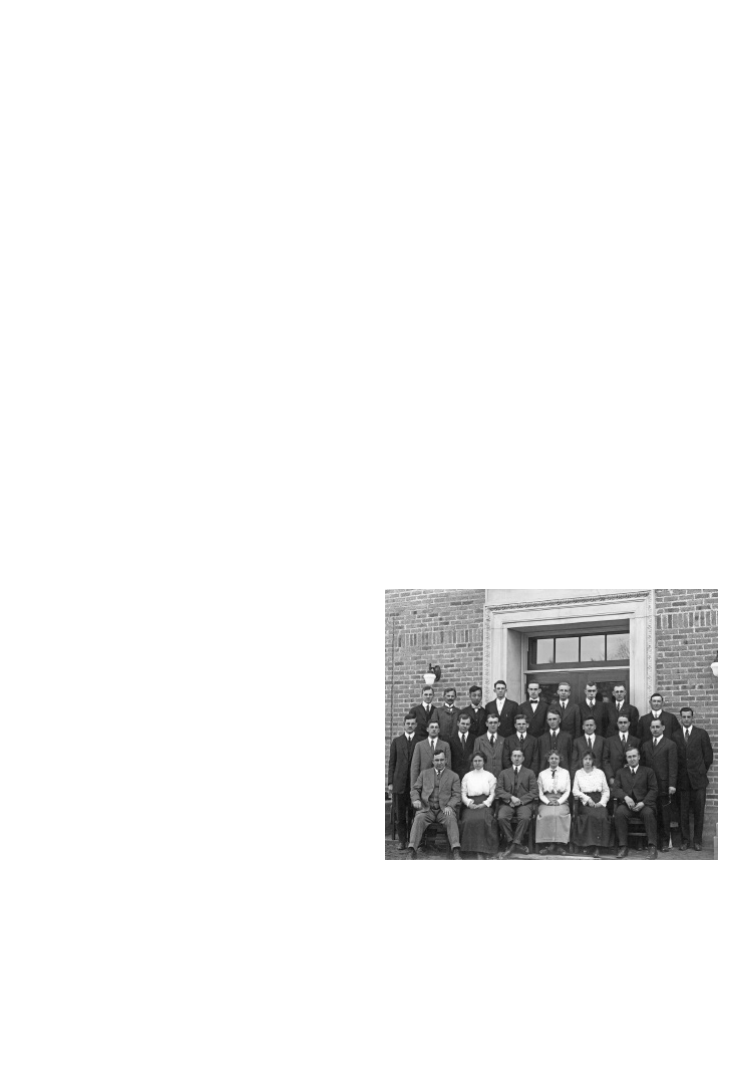
Stross, 1986, p. 86). He was a member of the
Plant Breeding Department’s Synapsis Club,
a graduate student-faculty organization that
met weekly for seminars and dinners (Figure
1, Murphy and Kass, 2011, p. 147).
Figure 1. Department of Plant Breeding,
Cornell University, Spring, 1914. Back Row,
the first from the left is John Henry Reisner,
and Dr. Gilbert, his minor professor of Plant
Breeding, is sitting in first row, far left. (Re-
printed with permission from Murphy & Kass
2011.)

PSB 68 (3) 2022
189
Reisner finished the required courses for a
master’s degree in September, 1914. He passed
the qualifying examination but departed for
China before completing his thesis. Later, in
1915 at Nanking, Reisner finished writing his
thesis on the history of wheat in New York
State (Reisner, 1915b; Stross, 1986, p. 86)
and was awarded his master’s degree from
Cornell’s Department of Farm Crops on June
16, 1915 (Reisner, 1915a, 1916). The course
work that Reisner completed at Cornell, his
appointment as Assistant in the Department
of Farm Crops (Cornell University, 1914a,
p. 181), and his thesis research problem
(Reisner, 1915b) well prepared him for his
future scientific contributions to agriculture
in China.
In September he left for San Francisco, arriving
in Nanking about a month later (Newberry,
1998; Bailie, 1964, p. 60). Reisner was on the
Faculty of the College of Agriculture and
Forestry, University of Nanking from 1914
to 1916, and Dean or Co-Dean from 1916 to
1931 (Yale University, 1920, p. 150; Holcomb,
1922, p. 560; Buck, 1973, p. 9; Shavit, 1990,
p. 418). Mrs. Reisner helped to develop a
cookbook employing Chinese food stuff. The
objective of the book of recipes was for non-
Chinese people living in China to use the food
grown locally, an initial effort to keep food
available for allied soldiers fighting the war in
Europe (WWI). It was published bilingually in
English and Chinese (American National Red
Cross, 1918; Jinling Da Xue, 1924)
1
and was
used for many years in most Asian countries
(Newberry, 1998). After returning to the
United States in 1931, Reisner was active with
Agricultural Mission work, for which he was
mostly remembered; he died in Hicksville,
Long Island, New York, on April 26, 1965
(Anonymous, 1965).
REISNER’S
CONTRIBUTIONS TO
AGRICULTURAL
RESEARCH WHILE
WORKING IN CHINA
As mentioned above, Reisner was remembered
more for his leadership in agricultural
missionary activities, to “accompany and
support people of faith and conscience around
the world in the struggle to end poverty and
injustice that affect rural communities” than
for his specific achievements in agricultural
research towards early development of
China’s agricultural science and technology in
modern history (Shavit, 1990, p. 418). He was
the second person in China to hold a master’s
degree in agriculture or forestry (Stross, 1986,
pp. 85-86). The forestry scientist, An Han (
韩
安
, 1883-1961), had been the first Chinese
student to achieve a master’s degree in forestry
from abroad. Han got his bachelor’s degree
in 1909 at Cornell University and a master’s
degree in 1911 at Michigan State University.
After graduation, Han returned to work
for the Chinese government and became a
close friend of Reisner (Reisner, 1962, p. 10;
Anonymous, 2016).
1
The 1918 edition was prepared by the Committee on War Time Economy for the Household. It encouraged
Americans overseas to use local food products to help save home food imports for the allied armies. A copy of the
1918 edition is in the Cornell archives, donated by Mrs. Reisner’s daughter Jesse. The 1924 revised edition was
published with the permission of the Nanking Chapter of the American Red Cross. It was apparently edited by
Bertha Reisner, and she is listed as first author in the Stony Brook University Library catalogue.
PSB 68 (3) 2022
190
Reisner was also the first person on the
faculty of the University of Nanking trained in
agriculture. Clearly there were few men that
had extensive training in what is called scientific
agriculture today (Reisner, 1962, p. 10; Allen,
1982). Considering the fact that the University
of Nanking was the earliest institution in
China offering degrees in agriculture and
forestry—and has long held one of the leading
positions in agricultural research, education
and extension in modern China—Reisner
later recalled, “Almost anything that one did
in China at that time was a first” (Reisner,
1962, p. 10; Stross, 1986, p. 86). Since Reisner
was the earliest agriculturist on its faculty, his
early efforts in applying or communicating
scientific agriculture was undoubtedly
pioneering and essential to the improvement
of China’s traditional agriculture based on
modern agricultural science (Reisner, 1921a;
Stross, 1986, p. 85).
Reisner recalled that his most notable
achievement was definitely in crop breeding
and improvement. Not only did he institute the
Plant Improvement Project, carried on from
1925 to 1931 by Cornell and the University
of Nanking with financial aid from the
International Education Board (funded by the
Rockefeller Foundation), which was regarded
as the first notable example of international
technical cooperation in agriculture (Love and
Reisner, 2012, p. iii), but he also initiated very
early trials in crop breeding and improvement
upon his arrival in China (Reisner, 1926).
He also recalled, “I developed the first pure
strain of wheat from a single plant which
yielded very much more than the local farmer’s
wheat and was used as the check variety in the
plant breeding work tests until about 1929 or
1930. I also developed a Chinese yellow corn
from selections that I had made, I think, in the
fall of the first year that I had been in Nanking.
That corn proved to be valuable in very many
parts of China” (Reisner, 1962, p. 6). The wheat
variety developed by Reisner was No. 26,
the first developed with “modern” breeding
technology in China, and was quite popular
among the farmers. This variety was distributed
via the extension service and planted widely.
For example, Cornell’s Professor C.H. Myers,
Figure 2. A table in the final report of the Plant Improvement Project. (Reproduced from C.H.
Myers, 1934, no copyright restrictions.)

PSB 68 (3) 2022
191
on leave at University of Nanking, reported on
their Plant Improvement Project. He showed
(Figure 2) that wheat No. 26 was used as a
standard variety in experiments during 1927
to 1931, yielding 7% better results than the
farmers’ variety in use at the time (Myers,
1934, p. 60). Such success gave Reisner much
confidence in crop breeding, and a strong
belief that it would be a very promising career
in China (Reisner, 1926; Zhao, 2015). Reisner
(1926) predicted that, “Increased agricultural
production in China will come most easily and
quickly through increasing yield by scientific
plant selection.”
The corn Reisner introduced to China was
named Nanking Yellow. It was developed
with completely new and so-called modern
breeding technology, as summarized by Love
and Reisner (2012, p. 22): “Corn improvement
was begun by Dean J.H. Reisner when he first
went to the College of Agriculture and Forestry
in 1914. He followed the ear-row method that
was being used at most experiment stations in
the United States at that time by the selection of
individual plants and continuing the selection
process. The Nanking Yellow developed by this
method proved to be a good variety, especially
in the area of the Yangtze River, and it also did
well in some areas farther away.”
Dr. Shen Tsung-han (
沈宗翰), a renowned
Chinese plant breeder and agriculturist,
reflected in 1934 on the origin and
development of China’s plant breeding
career, by saying that China’s plant breeding
originated in about 1915 and had experienced
two stages. Compared to a person’s growth,
the first stage (1915-1924) was like childhood,
while the second stage (1924-1934) was like
a teenager. The time of origination was just
about the time of Reisner’s arrival, and the
advancement of the second stage was the
Cornell-Nanking Plant Improvement Project,
initiated by Reisner. Evidently Reisner holds
a close connection with China’s early crop
breeding programs. Furthermore, Shen also
listed several representative personnel within
the process of this career, among whom
Reisner was specifically named for both
stages, respectively (Shen and Ma, 1934, p. 14).
Reisner was one of the earliest individuals
to introduce modern breeding methods to
China, and thus laid the foundation of China’s
crop breeding and improvement in Chinese
modern history. From the standpoint of crop
improvement, no extensive experiments had
been conducted previously, other than those
made by Dean Reisner and his associates.
Within about ten years of Reisner’s arrival
in China, the Cornell-Nanking Crop
Improvement Project began to achieve
remarkable success and bring about long-
lasting influence to promote the development
of China’s modern scientific agriculture.
In addition to food crop breeding, Reisner
also did research on cotton improvement,
which resulted in some very valuable results
and conclusions for Chinese agriculture
(Nanking College of Agriculture, 1920,
1924). We describe next accounts of Reisner’s
contributions to those efforts. In addition,
Reisner’s philosophy, initiated for permanent
famine prevention, will be described separately
below.
Popular accounts of cotton improvement
in modern China refer to achievements by
foreigners, and most credited American-
born J.B. Griffing. Many attributions made
no mention of Reisner’s earlier contributions
(Cotton Millowners [sic] Association, 1923;
Anonymous, 1924). According to several
scholars, the University of Nanking introduced
an American cotton variety and domesticated

PSB 68 (3) 2022
192
Chinese local cotton prior to Griffing’s arrival
in China (Stross, 1986, p. 122; Shen, 2004).
Reisner’s earliest involvement in Chinese
cotton improvement apparently stems from
his university affiliation as early as 1914,
his professional training in agriculture, and
more importantly his published articles
on cotton improvement: “Cotton Seed and
Cotton Improvement in China” (Reisner,
1920), and “Dangers and Control of Cotton
Seed Importation and Distribution in China”
(Reisner, 1921a, pp. 473-474), as found in the
Shanghai-issued English magazine “Millard’s
Review of the Far East.” Both of these early
reports offered very valuable suggestions
and recommendations on China’s cotton
improvement and were published only
months after Griffing and O.F. Cook arrived
at the University of Nanking in 1919 to assist
with the program (Stross, 1986, p. 121).
As early as 1920, Reisner reported, “In the
Egyptian cotton area of Arizona [USA]
recently developed, it is illegal and punishable
by law to plant any other kind of cotton except
Egyptian within the area. Only in this way
can improvements made in raw cotton be
maintained. This is because of the fact that
cotton cross pollinates, and where two plants
of different varieties are grown together,
cross pollination invariably takes place, and
crossing always leads to deterioration … Pure
seeds, of improved strains, produced on seed
farms with capable supervision is the goal
toward which efforts should be directed for
the improvement of the native staple.” He also
pointed out that not enough attention was
being paid to the improvement of the local
varieties, while it seemed as if undue emphasis
was being put upon the importation of foreign
seed, especially from America (Reisner, 1920).
By 1921, he also used the lesson of the United
States to remind Chinese people of the concept
of plant quarantines: “The United States has
suffered keen losses through the introduction
of plant insects and diseases from foreign
countries, and yearly expends large sums
of money in trying to control such insects
and diseases and prevent the introduction
of others” (Stross, 1986, p. 127). “The most
serious danger connected with the importation
of American cotton seed is the introduction of
the Mexican Boll Weevil … No less imminent
are the dangers of distributing the insects
and diseases which now effect [sic] Chinese
cotton. Of these probably the Pink Boll worm
is by far the most important, distributed as it
is over practically the entire cotton growing
area. Club-leaf disease, associated with the
leaf hopper, is an important disease, widely
distributed, for which there is no known
control” (Reisner, 1921a).
Reisner’s suggestion included adequate
provision for controlling all importation and
scientific means for proper fumigation of all
foreign cotton seed, and limitation to one
or two ports of entry for importation with
prohibition on importation by parcel post,
and so forth (Reisner, 1921a). Noteworthy
is that Reisner might be one of the earliest
agriculturalists to introduce the concept
and practice of plant quarantine to China.
According to Shi and Zhang (2002, p. 298),
it was only Tsou Ping-wen (
邹秉文) who
had previously mentioned the idea of disease
prevention in 1916, which was only a few
years before Reisner’s suggestion. They also
reported that after Reisner, Cai Banghua
(
蔡邦华) published an article on the need to
establish a national plant quarantine station in
1922. And later, in 1929, Zhang Jing’ou (
张景
欧) started to build plant quarantine stations
at Guangzhou and Shanghai by order of the
government.

PSB 68 (3) 2022
193
Reading the early articles authored by Reisner,
one senses that he was fully acquainted with
cotton improvement research and had deep
insights into the practical work in China.
This was clearly on the basis of his first-hand
involvement or understanding of cotton
improvement and wide range of knowledge in
several disciplines in the field of agriculture.
Reisner’s earliest commitment and pioneering
contributions to China’s cotton improvement
research may be documented by Griffing
(1920): “The work on cotton improvement by
the writer may be said to have begun when he
accompanied Dr. O.F. Cook of Washington,
D.C., U.S.A., and Prof. J.H. Reisner, of the
University of Nanking, on an expedition of
survey of cotton experiments and cotton
problems throughout East, Central and North
China. The findings of this investigation
have been of inestimable value as a basis for
the further work on cotton which we have
taken up.” Cook was invited by the University
of Nanking to offer guidance on cotton
improvement, and he came to China in 1919
(Li, 2012, p. 136). Griffing then followed
with a successful cotton research project at
University of Nanking (Stross, 1986, p. 123).
China’s economic development during this
time coincided with Reisner’s major work in
agricultural research on food crops and cotton,
reflecting the Chinese peoples’ two basic
necessities for survival, namely adequate food
supply and good quality clothing for warmth.
Residing in China for an agricultural mission,
Reisner actually chose the most effective ways
and means to apply his personal knowledge
and ability, as well as fulfill this mission.
DEVELOPING THE
COLLEGE OF
AGRICULTURE AND
FORESTRY AT
UNIVERSITY OF
NANKING: REISNER AS
DEAN, AND HIS
ACHIEVEMENTS IN HIGHER
AGRICULTURAL
EDUCATION
Originally offered the position of teaching
at the University of Nanking, Reisner taught
courses in agronomy and plant breeding
for several years (Allen, 1982). Reisner’s
achievements in promoting China’s higher
agricultural education, however, may be
considered greater than his classroom
teaching contributions. He was the chief
person responsible for the initial development
of the College of Agriculture and Forestry
at University of Nanking, the establishment
of which marked the beginning of China’s
modern higher agricultural education system,
as it was the first institute in China to offer
a four-year bachelor’s degree in the field of
agriculture (Dong et al., 2014). Historically,
the College of Agriculture and Forestry grew
out of the concern of Joseph Bailie, a teacher
of mathematics at the University of Nanking,
who was the first dean of the College, and
succeeded by Reisner (Reisner, 1962, p. 4;
Stross, 1986, p. 68; Zhang, 2002, p. 294).
Reisner (1962, p. 5) spoke highly of Bailie’s
work in establishing the College, while also
asserting, “He had been Dean of the College
of Agriculture and Forestry but was away

PSB 68 (3) 2022
194
from the College most of the time. Being the
one person on the campus with a degree in
agriculture, the President turned over to me
most of the relationships with the students.”
Reisner arrived just in time to assist with the
instruction of the first class of agriculture
students in the College. “I was the first person
on the faculty with any training in agriculture.
I was supposed to spend a year in language
school but the students soon became restless
and went to the President and asked that in
view of the fact that I was on the campus that I
should provide some technical courses, which
I did to the detriment of my study of the
Chinese language” (Stross, 1986, pp. 67, 86)
.
When Bailie resigned as Dean of the College
,
Reisner was appointed to assume his duties
in 1916. Reisner had been very involved in
administration of the College until returning
to America in 1931. During Reisner’s era, the
College of Agriculture and Forestry developed
rapidly. It not only maintained the strongest
faculty but turned out the best-trained
students in China, many of whom became
national leaders in agricultural development,
research, teaching, and administration. The
budget for the year 1916-1917 was 13,458.36
silver dollars and increased to 188,702.04
silver dollars for the year 1930-1931. The
number of students in 1916-1917 was 52 (46
undergraduates and 6 graduates) and stood at
197 in 1930-1931 (163 undergraduates and 34
graduates) (Buck, 1973, p. 11).
Some reasons for the College’s rapid progress,
during Reisner’s administration, include his
idea of applying a land grant college system,
which was “devoted equally to teaching,
research, and extension.” Such idea and
practice was already very successful as a result
of the Morrill Acts (1862, 1890) and Hatch
Act (1887) in America, but was innovative
in China. The nearly equal emphasis on
instruction, research, and extension enlisted
support for the College from both missionary
organizations and government. This approach
to higher agricultural education was later
adopted by other institutions in China,
including the Agricultural Department
of public Nanking Normal College, and
the Agricultural Department of Southeast
University (later National Central University),
among others. Subsequently, this method has
become widely influential in China’s history of
modern education (He, 2011, pp. 42-43).
Another reason for the College’s development is
that Reisner maintained close personal contact
with government, agricultural, and personnel
programs, as well as with Cornell University,
Cornellians, and agricultural missionaries
from the United States. These affiliations
offered significant support and help to the
College’s instruction, research, and extension,
afforded by Reisner’s first-hand understanding
of the many difficulties involved in China’s
agricultural and economic development.
On his first furlough, 1920-1922, he secured
$950,000 for the growth and expansion of the
College (Reisner, Unpublished, p. 2). Other
than financial support, “Many of the students
whom I came to know during my year and
a half at Cornell [1912-1914] later became
professors and heads of departments in the
College and have been my friends throughout
the years. It was during this time, also, that I
met the members of the Department of Plant
Breeding; Dr. Love, especially, with whom I
was to become closely associated in later years
in the development of the Cornell University/
International Education Board/University of
Nanking Crop Improvement Project” (Reisner,
1962, p. 2). Additionally, Reisner decided to
make some changes to the Nanking College of
Agriculture in 1920 and created a department

PSB 68 (3) 2022
195
of agricultural economics and established
a formal extension program to convey the
College’s work to more farmers in China.
Therefore, he invited fellow Cornellian John
Lossing Buck (1890-1975, Cornell B.S. 1914,
M.A. 1925, The Register, 1924-1925, pp. 145,
136; Ph.D. 1933) to join him in accomplishing
these goals. Buck further embodied the
modern approach to agriculture in China,
expressing it in the courses he taught, and
applying it in research and extension (Allen, 1982).
Due to the advanced scientific ideology and
techniques brought and introduced by those
invited, who contributed American expertise,
the College soon pioneered many aspects of
modern agriculture in China under Reisner’s
leadership. For example, its research studies in
farm management and agricultural economics,
by J.L. Buck, were noteworthy and are still
standard reference materials. Its Price Index
was used by both government and business in
China. Its crop reporting system was in time
transferred to government. It also pioneered
in extension programs and techniques,
in community development programs, in
rural education under J.B. Griffing, in the
improvement of sericulture and in plant
pathology. Moreover, its work in forestry was
for many years the only program of its kind in
China (Reisner, unpublished, p. 1).
Furthermore, another policy initiated and
maintained by Reisner, demonstrating
his ability in management, was to include
a competent Chinese colleague as a Co-
Dean, thus creating a Chinese-American
administration of the College. He voluntarily
resigned as Dean in 1925 with the intention
of bringing in a Chinese administrator, and
he was then elected Co-Dean, which position
he held until his resignation in 1931. Reisner’s
policy proved to be a wise and successful
choice considering China’s domestic position,
and given that local people opposed control
by foreigners at that time. For example, The
Nanking Incident occurred on March 21-
23, 1927, when Chinese Nationalist troops
entered the city as part of their Northern
Expedition military campaign (1926-1928).
Troops particularly targeted the city’s foreign
residents; several were killed or injured and
their property looted. Dr. John Elias Williams
(1871-1927), Vice President of University of
Nanking, was murdered. The Cornell Alumni
News reported on the 1927 lootings in Nanking
(Anonymous, 1927): Cornell Alumni, Mr.
& Mrs. Reisner, Tuan Shin Kuo (Dean of
Agriculture and Forestry), John Lossing
Buck, and John B. Griffing (graduate student
in 1925-1926) had “left the city in safety.”
And Professor Roy G. Wiggans of Cornell
was waiting in Shanghai for word of further
developments to proceed on to Nanking.
REISNER’S PHILOSOPHY
FOR PERMANENT
FAMINE PREVENTION
LEADING TO SINO-U.S.
EARLY COOPERATION IN
CROP INPROVEMENT
Rural Missions or Agricultural Missions
include all efforts to achieve a satisfactory
agriculture and a satisfying life in rural
communities, which was originally a broad
field calling for all valid means for expressing
Christian redemptive concern for people
on the land in concrete ways that they can
understand and accept (Moomaw, 1956). As
an agricultural missionary, Reisner wanted
to help people without “preaching” at them
(Reisner, 1956). Therefore, he set his mission to
study and analyze local agricultural problems,

PSB 68 (3) 2022
196
and devise and teach practical methods to
improve agriculture (Newberry, 1998).
In 1918, L.H. Bailey, former dean of Cornell’s
College of Agriculture, commented on the
missionaries’ role in China, “It is estimated
that eighty-five percent of the population of
China is agricultural. The missionary who
can aid the people in their farming will have
a double hold” (Bailey, 1918). At that time,
frequent flooding, which often caused famine
conditions, was the worst problem, so that
famine prevention was the most challenging
and a complicated task to be tackled by those
mission stations. Dean Reisner’s predecessor,
Dean Bailie, who previously was involved in
famine relief work in the Hwai River area, was
disturbed by the perennial need for relief in
China. To overcome this problem, he sought
to establish “a college where men could be
trained in both agriculture and forestry; and
thus, make their own contribution to solving
the famine problem” (Allen, 1982). Possibly
influenced by Bailie’s work and ideology,
Reisner came to two convictions early on:
(1) Chinese people must be trained to do the
job (in a modern way) and (2) the job itself
was complex, involving quite a few aspects,
including better seeds, education, flood
control, among others (Reisner, Unpublished,
p. 1). Following on Bailie’s famine relief work,
Reisner further developed his understanding
of China’s need for a famine prevention
concept (Murray, 1921, p. 55).
In his book Reforesting China, Permanent
Famine Prevention versus Famine Relief,
Reisner (1921b) defined famine prevention
as a comprehensive program involving
several factors, including improvements
in agriculture. He reemphasized in Famine
Prevention by Reforestation and Improved
Agriculture (Reisner, 1922, p. 1) that “the
problems involved in the prevention of
famines in China are extremely complicated,
interdependent and strike at the very roots
of China’s present economic and social life
and customs. Many factors are involved.” He
believed that “such statements applied more
particularly to the region north of the Yangtze
River in which floods and famine are most
frequent, but in many cases apply to conditions
in the south as well” (Reisner, 1922, p. 2).
On the basis of such a philosophy, Reisner
began to seek opportunities to make his
unique contribution to China’s situation. He
planned to apply his work in the College and
utilize his personal academic resources and
social relations (Reisner, 1921c)
.
He tried to
popularize his ideas by instituting a rather
comprehensive program to fulfill agricultural
improvement and permanent famine
prevention. The acceptance of this philosophy
is best illustrated by the earliest large-scale
Sino-U.S. cooperation: the Cornell-Nanking
Crop Improvement Project. Apparently,
the science and the education pursuit took
precedence over the religious mission of
conversion.
The Cornell-Nanking story originated from
another serious famine occurring in the
same general Hwai River area in 1920. U.S.
President Woodrow Wilson responded by
setting up a Committee of One Hundred for
China Famine Relief. The famine relief work
ended sooner than had been anticipated and
the Committee found itself with considerable
unused funds and the problem of how they
could be most wisely and widely used (Stross,
1986, p. 139). At that time, most international
famine relief work groups devoted their efforts
to public works projects beyond emergency

PSB 68 (3) 2022
197
relief—particularly emphasizing river control
projects, represented by the China International
Relief Commission (Li, 2007, p. 302).
China International Famine Relief
Commission was formed in September 1921
and became a permanent relief organization
composed of existing famine relief groups.
It functioned for almost two decades as the
key private voluntary organization of relief
operations. Its directors and constituents
were both Chinese and foreigners, and it had
branches and projects in most of the provinces
in China. It saw itself not as an emergency
relief group but as an organization dedicated
to seeking a “permanent improvement” of
conditions in China.
Just at this time, Reisner submitted a proposal
to the Committee of One Hundred for
China Famine Relief, requesting that some
of the unused funds be used for long-term
famine prevention purposes, especially in the
field of agriculture. His proposal was soon
approved. Thus, the College of Agriculture
at University of Nanking was appropriated
around $750,000 (Love and Reisner, 2012,
p. 3). Reisner’s next step was to design an
effective and comprehensive program, to best
apply his philosophy and fulfill his mission,
and to help alleviate hunger and poverty in
China. In 1924, Co-Dean Reisner proposed
to Dr. H.H. Love, of the Department of Plant
Breeding at Cornell University, a cooperative
institutional arrangement whereby he and two
of his associates would spend one year each
at the College of Agriculture and Forestry in
Nanking to help develop its plant breeding
program and give further training to its
staff (Figure 3) (Stross, 1986, p. 144, see also
Chapter 6; Love and Reisner, 2012, p. 2).
Actually, each professor made a second visit
during a six-year period. Through a series of
summer training courses, practically every
plant breeder in China received training.
Many of these students were further trained
at Cornell. The outstanding practical result
was in better seeds for the farmers. Their
account of these accomplishments, The
Cornell – Nanking Story: the First International
Technical Cooperation Program in Agriculture
by Cornell University, first published in 1963
(Love and Reisner, 1963, reprinted 1964
and 2012), reports the significance of the
program: “Higher yielding strains of wheat,
barley, rice, kaoliang [Sorghum bicolor] and
soybeans, cotton and millet—all of them
important crops in east and north China—
were developed and put into distribution to
farmers. Crop improvement methods were
standardized throughout the area and later
adopted throughout most of China. Detailed
plans for small grain breeding and testing
were prepared and made available in the
Chinese language” (Love and Reisner, 2012,
p. 55). Later, Dr. Love was invited to China
by the Ministry of Agriculture and helped to
establish its National Agricultural Research
Bureau. The contributions accruing to Cornell
were generously acknowledged (Zuidema,
2013, p. 8).
The Cornell-Nanking Story was undoubtedly
a very comprehensive cooperation, involving
education, extension, agricultural research,
and many other practices. Another value
of such cooperation was its creation of an
approach, called “educational assistance.” The
latter brought training for the U.S. Point IV
Program and the widely accepted method of
“Technical Assistance” (Buck, 1973, p. 5; Turk,
1974, p. 13).
At the time of the Cornell-Nanking program,
the term “technical assistance” had not
yet come into the prominence it attained
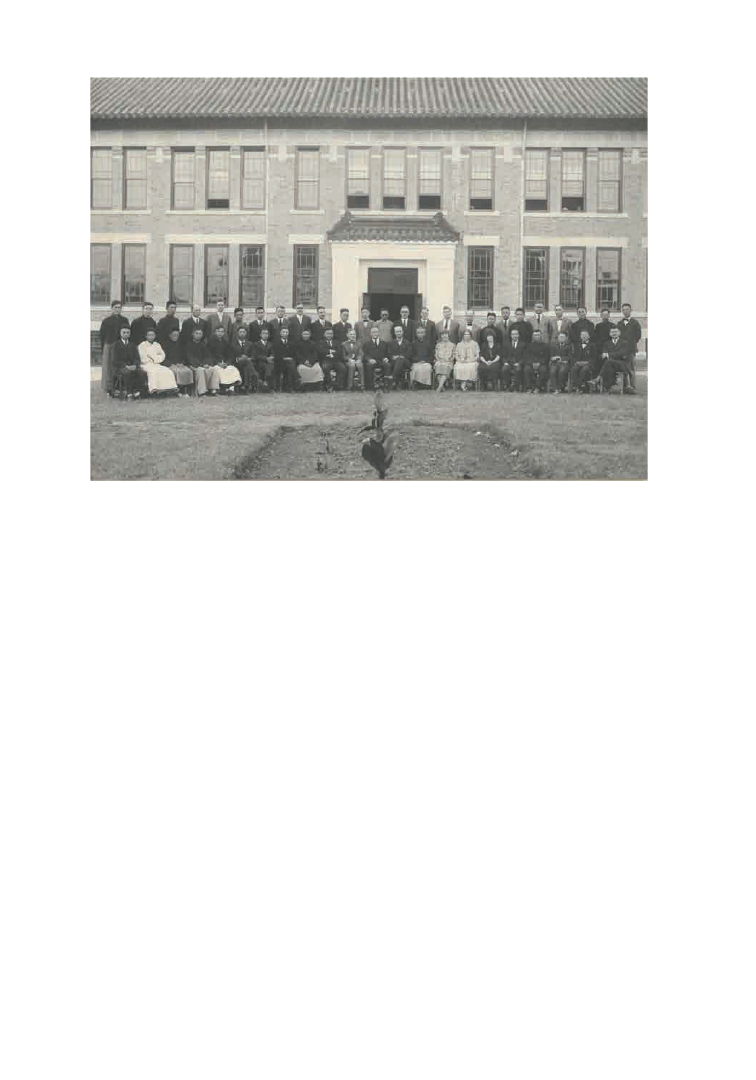
PSB 68 (3) 2022
198
later. From most viewpoints it means the
development of international understanding
and good will; the transfer of technical
knowledge to a host country; the establishment
of an ongoing program definitely related to a
pressing national need; and the creation of a
reservoir of well-trained nationals capable of
carrying on when the “technicians” departed.
Such a program could be rated as “technical
assistance” at its best, in modern terms,
without the demand of religious conversion.
With the results obtained and in terms of its
low cost, it probably set some kind of a record
(Love and Reisner, 2012, p. 56). We may
also conclude that Reisner’s philosophy and
initiation for permanent famine prevention
led to an innovative project of the later
Point IV Program, and pioneering trial of
the technical assistance programs, which is
still very significant and popular in current
international society.
CONCLUSIONS
Over the centuries, the vast land of China
has resisted changes that successive waves of
foreign reformers sought to force upon its
people. As a foreign innovator, Mr. Reisner had
early realized that the fundamental situation
in China then was not just its government,
its social institutions, or its commercial
development, but also its agriculture, because
those millions of people must be clothed, fed,
and supported, and the standard of living
must certainly rise. Like the first man to walk
on the moon, Reisner never bragged of being
first in his scientific accomplishments, and
he believed that he was only doing his job
(Kalb, 2012). Unlike those who are famously
remembered for being first, Reisner’s new,
unique, and innovative achievements seem
to have been overlooked in many historical
Figure 3. In front of the College of Agriculture, University of Nanking. Front row, the 11
th
from
the left is Reisner, and the 13
th
is Dr. Love [date ca. 1925]. (Image used with permission of Plant
Breeding and Genetics, Cornell University.)

PSB 68 (3) 2022
199
accounts. And the difficulties he overcame to
accomplish his goals have not been lauded or
imbedded in most memories. Reisner’s major
interest was in the rural people of China,
and the whole developing world, and in their
aspiration for a better life. His contributions to
agricultural improvement work in China were
creative and pioneering. His long residence
in China proved to be both successful and
influential and are still remembered there to
this day.
ACKNOWLEDGMENTS
The authors thank Prof. Max Pfefferfor inviting
Song Shi to do research as visiting scholar at
Cornell University and Prof. Ronnie Coffman
for recommending Prof. Lee B. Kass as mentor
to Song Shi; Kass appreciates the invitation to
co-author the manuscript. The authors also
thank staff at International Programs, College
of Agriculture and Life Science (IP CALS),
Cornell University, especially Prof. Coffman
and Ms. Denise M. Percey, for offering a
nice workplace and environment, and much
kind help for Shi’s research. Additionally, the
authors are grateful to Ms. Eileen Keating and
Ms. Elaine Engst, archivists and librarians at
Division of Rare & Manuscript Collections,
Kroch Library, Cornell University, for their
kind help with archival searches. Song Shi
thanks Jesse Reisner Middlemast for sharing
her father’s, J.H. Reisner, Unpublished
“Memorandum,” which had been distributed
to his eight grandchildren on June 4, 1965. We
are grateful to Allan Paul Shatkin, President,
Bright Star Educational Services (Monterey
Park, CA) and Bai Yongbo, President, Be-
There Education Abroad (Hangzhou, China),
for reviews of Chinese names. Finally, the
authors thank Prof. Mark Tauger, West
Virginia University, for his critical comments
and editorial suggestions on early drafts of the
manuscript.
REFERENCES
Allen, M. J. 1982. Taking root in foreign soil:
Techniques planted by Cornellians survive a
hectic half century in China. Cornell Alumni
News 84: 24-29.
American National Red Cross, Nanking
Chapter. 1918. American Red Cross Book of
Recipes for the use of Chinese Foodstuffs.
Shanghai, China, American Presbyterian Mis-
sion Press. [book reprinted and enlarged in
1924; see Jinling Da Xue]
Anonymous. 1924. Improved Chinese cotton:
Results of mill tests on staple produced by the
University of Nanking: Encouraging features:
A review of the present situation. The North
- China Herald and Supreme Court & Con-
sular Gazette (1870-1941), 01 March: 346.
Anonymous. 1927. Cornellians in Nan-
king. Cornell Alumni News 29:324. https://
ecommons-new.library.cornell.edu/han-
dle/1813/26839
Anonymous. 1965. John H. Reisner, 77, Led
farm missions. New York Times (1923-Cur-
rent File), 27 Apr: 37.
Anonymous. 2016. Jin Dai Nong Ye Ren Wu -
Han An. Zhong Guo Liang Shi Jing Ji 29: 69.
Bailie, V. W. 1964. Bailie’s activities in China:
An account of the life and work of Professor
Joseph Bailie in and for China, 1890-1935.
Pacific Books, Palo Alto, CA.
Bailey, L. H. 1918. The point of view in Chi-
na. The American Museum Journal 18: 263-
268.
Buck, J. L. 1973. Development of Agricultur-
al Economics at the University of Nanking:
Nanking, China, 1926-1946. Cornell Interna-
tional Agricultural Development Bulletin 25.
https://hdl.handle.net/1813/42407

PSB 68 (3) 2022
200
Chang, D. 2014. An economic analysis of ca-
lamities and conflicts in Rural China, 1929-
1933. Cornell University, Ithaca, NY; Mas-
ter’s Thesis, August 2014.
Cline, M.C. 1982. J.H. Reisner, p. 202. Agron-
omy at Cornell 1868 to 1980. Department of
Agronomy, Cornell University, Ithaca, NY.
Cornell University. 1913. Catalogue Number
1912-1913, Volume IV, No. 16(August 1).
Ithaca, NY. (Summer Session 1912, Reisner,
p. 123; Students registered for 1912-1913,
Reisner, p. 82).
Cornell University. 1914a. Proceedings of
the Board of Trustees of Cornell University,
1913-1914 (June 24), Ithaca, NY.
Cornell University. 1914b. Catalogue Number
1913-14, Volume V, No. 16(Sept 1). Ithaca,
NY. [Degrees Conferred, Feb. 4, 1914, Bach-
elors of Science (unnumbered p., follows two
pages after p. 158); Graduate Students 1913-
1914: Reisner, John Henry, B.A. (Yale) 1911,
Farm Crops, Plant Breeding (Montgomery,
Gilbert) M.S. in Agr. (p. 115)]
Cotton Millowners [sic] Association. 1923.
Improvement work in Nanking. The North -
China Herald and Supreme Court and Con-
sular Gazette (1870-1941), 06 Oct: 39.
Dana, J. D., R. A. Gibney, and H. S. Irons.
1911. History of the Class of 1911, Yale
College, Vol. I. Yale University, New Ha-
ven, CT. https://archive.org/details/historyof-
class1yale/page/n7
Dong, W. C., C. Y. Dengand, and J. M. Yuan.
2014. Jinling Da Xue Nong Xue Yuan Ruo
Gan Zhong Yao Shi Yan Jiu. Zhong Guo
Nong Shi 34: 128-137.
Geng, X. 2015. Serving China through agri-
cultural science: American-trained Chinese
scholars and “Scientific Nationalism” in de-
centralized China (1911-1945). University of
Minnesota, Minneapolis, MN. Ph.D. Disser-
tation, August 2015. https://conservancy.umn.
edu/handle/11299/175439
Griffing, J.B. 1920. Cotton improvement
in China: Introduction of American seed-
-Training Chinese expert workers--Antiquat-
ed methods--Insects and disease--Educating
the farmer. The North - China Herald and
Supreme Court & Consular Gazette, (1870-
1941), 16 Oct: 181.
He, S. Q. 2011. Mei Guo Nong Ke Jiao San
Wei Yi Ti Mu Shi De Yin Ru Ji Qi Ying Xiang
Yan Jiu. Nanjing Agricultural University,
Nanjing, China. [Dissertation]
Holcomb, J. M. Jr. (ed). 1922. History of the
Class of 1911, Yale College, Volume III-De-
cennial record. Knickerbocker Press, New
Rochelle, NY. (Reisner’s photo appears fol-
lowing p. 376). https://babel.hathitrust.org/
cgi/pt?id=njp.32101068034683&view=1up&
seq=9
Jinling Da Xue [University of Nanking].
1924. The Nanking Cook Book: An Enlarge-
ment and Revision of the American Red Cross
Book of Recipes for the Use of Chinese Food-
stuffs. Women’s Auxiliary of the University
of Nanking [Editors], Presbyterian Mission
Press, Shanghai, China.
Kalb, I. 2012. Neil Armstrong shows us
the potent branding power of being the first
to do something. Business Insider 27 Aug
2012. https://www.businessinsider.com/neil-
armstrong-and-the-brand-power-of-being-
first-2012-8

PSB 68 (3) 2022
201
Li, L. M. 2007. Fighting famine in North Chi-
na. Stanford University Press, Stanford, CA.
Li, Y. 2012. Min Guo Shi Qi Chang Jiang San
Jiao Zhou Mian Ye Yan Jiu. Nanjing Agricul-
tural University, Nanjing, China.
Love, H. H., and J. H. Reisner. 1963. The
Cornell-Nanking Story: the First International
Technical Cooperation Program in Agricul-
ture by Cornell University. The Department
of Plant Breeding, New York State College
of Agriculture, Ithaca, NY, USA: 82. https://
babel.hathitrust.org/cgi/pt?id=coo.31924073
954210&view=1up&seq=3
[Reprinted in 1964 as Cornell International
Development Bulletin 4]
Love, H. H. and J. H. Reisner. 1964(April).
The Cornell Nanking Story. Cornell Inter-
national Development Bulletin 4. New York
State College of Agriculture, Cornell Univer-
sity, Ithaca, NY. https://archive.org/details/
cornellnankingst00love
Love, H. H. and J. H. Reisner. 2012. The Cor-
nell-Nanking Story: The First International
Technical Cooperation Program in Agriculture
by Cornell University. The Internet-First Uni-
versity Press, Cornell University, Ithaca, NY.
[e-book]. https://hdl.handle.net/1813/29080
[Reprint of Love and Reisner 1963, with ad-
ditional notes by publisher]
Moomaw, I. C. 1956. I. Why Rural Missions?
In: I. C. Moomaw, J. H. Reisner, R. A. Fel-
ton, F. W. Price. New dimensions in rural
missions, A symposium. Occasional Bulletin
from the Missionary Research Library New
York, NY. http://www.internationalbulletin.
org/issues/1956-00/1956-04-001-moomaw.
pdf
Murphy, R. P. and L. B. Kass. 2011. Evolu-
tion of Plant Breeding at Cornell University: a
Centennial History, 1907-2006. Rev. ed. The
Internet-First University Press, Ithaca, NY.
http://hdl.handle.net/1813/23087
Murray, J. L. 1921. Missionary education
movement of the United States and Canada.
World Friendship, Inc., New York, NY.
Myers, C.H. 1934. Final report of the plant
improvement project, Nanking, China. Col-
lege of Agriculture and Forestry, University
of Nanking, Nanking, China.
Nanking College of Agriculture. 1920. Report
of the College of Agriculture and Forestry,
Nanking University. Millard’s Review of the
Far East (1919-1921), 07 Feb: 491.
Nanking College of Agriculture. 1924. Satis-
factory results in improvement of cotton and
grain: Some statistics. The North - China Her-
ald and Supreme Court & Consular Gazette
(1870-1941), Shanghai, 13 Dec: 446.
Newberry, S. P. 1998. The life and achieve-
ments of John H. Reisner Jr., Ph.D. Micros-
copy and Microanalysis 4: 435-440.
Reisner, John Henry. Deceased alumni file
[Grad. 1915], Cornell University Public Af-
fairs Records, Deceased Alumni Files, Coll.
#41-2-877 (in the first batch), Division of
Rare and Manuscript Collections, Cornell
University Library, Ithaca, NY.
Reisner, John Henry. Graduate School file,
Cornell University Graduate School Student
Records 1891-2014, Coll. #12-5-636, box 49,
Division of Rare and Manuscript Collections,
Cornell University Library, Ithaca, NY.

PSB 68 (3) 2022
202
Reisner, John Henry. Unpublished. Memoran-
dum, John H Reisner (1888-1965). [Distrib-
uted on June 4, 1965, by his daughter Jessie
Reisner Middlemast.]
Reisner, John Henry. 1915a. Registered for an
M.S. in Agriculture, 1914:60. The Register of
Cornell University 1914-1915. Cornell Uni-
versity, Ithaca, NY.
Reisner, J.H. 1915b. Wheat in New York
State with particular reference to a history of
its culture: the varieties grown, their origin,
description, improvement, classification, syn-
onyms and history; its milling and flour quali-
ties; present day distribution and problems,
and statistical data, with additional chapters
on implements of wheat culture, cultural
methods and management, fertilizers and ma-
nures, wheat diseases and insects, flour mills
and flour, and spring wheat. Cornell Univer-
sity, Ithaca, NY. [Thesis M.S. in Agr. Cornell
University, 1915]
Reisner, J. H. 1916. Master’s degree awarded
1915 for thesis: Wheat in New York State with
particular reference to a history of its culture.
The Register of Cornell University 1915-
1916. Cornell University, Ithaca, NY, p. 203.
Reisner, J. H. 1920. Cotton seed and cotton
improvement in China. Millard’s Review of
the Far East (1919-1921), 31 Jan: 442.
Reisner, J. H. 1921a. Dangers and control
of cotton seed importation and distribution
in China. Millard’s Review of the Far East
(1919-1921), 29 January 1921: 473-474
.
Reisner, J. H. 1921b. Reforesting China, Per-
manent Famine Prevention Versus Famine
Relief. China Society of America, New York,
NY, 15 pp. https://archive.org/details/refor-
estingchina00reis
Reisner, J. H. 1921c. Agricultural education
in China. World Agriculture II: 97-98.
Reisner, J. H. 1922. Famine Prevention by
Reforestation and Improved Agriculture.
[Shanghai, China]: [publisher not identi-
fied], 13 pp. “Reprinted from The [China]
Weekly Review of the Far East, January
14, 1922, Shanghai, China.” https://www.
worldcat.org/title/famine-prevention-by-
reforestation-and-improved-agriculture/
oclc/775824208&referer=brief_results
Reisner, J. H. 1926. Better agriculture in Chi-
na. The China Weekly Review (1923-1950).
Shanghai, 27 Feb.:353.
Reisner, J. H. 1956. II. Rural missions since
the war. In: New dimensions in Rural Mis-
sions, A symposium, by Ira C. Moomaw, John
H. Reisner, Ralph A. Felton, Frank W. Price.
Occasional Bulletin from the Missionary Re-
search Library 7, New York, NY: 6-8. http://
www.internationalbulletin.org/issues/1956-
00/1956-04-006-reisner.pdf
Reisner, J. H. 1888-[1965]. 1962. Oral history
interview with Gould P. Colman, 8 Nov. 1962.
In: Cornell-in-China oral histories, Coll. #13-
6-321, trsc. #2457. Division of Rare and
Manuscript Collections, Cornell University
Library. Ithaca, NY.
Shavit, D. 1990. The United States in Asia: A
Historical Dictionary. Greenwood Press, New
York, NY.

PSB 68 (3) 2022
203
Shen, Z. Z. 2004. Mei Guo Zuo Wu Pin Zhong
Gai Liang Ji Shu Zai Jin Dai Zhong Guo De
Yin Jin Yu Li Yong – Yi Jinling Da Xue Nong
Xue Yuan, Zhongyang Da Xue Nong Xue
Yuan Wei Zhong Xin De Yan Jiu. Zhong Guo
Nong Shi 23: 24-31.
Shen, Z. H. and B. Z. Ma. 1934. Zhong Guo
Zuo Wu Yu Zhong Shi Ye Zhi Guo Qu Xian
Zai Ji Jiang Lai, Zhong Guo Zuo Wu Gai Li-
ang Yan Jiu Hui Yi Yan Jiang Ji. Shi Ye Bu
Zhong Yang Nong Ye Shi Yan Suo, Nanjing,
China. [On Z.H./T.H. Shen, see Stross 1986,
Chap. 8 (Cornell student 1924, p. 193); on
T.H..(Z.H.) Shen, Cornell Ph.D. 1928, see
Murphy and Kass, 2011, pp. 46, 120].
Shi, Y. C. and X. Q. Zhang (Eds.). 2002. Chi-
nese Academic Canon in the 20th Century,
Agricultural Science (20 Shi Ji Zhong Guo
Xue Shu Da Dian. Nong Ye Ke Xue). Fujian
Jiao Yu Chu Ban She, Fuzhou, China.
Stross, R. E. 1986. The Stubborn Earth:
American Agriculturalists on Chinese Soil,
1898-1937. Berkeley: University of Cali-
fornia Press. http://ark.cdlib.org/ark:/13030/
ft2g5004m0/
The Register 1924-1925 (1 Sept, 1925);
Vol. 16. No. 17, Cornell University, Itha-
ca, NY. https://ecommons.cornell.edu/han-
dle/1813/22354
Turk, K. L. 1974. The Cornell-Los Baños story.
Cornell University, Ithaca, NY.
Yale University. 1920. Alumni Directory of
Yale University (Graduates and Non-grad-
uates). Yale University, New Haven, CT.
https://babel.hathitrust.org/cgi/pt?id=uc2.
ark:/13960/t5p84bc8k&view=1up&seq=7
Zhang, X. 2002. Jinling Da Xue Shi. Nanjing
Da Xue Chu Ban She, Nanjing, China.
Zhao, X. Y. 2015. Si Xiang Yu Shi Jian: Nong
Ye Chuan Jiao Shi Yu Zhong Guo Nong Ye
Xian Dai Hua – Yi Jinling Da Xue Nong Xue
Yuan Wei Zhong Xin. Zhong Guo Nong Shi
35:36-48.
Zuidema, L. W. 2013. Cornell University
meets the challenge of world agriculture.
In: Royal D. Colle, Editor, Cornell Univer-
sity – The Global Dimension. Cornell Asso-
ciation of Professors Emeriti (CAPE), Ithaca,
NY. Chapter 3. https://ecommons.cornell.
edu/bitstream/handle/1813/11117/Chapter3.
pdf?sequence=16&isAllowed=y; (Incremen-
tal e-book on-line 2008, Chapter 3 submit-
ted 2013, https://ecommons.cornell.edu/han-
dle/1813/11117)
PSB 68 (3) 2022
204
205
By
Amelia Neely
BSA Membership &
Communications
Manager
E-mail: ANeely@
botany.org
MEMBERSHIP NEWS
BSA SPOTLIGHT SERIES
The BSA Spotlight Series (https://botany.org/home/careers-jobs/careers-in-botany/bsa-
spotlight-series.html) highlights early career scientists in the BSA community and shares
both scientific goals and achievements, as well as personal interests of the botanical scientists,
so you can get to know your BSA community better.
Here are the latest Spotlights:
Molly Edwards, Science Communicator, Science IRL Productions
https://botany.org/home/careers-jobs/careers-in-botany/bsa-spotlight-series/molly-ed-
wards.html
Brandon Corder, Graduate Student, University of Wisconsin-Madison
https://botany.org/home/careers-jobs/careers-in-botany/bsa-spotlight-series/brandon-
corder.html
Greg Tooley, Graduate Student, Kansas State University
https://botany.org
/home/careers-jobs/careers-in-botany/bsa-spotlight-series/greg-tooley.htm
Would you like to nominate yourself or another early career scientist to be in the Spotlight Series?
Fill out this form: https://forms.gle/vivajCaCaqQrDL648.

PSB 68 (3) 2022
206
THANK YOU,
TERESSA ALEXANDER!
A big thank you to Teressa Alexander, the
2021-2022 BSA Student Social Media Liaison,
for her amazing work this year supporting
BSA on our social media platforms.
Teressa is now in her 5th year at the University
of the West Indies, Trinidad, where she
is pursuing a Ph.D. in Plant Science. She
continues to study the response of cacao
(Theobroma cacao) to drought stress toward
strategies to buffer the effects of climate change
on the crop in the southern Caribbean. Teressa
will continue to work diligently in science, art,
and outreach. Using science as the foundation,
she has been communicating plant science
mainly through photography and has plans to
produce short films. She is also the co-founder
of STEMNoire, a scientific conference and
wellness retreat for black women in STEM,
and she mentors Caribbean students seeking
direction in STEM careers through the
Cariscolar program and independently.
DID YOU KNOW?
Do you want to know more about what the
BSA has to offer you as a member? Each month
a new BSA resource will be highlighted in the
BSA Membership Matters newsletter in the
“Did You know” section. Below are the three
most recent resources. Visit botany.org
and browse the website to find even more
great information.
• BSA has a brand new Student Mem-
ber Hub (https://botany.org/home/
membership/bsa-student-members.
html)! The 2021-2022 BSA Student
Representatives, Imeña Valdes and Ioana
Anghel, gathered information into one
spot to help student members navigate
and get the most out of being in the BSA
community. If you have ideas to include
on this web page, email them to cur-
rent BSA Student Representatives Ioana
Anghel (studentrep1@botany.org) and Eli
Hartung (elishartung@gmail.com).
• You can access the current BSA Stra-
tegic Plan! Want to know the Society’s
strategic priorities, goals, and strategies?
To access the entire strategic plan, see
https://bit.ly/3gSDfzg. Included is our
new mission statement: To inspire and
promote an inclusive global community
committed to advancing fundamental
knowledge and innovation in the botanical
sciences for the benefit of people and the
environment.
• You can show your support of BSA
with a Zoom background! Virtual meet-
ings seem here to stay, so why not show
off your membership with BSA by using
a free BSA Zoom background? Visit:
https://botany.org/home/membership/
zoom-backgrounds.html. Click on the
photo you would like to use and you will
be led to a hi-resolution photo to right-
click and download. Have some great
ideas for a Zoom background? Email
aneely@botany.org.

PSB 68 (3) 2022
207
BOTANY360
CONTINUES TO GROW
Botany360 is a series of programming that
connects our botanical community during
the 360 days outside of Botany Conferences.
The Botany360 event calendar is a tool to
highlight those events. To access the calendar,
see recordings, register for events, or apply
to have your event included in Botany360,
go to https://botany.org/home/resources/
botany360.html.
Recent and Upcoming Events
• Intro to Reviews and Meta-analysis
(November 7, 2022) - Recording now
available.
Introduction to writing a review article,
including question formulation, quantita-
tive vs. qualitative approaches, systematic
review methods. Available at https://bit.
ly/3U4hk6o.
• Utilizing Botany Conference Content in
Your Teaching
(November 2, 2022) - Recording now
available.
Brought to you by the BSA Teaching Section
Through the pandemic, our annual
Botany conference has changed to al-
low virtual and asynchronous participa-
tion, hosting for a year our online talks
and other materials. Our students,
classrooms, and labs could benefit from
engaging with Botany conference content
throughout the year.
•
Applying to Grad School A Q&A
Session
(September 20, 2022) - Recording now
available.
Brought to you by the BSA Early Career
Professional Development Committee
This event was aimed at providing helpful
information and guidance for students
thinking about applying to graduate
school in plant sciences. Panelists have
a range of experience and come from a
variety of institution types. After brief
introductions and some initial questions
from the host, an open and moderated
Q&A was conducted.
NEW BSA AWARD!
GRADUATE STUDENT
DISSERTATION AWARD
IN COMPARATIVE PLANT
BIOLOGY
We are very excited to share that thanks to an
anonymous donor and long-time BSA member,
the Society has established an endowed fund
to support the PhD research of graduate
students in the area of comparative plant
biology, broadly speaking, from genome
to whole organism. The new award of
up to $10,000 may be used to support
equipment and supplies, travel for research
and to attend meetings, and for summer
support. International students are welcome
to apply. The online portal for applications
will open in a few months, and the deadline for
submissions is February 15. Learn more about
the new award at https://botany.org/home/
awards/awards-for-students/cpd-award.html.

PSB 68 (3) 2022
208
This award joins the other $10,000 BSA
award, the Donald R. Kaplan Dissertation
Award in Comparative Morphology.
The Kaplan comparative morphology
award, established with an endowed fund
by the Kaplan family, promotes research
in plant comparative morphology and
supports the PhD research of graduate
students in this area. For more information
about this award, go to https://botany.
org/home/awards/awards-for-students/
kaplancomparativemorhpology.html.
We want to show our appreciation for
both families for helping us fulfill the
goals in our strategic plan by supporting
students and botanical research. To discuss
the ways in which you can support the
Society through endowed gifts, please
email BSA Executive Director Heather
Cacanindin at
hcacanindin@botany.org.
BSA STUDENT CHAPTER
UPDATES AND EVENT
NOTIFICATIONS
DUE DECEMBER 31, 2022
BSA Student Chapter officers and advisors
were notified of changes to the Student Chapter
program earlier this year. The deadline to make
the updates to chapters, and to turn in two event
forms, is December 31, 2022. Any chapters
that do not have these two things finished
by that deadline will be under consideration
for termination from the program.
To learn more about the changes, see
the New Student Chapter Application at
https://botany.org/home/membership/
student-chapters.html#application.
Would you like to start your own Student
Chapter at your Institution? Visit the page
above and fill out the form to get started.
IT’S RENEWAL SEASON!
Thank you for your current BSA
membership support! BSA provides annual
memberships that run from January to
December of each year. This year there are
slight increases in dues for the Professional
and Retired membership categories—the
first dues increase since 2014, to help cover
increasing costs of doing business
While renewing, you can also renew your
sectional affiliations, donate to the
BSA endowment, award funds, and
section award funds, and purchase gift
memberships. If you are not due to renew
this year, we hope you will consider donating
to BSA and giving gift memberships during
the fourth quarter.
Year-end Giving
BSA is proud to provide over $120,000 in
awards and grants to our members every
year. Most of these are funded directly by the
generosity of our members via donations to
specific award funds. We hope that you will
consider making a donation to our many
funds including student, professional, and
sectional award funding, when you renew
your membership this year. You can also visit
botany.org and click Donate to start
giving right now.
Professional members are given the
opportunity of increasing their annual dues by
$25 in order to support the Graduate Student
Research Award fund. Together with GSRA
donations, over $29,407 in additional funds

PSB 68 (3) 2022
209
were raised for the GSRA in the last fiscal year
and 31 GSRA awards were able to be given in
2022. Thank you to all of our members who
made this possible.
Both the Endowment Fund and the
Unrestricted Fund have very important roles
in the stability and longevity of BSA. We hope
you will consider making donations to these
funds when choosing your year-end donation
plans. Donations to these funds are being used
to move BSA into the future, and to support
our global community like never before.
Want an even more lasting way to support
BSA? Consider joining the Legacy Society.
To learn more about the society see our
latest Legacy Society email at https://
mailchi.mp/botany.org/bsa-legacy-society-
2022-dr1, or visit our Legacy Society
web page at https://botany.org/home/
membership/the-bsa-legacy-society.html.
BSA Gift Memberships
The 2022 Gift Membership Drive has begun!
This year our goal will be 175 gift memberships
from now through December 31, 2022!
BSA Gift Memberships are a great way to
introduce students and developing nations’
colleagues to the BSA community. You can
purchase one-year ($10) or three-year ($30)
gift memberships by visiting: https://botany.
org and choosing “Give a Gift Membership.”
Don’t have anyone specific for whom to
purchase a gift membership? Not a problem!
You can put your own name and email in the
gift membership fields and we will make sure
they get to those students and developing
nations’ colleagues who need financial
assistance. Questions about gift memberships
or other ways to donate? Email Amelia Neely
at aneely@botany.org.
We are giving back! Any gift membership
recipient who starts their membership before
January 31, 2023 will be entered into a drawing
for a free registration for Botany 2023!

PSB 68 (3) 2022
210
FROM THE
PSB
ARCHIVES
60 years ago
“An awareness of the nature and of the urgency, which I feel very keenly, of these problems and
of the taxonomists’ possible roles in their solutions brings with it definite responsibilities. We
must educate and 'sell' to the public, to the politicians, to the statesmen on the world scene, and
even to many of our own colleagues in related sciences, a vigorous program of exploration for,
and conservation of, plant materials today unknown.
“There are other matters in which we have responsibilities, and which need our attention: For
example, the recruitment of young workers to our field, a more adequate use of youngsters and
amateurs in our research programs, the preservation of local natural areas for future educational
and training programs. All of these and others, if properly handled, could furnish us with much
greater opportunities.”
--Sharp, A.J. 1962. Responsibilities and Opportunities of the Taxonomist Today. PSB 8(3): 7-9
50 years ago
“Consider the chemistry of any of the modern herbicides or pesticides. Knowledge of the
compound’s basic molecular structure, its method of synthesis, and most modifications of its
structure is the product of decades of basic organic chemistry — not information gained in
the last few years as the compound became useful. In fact, had it not been for years of basic
research we simply would not have the arsenal of chemicals used in our everyday life. On second
thought, that might be a good argument against basic research.
“Finally it would be fun to speculate on the consequences to present-day plant breeding and
genetics if, back in the mid-1800’s, some Chairman or Dean Friar had walked up to a certain
monk and said “Gregor!, get these damn wrinkled, yellow peas out of here and get on to
something important like growing bigger potatoes!”
. . .The Editor’s comment notwithstanding, it seems to me that there is still a place for any kind of
well-done research, be it immediately relevant or not. [M. Taylor, PSB editor]
--Rickson, Fred R. 1972. To Be Basic is Basic. PSB 18(4):40-41
40 years ago
“Creationism suffered a reversal in Arkansas. Judge Overton, in a landmark decision (Science
19 Feb. 1982), overturned a state law that required creationism be given equal time in the
schools when evolution was taught. The judge’s decision is not binding in other Federal District
Courts but it is certain to be heeded widely. For example, the New York State Commissioner of
Education waited for the decision before declaring that creationism need NOT be given equal
time in New York schools. The creationist ploy of requesting equal time—'fair play'—'is based
on the assumption that there is a science of creationism and that, as such, it is the alternative to
the evolutionary explanation of life on earth. The trial convinced Judge Overton that 'creation
science' is simply a cover for a religious belief, hence something to be barred constitutionally
from the schools.”
--Banks, Harlan P. Creationism: A Call to Arms. 1982. PSB 28(5): 34-35.
211
SCIENCE EDUCATION
By Dr. Catrina Adams,
Education Director
Jennifer Hartley,
Education Programs
Supervisor
PlantingScience Welcomes the
2022-2023
Master Plant Science Team!
The 2022-2023 school year is underway,
and we are looking forward to another great
year with PlantingScience! We’re especially
excited to be working with the BSA-sponsored
members of this year’s Master Plant Science
Team! The following early-career scientists
will be representing BSA in our work with
6th-12th+ classrooms through the spring
semester in 2023!

PSB 68 (3) 2022
212
Israel Borokini
Yanni Chen
Lyanna DeLeon
Ana Flores
Nitin Gaikwad
Waqar Hussain
Devani Jolman
Jacqueline Lemmon
Guadalupe Maldonado Andrade
Allyssa Richards
Juan Diego Rojas-Gutierrez
Cierra Sullivan
Jessica Szetela
Shan Wong
PLANTINGSCIENCE’S
FALL 2022 SESSION IS
UNDERWAY!
Our Fall 2022 session began in mid-September.
This session includes seven middle schools,
seven high schools, and two undergraduate
biology classes. This session is smaller than
previous fall sessions, as we are gearing up
for our Digging Deeper {F
2
} research session
coming up in 2023. However, all together
they comprise 118 teams of students that are
working on plant science themes under the
guidance of our wonderful scientist mentors!
DIGGING DEEPER {F
2
} IS
RECRUITING TEACHERS!
Recruiting is now underway for the
PlantingScience Digging Deeper {F
2
}
initiative. This study will replicate the research
conducted in 2016 and 2017 on the impacts that
scientist mentors have on student outcomes,
including their understanding of the concepts
studied and their perceptions of scientists
and science careers. That research, which was
published in the Journal of Research in Science
Teaching, demonstrated significant positive
shifts in both areas. The current initiative will
repeat the earlier format, but also explore the
impacts of teacher professional development
conducted remotely.
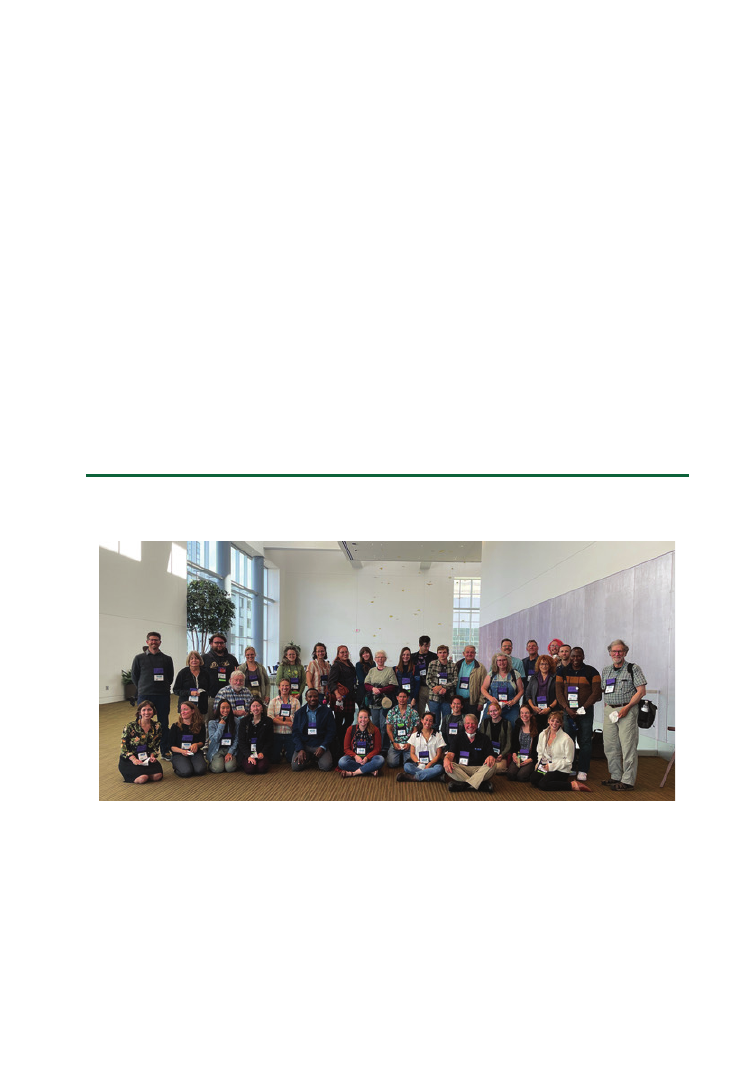
PSB 68 (3) 2022
213
Please consider sharing this opportunity with
high school teachers in your network. Selected
applicants will receive stipends, professional
development, classroom materials, and
curriculum resources. The application link
can be found on the PlantingScience.org
homepage.
LIFE DISCOVERY
CONFERENCE 2023
Plans are underway for the 8th annual Life
Discovery Conference, which will take place
March 22-25, 2023 at Florida A&M University
in Tallahassee, Florida. This education-
focused conference is organized as a joint effort
between the Ecological Society of America,
the Society for the Study of Evolution, and
the Botanical Society of America. Educators
who teach high school, community college,
and undergraduate courses in life sciences
are invited to take advantage of this unique
opportunity to network with educators at the
various levels. This year’s theme is ‘”Variants
in Biology Education: What can we learn from
pandemics” Find more info at https://www.
esa.org/ldc/.
The California Botanists Luncheon, started back in 2008, is an ongoing event at the Botany
meetings for anyone interested in California plants to get together, mingle, and hear about
important events in California botany such as projects, funding, and new positions. This year’s
short presentations included the progress of the California Consortium of Herbaria projects
(CCH1 & CCH2.org), the state’s allocation of major funding for "biorepository upgrades
and orphan collections," updates in the Jepson eFlora, and notification of the upcoming
Southern California Botanists meeting (hosted by CalBG.org). After the three-year hiatus, it
was wonderful to see in person some of our community of California botanists. We hope to
see many of you next year in Boise!
California Botanists Meet in Anchorage
PSB 68 (3) 2022
214

215
STUDENT SECTION
By Ioana Anghel and Eli Hartung
BSA Student Representatives
Botany 2022 Review
It was so great seeing so many of your faces
again in person at Botany 2022 in Anchorage!
Students made up 42% of the total conference
attendees with 534 total students. About a
quarter of the students were undergraduates,
and three quarters were graduate students.
About two thirds of total students attended
the conference in person. Returning face-
to-face highlighted how important it is to
have in-person interactions to cultivate our
botanical network. At the same time, about
a third of students attended virtually. We
hope the opportunity to tune in remotely
helped students stay connected to the
botanical community this year, even though
they couldn’t be there in person. The hybrid
meeting format was challenging, and we
are working with the BSA Board to make it
a more integrated piece of the conference in
future years.
The Student Reps worked to encourage
more interactions between students and the
botanical community at a variety of events.
Our first event of the week was the Planting
the Seeds of Science Communication Workshop
on Sunday, where 10 superstars in their
respective areas of sci-comm shared tips for
engaging audiences about plants. The next
day, we held the widely popular Careers in
Botany Luncheon where students were able
to connect with 20 panelists. We then helped
host a very well-attended Student Social at the
Top of the World Deck of the Hilton where
we chatted late into the night. We also held
three in-person CV Review Sessions and a few
more online for those attending remotely. We
also had a Student Chapter Meet-up where
we discussed ideas to connect members with
other chapters across the country.
For those of you who have not filled out the
Conference Survey, please visit https://www.
surveymonkey.com/r/KLG7CQ5 to help us
make the conference a better experience for
you in the future.
Reach us by email or Twitter:
Ioana: studentrep1@botany.org; @ioana_anghel
Eli: elishartung@gmail.com; @hartung_eli
CAREERS IN BOTANY
LUNCHEON
At the Careers in Botany Luncheon,
we had 20 panelists with careers in
academia, government, non-governmental
organizations, consulting companies,
herbaria, botanical gardens and museums.
They represented the spectrum of career
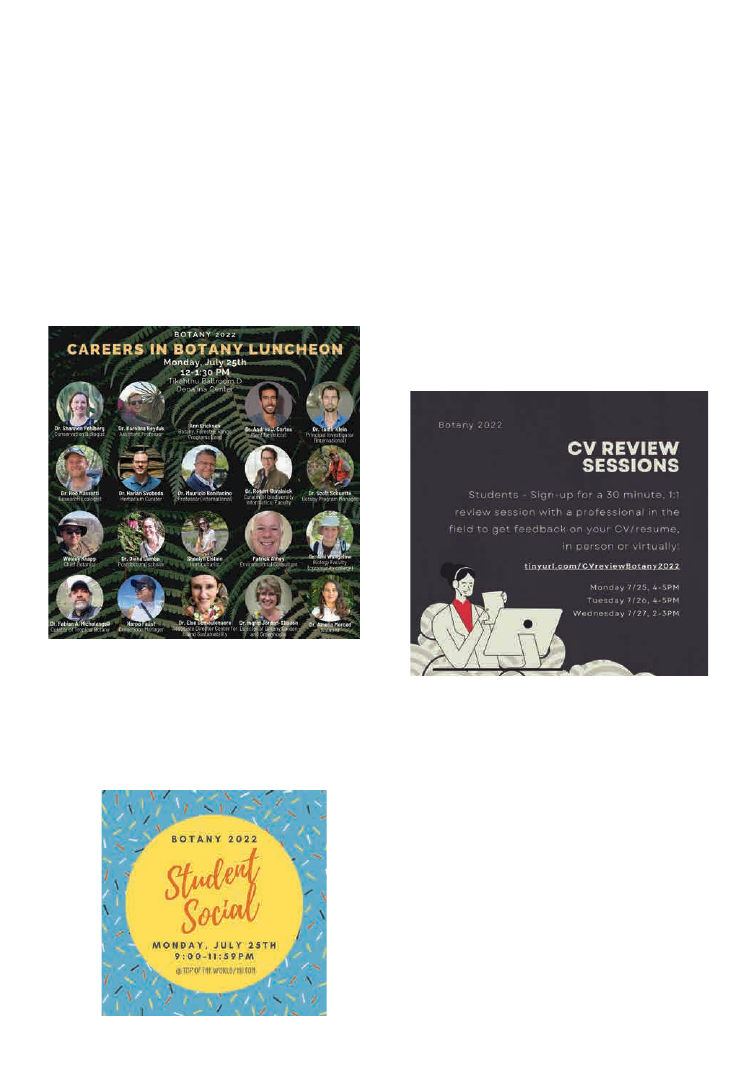
PSB 68 (3) 2022
216
stages, and they worked in five countries,
eleven U.S. states, and two territories. A total of
83 students attended, with approximately half
graduate students and half undergraduates.
Below was the flier we used to advertise the
event, and here is where you can read more
about the panelists at the Careers in Botany
Profiles:
https://botany.org/home/careers-
jobs/careers-in-botany/careers-in-botany-
profiles-2022.html.
STUDENT SOCIAL
Thank you to the 175 of you who attended the
Student Social! We had a great time getting to
know each other in the never-ending daylight
of Anchorage.
CV REVIEW SESSIONS
We had three in-person opportunities for
students to work with botany professionals to
improve their resume. We also paired remote
attending students and professionals to do the
same. We had a total of 18 students and nine
professionals working together on resumes.
Thank you so much to Jacob Landis, Jenny
Xiang, Matthew Rubin, Elizabeth Hunter,
Suneeti Jog, Angela McDonnell, Sara Handy,
Brittany Sutherland, and Naomi Fraga for
helping students with this important career
skill!
PLANTING THE SEEDS
OF SCIENCE
COMMUNICATION
WORKSHOP
Our first sci-comm workshop was a great
success with 10 panelists and 20 attendees.
The workshop panelists were a diverse
group of plant science communicators who
reach people through various platforms
including community outreach, museums
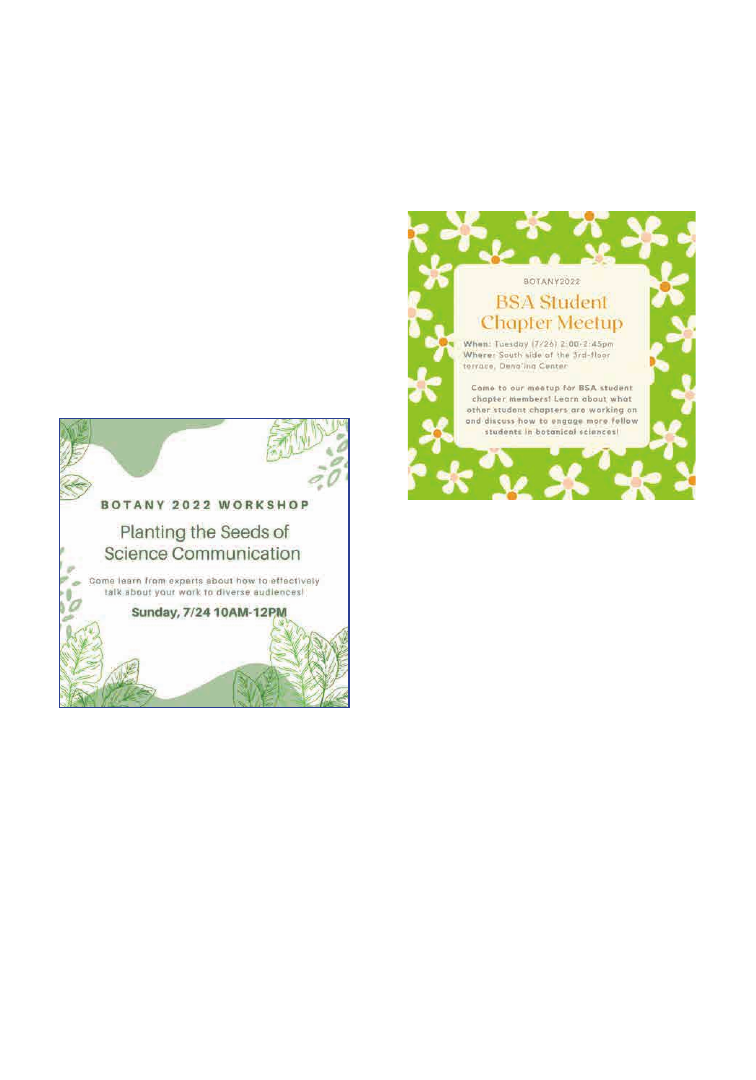
PSB 68 (3) 2022
217
and botanical gardens, social media, video,
and writing. First, the panelists spent a few
minutes introducing themselves and their
work. Then, we had small group discussions
on a variety of topics including what it’s like
to get started in video sci-comm, strategies to
tell compelling stories in social media posts,
and how to engage in social media arguments
about science more productively. We learned
so much from the panelists, both through
their engaging presentation content and style,
and in the super interesting small discussions.
Read the section “Heard at the Planting the
Seeds of Science Communication Workshop”
to learn some tips from our panelists.
STUDENT CHAPTER
MEET-UP
We held our first-ever Student Chapter Meet-
up at the conference this year. The event was
initiated and organized by Anisa Khalid, a
motivated undergraduate who is the President
of her local BSA Student Chapter at University
of Central Florida. We would love to host this
at the conference each year. To maintain this
momentum, the Student Reps are organizing
a Student Chapter Meet-up as part of the
Botany360 program (https://botany.org/
home/resources/botany360.html). We are
planning to hold it very soon. Stay tuned on
the @Botanical_ Twitter and BSA Student
Newsletter to hear more details.
NETWORKING BOARD
For our conference Networking Board, we
heard from 11 labs recruiting for more than 18
positions including master's and PhD student,
research assistant, post-doc, and technician
openings in 10 states across the country.
About half of those recruiting did not attend
Botany, so be sure to reach out to them using
the contact information listed on the board!
We also heard from 32 early career researchers
looking for graduate school positions; post-
docs; and jobs in industry, government, lab,
or field positions. For those of you recruiting,
please check out this list!
https://tinyurl.com/264nuk7t

PSB 68 (3) 2022
218
BEYOND THE
CONFERENCE
Last year, we launched a new committee to
support students and early career profession-
als through the BSA Early Career Profes-
sional Development Committee. This group
is working hard to help students and junior
botanists meet other professionals, find men-
tors, and take advantage of various opportu-
nities. Their GRFP workshop and mentorship
opportunity is aimed at helping students ap-
plying for the NSF award this year, and it has
already kicked off earlier in September.
They also put together an “Applying to
Graduate School” workshop in September,
which can be viewed at https://tinyurl.
com/2p8x5wej.
Learn more about the committee at: https://
botany.org/home/governance/early-
career-committee.html.
ADVICE FROM THE
CAREERS IN BOTANY
LUNCHEON
We had another great time at this year’s
Careers in Botany Luncheon. First, thanks
again to the professionals and students who
came and helped make this such a great event!
We got great feedback from professionals and
students alike from this event and wanted
to share what we’ve gained. We asked the
professionals, “What was an important piece
of advice that you gave at the Careers in
Botany Luncheon that you think students
should remember?” We asked the students,
“What was the most important advice you
learned at the Careers in Botany Luncheon at
Botany 2022?”
Professionals
“Plants matter! Botany
is so fundamental to
life, that you would be
surprised how diverse a job
market is out there: from
Agro-Tech to botanical
surveying, from academy
to NGOs; just follow your passion!”
-Tamir Klein, Weizmann Institute of Science
“It is never too soon to start planning for
retirement. Even if you don’t yet have a “real
job,” start a Roth IRA and try to max it out
every year. You may feel like you have no
money, but being able to squirrel away in your
20s, will make you so far ahead of the game in
your 40s. It goes by quicker than you think!”
-Ann Erickson, Bureau of Land Management
“Work around your
priorities. Life is full of
compromises, but when
your priorities are clear you
can better assess what
sacrifices or risks are worth
taking. This requires self-
reflection and being honest with yourself.
Adopt a growth mindset. Knowing how to
learn is one of the most valuable lessons for a
person. Things you don’t know become things
you don’t know yet. Be brave, work hard, and
show up. Know your plant(s)! Whether it is a
molecular mechanism or an ecological process
you’re investigating, learn about the biology of
the organism you’re studying. Be interested in
other levels of organization: molecular-
organismal-ecological-evolutionary. Does it
make biological sense? Also, learn about the
plants that surround you and get interested in
your local flora. At some point this will be very

PSB 68 (3) 2022
219
useful. Not all advice is good advice for everyone,
so take what resonates with you. What works for
me doesn’t necessarily work for others.”
-Amelia Merced
“Network, network, network.
You never know who might
change your life or introduce
you to a partner that will be
critical for future success.
Meet as many people in
your field as possible. A close
second is to always say 'yes' to an opportunity.”
-Wesley Knapp, NatureServe
“Clearly communicating
your expectations and
limitations is key to avoiding
m i s u n d e r s t a n d i n g s
with your colleagues
and maintaining a good
network of collaborations.”
-Andrés J. Cortés, Colombian Agricultural
Research Corporation
Students
“You can tailor a job to fit your interests.”
“We all can learn from people at different
career stages (younger or older).”
HEARD AT THE
PLANTING THE SEEDS
OF SCIENCE
COMMUNICATION
WORKSHOP
We had a great turnout for the Planting the
Seeds of Science Communication workshop.
We asked those who attended what sci-comm
advice they gained (or gave) at the workshop
would be valuable and impactful to the
broader botanical and scientific community:
“Be your authentic and
true self. All your plant
(science, cat, etc.) love
will shine through!
It is ok to take
social media breaks.
Be mindful of what you are saying.”
-Tanisha Williams, Bucknell University
“The world will be a better
place with more science
communicators. The
barrier to entry is low, and
there are never too many.”
-Jacob Suissa, Cornell
University

PSB 68 (3) 2022
220
PAPERS TO READ FOR FUTURE LEADERS
As we continue in our careers, we hope to see the academic culture shift to be healthier and
more inclusive. Below are a few papers the BSA community recommends reading if you hope to
lead. We hope to continue to recommend “
Papers to Read for Future Leaders” to BSA Student
members. If you have papers you would like us to include, please share it with us via this Google
form: https://tinyurl.com/y5dp8r4m.
• Allen, K., J. Reardon, Y. Lu, D. V. Smith, E. Rainsford, and L. Walsh. 2022. Towards im-
proving peer review: Crowd-sourced insights from Twitter. Journal of University Teach-
ing & Learning Practice 19(3). https://ro.uow.edu.au/jutlp/vol19/iss3/02
• Gin, L. E., N. J. Wiesenthal, I. Ferreira, and K. M. Cooper. 2021. PhDepression: Examin-
ing how graduate research and teaching affect depression in life sciences PhD students.
CBE—Life Sciences Education 20(3).
• Herz, N., O. Dan, N. Censor, and Y. Bar-Haim. 2020. Opinion: Authors overestimate
their contribution to scientific work, demonstrating a strong bias. Proceedings of the
National Academy of Sciences 117: 6282–6285.
• Ramírez-Castañeda, V., E. P. Westeen, J. Frederick, S. Amini, D. R. Wait, A. S. Achmadi,
N. Andayana, et al. 2022. A set of principles and practical suggestions for equitable
fieldwork in biology. Proceedings of the National Academy of Sciences, 119(34). https://
doi.org/10.1073/pnas.2122667119
• Tilghman, S., B. Alberts, D. Colón-Ramos, K. Dzirasa, J. Kimble, and H. Varmus. 2021.
Concrete steps to diversify the scientific workforce. Science 372: 133–135.
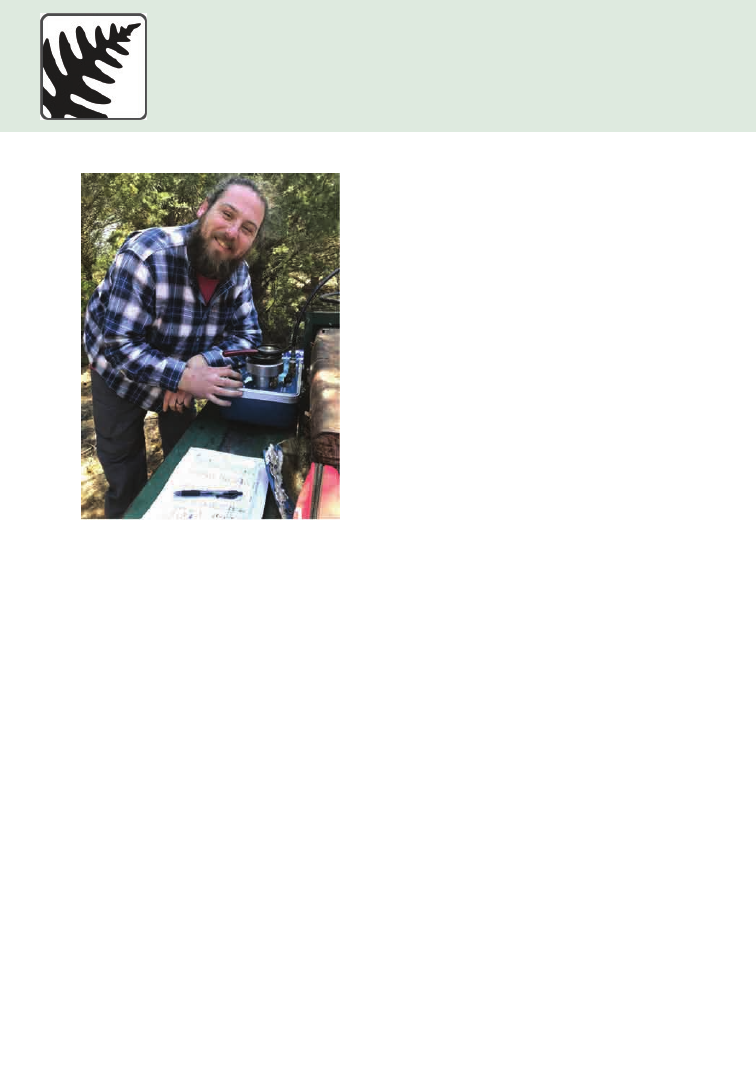
221
ANNOUNCEMENTS
IN MEMORIAM
JONATHAN GIDDENS
(1986-2021)
Dr. Jonathan Giddens passed away
unexpectedly on November 12, 2021, at age
35. Jon was a lifelong Oklahoman, growing
up in Jenks, OK before completing his
undergraduate and graduate degrees at the
University of Oklahoma (OU).
At OU, Jon pursued his interests in plants and
environment, first earning an undergraduate
degree in Interdisciplinary Perspectives of the
Environment in 2008. Then, in 2014 he earned
his Master’s in Plant Biology, working with Dr.
Wayne Elisens on morphological variation
in the Iva Annua Complex (Asteraceae:
Heliantheae). It was during this time that I
first got to know Jon, initially as a committee
member, and then as his major advisor for
his PhD work. Over the course of his PhD,
he developed a series of research projects
focused on water use and drought tolerance
in eastern redcedar (Juniperus virginiana).
He was especially drawn to studying plant
hydraulics and how hydraulic traits might
help explain why this species is so successful
in encroaching into Oklahoma grasslands. Jon
defended his Plant Biology PhD in May 2021,
and we were still working on transitioning
his dissertation chapters into manuscripts for
journal submission.
Although Jon was early in his career, he had
already impacted so many people with his love
for plant biology. He was a teaching assistant
for multiple plant courses at OU, including
Introduction to Plant Biology, where his
enthusiasm motivated many students to give
plants a second look. He even converted some
of them to Plant Biology majors! He received
multiple university level teaching awards
based on evaluations from the students he
taught.
Finally, Jon was well known within BSA. He
was very actively involved, serving in multiple
roles in the student section, including as
Student Representative to the Executive
Committee from 2013 to 2015. He was always
a friendly and enthusiastic presence.
I deeply regret that we will never be able to
know what Jon would have done next in his life
and career. But it is clear that he had already
impacted so many and will remain with them.
-Heather McCarthy, Associate Professor of
Plant Biology, University of Oklahoma
PSB 68 (3) 2022
222
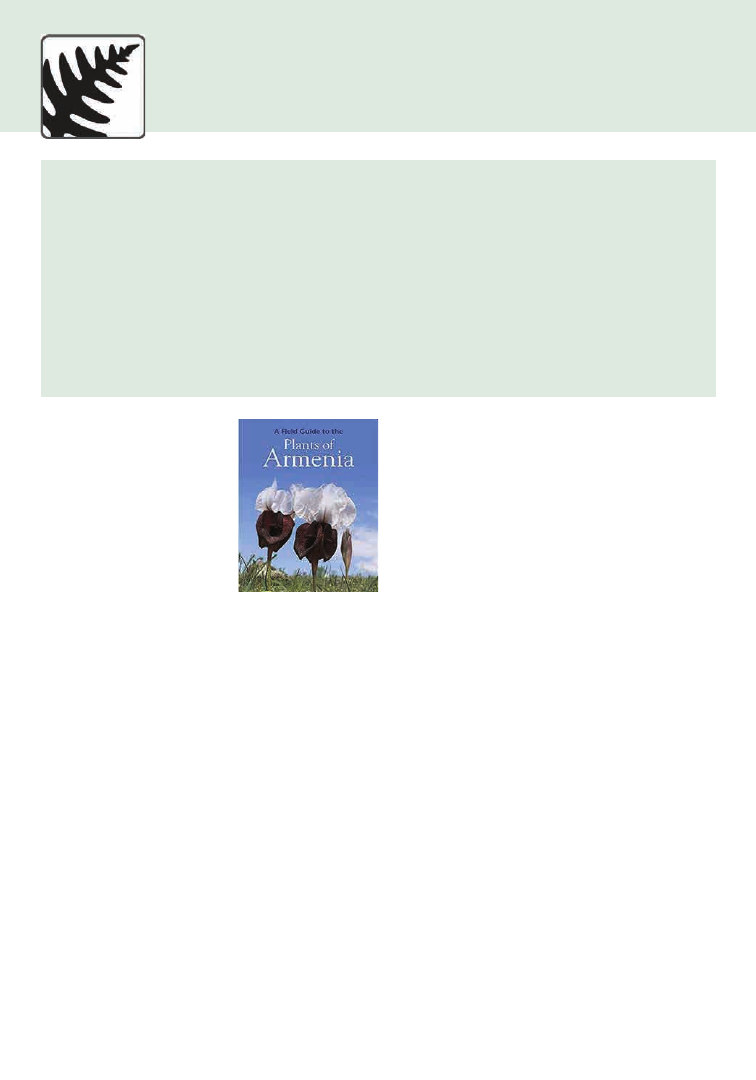
223
• A Field Guide to the Plants of Armenia
• The Hidden Beauty of Seeds & Fruits: The Botanical photography of Levon Biss
• Kaplan’s Principles of Plant Morphology
• Orchid Species from Himalaya and South East Asia Vol 2 (G-P), Vol 3 (R-Z).
• The Western Woodlands of Ethiopia: A Study of the Woody Vegetation and Flora
Between the Ethiopian Highlands and the Lowlands of the Nile Valley in the
Sudan and South Sudan
BOOK REVIEWS
A Field Guide to the
Plants of Armenia
Tamar Galstyan
2021;
ISBN: 978-1-9997345-8-9
£25 (Paperback); 592 pp.
Filbert Press, UK
The Republic of Armenia
is a landlocked country in the southern
Caucasus, situated northeast in the Armenian
Highland, with a mixture of lava plateaus,
volcanic cones, fault-fold ranges, and Lake
Sevan in a tectonic depression. Armenia has
a highland continental, dry climate, with cold
winters and warm summers. Temperatures
depend upon elevation. Average midwinter
temperature is 0ºC; midsummer temperature
exceeds 25ºC. Average precipitation ranges
from 250 mm per year in the lower Araxes
River Valley, to 800 mm at the highest altitudes,
with heaviest rainfall in the mountains. Its
specialized habitats support a multiplicity of
species in breathtaking landscapes.
Plants of Armenia is the first English-language
guide to Armenia’s diverse flora, including
more than 1000 species. Arrangement is
alphabetical by family; monocots separated
from dicots with colored margin tabs. The
guide holds 1900 color photographs, each
identified by its Latin binomial, name in
Armenian, short diagnostic description,
flowering time, and elevation range. Nearly
1800 range maps show geographic distribution;
where applicable, they indicate critical or
endangered/vulnerable status (red dot) and
endemism (green). The plates are clear, and
the guide is well bound for frequent use, with
rounded corners for safety; the coated cover
provides protection from moisture and soil,
and its compact 21 × 14.5 cm size fits in a
backpack.
The introductory pages briefly describe
Armenia’s biogeography, climate,
geomorphology, and native vegetation. A
glossary of botanical terms and species index
close the book. “Field guides are a way for
people to connect with the environment by
putting a specific face on the term biodiversity
(Stevenson et al., 2001: 15-16). The economics
of traditional publishing dictate that paper
field guides must have commercial viability,

PSB 68 (3) 2022
224
so they tend to focus on popular geographic
areas.” In this instance, the book relies
on residents, tourists, and the Armenian
diaspora, satisfying pride and longing for our
ancestral homeland.
Personally, I am smitten with the extraordinary
Oncocyclus section Iris; the guide’s cover
shows Iris iberica subsp. elegantissima (Sosn.)
Fed. & Takht., with “flowers up to 10cm in
diameter, the stems usually 20-30cm height.
The falls reflex very sharply so that the blade
lies almost vertically” (Mathew, 1989: 52). I
had an opportunity to observe these beauties
in abundance on the rocky high plateaus
surrounding Erzurum, Kars, and Lake Van,
in early May 1997. “By May or June, the
rhizomes are getting a consistent baking every
day, continuing for several months” (Mathew,
1972: 130); these alpine growth conditions are
difficult to replicate in temperate areas.
Markarian (2004: 43) recounts details about
Dr. Giovanni Franceso Gemelli Careri’s visit
to Armenia on May 26, 1694. Mr. Careri
described a unique flower in the Talin area in
Armenia: “In those villages I saw a vague and a
strange flower, that every Italian prince would
definitely pay much to have in his garden.
The stalk is no more than a half palm high,
on top of which are three white flowers that
are straight, and three others, that fall into the
form of a triangle of purple color with a tiny
black rose in the middle, and other three of
lighter color entangled in the same flower.”
By coincidence, Srpazan [Archbishop Ashjian]
had read this account on May 25, last year.
Immediately he decided to go to the village of
Talin to find the flower, taking photographers
with him. “We visited the Armeno-Turkish
frontier, prayed in the Haygavank Church,
admired the monastery of Horomos, and
finally reached Talin. We started our search
with some shepherds. No hope. We inquired
whether there was a knowledgeable woman
in those parts who might have some special
love towards flowers. We found one. She was
the wife of the principal of the school, Mrs.
Rima Hakobian, who told us of a lady in town
who a couple weeks ago brought some flowers
from the fields ‘like the one you described.’
We rushed to see Mrs. Siranoush Gevorgian
and her collection of wildflowers. We were
late; they had wilted. But we kept insisting,
so the lady told us to go to St. Christopher’s
Cemetery, suggesting that we might find it
there. We rushed and, lo and behold, several
flowers of the type described were there
smiling at us, like little urchins, teasing us, and
how happy we were to finally get to them. We
kissed the flowers, made a bouquet of them,
then prayed for the man from whose tomb
we had picked them. The name of that man?
Ardoush, son of Sedrak Grigorian, 1924-1976.
‘Sorry Ardoush, instead of bringing flowers to
your grave, we just stole what nature had given
to you. Forgive us.’ Later Archbishop Ashjian
learned the scientific name for this flower, Iris
elegantissima.”
Galstyan’s travels to see plants in their natural
habitats led to a Facebook page, “Plants of
Armenia," a career as a guide for botanical
tours in Armenia, and the creation of a travel
company, SkyGreen. We owe gratitude to
the author and those photographers and
enthusiasts she consulted for contributing to
this splendid volume. We also acknowledge
the “largely unsung toils of taxonomists and
field biologists who provided the very basic
knowledge that is required for field guides to
exist” (Holt, 2016: S94).
Although Plants of Armenia was written for a
general audience, it ranks as an authoritative
reference for species identification, often
providing two views to show variable

PSB 68 (3) 2022
225
morphology, which should also interest
professional botanists. Highly recommended
for its illustrations, range maps, and layout,
it could also prove informative for use in
surrounding regions.
REFERENCES
Holt, R. D. 2016. Geographical variation in the avail-
ability of natural history field guides? Personal reflec-
tions, causes, and consequences. The American Natu-
ralist 188: S90-S95.
Markarian, H. 2004. Etchmiadzin Chronicles. Out-
reach 26: 37-43.
Mathew, B. 1972. Plant Portraits. Iris elegantissima.
Bulletin of the Alpine Garden Society 40: 130-131.
Mathew, B. 1989. The Iris. B.T. Batsford Ltd., London.
Stevenson, R. D., W. A. Haber, and R. A. Morris. 2001.
Standing on the shoulders of taxonomists: Electronic
field guides and user communities in the ecoinformat-
ics revolution. Website: http://citeseerx.ist.psu.edu/
viewdoc/download?doi=10.1.1.195.2801&rep=rep1&
type=pdf
–Dorothea Bedigian, Research Associate, Mis-
souri Botanical Garden, St. Louis, Missouri, USA
The Hidden Beauty of
Seeds & Fruits: The
Botanical Photogra-
phy of Levon Biss
Levon Biss
2021.
ISBN: 9781419752155
Hardcover, $40.00; 144 pp.
Abrams Books, NY
An herbarium’s carpological collection
contains plant parts that are too chunky to be
pressed on an herbarium sheet: seeds, bark,
gum, fruits (e.g., cones), and leaves. Many of
these cross reference with herbarium sheets
and help to enrich the preserved collection.
Taxonomists have made use of carpological
collections to correct identifications, e.g.,
Farjon (1995) lectotypified a Mexican pine
with an ovuliferous cone found among
carpological material in the herbarium at
Vienna (W).
Levon Biss is an award-winning British
photographer, widely praised for producing
peerless images with a macro lens of his
generation. Biss polished his skills when
compiling photographs for Microsculpture
(2017), a unique photographic study of insects
in exceptional magnification. Applying his
skills as a professional photographer, his
artist’s eye, his background in graphic design,
and eagerness to tackle technical challenges,
Biss devised a customized technique for
macrophotography, using instruments he
designed, shooting numerous “stacked”
photos to maintain sharp focus throughout,
and subsequently compiling the segments into
magnificent prints. The resulting photographs
possess considerable depth, revealing every
minute detail. Biss explains that in mounting
a camera onto a microscope, one obtains only
a very shallow depth of field. Consequently,
he creates a composite view by combining
many photographs, then flattens them down
to produce one single high-resolution file.
Hence each final photograph might be the
combination of 8000 to 10,000 individual
photographs.
Microsculpture led to international exhibitions
that ensued from it that displayed large format
photographs across Europe, the Middle East,
South America, and the USA, with solo shows
in 22 countries. Later his acclaim opened
exceptional access to treasured historical
museum collections, entrée normally granted
only to research scholars whose credentials
warrant admission to these vaults holding
scientific specimens, and viewed by the lay
public as mere cabinets of curiosities.

PSB 68 (3) 2022
226
Biss was welcomed to work with the
carpological collection at the renowned Royal
Botanic Garden Edinburgh herbarium. Over
a period of 6 months, he inspected many
thousands of specimens. Ultimately, Biss
selected 100 fruits and seeds to photograph
for the project. The final images display seeds
and fruits from around the world in exquisite
detail, enabling the viewer to appreciate
their intricate textures and their anatomy,
which offers potentials for environmental
adaptations. For the viewer, Biss’ stylish
photographs generate admiration for the
beauty of the hidden natural world. If one
accepts the premise that there is nothing more
transformative than the healing forces of the
visual and musical arts, in this meeting where
art meets science in the botanical photography
of Biss can be found emotional as well as
educational support and ample examples to
inspire appreciation of nature’s biodiversity,
so urgently in need of protection.
REFERENCES
Biss L. 2017. Microsculpture: Portraits of Insects.
Abrams Books, NY.
Farjon A. 1995. Typification of Pinus apulcensis Lindley
(Pinaceae), a misinterpreted name for a Latin Ameri-
can pine. Novon 5: 252-256.
–Dorothea Bedigian, Research Associate, Mis-
souri Botanical Garden, St. Louis, Missouri,
USA
Kaplan’s Principles of
Plant Morphology
Donald R. Kaplan. Edited
and compiled by Chelsea
D. Specht.
2022. ISBN
9781482245196 (hard-
back), 9780367655419 (pa-
perback), 9781315118642
(e-book)
1317 pp; US$300.00.
CRC Press, Taylor & Francis
Group, LLC, Boca Raton, FL
To paraphrase Dennis Stevenson’s summary
of Chapter 23, on Angiosperm Inflorescence
Morphology: “There is an extensive amount
of literature on morphology published in
German. This book is an excellent synopsis
of that work.” It is true that Don Kaplan
was a master of the German morphologists,
from Hoffmeister through von Goebel, on to
Troll and finally Hagemann, and their ideas
and illustrations form a solid foundation for
Kaplan to build upon. But besides simply
compiling, organizing, and interpreting this
massive German literature, he extends their
work using his own prolific research and that
of his many students.
Kaplan's goals are simple: “1) to teach the reader
how to analyze the basic structural features of
plants that are altered to produce the major
variations in plant form and 2) to determine
the significance of the morphological variants
in the environments in which the plants grow.”
And Kaplan is an excellent teacher (a recipient
of the BSA’s Charles Edwin Bessey Teaching
Award) who realized that the only way for
students to develop a deep understanding of
a concept is to be presented with a variety of
perspectives and challenges, in a variety of
situations, and to be led to the most logical
conclusion. This is the goal of the book.

PSB 68 (3) 2022
227
Kaplan begins with the concept of homology
in Chapter 1, where he introduces the
three criteria that will be used to analyze
morphological structure throughout the
text. The first is position within the body of
the plant. Second are any special criteria or
distinctive characteristics of the structure
in question, and third is the existence of
intermediates between distinctive structures.
He then demonstrates how to apply these
criteria using familiar flowering plants. In
Chapter 2, he views these concepts from the
perspective of the entire plant kingdom (sensu
lato) and then ties them to internal anatomy
and development in the next four chapters.
Kaplan’s is not the traditional American
approach to plant morphology, which focuses
on evolutionary relationships and adaptive
trends. Rather, the constraints are the
morphological principles themselves as they
influence ontogeny. Chapter 3, describing
the relationship between morphology and
anatomy, provides an opportunity for Kaplan
to question the traditional maxim that the cell
is the “building block of the organism” and
morphology is the result of how the blocks
are put together. Kaplan’s morphological
approach begins analysis at the whole plant
level and brings it down to the cell. He presents
his alternative “organismal theory,” which
argues that cells “fill in” the morphological
form determined by the organism (Kaplan
and Hagemann, 1991). Clear examples of
morphology’s primacy are the complex forms
of coenocytic algae, with multiple nuclei but
no cellular compartmentalization, which I
continue to find intriguing.
The next 12 chapters address specific aspects
of organogenesis, or the development and
variability of major organ systems of the plant.
Because of Kaplan’s step-by-step approach
in applying the morphological principles,
documented with detailed illustrations,
this third of the book is a treasure trove of
examples illustrating virtually every variation
of vegetative plant structure you can think of
(and probably many you weren’t aware of).
In more than one instance, Kaplan delights
in teaching you that there can be more than
one way to achieve what appears to be a very
similar structure and only careful study will
permit a determination. And again, like a
good teacher, Kaplan will frequently end a
section with a comment like: “However, to
date there have been no developmental studies
made to see if…”, as a way of pointing out
future projects the reader may be interested in
pursuing.
The second half of the book (six chapters)
deals almost exclusively with reproductive
structures, mostly pteridophytes (192
pp.) and gymnosperms (290 pp.). Floral
shoots, floral organs, and inflorescences
are covered in three separate chapters
totaling 148 pages. Throughout these
reproduction chapters, Kaplan regularly
reminds the reader of the morphological
and developmental convergence between
vegetative and reproductive phases of growth,
always following the common morphological
principles. A final short chapter covers the
root.
In addition to the thorough descriptions of
form and its development, the book is filled
with little bits of information I either had
forgotten about or never knew. For instance,
why is it that many conifer pollen grains
develop their “wings?” The traditional, and
“obvious,” explanation is to facilitate wind-
borne pollination. No, they are “water wings!”
While Gifford and Foster (1989) mention this
in a paragraph in the third edition of their text,
who remembers? Kaplan understood that you
need deep explanations to overcome common

PSB 68 (3) 2022
228
misconceptions. He spends 10 pages and 7
figures, mostly from the publications of Joseph
Doyle, examining the correlations between
variations in megagametophyte structure
and presentation (at the time of pollination),
with presence and size of “air bladders” on
the microgametophyes (pollen grains) in a
range of gymnosperm genera. If the ovules
are inverted with the micropyle pointed
down, the pollination drop is exuded at the
bottom and the pollen grains have buoyant
sacci so they float up to the nucellus within
the ovule. If the ovules are orthotropous, with
a pollination drop on top, the grains lack sacci
and sink down to the nucellus. And who even
knew about the prodigious output of Joseph
Doyle, “one of the most notable students of
Gymnosperm structure and evolution in this
century”? Kaplan notes that because Doyle
published mostly in a local Irish journal, “his
reputation suffered” [p. 974].
So how does this compendium compare with
the original four-volume “Odin Readers”
Kaplan (1998) published for students in
his later classes? First, the equivalent of a
fifth volume was added. The original series
ended with what is now Chapter 19. Kaplan
had drafts of the next four chapters, which
Specht edited and compiled along with
files from the mostly finished final chapter
(Specht, personal communication). Almost
nothing is missing from the original (except
for his section on classification, which, as
noted in a footnote, continues to change
with ongoing phylogenetic work). Second,
each new chapter begins with a paginated
outline of topics (a useful device to scan for
your interests), and third, figures are inserted
into the text rather than compiled at the end
of a chapter. Changes in nomenclature have
been made, as necessary, throughout the text,
and several, but not all, of his original hand-
drawn illustrations have been professionally
re-done. Line drawings are crisp, as are most
photo images. However, if they were poor
quality in the originals, there is only so much
enhancement you can do. Especially on some
whole specimen and habitat shots, I would
have preferred to see new, sharper, images
presented. Some, but not all, of the chapters
have a summary or update section bringing
new information to bear on the topics covered.
Most useful were: Michael Christianson’s
contribution to seedling development in
Chapter 6; Rolf Rutishauser’s observations and
updates on phyllotaxy in Chapter 7; Jennifer
Richards’ commentary on specialized shoot
branches in Chapter 13; Julie Kang and Nancy
Dengler’s review of molecular controls on leaf
symmetry in Chapter 15; Alejandra Vasco
and Barbara Ambrose’s reviews and edits
of the pteridophytes in Chapter 19; Dennis
Wm. Stevenson’s summary of inflorescence
morphology in Chapter 23; and James Seago’s
contributions to the final chapter on roots.
Unfortunately, there is not much of a market
for an advanced plant morphology textbook
these days. But, there is a huge need for
plant geneticists and breeders, developmental
botanists and physiologists, and plant
ecologists and evolutionary biologists to be
able to understand the foundations of plant
morphology relevant to their specific research
interests (Minelli, 2018). At the very least,
there should be a copy of Kaplan’s Principles of
Plant Morphology in every library supporting
plant researchers.
Finally, in answer to Stevenson’s challenge
about a controversy between “the Trollians
(including Don Kaplan)” and Laurie Johnson
at the 14
th
International Botanical Congress in
Berlin (1987): “Guess who prevailed!” It was
not Kaplan.

PSB 68 (3) 2022
229
REFERENCES
Gifford, E. M. and A. S. Foster. 1989. Morphology and
evolution of vascular plants, 3rd ed. New York. W.H.
Freeman and Company.
Kaplan, D. R. 1998. Plant Biology 107. Principles of
plant morphology, Volumes 1-4. Berkeley, CA. Odin
Readers.
Kaplan, D. R., and W. Hagemann. 1991. The relation-
ship of cell and organism in vascular plants. BioSci-
ence 41: 693-703.
Minelli, A. 2018. Plant evolutionary biology. The
Evolvability of the phenotype. New York. Cambridge
University Press.
-Marshall D. Sundberg, Roe R Cross Professor of
Biology, Emporia State University, Emporia, KS.
Orchid Species from Himalaya and South
East Asia Vol 2 (G-P), Vol 3 (R-Z).
Eng Soon Teoh
Vol. 2 (G-P)
2021, ISBN 978-3-
030-80427-5, ISBN
978-3-030-80428-2
(eBook)
Hard cover, $179.99;
ebook, $169.00; MyCopy,
a Springer service which
allows library patrons of
institutions with subscrip-
tions to SpringerLink, to
order a personal, print-on-demand soft cover edi-
tion of an eBook for $39.99 364 pp.
Vol. 3 (R-Z)
2022, ISBN 978-3-
030-97629-3, ISBN
978-3-030-97630-9
(eBook)
Hard cover, $179.99;
ebook, $169.00; My copy,
$39.99
Three volume set, $499.99.
181 pp.; Springer Nature
Switzerland AG, Geweber-
strasse 11, 6330, Chem, Switzerland.
(Full disclosure: Dr. Teoh and I have been
friends since 1974.)
This three-volume monumental work—I
reviewed volume 1 previously (Arditti,
2021)—describes and illustrates a total of
118 genera, 879 species, and approximately
232 hybrids. Not included in the 879 species
number are color variations and cultivated
varieties of species. Whenever possible, species
are shown in their natural habitats. Some were
photographed in botanical gardens, private
collections, commercial establishments, and
a variety of sites. Altogether there are 1304
illustrations of species and 255 images of

PSB 68 (3) 2022
230
hybrids. The total number of illustrations is
a staggering 1559. Of the species included in
the three volumes, sixteen in seven genera
were first described in the 21st century and
may not be well known.
I am amazed by the large number of
photographs Dr. Teoh has included in this
book because not all of the illustrated species
are in cultivation (or are cultivated rarely).
In addition to photographing many species
in Singapore, Dr. Teoh photographed a large
number in other countries (and many locales
in each country), to which he traveled for the
sole purpose of photographing orchids. Some
photographs, all properly acknowledged, are
by others.
In addition to photographs, paintings from
classic old orchid books are included. A few
of these books are available in Singapore, but
not many. A fair number of these illustrations
can be found online and downloaded, but the
resolution is too low for quality publication.
Collecting and accumulating these
illustrations in proper format and resolution
was not easy. Having searched for illustrations
myself, I know how difficult this can be.
In text quality, organization, format, style of
writing, and other details, these two volumes
are as excellent as the first volume. Having
already dealt with that volume (Arditti, 2021),
I will not repeat my statements here for the
sake of brevity. Suffice to say that volumes 2
and 3 describe and illustrate 388 species and
many of their variants (I did not count them)
plus approximately 177 hybrids clearly, well,
and in great detail. Like volume 1, volumes
2 and 3 are a pleasure to read and look at.
Together these three volumes describe a very
large number of orchids and should satisfy
the curiosity and/or needs of many orchid
aficionados and plant scientists in general.
In the words of the author himself, “This work
is not a comprehensive flora of the region.
No single sane person should try to write a
comprehensive illustrated flora of the region,
there being, I am told 1256 species in India,
4000 species in Indonesia . . .” And 3000
species in Malaysia, 900 in the Philippines,
1300 in Thailand, 1040 in Myanmar, and
many more in other countries of the region.
New species are being described almost
daily. Many species are found in more than
one country, and orchid taxonomists never
cease to add and delete (or maybe “add” and
“delete”) species by splitting and combining
taxa (and always arguing about it). Therefore,
to accurately determine the number of species
“from Himalaya and Southeast Asia” is indeed
a task, which can drive a “single sane person”
to insanity.
Comprehensive orchid floras of countries or
even parts thereof, regions, or continents, and/
or encyclopedias of the family are notoriously
difficult (or close to impossible) to write. Many
ambitious such books, single or multi volume
(the latest is six volumes), by one or more
well- or lesser-known authors, which languish
in my library and collect dust on its attest to
this. Therefore, Dr. Teoh was wise to present
only a judicious and impressive selection of
the myriad orchid species, which are found
from the Himalayas to Southeast Asia.
Some of these species deserve special mention
for a variety of reasons:
• Grammatophyllum scriptum was given
its specific epithet because the mark-
ings on its sepals and petals were
thought to resemble Hebrew letters.
It was first described by the “blind
seer of Ambon,” Georgius Everhardus
Rumphius (1627, Wölfersheim, Ger-
many – 1702, Ambon, Indonesia) who
drew it on a coconut tree.

PSB 68 (3) 2022
231
• Grammatophyllum speciosum plants
may well produce the largest of all or-
chid plants. They can weigh as much
as 2000 kg. A plant I saw on a tree in
the Bogor Botanical Gardens in Indo-
nesia many years ago was that large or
perhaps larger.
• Several orchids in the region, known
as Jewel Orchids—as for example,
Ludisia and Macodes—have beautiful
foliage that is shown very well in Dr.
Teoh’s photographs. They are cultivat-
ed for their foliage. Their flowers are
not impressive.
• Paphiopedilum henryanum was named
by a combative and controversial pri-
vate taxonomist (i.e., one not associ-
ated with a scientific institution) for a
convicted orchid poacher and smug-
gler, probably to spite established or-
chid scientists with whom both the
“namer” and “namee” did not get
along. Unusual and eccentric individ-
uals are common in the orchid world.
• Papilionanthe Miss Joaquim, the Sin-
gapore National flower as Vanda Miss
Joaquim, is a natural hybrid, a single
plant, which was discovered in 1893
by Miss Agnes Joaquim (1854-1899),
an avid gardener who is not known
to have grown orchids, in a clump of
bamboo in her garden. Henry Ridley
(1855-1956), then director of the Sin-
gapore Botanic Gardens, named it in
her honor. According to an urban leg-
end, Agnes Joaquim herself took the
orchid to Henry Ridley. This is proba-
bly not true. The herbarium specimen
has a date and a note in Ridley’s own
hand indicating that he received the
plant from her brother, Joe Joaquim
(ca. 1850-1899), a lawyer who grew
orchids. About 20 years ago, a non-
orchid expert with a personal agenda
suggested that Miss Joaquim actually
bred the orchid. There is not a shred
of evidence to support this suggestion
(Arditti, 2022), but it created a contro-
versy that still continues (Arditti and
Hew, 2007). As a co-author of a book
about Vanda Miss Joaquim (Hew et al.,
2002), I am in the middle of it.
• Spathoglottis Primrose (Spathoglottis
aurea × Spathoglottis plicata) is the
very first human-made orchid hybrid
produced in Singapore in 1932 by R.
E. Holttum (1895-1990), then Direc-
tor of the Singapore Botanic Gardens.
Holttum produced the hybrid only
after he learned how to use Knud-
son’s asymbiotic method of seed ger-
mination (solution B) from the Ger-
man mycorrhiza expert Hans Burgeff
(1883-1976), who visited Singapore
on his way to the Bogor Botanical
Gardens in Indonesia.
• Taeniophyllum is a leafless epiphytic
orchid. Its fleshy roots are green and
probably fix carbon via CAM. I saw
many plants on trees in the Bogor Bo-
tanical Garden. Sometimes they are
hard to see.
These books are not free of problems. An
error by the author is the use of “pod” in the
Spathoglottis section to describe orchid fruits,
which are capsules. All other problems are
due to inattention to detail, sloppy (if any)
editing, careless production, and low editorial
standards—all of which I encountered in some
of my books that were published by Springer-
Verlag.

PSB 68 (3) 2022
232
• Volume 1 has lists of references for
every genus and a general list of ref-
erences. There is only a general list of
references in volume 2. Like volume
1, volume 3 has a list of references for
every genus and a general list of ref-
erences. A careful publisher would
have insisted that a major three-vol-
ume work like this should have only
a single list of references (or literature
cited) for all volumes in volume 3.
• There are indexes of species and hy-
brids (in this order) in volume 1, but
no index of countries. The order of in-
dexes in volume 2 is hybrids, species,
countries. In volume 3 the order is
species, countries, hybrids. A publish-
er who pays attention to detail and has
high editorial standards would have
insisted on the same three indexes in
all volumes, all in identical order. Bet-
ter yet, the indexes should have been
combined (one each for species, hy-
brids, and countries) in volume 3.
• There is no general index. A non-
sloppy publisher would have insisted
on, or provided, a general index for
an interesting and complex work like
this, which contains a great wealth of
information. The lack of such an index
renders difficult the use of this terrific
book. An excellent publisher like John
Wiley and Sons (my favorite) did that
for several one-, two-, or three-vol-
ume books of mine. In multi-volume
books, Wiley moved all indexes and a
sole list of reference to the last volume.
In book reviews it is often stated at the end
that whatever faults or problems a book has
do not detract from its value. I would like to
end by stating that the value Dr. Teoh’s truly
excellent book was reduced by the mediocre,
even low, publication standards of Springer.
REFERENCES
Arditti, J. 2021. Orchid species from Himalaya and
South East Asia. Vol. 1 (A-E). Plant Science Bulletin
67: 137-139.
Arditti, J. 2021. Papilionanthe Miss Joaquim. How
did it originate? Orchids 90: 926-930.
Arditti, J., and C. S. Hew. 2007. The origin of Vanda
Miss Joaquim. In: K. M. Cameron, J. Arditti and T.
Kull [eds.], Orchid Biology, Reviews and Perspectives,
Vol. IX, 261-309. The New York Botanical Garden
Press, New York.
Hew, C. S., T. W. Yam, and J. Arditti. 2002. Biology
of Vanda Miss Joaquim. National University of Singa-
pore Press, Singapore.
– Joseph Arditti, Professor Emeritus, Univer-
sity of California, Irvine.

PSB 68 (3) 2022
233
The Western
Woodlands of
Ethiopia: A Study
of the Woody Veg-
etation and Flora
Between the Ethio-
pian Highlands and
the Lowlands of the
Nile Valley in the
Sudan and South
Sudan
Scientia Danica. Series B, Biologica, vol. 9
Ib Friis, Paulo van Breugel, Odile Weber, and Sebsebe
Demissew
2022. ISBN: 978-87-7304-440-7
Hardcover, 386,00 kr; (~$40); 521 pp.
Det Kongelige Danske Videnskabernes Selskab.
Plant biodiversity is deeply endangered, yet
we have not identified many species that
exist on our planet. There is much that we do
not know about how such unknown species
contribute to the ecosystem. We are at risk
of losing vital taxa before they have been
named. This is particularly true for forests,
which hold immense biodiversity. Major new
threats to biodiversity and individual species
include habitat degradation, climate change,
over-exploitation, increased pollution,
mining, unsustainable logging (e.g., roads and
infrastructure) and oil exploration—all direct
results of human activities. Such destruction
also exacerbates climate change, since the
woodland forests retain a large proportion of
the world’s carbon that would otherwise be in
the atmosphere. By reshaping the biodiversity
in an area, humans are restructuring the
whole ecosystem and making it less resilient
to natural disasters.
Realizing that the western woodlands of
Ethiopia had been less studied than the
highlands, a collaboration in field and
herbarium studies was initiated in 1980
between the Ethiopian government and
the University of Copenhagen to increase
information about those still largely intact
western woodlands. That led to establishment
of the Ethiopian Flora project, funded by
SAREC (Swedish Agency for Research
Cooperation with Developing Countries).
The Western Woodlands of Ethiopia represents
the pinnacle of four decades of collaboration
between Friis, Demmisew, van Breugel,
Weber, and numerous other collaborators. It
follows up their previous 10-volume floristic
characterization (Friis et al., 2010). This opus
magnus, weighing nearly 9 pounds (with its
contents matching its heft), holds a treasure
trove of topics, including botany, geology,
history, phytogeography, and soils. The
volume is dense with data.
Data collection was done using a technique
termed relevé, an initial concept that was
developed by Swiss ecologist Jacques Braun-
Blanquet during the mid-20th century. Relevé
is useful to classify species diversity of plant
cover in large areas. Specifically, % Cover
Concept: Individual species (taxon) is said
to have 10% cover if it covers 10% of the
area of a relevé. In field data collection, each
taxon (species) is rated with a cover class of
1–5, with 1 being 75%–100% to 5 (1%–5%).
Sociability Concept: Class 1—Species occurs
in large, nearly pure stand; Class 2—Species
occurs in large aggregates or carpets; Class 3—
Species occurs in small aggregates or clusters;
Class 4—Species occurs in isolated clumps
or bunches; Class 5—Single occurrence of
species in relevé.
The authors used their data for clustering
and principal component analyses to study
continuity and discontinuity of the vegetation
and the drivers of variation. They found
that their clusters relate to variables such as

PSB 68 (3) 2022
234
latitude, altitude, climate, and soil types, while
slope, fire frequency, and other parameters
were less important.
The decade-long controversy involving the
Grand Ethiopian Renaissance Dam (GERD)
is central to the results reported in this
monograph. Ethiopia’s western highlands hold
important tributaries to the Nile, particularly
through the Blue Nile, but also through 10
or more other rivers running to the Nile.
The new Ethiopian GERD reservoir will
encompass substantial areas investigated here.
The authors warn (p. 398) that “much of the
area with relatively high species-richness, will
be flooded by the reservoir behind the GERD
dam if the project develops as planned.”
The reference work concludes with seven
appendices documenting the authors’
findings. Particularly useful are the complete
records of field observations and species
lists in Appendix 1, distribution of taxa
on geographical areas in Appendix 4, and
ecological adaptations of species in Appendix
5. The book closes with a valuable 15-page
List of References, containing some venerable
rare titles including Poncet (1709)—a source
that I found useful when preparing literature
reviews about the desert regions of Kenya and
Sudan—and an indispensable 8-page index to
plant names. The stature of the authors and
their long devotion to this project provides
reliably precise data and computations that
will inform future Ethiopian students to
recognize the ecological and environmental
uniqueness of their western woodlands,
hopefully leading to further support for its
preservation. The mapping and analyses
are made with prevailing, tested techniques
(including DIVA-GIS, ArcMap, Q-GIS,
UPGMA, various ordination methods) and
careful attention to detail. This subject is
unquestionably significant, and I would expect
that this monograph will become adopted
as the standard reference for specialists,
and may serve as a model for other regional
biogeographers.
Paper quality is an essential consideration for
a book such as this, to retain permanently
each plant photograph and colorful map.
Printed in Denmark by Narayana Press on
sturdy paper stock, this robust hardcover copy
should withstand long-term handling well.
REFERENCES
Friis, I., S. Demissew, and P. van Breugel. 2010. Atlas of
the potential vegetation of Ethiopia. Royal Danish Acad-
emy of Sciences and Letters. Biologiske Skrifter 58.
Poncet, C. J. 1709. A Voyage to AEthiopia, made in
the years 1698, 1699, and 1700. Describing particu-
larly that Famous Empire; as also the Kingdoms of
Dongola, Sennar, part of Egypt, &c, with The Natural
History of those Parts. London. https://www.google.
com/books/edition/A_Voyage_to_AEthiopia_Made_
in_the_Years/HEEGAAAAQAAJ?hl=en&gbpv=0.
–Dorothea Bedigian, Research Associate, Mis-
souri Botanical Garden, St. Louis, Missouri,
USA

PSB 68 (3) 2022
235
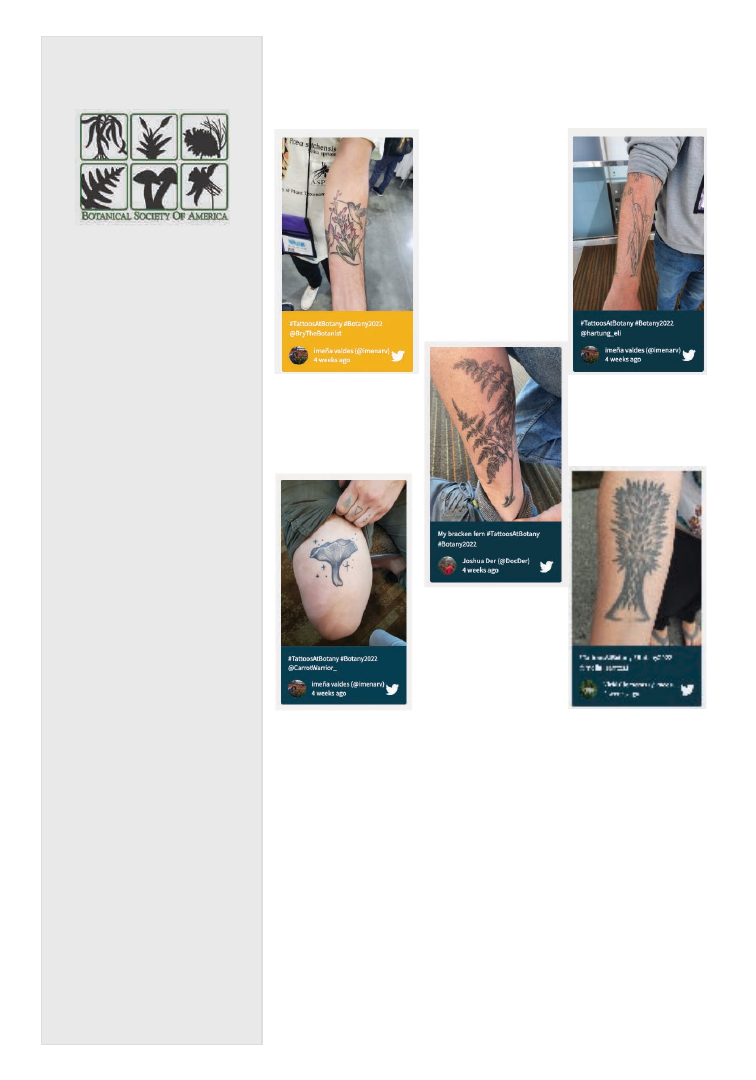
The Botanical Society of
America is a membership soci-
ety whose mission is to: pro-
mote botany, the field of basic
science dealing with the study
& inquiry into the form, func-
tion, development, diversity,
reproduction, evolution, & uses
of plants & their interactions
within the biosphere.
ISSN 0032-0919
Published 3 times a year by
Botanical Society of America, Inc.
4475 Castleman Avenue
St. Louis, MO 63166-0299
Periodicals postage is paid at
St. Louis, MO & additional
mailing offices.
POSTMASTER:
Send address changes to:
Botanical Society of America
Business Office
P.O. Box 299
St. Louis, MO 63166-0299
bsa-manager@botany.org
The yearly subscription rate
of $15 is included
in the membership
Address Editorial Matters (only) to:
Mackenzie Taylor, Editor
Department of Biology
Creighton University
2500 California Plaza
Omaha, NE 68178
Phone 402-280-2157
psb@botany.org
Plant Science Bulletin
Fall 2022 Volume 68 Number 3
Wearing your Botany on
your sleeve!
Spotted at Botany 2022
 View on Issuu.com