
FALL 2024 VOLUME 70 NUMBER 3
PLANT SCIENCE
BULLETIN
A PUBLICATION OF THE BOTANICAL SOCIETY OF AMERICA
In This Issue
The Development of BSA’s
Comprehensive AI Policy for
Its Academic Journals....p. 205
New Editors-in-Chief Named:
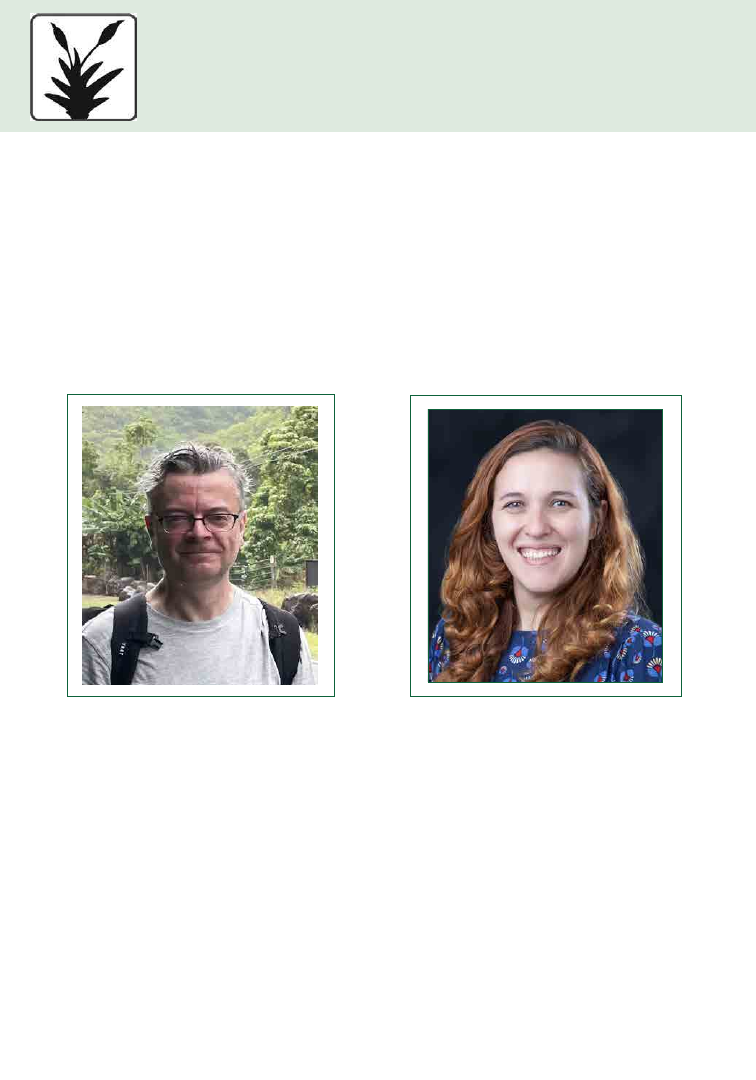
Sean Graham (
AJB) &
Carolina Siniscalchi (
PSB) .... p. 197
Insights from a Fulbright U.S.
Scholar Alumni Ambassador
by Nishanta Rajakaruna .... p. 277
A Pair of SciArt articles
focused on paleobotany! .... p. 259
Congressional Visits Day Report
by Jenna Miladin
& Cael Dant... p. 286
A Collection of Articles by
Charles E. Bessey Teaching
Award Winners ... p. 216

Fall 2024 Volume 70 Number 3
FROM the EDITOR
Sincerely,
Greetings,
Putting together this issue of Plant Science Bulletin has been bittersweet for me, as it is my
last issue as editor-in-chief. Serving as PSB editor has been one of the highlights of my career
and I speak more about this in a short question-and-answer segment on page 199. I am very
proud of this issue, as it exemplifies my favorite kind of PSB issue by including a little bit of
everything. We have timely articles that focus on pressing issues in botany, including one by
Theresa Culley and colleagues that addresses the use of AI in BSA publications and one by
Caroline Bose that discusses why and how botany can become more inclusive and accessible.
You will also find reflections by the two winners of the 2024 BSA Public Policy Award who
attended the AIBS Communication Boot Camp and Congressional Visits Day in D.C. to
promote science and botany to legislators.
The highlight of this issue, for me, is a special feature on education in which several of our
recent Charles E. Bessey Award winners share teaching philosophies and strategies. I was
thrilled with the diversity of articles that I received in response to my invitations. I am
also happy to include two final articles on the theme of science and art. Both articles look
specifically at the role of art in paleobotany.
Thanks to you all for being readers of Plant Science Bulletin. I hope you enjoy this issue!

PSB 70 (3) 2024
195
195
TABLE OF CONTENTS
SOCIETY NEWS
Changes in Editors-in-Chief for Two BSA Publications..................................................................197
Ten Years of
Plant Science Bulletin
: An Exit Interview with Editor-in-Chief
MackenzieTaylor.......................................................................................................................................199
An Exit Interview with
American Journal of Botany
Editor-in-Chief Pamela Diggle
After a Decade of Service ....................................................................................................................202
The Development of BSA’s Comprehensive AI Policy for Its Academic Journals........205
SPECIAL SECTION
HONORING THE TRADITION OF BOTANY EDUCATION IN THE
PLANT SCIENCE
BULLETIN:
A COLLECTION OF ARTICLES BY CHARLES E. BESSEY TEACHING
AWARD WINNERS...................................................................................................................................................216
Four Things I Learned from 30 Years of Teaching
(that you probably already know) (by Cynthia Jones) ........................................................218
Universal Design for Learning Botany (by J. Phil Gibson)............................................................223
Field-based courses still matter, but not like they used to
(by Christopher T. Martine)...............................................................................................................227
Neo-natural history: careful observation and co-discovery in
teaching botany.(By Joan Edwards) .............................................................................................230
Using Inquiry as a Tool to Help Students Develop a more Sophisticated Understanding
of Frequently Misunderstood Concepts. (by Marshall Sundberg)...............................235
Don’t forget our roots: learning with drawing. (By Stefanie M. Ickert-Bond
and Brett C. Couch)....................................................................................................................... 242
The two rules of great teaching: present with enthusiasm and make your
students do the work (By Bruce Kirchoff) ........................................................................... 248
The Evolution of an Educator – (By Suzanne Koptur).................................................................. 252
ART IN THE BOTANICAL SCIENCES: PAST, PRESENT, AND FUTURE..........................259
Illustrating Cretaceous Park: First Steps Toward a Botanical Field Guide for the
Hell Creek Formation (By Kirk R. Johnson and Marjorie Leggitt)................................260
Reconstructing the Botanical Past: Art and Paleobotany (By Edward J. Spagnuolo,
L. Alejandro Giraldo, Mario Coiro, and Susannah Lydon) ................................................264
SPECIAL FEATURES
The Fulbright U.S. Scholar Program: Insights from a Fulbright U.S. Scholar
Alumni Ambassador ..............................................................................................................................277
Twelve Pounds of Duct Tape and No Manual: Shifting Mindsets Around Disability in
Botany............................................................................................................................................................286
Report from 2024 Congressional Visits Day ........................................................................................290

PSB 70 (3) 2024
196
196
TABLE OF CONTENTS
MEMBERSHIP NEWS
BSA Virtual Symposium on Climate Change: .....................................................................................290
Support Graduate Students with Year-End Donations to the GSRA Fund
Donate today!.............................................................................................................................................290
Help Us Reach Our Goal of 100 Gift Memberships by December 31! .................................291
Three-Year Memberships—Stay Connected at a Discount!........................................................291
Botany360 Updates............................................................................................................................................291
BSA Sponsorship Opportunities.................................................................................................................292
BSA Student Chapters.....................................................................................................................................292
BSA Spotlight Series.........................................................................................................................................292
FROM THE
PSB ARCHIVES.............................................................................................................294
SCIENCE EDUCATION
Student Perceptions of Scientists: Preliminary Results from PlantingScience
F2 Research Project...................................................................................................................................295
Master Plant Science Team Applications Open for Spring and Fall 2025..........................300
Huge PlantingScience Fall Session Wrapping Up............................................................................300
State-by-State Resource Update: List of States/Territories Still Needed............................300
Nominations for 2025 Bessey Award.......................................................................................................301
STUDENT NEWS
Botany 2024 Recap............................................................................................................................................302
Grant Opportunities............................................................................................................................................302
Grad School Advice ...........................................................................................................................................302
Papers to Read for Future Leaders ...........................................................................................................303
ANNOUNCEMENTS
Art, Ecology, and the Resilience of a Maine Island: The Monhegan Wildlands................301
IN MEMORIAM
Pieter Baas(1944–2024) ................................................................................................................................305
Dr. Elisabeth Zindler-Frank ...........................................................................................................................307
BOOK REVIEWS......................................................................................................................................308
PSB 70 (3) 2024
197
197
The Botanical Society of America is thrilled to
announce that Dr. Sean Graham (University of
British Columbia) will serve as the new Editor-in-
Chief for the American Journal of Botany (AJB)
and Dr. Carolina Siniscalchi (Mississippi State
University) will serve as the new Editor-in-Chief
of the Plant Science Bulletin (PSB) beginning in
January 2025.
Both Drs. Graham and Siniscalchi bring to
their new roles impressive credentials and
strong commitments to Society publications. In
concordance with the strategic goals of the BSA,
Changes in Editors-in-Chief for
Two BSA Publications
DR. SEAN GRAHAM APPOINTED NEW EDITOR-IN-CHIEF OF THE
AMERICAN JOURNAL OF BOTANY AND DR. CAROLINA SINISCALCHI
APPOINTED NEW EDITOR-IN-CHIEF OF THE
PLANT SCIENCE BULLETIN
they both are committed to diversity, equity, and
inclusion as an essential practice in all aspects of
science.
Dr. Graham is a Professor in the Department
of Botany at the University of British Columbia,
Vancouver, Canada, who has wide-ranging research
interests in plant systematics and evolution, and in
particular characterizing plant biodiversity from
phylogenetic and phylogenomic perspectives. His
interests have ranged from addressing challenging
higher-order relationships—both across and
within the major lineages of land plants—to more
focused systematic studies of closely related taxa.
SOCIETY NEWS
DR. SEAN GRAHAM
DR. CAROLINA SINISCALCHI

PSB 70 (3) 2024
198
He has studied the molecular evolution of plant
genes and genomes, and the evolution of plant
sexual systems. He has strong ongoing research
interests in monocots and mycoheterotrophic
plants.
In addition to a full career as a professor and recent
Head of the Botany Department at UBC (2016–
2021), Dr. Graham has served BSA Publications
for many years, including as an AJB Associate
Editor (2008–2017 and 2019–2024), and as a guest
co-editor on two AJB special issues (“Exploring the
Potential of Angiosperms353, a Universal Toolkit
for Flowering Plant Phylogenomics” in 2023; the
Charles Darwin Bicentennial in 2009). He has
also played a publications-related leadership role,
as he was elected for two successive terms as the
BSA Director-at-large, Publications. In this role he
helped lead the transition of AJB and Applications
in Plant Sciences from self-publishing to
partnering with the commercial publisher Wiley.
As a Director, he was also a BSA board member,
and he advocated to the Board for the creation
of the AJB Synthesis Prize for early-career
researchers (ECRs). He has also served in multiple
additional official and unofficial service roles,
including on the BSA publications committee and
the publication ethics subcommittee. He regularly
assists the editorial team with analysis of the annual
Journal Impact Factor and has strongly promoted
the need to increase the number of review articles
as a key tool to improve our impact more broadly.
This insight helped lead to the creation of an AJB
“Reviews Editor” role at the journal, and was part
of the motivation to establish the AJB Synthesis
Prize..
According to Dr. Graham, “I believe strongly
in society-run scientific journals, which are
motivated by science over profit. I therefore
regularly publish some of my best research in AJB.
I would like to find new ways to encourage others
to do so, too.”
Dr. Graham will begin his five-year term on
January 1, 2025. He replaces the remarkable
current Editor-in-Chief, Dr. Pamela Diggle,
whose second five-year term concludes December
31, 2024. [See her outgoing thoughts elsewhere in
this issue of the PSB.]
Dr. Siniscalchi is an Assistant Professor and Data
Science Coordinator in the University Libraries
at Mississippi State University. Her main areas of
botanical research interest are the macroevolution
of the nitrogen-fixation symbiosis in flowering
plants and the systematics and evolution of
the sunflower family. She also has expertise
in data science, bioinformatics, and research
data management. Her strong background in
systematics research and current position in
library science are a unique combination that will
bring new ideas and directions to the PSB.
Dr. Siniscalchi received her bachelor’s, master’s,
and doctoral degrees from the Universidade
de São Paulo, Brazil. She has been a member
of the BSA since 2017, when she first moved to
the United States, and has attended five Botany
meetings since then. She was a member of the
APPS Reviewing Board from 2020 to 2022, served
on the BSA International Affairs Committee
(2019–2021), and is currently the Secretary/
Treasurer for the Southeastern Section.
Dr. Siniscalchi’s vision for the PSB is that it will
reflect the wide array of interests and diversity
of BSA’s membership. “I want BSA members to
see the bulletin as not only the place where they
receive information from the society, but also as
the place where they can talk about themes that
are not strictly scientific but that are inherently
part of being a botanist (and I use botanist here in
the widest sense: not only as academics, but every
person that has plants as the center focus of their
work or hobby),” she says.
Dr. Siniscalchi will begin her five-year term on
January 1, 2025. She replaces the amazing current
Editor-in-Chief, Dr. Mackenzie Taylor, whose
second five-year term concludes December 31,
2024. [See her outgoing thoughts elsewhere in this
issue of the PSB.]

PSB 70 (3) 2024
199
Ten Years of
Plant Science Bulletin
:
An Exit Interview with
Editor-in-Chief Mackenzie Taylor
What first drew you to take on the role of editor-
in-chief of the Plant Science Bulletin?
I was interested in serving as the editor-in-chief
of PSB because I believe strongly in its role as a
resource for the botanical community. I have
always loved the variety of articles in the PSB and
the fact that it celebrates the achievements of BSA
members. I think, at its best, it builds community
within the BSA and provides a place for important
discussions to occur outside of annual meetings.
Additionally, I wanted to provide a positive
experience for others who wished to publish
in PSB, especially for people rather new to
publishing. My first publication was in PSB
(Johnson et al., 2004), and I valued the experience
of getting to work with collaborators and publish
an article as an undergraduate. Marsh Sundberg,
who was PSB editor at the time, made this a very
positive experience and I hoped to pass this along
to others.
What were your goals as editor-in-chief?
During my time as editor, I have had three
primary goals for the PSB. The first has been to
provide a platform for members and friends of the
BSA to share ideas and knowledge in the realms
of education, public policy, public outreach, and
history. I consider the PSB to be the publication of
record for the BSA in matters outside of scientific
research. I believe that its pages should provide a
snapshot of the environment in which botanical
research and education is taking place, both for
contemporary readers and for posterity.
The PSB team and I have accomplished this by
inviting many of the people who have given
addresses to the Society or led workshops, either
at the Botany meetings or through the Botany360
program, to prepare written articles so that they
might reach a broader audience. Some of our most
thought-provoking pieces have come from these
contributions. I have also encouraged our Public
Policy Committee to keep the Society updated
on matters such as funding for plant science
research and relevan
t bills that come before
Congress. When I started as editor, I felt strongly
that the PSB could play a larger role in promoting
and facilitating science advocacy. I think we made
gains in this area.

PSB 70 (3) 2024
200
My second goal was to provide resources for the
botanical community, especially as they related
to goal number one. During my 10 years, PSB has
published articles with practical strategies and tips
for preparing articles for publication, avoiding
predatory publishing, submitting successful NSF
grants, applying for Fulbright awards, conducting
field work, improving scientific presentation
skills, and moderating scientific sessions at
conferences, among many other topics. PSB
authors have contributed to the debate on issues
such as plant awareness disparity and whether
standardized tests should be used in admissions.
We have continued to publish articles that
present strategies for teaching in the classroom
and laboratory, as well as for public outreach.
Further, we created a section just for students.
The student representatives share information and
resources for student members and highlight the
accomplishments of those members. I hope that
PSB readers have found these articles to be useful.
They continue to be available in the PSB archives.
My third goal was to elevate as many individual
voices in the PSB as possible and provide a
platform for many perspectives. There is always
room for improvement in this area, but we have
made a significant effort to engage with the broad
botany community. For example, our recent
special issues on Art and Botany included an open
call for articles; the response was tremendous,
including from authors who had never published
in PSB before. In another example, we asked the
larger community, including on social media,
for articles about dealing with the pandemic that
stimulated many thoughtful responses.
How has the direction of the PSB evolved over
the past 10 years?
Over the last 70 years, PSB has been continually
evolving to fit the needs of the BSA. During some
periods it has included more articles and essays
and in others, it has been more of a newsletter used
for disseminating news and announcements. Over
the last 10 years, we have continued a trend to
reduce the emphasis on news and announcements,
mostly because these are more easily and quickly
disseminated via the email newsletters. In turn,
I have made a deliberate effort to increase the
number of peer-reviewed articles in each issue.
My goal was always one or two articles per issue
and most of the time we accomplished this. I also
wanted to diversify the type of articles published
in PSB so that we were serving as much of the
botanical community as possible.
We decided when I became editor that we would
continue to emphasize the print version as most
of our readers indicated that they preferred
that format. Near the start of my first term, we
revamped the look of the PSB and created a new
logo that I absolutely love. Ten years on, much has
changed in the publishing landscape and the new
editorial team will have to decide if it is time to
transition to online-only publication or if there are
new and better ways to reach readers. Whatever it
looks like in the future, I am hopeful that PSB will
only grow in value to BSA members.
What do you consider your most rewarding
accomplishments in your role with the PSB?
There are many things I’m proud of regarding my
role as PSB editor. One of the most rewarding to
me personally was the series of issues that came
out in 2020–2021. These were very volatile times,
with universities and businesses shut down due to
the COVID-19 pandemic and the United States
in the middle of significant political upheaval. I
conceptualized and coordinated both the Summer
and Fall 2020 issues from my dining room table
because Creighton’s campus was closed. Despite
this, I believe these issues are some of the most
important in PSB’s history. We provided tips for
educators and researchers who were working with
reduced resources and attempted to provide a
record of these times for future reference through
special features (Taylor, 2020; Min et al., 2020;
Gaynor and Valdez, 2020). We also did our best
to lift up the voices of people who had timely and
meaningful ideas to share about inclusion and
equity in botany (e.g., Dewsbury, 2020; Leonard,
2020; Asai, 2021) and have made featuring these
perspectives an ongoing priority. I am also very
proud of the Art in the Botanical Sciences special

PSB 70 (3) 2024
201
issues that were published in Fall 2023 and Spring
2024, although the hardest work was done by the
guest editors for these issues and the authors.
These were very well received and demonstrate the
unique ability PSB has to cross disciplinary lines.
What has been the best part of serving as PSB
editor?
Serving as the editor of Plant Science Bulletin
has truly been a highlight of my career. I have
found great joy in thinking about what topics
members of the Society would be interested in
and then working with Richard Hund to figure
out how to best feature that in PSB. The best
part has been getting to interact with people I
might not otherwise have had a reason to get to
know, including our wonderful authors, section
contributors, and article reviewers, as well as our
book reviewers and the publishers who provide
books for review.
Do you have any last thoughts?
It takes a team to create the PSB, so I want
to thank everyone who has contributed to the
Bulletin during the last 10 years, whether as an
author, contributor, reviewer, or book reviewer.
I especially want to recognize all the student
representatives and policy committee chairs who
have prepared sections for each issue as a part
of their service in that role, as well as Catrina
Adams and Jennifer Hartley for preparing our
regular feature on Science Education. Truly, Plant
Science Bulletin does not exist without those of
you who contribute your time and energy to PSB.
Thank you to Amy McPherson and to the BSA
Publications Committee for helping to develop
procedures and sharing thoughtful ideas. Special
thanks to Johanne Stogran for compiling and
formatting each issue. She does an incredible job
making the PSB look fantastic in print and ISSU
format. Finally, it has been an absolute joy to work
with Richard Hund, PSB managing editor. I know
that the PSB issue will be in the capable hands of
Carolina Siniscalchi, and I am excited to see what
she does to move the Bulletin forward.
REFERENCES
Asai, D. 2021. The little red hen and culture change.
Plant Science Bulletin 67 (3): 174-180. https://bot-
any.org/userdata/IssueArchive/issues/originalfile/
PSB_67__3__2021.pdf
Dewsbury, B. 2020. What have we learned? Lessons
and strategies from the chaos. Plant Science Bulle-
tin 66 (3): 198-205. https://botany.org/userdata/Is-
sueArchive/issues/originalfile/PSB_2020_66_3.pdf
Gaynor, S., and I. Valdes. 2020. Shifting gears: field-
work, benchwork, and greenhouse studies during
COVID-19. Plant Science Bulletin 66 (3): 236-242.
https://botany.org/userdata/IssueArchive/issues/origi-
nalfile/PSB_2020_66_3.pdf
Johnson, E. E., M. Taylor, R. Lopez-Smith,
and D. Morningstar. 2004. What Works for
Me: Undergraduate Perspectives on Professional De-
velopment. Plant Science Bulletin 50 (4): 102-104.
https://botany.org/psbarchive/issue/2004-v50-no-4.
html
Leonard, B. G. 2020. Diversity and inclusion in the
sciences: relationships and reciprocity. Plant Science
Bulletin 66 (3): 191-197. https://botany.org/userdata/
IssueArchive/issues/originalfile/PSB_2020_66_3.pdf
Min, Y., S. Gaynor, and I. Valdes. 2020. Student ex-
periences during the COVID-19 lockdown. Special
Feature Plant Science Bulletin 66 (2): 129-134. https://
botany.org/userdata/IssueArchive/issues/originalfile/
PSB_2020_66_2.pdf
Taylor, M. 2020. COVID-19 and you: checking in with
12 BSA members during a global pandemic. Special
Feature. Plant Science Bulletin 66 (2): 93-110. https://
botany.org/userdata/IssueArchive/issues/originalfile/
PSB_2020_66_2.pdf
Art in the Botanical Sciences Special Issues
https://botany.org/userdata/IssueArchive/issues/origi-
nalfile/PSB%2070(1)%2020242.pdf
https://botany.org/userdata/IssueArchive/issues/origi-
nalfile/WebPSB_69_3_2023.pdf

PSB 70 (3) 2024
202
What first drew you to take on the role of
AJB Editor-in-Chief?
One (perhaps glib) answer is that Carol Goodwillie
asked me to!! She was the BSA’s Director-at-Large
for Publications and chairing the search committee.
She was passing through my neighborhood and
dropped by to discuss the possibility. I have vivid
(very positive) memories of the occasion. We
went for a long walk and talked at great length
about the possibilities for the position. The other,
more heartfelt, answer is that I had always been
(and continue to be!) a strong supporter of the
BSA and had participated in many aspects of its
governance; I saw the editorship as an important
opportunity to continue serving the society and
botany. The American Journal of Botany also is
of great significance to me personally. AJB was
the first journal I subscribed to as a beginning
graduate student, and I read the articles avidly.
The growing row of issues, then bound in bright
yellow card stock, arranged on my bookshelf,
gave me a sense of belonging and professionalism.
My first research paper was published in AJB. I
also knew that AJB has been equally important
in the careers of botanists across the country and
internationally. So, as soon as Carol raised the
possibility, I got very excited by the prospect and
immediately began to consider what I might (aim
to) do as Editor-in-Chief.
What were your goals as Editor-in-Chief?
I looked back at some of the documents I
submitted with my application for the position and
this sentence stood out: “The primary challenge
An Exit Interview with
American Journal of Botany
Editor-in-Chief Pamela Diggle
After a Decade of Service
faced by the AMERICAN JOURNAL OF BOTANY
is the same challenge faced by the publications
of all scientific societies: How will the Journal
maintain relevance in this rapidly evolving world
of diverse outlets for dissemination of science?”
This is as true today as it was 10 years ago, and I
continue to keep my focus on this challenge. One
of my goals as incoming EiC was to increase the
breadth of research areas included in the journal
and to expand the geographic, institutional, and
demographic diversity of authors and editors. To
this end, I aimed to increase all aspects of diversity
among the board of Associate Editors. AJB
currently has 64 Associate Editors, 49% of whom
are women, and who are in institutions from
Argentina (1), Austria (1), China (2), Colombia
(1), Denmark (1), France (2), Germany (4), India
(1), Israel (1), Korea (1), Mexico (3), Netherlands
(1), New Zealand (1), North America (39), South
Africa (1),
Spain (2), and Sweden (1).
The
diversity of authors is more difficult to gauge, but

PSB 70 (3) 2024
203
we will begin to track self-reported demographic
data next year and will be able to keep tabs on
how we’re doing. I also aimed to “have the pulse
of the readership”; to understand how readers and
authors discovered articles, and what new and
exciting research was on the horizon. I began
to implement this immediately by holding a
series of listening sessions (online and at Botany
conferences) with botanists from a broad range of
disciplines and career stages to understand how
best to serve our community. These listening
sessions have now been formalized as the ECAB
(Early Career Advisory Board), which consists of
advanced graduate students and post-docs who
provide input and suggestions through regular
meetings. I also wanted to bring new readers and
authors to the journal by introducing a “News and
Views” section in each issue of the journal that
includes non-technical summaries of research
papers (“Highlights”), brief essays on new areas of
research (“On The Nature of Things,” now a regular
feature of most issues), and a diversity of opinion
pieces and commentaries. Also, as a result of a plan
hatched during a 2-day strategy retreat, AJB now
features regular review articles. I thank incoming
EiC Sean Graham, who was at that meeting, for
presenting a compelling argument for a reviews
section in AJB. And I am so very grateful to
Jannice Friedman for taking on the enormous task
of getting this feature off the ground successfully
and serving as Reviews Editor for over two years,
and to the current Reviews Editor, Kasey Barton,
for carrying on this important work with grace
and enthusiasm.
How has the direction of AJB evolved over
the past 10 years?
Both AJB and the scholarly publishing industry
in general have undergone tremendous change
over the last decade. The year I started, 2015,
marked a full century of AJB publication and
in all of that time, it had been self-published.
Library subscriptions largely supported the
journal and, critically, other activities of the
BSA. In acknowledgment of changing financial
models and challenges of competition among
scientific journals for diminishing resources
in library budgets, AJB, in 2017, entered into a
partnership with Wiley and is now in a second
five-year contract. We joined with Wiley at a time
when they had a strong stable of Society journal
partners, and we benefit from their scholarly
publishing expertise and economies of scale.
With Wiley we have been better able to adapt to
the strong push in STEM toward Open Access,
which offers great advantages but also tremendous
financial challenges—for both authors and
Societies. Major changes in AJB’s distribution
have also occurred. In 2015, AJB was provided
to members electronically and/or, by request, as
a hard copy of each issue. Printing of the journal
was discontinued in 2019, and now all access is
electronic. The ability to promote and share links
to articles to a vast international community of
botanical enthusiasts was greatly expanded as
social media exploded over the past decade. As the
social media landscape has grown more complex,
AJB, along with the BSA, is emphasizing more
diverse, and less divisive, platforms. One thing
that hasn’t changed is our careful copy editing, and
the care and attention to detail that the AJB staff
bring to each article and to our authors.
I want to emphasize, that although publishing has
undergone dramatic transformations and many
new features have been added to the Journal, AJB
is a Botanical Society of America publication,
and as EiC, I have kept the mission to serve the
society and to publish “peer-reviewed, innovative,
significant research of interest to a wide audience
of scientists in all areas of plant biology” in mind
with every decision that we’ve made.
What do you consider your most rewarding
accomplishments in your role with
AJB
?
I would like to highlight my efforts to increase
AJB’s inclusivity. As noted above, one of my goals
as EiC has been to increase the diversity (in all of
its multiple meanings) of authors, readers, and
editors. To further this goal, all Special Themed
Issues now include an open call for proposals
for articles to be included in the issue. Early-

PSB 70 (3) 2024
204
career and other underrepresented groups of
authors are especially encouraged to participate.
And, last year we ran an open call for Associate
Editors. This initial call drew a gratifying array
of applicants from across the globe who were
interested in serving botanical research generally
and the journal specifically. The demographics
of the BSA and of science and society at large are
changing rapidly and that should be reflected in
our journal. Moreover, encompassing a broad
and diverse range of perspectives and approaches
is imperative for addressing the pressing issues of
global climate change.
What has been the best part of serving as
AJB editor?
Serving as the Editor-in-Chief of AJB has been one
of the most gratifying and rewarding experiences
of my career. AJB is so much more than a journal.
It is a community of exceedingly talented people
working selflessly to advance botanical sciences
and to support botanical scientists. We all
know that, despite our best efforts as authors, it
is the rare paper that is not improved during the
peer-review process. I have had the pleasure of
watching this “evolutionary process” as reviewers
and Associate Editors take the time from their
already over-scheduled days to carefully read
and comment—some even going so far as to
suggest new analyses, and provide code and all!
The result is inevitably a stronger/clearer paper
with greater impact. We receive many notes from
authors about the positive experience they had
at AJB. I’m grateful for the generous work of all
the many people involved, past and present, in
the American Journal of Botany. AJB’s Associate
Editors continually amaze me. They bring such
knowledge and insight to the papers they handle,
and each of them is dedicated to the success of
the journal. And then, there are the multitude
of reviewers who cannot be thanked enough for
their contributions. A special thanks goes to the
amazing AJB Managing Editor, Amy McPherson,
who has very much been my partner over the
past decade (and the leader in understanding
the rapid changes to the publishing industry).
It has also been my pleasure to work with the
equally amazing Production Editor, Richard
Hund
,
who handles all the “behind the scenes”
complexities that turn your manuscripts into
published papers. (And who gleefully smuggled
chips and beer into the Botany meeting venue for
our first several information-gathering sessions.)
Talented Content Editor Staci Nole-Wilson (and
past Content Editors Sophia Balcomb and Marian
Chau), among other things, skillfully ensures that
your papers have all of the vital sections and are
ready publish. And, most especially, I thank all
of you who have contributed to the success of the
journal by sending your research papers to the
journal!

PSB 70 (3) 2024
205
In today’s society, artificial intelligence (AI) is
rapidly advancing and expanding through all
aspects of our lives. The release of ChatGPT in
November of 2022 made AI accessible to anyone
with a computer and an internet connection. After
the explosion of interest and activity that followed,
AI now has the potential to radically change
our world as we know it. According to a recent
Oxford University Press poll (Anderson, 2024),
researchers across scientific disciplines today are
increasingly using AI tools, but also have extensive
misgivings about AI technology. For example, 76%
of researchers globally currently use some form
of AI in their research (e.g., chatbot, machine
translations, AI-powered search engines and
research tools), but only 8% trust the AI companies
not to use their own data without permission, and
25% are concerned about AI reducing the need
for critical thinking skills in science (Anderson,
2024). Most recently, publishers Taylor & Francis
and Wiley agreed to sell access to academic content
The Development of BSA’s
Comprehensive AI Policy for Its
Academic Journals
By Theresa M. Culley
1,11*
, Irene Cobo-Simón
2*
, Robert L. Baker
3
, Aaron S. David
4
, Matthew A.
Gitzendanner
5
, Matthew S. Olson
6
, Tilottama Roy
7
, William N. Weaver
8
, Pamela Diggle
9
, and
Briana Gross
10
1
Department of Biological Sciences, University of Cincinnati, OH
2
Institute of Forest Sciences (ICIFOR-INIA, CSIC), Madrid (Spain); Associate Editor of APPS
3
National Park Service, Fort Collins, CO; Associate Editor of APPS
4 Archbold Biological Station, Venus, FL; Associate Editor of AJB
5
Department of Biology, University of Florida, FL
6
Department of Biological Sciences, Texas Tech University, TX
7
Department of Biology, Missouri Western State University, MO
8
Department of Ecology and Evolutionary Biology, University of Michigan, MI
9
Department of Ecology & Evolutionary Biology, University of Connecticut, CT; Editor-in-Chief of AJB
10
Swenson College of Engineering and Science, University of Minnesota-Duluth, MN; Editor-in-Chief of APPS
11
Corresponding author: theresa.culley@uc.edu
*Joint first authors
to certain tech companies for training AI models,
causing concern among the scientific community.
AI itself is a broad term that refers generally to
non-human (machine) intelligence (De Waard,
2023), but AI can be adapted and used for specific
purposes (Zhou, 2023). Underlying many AI tools
are large language models (LLMs), which are
trained on large amounts of existing text data or
visual and sound recordings to decipher written
human language and create media. LLMs are most
useful for translation, summarizing existing text,
and generating requested content such as Q&A.
Generative AI tools such as ChatGPT use these
LLMs with additional training to then create
original content such as text, images, code, and
even videos or music. AI can also be used in a
process known as “inference” to draw conclusions
from new data without depending upon only past
examples.

PSB 70 (3) 2024
206
Generative AI tools are already impacting multiple
fields of scientific research and the publication
of scientific articles. Generative AI tools include
a wide variety of technologies, such as natural
language processing (NPL), which underlies
generative pre-trained transformer (GPT)
models, and image generation and editing. These
tools can be used in writing to suggest text, correct
grammar or spelling, or match a particular style
of a scientific journal. AI tools are also extremely
useful for data analysis; they can process large
amounts of data with accuracy and speed, and
identify patterns and information difficult to
detect with traditional methods. AI can be used
to generate code, automate repetitive tasks, and
simulate experimental conditions. When used in
these ways, AI has the exciting potential to propel
science forward in ways we can only imagine
today; however, its use also raises important
ethical and practical considerations. Present-day
AI-generated content can sometimes include
incorrect, out-of-date, or nonexistent citations,
or contain repetitive or inappropriate language,
reflecting the biases/inaccuracies of the data on
which the tools have been trained. AI tools can
be used to manipulate images and may plagiarize
existing text, but this technology can also be used to
detect such actions with ever-increasing accuracy.
For example, publishers such as Elsevier, Springer,
and Wiley now use their own in-house AI tools
to check for AI usage in submitted manuscripts to
ensure integrity of their publications.
Recognizing the necessity of addressing the
use of AI in the publication process, the
Botanical Society of America (BSA) formed
an ad hoc committee in fall 2023 to develop a
policy regarding use of AI in its publications
(American Journal of Botany, Applications in Plant
Sciences, and Plant Science Bulletin). Committee
members consisted of researchers selected from
a special call for participants, BSA editorial staff
(managing editors, production staff, associate/
reviewing editors, and editors-in-chief), and the
BSA Director-at-Large for Publications. This
committee was charged to discuss generative
AI tools as they apply to publishing and to then
develop guidelines, policies, and best practices for
authors, reviewers, and editors of BSA journals.
The committee specifically focused on the
following three categories:
1. Defining how authors may or may not use AI
when writing text, including how to properly
acknowledge AI tools (if allowed in any cir-
cumstance)
2. Describing how AI tools can be used for gen-
erating code as a potentially acceptable use
3. Deciding how reviewers may or may not use
AI in their reviews
The committee met several times during the
following months as individual workgroups
focused on drafting sample language for each
point above, and then as the full group to fine-
tune the language. This AI policy established
guidelines to promote responsible and ethical
use of AI in scientific publications—aiming to
harness the potential of AI while safeguarding the
integrity of scientific research. The AI policy was
then added to the Author Guidelines for all BSA
journals and released publicly in spring 2024, with
required disclosure of AI use on the author and
reviewer submission forms. As AI continues to
evolve, ongoing dialogue and adaptation of these
policies will be crucial to ensuring that the BSA
community remains at the forefront of innovation
and ethical practice.
The purpose of this article is to describe the key
points considered by our ad hoc committee during
our discussions, namely: (1) how other journals
and publishers have addressed AI to date, (2)
current opportunities and challenges of AI tools,
and (3) a summary of our committee discussion
that resulted in the final BSA AI policy.

PSB 70 (3) 2024
207
CURRENT STATUS OF AI
IN PUBLISHING
Here we review as of April 2024 the current
guidelines and policies of the top six academic
publishers, as identified by Scholarly Publishers
Indicators 2022 (https://spi.csic.es/), on the use of
AI generated content (AIGC):
• Cambridge University Press
https://authorservices.wiley.com/ethics-
guidelines/index.html
• Elsevier
https://www.elsevier.com/about/policies-and-
standards/the-use-of-generative-ai-and-ai-
assisted-technologies-in-writing-for-elsevier
• Oxford University Press
https://academic.oup.com/pages/authoring/
books/author-use-of-artificial-intelligence
• Taylor & Francis
https://asset.routledge.com/
rt-files/AUTHOR/Guidelines/
Manuscript+preparation+guide.pdf
• Springer
https://www.springer.com/gp/editorial-poli-
cies/artificial-intelligence--ai-/25428500
• Wiley-Blackwell
https://authorservices.wiley.com/ethics-
guidelines/index.html
All publishers consider the use of AI an ethical
issue. For example, Oxford University Press states,
“AI must be consistent with the Press’s mission
and the values inherent in our publishing, with
all that this entails in terms of quality, integrity,
and trust.” All six publishers agree that AI is a
tool that simulates human intelligence, but is not
an intelligent entity in itself. Consequently, none
of the publishers allow a statement of authorship
by any AI-based tool (such as ChatGPT) in
scientific articles. This is consistent with the 2023
statement from the Committee On Publication
Ethics (COPE; https://publicationethics.org/cope-
position-statements/ai-author), which states that
AI tools cannot perform the role of an author of
a work, nor therefore, appear in the list of authors
of a work. As non-legal entities, AI tools cannot
take responsibility for the ethical and legal aspects
of the submitted work. Furthermore, Wiley and
Elsevier point out the difference between the use
of AI to make original intellectual contributions
(without human direction)—which is not
allowed—versus assistance in the preparation
of scientific articles—which is allowed. Both
publishers also point out the need for the authors
to supervise the content generated by the AI tools.
All publishers (except Oxford) state that authors
are ultimately responsible for their manuscript
content regardless of whether AI was used.
All publishers also agree that the use of AI to
generate content must be transparent and correctly
referenced, as required with any other tool. Any
use of AI must be disclosed in the cover letter
to the editor upon manuscript submission and/
or in the Methods or Acknowledgments section
of a manuscript. This is also consistent with
COPE’s position statement on AI tools. Elsevier,
Cambridge, and Taylor & Francis all state that the
use of AI tools must comply with editorial policies
on authorship and principles of publishing ethics
(also mentioned in COPE’s position statement).
Cambridge also emphasizes its anti-plagiarism
policy, pointing out that any content generated
by other authors and coming from AI-based tools
must be cited and referenced in an appropriate
and transparent manner.
There is a lack of consensus regarding the
generation or modification of images through AI
tools. Elsevier and Springer consider AI-generated
figures separately from the generation of other
types of content such as text, and prohibit it, with
few exceptions. While Elsevier does not provide
any explanation for this policy, Springer supports
their policy by stating that legal issues relating to
AI-generated images and videos remain broadly
unresolved; consequently, Springer is unable to
permit its use for publication. In contrast, Oxford
evaluates AI-generated images in a similar way to
the generation of other types of content (e.g., text,

PSB 70 (3) 2024
208
code), allowing it as long as it meets the criteria of
transparency and is cited correctly. The remaining
publishers do not consider the use of AI to
generate and/or modify images separately in their
Author Instructions; therefore, it is understood
that they consider images along with generation of
content in general. This is also in line with COPE’s
position statement on authorship and AI tools,
which considers AI-generated images similarly
to other AI-generated content (text, graphical
elements, data collection, and analysis) and allows
it as long as authors are transparent in disclosing
within the article how the AI tool was used and
which tool was used. Authors are also considered
fully responsible for any AI-generated content,
including all of its ethical aspects.
Several publishers have also developed policies
concerning the use of AI in the review process.
Springer stresses transparency in the use of AI
tools during the peer-review process, requiring
reviewers to declare any use of AI in their peer-
review report. Springer notes that this technology
still has considerable limitations (e.g., as
described below, such as outdated information).
Furthermore, Springer also explicitly prohibits
reviewers from uploading any manuscript content
into generative AI tools because manuscript text
may contain sensitive or proprietary information.
Both Elsevier and Springer note the rapid
advancement of AI tools and therefore the need
to regularly review their AI-related policies and
guidelines.
More recently, publishers Taylor & Francis and
Wiley separately gave licensing rights to AI
companies for their repository of past publications
(Dutton, 2024); Oxford University Press and
Cambridge University Press are now forming
partnerships as well (Wood, 2024). Taylor &
Francis’ $10 million deal with Microsoft is expected
to assist their development of Copilot, Microsoft’s
AI assistant. Wiley’s partnership with at least two
undisclosed companies was reportedly worth $23
million and $21 million; in return, Wiley provides
access to its published material to train LLMs by
using book content and small pieces of individual
articles, and to make a narrow range of articles
specific to a topic available for use in inference. At
this point, it is unknown whether authors will even
know if their publication has been used. Except for
a few publishers, authors are not able to opt-out
of having their material used in this way, which
has created much consternation for many authors
(Authors Guild, 2024). In the case of Wiley, the
company has established guiding principles for AI
technology and partnerships (https://www.wiley.
com/en-us/terms-of-use/ai-principles).
OPPORTUNITIES OF AI
TECHNOLOGY
Artificial intelligence and LLMs offer many new
and exciting opportunities for researchers not
only to enhance their science, but also to promote
communication through the publication process
(Buriak et al., 2023). One of the most common
uses of AI by authors is as a “personal copy editor”
to improve the quality and clarity of the language
in their manuscript, polishing text created by the
author. When used properly, these tools are not
dissimilar to automatic spell checkers and grammar
checkers. Even Microsoft Editor is now promoted
as an AI-powered service. The popular Grammarly
tool also boasts of an AI communication assistant
to help authors pinpoint areas of weakness, such
as typos, missing punctuation, or commonly
confused words. The premium version of
Grammarly is advertised as using AI to adjust the
tone, rewrite full sentences, and generate text for
over 1000 different AI prompts in manuscripts and
even email. Other AI-based editing and rewriting
tools include Wordtune (for rewriting, shortening,
or expanding content), WordRake (which edits for
brevity or simplicity), Writefull (helping to write
and paraphrase scientific text), and LanguageTool
(a grammar checker specialized for multilingual
writers). More grammar checker and rewriting
tools will undoubtedly be released in the future,
especially as generative AI and the machine
learning on which it relies continue to improve.

PSB 70 (3) 2024
209
Such personal copy editors powered by AI may
be especially helpful for multilingual authors
for whom English might not be their primary
language, particularly when submitting to an
English-only journal. Some authors already
upload their own text into ChatGPT and then
review the rewording, grammar, or punctuation
suggestions to enhance the clarity of their papers.
ChatGPT can be used for any language within
its repertoire, which now includes at least 50
languages, with more being added to make this
tool increasingly accessible and useful. Currently,
some AI-suggested text may still be scientifically
nonsensical or inaccurate, so a careful eye is
required before accepting and incorporating any
recommendations (see below). However, with
continued training, future renditions of AI tools
will likely overcome these problems.
AI tools can also be used by researchers to explore
the literature when first embarking on a new
topic, and to identify suitable references for their
manuscript. When asked to provide peer-reviewed
papers on a specific topic, ChatGPT provides a short
list of usually five papers, but can be prompted to
retrieve more. As with all AI-generated results, the
papers may or may not relate to the topic and need
to be reviewed further. Recent papers are usually
excluded from the list, as dates of retrieved papers
reflect when the AI was initially trained. For
example, ChatGPT-4 Turbo released in November
2023 can only identify literature published up to
April 2023. Other AI-powered platforms such
as scholarcy (https://www.scholarcy.com/) help
authors quickly summarize and organize articles
applicable to their own research, increasing the
efficiency with which researchers can search the
literature.
As more authors use generative AI for polishing
existing text, there are multiple downstream
benefits. First, the overall written quality of
manuscripts submitted to journals may increase,
making it easier for editors to ascertain if
a manuscript is appropriate for the journal
and should be sent out for external review. A
well-written manuscript is more likely to be
perceived favorably by reviewers, who can
focus on the scientific content rather than
distractions of misspellings, grammatical errors,
confusing sentence construction, and general
disorganization. Such a manuscript will also
reduce the amount of copy editing and time
required for conversion into a publication-quality
article, increasing the efficiency of the publication
process.
For several years, publishers and editorial staff
have been using their own AI tools to detect
plagiarism and image manipulation, and to find
appropriate reviewers for submitted manuscripts.
BSA journals commonly use CrossRef's Similarity
Check to review manuscripts for potential
plagiarism. AI-powered platforms such as
Proofig or imagetwin can also be used by editors
and publishers to detect image manipulation.
Publishers are now piloting AI to detect submitted
papers generated from “papermills”—groups of
individuals or an organization generating similar
papers and submitting them fraudulently to
multiple journals for financial gain. Editors can use
AI to analyze a submitted manuscript's relevance
to a journal, verify the identity of an author, and
detect irregular publishing patterns by authors
that may indicate fraud (e.g., a mathematician
submitting papers to a medical journal). In a
time where there are increasing numbers of
predatory journals (Culley, 2018), AI can also
be used to check the quality of references cited
within an article. Publishers are also beginning to
use AI tools to flag machine-generated content,
especially when text may be translated into one
language and then converted back in an effort
to avoid detection (such as “big data” in English
translated to “data grande” in Spanish and back to
“greater data”). In a time when finding appropriate
reviewers willing to read a submission is critical
to the peer-review process, publishers are now
using AI tools to locate suitable reviewers or to
identify conflicts of interest (e.g., a proposed
reviewer recently co-authoring a paper with the
author) instead of a handling editor spending
their own time to track down this information. In
summary, incorporating AI tools to assist editors

PSB 70 (3) 2024
210
and publishers can greatly decrease the amount of
time spent per manuscript, while enhancing the
quality of the review and publication process.
Finally, when properly trained, AI technology
can also be used to effectively conduct science.
For example, AI-based models can be used to
synthesize vast quantities of data that would
otherwise require multiple people and many hours
of labor. Such synthesis also minimizes the chance
of mistakes being made and enhances consistency
of any particular process. The power of AI can also
be harnessed to identify patterns and relationships
within large data sets that would otherwise be
difficult and time consuming to detect. For
example, LLMs can now be used to interpret text
in digitized images of herbarium specimen labels
(Weaver and Smith, 2023; Weaver et al., 2023).
Another example is the revolutionary and recently
developed AI program AlphaFold 3, which is
able to predict the structure and interactions of
proteins with other molecules such as DNA and
RNA with unprecedented precision and accuracy
(Abramson et al., 2024). AI can also be used as an
additional overlay to identify any information that
otherwise would regularly go undetected. Finally,
AI can check code or even generate code within an
experiment that would take a human many hours
to create. In summary, the advantages of using
AI within the scientific process itself are many,
provided of course that all results are supervised
and checked by the researcher themselves.
CHALLENGES OF AI
TECHNOLOGY
While AI poses exciting and innovative
opportunities, it is not without serious concerns
and challenges in the publication process,
particularly when used incorrectly. Many of these
concerns can be avoided by treating AI as a tool
to assist human decisions and by recognizing the
inherent limitations of AI, most of which reflect
the underlying machine-learning and training
technology.
On the most basic level, AI technology can be prone
to inherent errors such as incorrect, nonsensical,
or blatantly false output (Davis, 2023). Citations
may be incorrect, incomplete, or outdated because
the AI tool is limited by its most recent training
date. AI can also be weak at judging whether an
unusual outcome is “spurious, anomalous or
groundbreaking” (Buriak et al., 2023). Even the
ability to detect a typical outcome will depend
solely on the data provided to the tool during its
training—hence the strength of any current AI
tool will always be temporally and contextually
limited. AI-generated tools are also known for
sometimes creating shallow and superficial text
with a superfluous tone. There are now detectors
that can be used to identify such AI-generated text,
such as Turnitin, TraceGPT, Hive, and GPTZero,
but their effectiveness, accuracy, and cost can vary
(Walters, 2023). In addition, inadvertent errors
could occur if generative AI incorporates phrases
that are not in the author’s native language that
may have an alternative meaning in another
language that is not understood by the author (e.g.,
“background research” vs. “doing research in the
background”). Finally, while AI can be effective
at summarizing past studies (assuming it is able
to detect all relevant content), the technology at
the current time is still unable to look forward in
time and provide a critical assessment of a topic
and articulate next steps. These types of errors
are especially concerning if readers assume AI-
generated text is of human origin (Buriak et al.,
2023). Such inaccurate information would also be
very worrisome if it escapes detection by reviewers
and is then published in a peer-reviewed journal,
earning a scientific stamp of approval. In short,
current AI technology is limited because it lacks
human intuition and the ability to detect nuances
and to conclusively project into the future.
Another major concern with the use of AI
technology in the publication process involves
confidentiality. When reviewers are asked to read
a submission for a peer-reviewed journal, they
must agree to confidentiality and not share the
author’s work or ideas. However, confidentiality

PSB 70 (3) 2024
211
could be violated if a reviewer uses generative AI
to compose their written review by uploading part
or all of the submitted manuscript into an AI tool.
Although this is now starting to change, some
popular AI tools may still incorporate text that
has been entered into the search window in the
subsequent training of its tool or technology, such
that the same text or idea could potentially be
suggested by the tool to another user in response
to a related query. A potential solution is the use
of private generative AI tools within individual
laboratories in which training data are kept in-
house; however, even a private generative AI tool
may suffer from many of the same challenges
outlined above. Using a private tool to generate
a brief summary of the manuscript, as typically
presented at the top of a formal review, could be
helpful though, provided the platform is used with
human oversight.
AI tools may also express inherent biases based
on the algorithm and training data used to create
the tool. Such bias can be sexist, racist, or even
political, depending on what content was used
in the initial training. For example, ChatGPT
replicated gender bias when asked to construct
recommendation letters for males (which used
nouns such as “expert” and “integrity” and
adjectives like “respectful” and “reputable”) and
females (emphasizing “beauty” or “delight” and
who were “stunning” and “emotional”) (Wan et al.,
2023). In another example where ChatGPT was
asked to create a crime drama, researchers used
four-word prompts, only one of which changed
(either “black” or “white”), to explore ChatGPT’s
potential implicit bias (Piers, 2024). Motoki et
al. (2023) also found that ChatGPT exhibits left-
leaning political tendencies, such as towards
Democrats in the United States, the Workers’
Party in Brazil, and the Labour Party in the United
Kingdom. The reason for these biases is that many
LLMs use data from the internet for their training,
which largely reflects historical stereotypes and
perspectives already present online. Thus, if left
unchecked, the use of ChatGPT and other LLMs
could inadvertently amplify existing and historical
information on the internet and social media.
DEVELOPMENT OF THE BSA
POLICY ON AI TECHNOLOGY
Our ad hoc committee met several times in 2023
and 2024 to discuss the ethical use of AI in the
publishing process. We examined every aspect
of the development of a research project: initial
conceptualization, data collection, integration
and analysis, interpretation and presentation
of data, and writing the manuscript. Going
into these discussions, many of our committee
members were initially skeptical of using AI in the
publication process due to its inherent limitations
(see above) and the possibility of authors using it
unscrupulously to fabricate text. In fact, several
of us started the conversation thinking about
excluding all elements of AI from the publication
process but, as explained below, eventually we
changed our minds. Ultimately, we agreed that
there was no part of the scientific process for which
AI should be banned because it has the potential
to help in every aspect, if used appropriately.
We recognized that there is no AI tool that is
inherently beneficial or detrimental; it depends on
how a given tool is used and the extent to which
the user is aware of each tool’s limitations. AI has
the potential to make research more thorough
by uncovering additional information beyond an
author’s immediate knowledge. Thus, we agreed
that the development of guidelines for authors
and reviewers for the publication process is key
to taking advantage of this novel and promising
technology, while avoiding its potential drawbacks.
We also recognized that the AI field is rapidly
advancing with constantly evolving tools such
that what we perceive today as cutting-edge may
quickly become routine in the months and years to
come. The AI of tomorrow will likely be different
from the AI of today because machine learning
algorithms and technology are rapidly improving.
Consequently, our committee understood that
any AI publication policy developed now will
need to be revisited and modified in the future as
AI technology changes.

PSB 70 (3) 2024
212
CONSIDERATIONS FOR
AUTHOR GUIDELINES
We all agreed at the onset that AI cannot be an
author because a non-human entity cannot take
responsibility for a paper. There must be human
oversight of any AI assistance; it is imperative for
authors to take full responsibility for any inclusion
of AI-generated material in their research studies
and manuscripts. Just as before AI was available,
we trust authors to adhere to ethical standards
while conducting their studies and writing their
manuscripts. However, we also recognize that
guidance and specific policy are necessary to
prevent any intentional or inadvertent violations
within the new AI landscape. Just as it is critical to
specify when AI is not allowed, it is also important
to spell out any approved uses of AI tools. We
largely agreed with what publishers have already
been doing: AI tools can enhance the quality of
a manuscript in terms of grammar and sentence
structure if it is used to polish an author’s own
words. AI can expand the information available
to authors in the literature and locate otherwise
difficult-to-find sources, and it can be used to help
initially develop a research idea. If AI is used in any
part of the paper, the reviewer should also be aware
and take the time to confirm the accuracy and any
potential biases of any AI-based information in
the article. AI should never be used in isolation
to produce text without human oversight or input.
We discussed whether the use of AI should be
acknowledged in a manuscript through in-text
citations or in the acknowledgments section, or if
it only needs to be reported through the journal
submission portal. These discussions focused on
the question of who benefits from knowing that
AI was used, and why they need to know. For uses
related to improving the author’s original writing,
acknowledging AI software seemed unnecessary,
and akin to acknowledging ubiquitous tools such
as spell check within Microsoft Word. However,
when the AI software was a critical component of
the research, such as for image analysis, we deemed
it necessary to acknowledge the AI software and
version. Finally, because these are still early days
for generative AI, we decided to include a question
in the submission portal about AI use to better
understand how often researchers incorporate AI
in their manuscripts. This information would be
used only for data collection and would not be
passed on to the reviewers or editors.
We also considered the use of AI in code
development. We determined that using AI tools
to derive code is no different than adapting R
code found online for a user’s specific purpose.
However, while AI could be helpful in identifying
holes or inconsistencies in a researcher’s code, it
should not be used in stress-testing that code. We
eventually agreed that AI-generated code can be
used, provided that the authors acknowledge the
AI assistance and detail its usage in the Methods
section. An acknowledgment in the Methods
section suffices if the AI was used for writing
functions, adding documentation, or refactoring
code for clarity. For example:
We used OpenAI's ChatGPT-4o to generate
the initial implementation of the data
processing function and to add inline
documentation for improved readability.
These tasks are comparable to assistance
gained through Google searches or consulting
Stackoverflow, where authors remain responsible
for the accuracy and correctness of the code.
However, a detailed explanation of AI usage is
required when AI is used to automate analyses,
such as performing statistical analyses on
tabular data (see https://help.openai.com/en/
articles/8437071-data-analysis-with-chatgpt). For
instance:
We used OpenAI's ChatGPT-4o data
analysis tool (gpt-4o-2024-05-13) to
perform statistical analyses on our dataset,
including generating summary statistics and
visualizations. The AI tool›s methodology
and output were reviewed and validated by
the authors to ensure accuracy.

PSB 70 (3) 2024
213
In this example, the AI tool must be cited in a way
that ensures the reproducibility of results because
the AI significantly contributed to the analysis.
CONSIDERATIONS FOR
REVIEWER GUIDELINES
Our committee also considered the use of AI in
the review process. We decided that it does not
help the journal or authors when the reviewer
extensively uses AI to write their full review. The
point of having peer reviewers is to obtain the
researcher’s own unique expertise, which any
General Author Guidelines
Use of artificial intelligence and large language models (generative AI):
Generative AI programs, such as ChatGPT, are widely accessible and commonly adopted across various
scientific domains. When employing generative AI in scientific work, writing, or figure generation, it is
crucial for authors to be aware that unintended content may arise, necessitating careful oversight. Authors
must assume full responsibility for content produced by generative AI programs before incorporating it
into the submitted manuscript.
Authors are requested to cite the use of generative AI when appropriate. For example, if generative AI is
employed as an integral part of the methodology, it should be cited in the Methods section, specifying
the manner of use, program, and version. The use of AI to address editing and proofreading does not
require acknowledgement in the manuscript. Please see Wiley’s Best Practice Guidelines on Research
Integrity and Publishing Ethics (https://authorservices.wiley.com/ethics-guidelines/index.html) for
more information.
For Reviewers:
At (AJB/APPS/PSB), we highly value the professional expertise of peer reviewers to improve
manuscripts published by the journal. Artificial intelligence (AI), including large language
models or generative AI such as ChatGPT, is not allowed in the reviewing process. Uploading
any author-submitted text, including the manuscript, abstract, or title, into an AI platform is
considered a violation of confidentiality. The only exception is using AI as a tool to edit or
proofread the language of a reviewer’s own work.
Regarding Software and Code:
AI coding assistants have become increasingly powerful and commonplace. However, authors must be
vigilant about the quality and accuracy of the generated code and take full responsibility for the results.
Furthermore, authors who choose to use AI coding assistants are encouraged to take full advantage of
their capabilities to generate tests, write documentation, and create robust, user-friendly, functional
programs that can be more easily maintained and repurposed. In cases where AI is an integral part of the
methods of the study, the authors should cite the program within the Methods section.
AI tool would lack. To abide by an AI program’s
usage guidelines (such as for ChatGPT), reviewers
should not input the manuscript or any part of it
into a public AI tool because this would also be
a breach of confidentiality. However, reviewers
could potentially improve the spelling and
grammar of their own written review using an AI
tool, akin to a grammar or spell checker.
Based on these conversations, our ad-hoc
committee created AI policy for BSA journals as
shown in the following box.

PSB 70 (3) 2024
214
ACKNOWLEDGMENTS
The authors thank Amy McPherson (managing
editor of AJB), Beth Parada (managing editor of
APPS), Richard Hund (production editor of AJB/
managing editor of PSB), and Emily Sessa (BSA
Director at Large for Publications) for their insight
during committee discussions and for their careful
review of this paper.
REFERENCES
Abramson, J., J. Adler, J. Dunger, R. Evans, T. Green,
A. Pritzil, O. Ronneberger, et al. 2024. Accurate struc-
ture prediction of biomolecular interactions with Al-
phaFold 3. Nature 630: 493-500.
Anderson, P. 2024. Academic writers on AI: An Oxford
University Press Study. Website: https://publishingper-
spectives.com/2024/05/academic-writers-on-ai-an-ox-
ford-university-press-study/.
Authors Guild. 2024. Authors Guild demands prior
consent for AI use of academic and news content. Web-
site: https://authorsguild.org/news/ag-demands-prior-
consent-for-ai-use-of-academic-and-news-content/
Buriak, J. M., D. Akinwande, N. Artzi, C. J. Brinker,
C. Burrows, W. C. W. Chan, C. Chen, et al. 2023. Best
practices for using AI when writing scientific manu-
scripts: ACS Nanao 17: 4091-4093.
Culley, T. 2018. How to avoid predatory journals when
publishing your work. Plant Science Bulletin 64: 96-111.
Davis, P. 2023. Did ChatGPT just lie to me? The Schol-
arly Kitchen Website: https://scholarlykitchen.sspnet.
org/2023/01/13/did-chatgpt-just-lie-to-me/
De Waard, A. 2023. Guest post – AI and scholarly
publishing: A view from three experts. The Schol-
arly Kitchen Website: https://scholarlykitchen.sspnet.
org/2023/01/18/guest-post-ai-and-scholarly-publish-
ing-a-view-from-three-experts/
Dutton, C. 2024. Two major academic publisher signed
deals with AI companies. Some professors are out-
raged. The Chronicle of Higher Education Website:
https://www.chronicle.com/article/two-major-academ-
ic-publishers-signed-deals-with-ai-companies-some-
professors-are-outraged?sra=true
Motoki, F., V. Pinho Heto, and V. Rodrigues. 2023.
More human than human: Measuring ChatGPT politi-
cal bias. Public Choice 198: 3-23.
Piers, C. 2024. Even ChatGPT says ChatGPT is racial-
ly biased. Scientific American Website: https://www.
scientificamerican.com/article/even-chatgpt-says-
chatgpt-is-racially-biased/
Walters, W. H. 2023. The effectiveness of software de-
signed to detect AI-generated writing: A comparison
of 16 AI text detectors. Open Information Science 7:
20220158.
Wan, Y., G. Pu, J. Sun, A. Garimella, K.-W. Change,
and N. Peng. 2023. “Kelly is a warm person, Joseph is
a role model”: Gender biases in LLM-generated refer-
ence letters. Website: https://arxiv.org/abs/2310.09219
Weaver, W. N., and S. A. Smith. 2023. From leaves to
labels: Building modular machine learning networks
for rapid herbarium specimen analysis with LeafMa-
chine2. Applications in Plant Sciences 11: e11548.
Weaver, W. N., B. R. Ruhfel, K. J. Lough, and S. A.
Smith. 2023. Herbarium specimen label transcription
reimagined with large language models: Capabilities,
productivity, and risks. American Journal of Botany
110: e16256.
Wood, H. 2024. Wiley and Oxford University Press
confirm AI partnerships as Cambridge University Pres
offers ‘opt-in’. The Bookseller Website: https://www.
thebookseller.com/news/wiley-cambridge-university-
press-and-oxford-university-press-confirm-ai-partner-
ships
Zhou, H. 2023. The intelligence revolution: What’s
happening and what’s to come in generative AI. The
Scholarly Kitchen Website: https://scholarlykitchen.
sspnet.org/2023/07/20/the-intelligence-revolution-
whats-happening-and-whats-to-come-in-generative-ai/
PSB 70 (3) 2024
215
International Journal of
Plant Sciences
IJPS
is seeking contributions for a
series of occasional papers, Primers
in the Plant Sciences. “Primers” are
short, peer-reviewed, accessible
introductions to well-defined topics
in the plant sciences.
Each Primer is both an introduction
to a topic in plant science and a
narrow-in-scope review that serves
as a useful first-stop reference to
scientists at all career stages.
Primers are intended to provide the
reader with a foundation in the topic
and introduce them to leading
research questions and
methodologies in the field.
Call for Proposals: Primers in the Plant Sciences
For more information, visit
journals.uchicago.edu/journals/ijps/primers

216
Bessey Award Winners Through the Years
As I started to near the end of my tenure as Editor-
in-Chief of Plant Science Bulletin, I thought a lot
about what I wanted my last issue to include.
One of my favorite parts of being editor has been
exploring the archives and reading the words of
contributors over the past 70 years. A prevalent
theme that has run through the PSB since the
beginning has been botanical education. In fact,
the very first article, printed on page one of the
January 1955 issue, is an essay by the chair of the
Education Committee, Sydney S. Greenfield. In
his essay, Greenfield declares that Plant Science
Bulletin will serve as a platform for discussions
about education in plant science.
“The Committee on Education of The
Botanical Society of America has been
studying means whereby it might effectively
promote greater appreciation and proper
development of plant science in the colleges,
SPECIAL SECTION
Honoring the Tradition of Botany
Education in the
Plant Science Bulletin:
A COLLECTION OF ARTICLES BY CHARLES E. BESSEY
TEACHING AWARD WINNERS
as well as the education of the general public
as to the importance of plants and their study
to man. It will require nationwide discussion
among botanists of educational and other
problems. with a view towards development
and formulation of professional policies, and
plans for coordinated constructive action.
Until now, a major obstacle to cooperative
analysis and attempts to solve our common
problems has been the lack of an appropriate
medium for intra-professional discussions,
and in this regard, the establishment of Plant
Science Bulletin may well presage a new
era for professional botany in this country.”
(Greenfield, 1955)
The early editions of Plant Science Bulletin
are particularly rife with essays examining
teaching philosophies and practices and setting
out strategies for connecting with students,
administrators, and the general public. I have
found many of these articles, such as those by
Palmquist (1956), Fuller (1957), and Stern (1971)
to be especially impactful and I keep Palmquist’s
Ten Commandments for the Teaching Botanist
posted on my office door. The need for dialogue
on educational themes, of course, endures and
PSB contributors have continued to both debate
educational ideals and share practical classroom
activities (e.g., Wandersee and Schussler, 2001;
Carter, 2004; Keller and Bordelon, 2022). I have
used a variation of the Market Botany lab in my
own botany course many times (Martine, 2011),
By Mackenzie Taylor
Editor-in-Chief, Plant Science Bulletin

PSB 70 (3) 2024
217
and I am thrilled to have been able to feature
many education-focused articles during my time
as editor (e.g., Doust, 2016; Sundberg, 2016;
Goodwillie and Jolls, 2018; Montgomery and
Farrah, 2021; Parsley, 2021; and many others). In
my last issue of Plant Science Bulletin, I wanted to
showcase and further this long tradition.
It seemed obvious to me that this special feature
could also provide a platform for some of our
Charles E. Bessey Teaching Award winners.
Fortuitously, many of these winners were already
preparing talks for the symposium “Bessey’s
Legacy: Enthusiasm and Innovation in Botanical
Instruction,” moderated by Ben Montgomery and
Rachel Jabaily at Botany 2024, and were willing
to adapt these presentations into print essays.
I reached out to other past winners, as well, and
almost everyone graciously accepted my invitation.
In my request, I asked only that contributors write
about an issue of their choice having to do with
teaching in botany. I suggested that articles could
be a reflection on personal teaching philosophy,
observations on the state of botany education, or
a call to action for change. I’m pleased to say that
the articles in this collection cover all of this and
more. I found these articles to be inspiring and
thought provoking and to provide a snapshot of
the challenges and rewards of teaching botany
in first quarter or so of the 21
st
century. I firmly
believe that Charles Bessey, as well as Sydney
Greenfield, Edward Palmquist, and the other
botany educators who have graced the pages of
Plant Science Bulletin, would be thrilled to see that
the members of the Botanical Society of America
continue a strong a tradition of thoughtful and
reflective teaching.
REFERENCES
Carter, J. L. 2004. Developing a Curriculum for the Teach-
ing of Botany. Plant Science Bulletin 50(2): 42-47. https://
botany.org/userdata/IssueArchive/issues/originalfile/
PSB_2004_50_2.pdf
Doust, A. 2016. RETurn to the Classroom: Linking Sci-
ence Teaching and Science Experience for Pre- and In-
service High School Science Teachers. Plant Science
Bulletin 62(1): 25-29. https://botany.org/userdata/Is-
sueArchive/issues/originalfile/PSB_2016_62_1.pdf
Fuller, H. J. 1957. The Role of Botany in a Liberal
Education. Plant Science Bulletin 3(1): 4-6. https://
botany.org/userdata/IssueArchive/issues/originalfile/
PSB_1957_3_1.pdf
Greenfield, S. S. 1955. The Challenge to Botanists. 1(1):
1-4. https://botany.org/userdata/IssueArchive/issues/orig-
inalfile/PSB_1955_1_1.pdf
Goodwillie, C., and C. L. Jolls. 2018. Combating Plant
Blindness and Plant Invasion Through Service-Learning.
Plant Science Bulletin 64(1): 11-17. https://issuu.com/bo-
tanicalsocietyofamerica/docs/psb_64__1__2018
Keller, H. W., and A. Bordelon. 2022. Discovering the
Microscopic World of Live Tree Bark: A Model Instruc-
tional Experience for Students and Teachers Using A
Virtual iAdventure, Teacher Preparation Guide, Student
Worksheets, and Moist Chamber Cultures. Plant Science
Bulletin 68(1): 12-23. https://botany.org/userdata/Is-
sueArchive/issues/originalfile/WebPSB68_1_2022_3.pdf
Martine, C. T. 2011. Market Botany: A Plant Biodiversity
Lab Module. Plant Science Bulletin 57(2): 61-66. https://
botany.org/userdata/IssueArchive/issues/originalfile/
PSB_2011_57_2.pdf
Montgomery, B. R., and K. P. Farrah. 2021. Teaching a
Distance Botany Laboratory with Online, Outdoors, and
Hands-On Exercises. Plant Science Bulletin 67(1): 16-28.
https://botany.org/userdata/IssueArchive/issues/original-
file/PSB67_1_2021.pdf
Palmquist, E. M. 1956. Stimulation of Interest Among
Undergraduates in Botany. Plant Science Bulletin 2(4):
5-8. https://botany.org/userdata/IssueArchive/issues/orig-
inalfile/PSB_1956_2_4.pdf
Parsley, K. M. 2021. Plant Awareness Disparity: Looking
to the Past to Inform the Future. Plant Science Bulletin
67(2): 94-99. https://botany.org/userdata/IssueArchive/is-
sues/originalfile/PSB_2021_67_2.pdf
Stern, W. L. 1971. Responsibilities of Universities to
Provide Trained Botanists for Undergraduate Education.
Plant Science Bulletin 17(1): 2-3. https://botany.org/ps-
barchive/issue/1971-v17-no-1.html
Sundberg, M. D. 2016. Botanical Education in the Unit-
ed States. Part IV. The Role of the Botanical Society of
America (BSA) into the Next Millenium. Plant Science
Bulletin 62(3): 132-154. https://botany.org/userdata/Is-
sueArchive/issues/originalfile/PSB_2016_62_3.pdf
Wandersee, J. H., and E. E. Schussler. 2001. Toward a
Theory of Plant Blindness. Plant Science Bulletin 47(1):
2-9. https://www.botany.org/userdata/IssueArchive/is-
sues/originalfile/PSB_2001_47_1.pdf
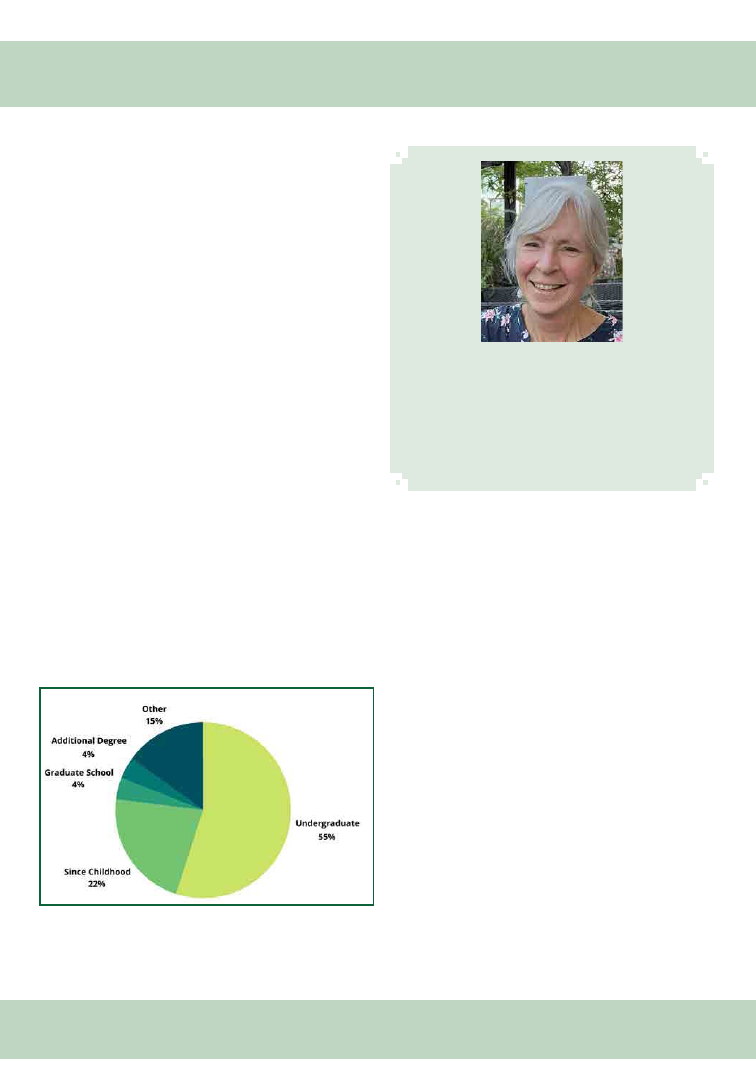
218
Bessey Award Winners Through the Years
Four Things I Learned from
30 Years of Teaching
(That You Probably
Already Know)
By Cynthia S. Jones
Department of Ecology and Evolutionary
Biology, U 3043, University of Connecticut,
Storrs CT 06250 USA
The Botanical Society of America is replete with
excellent teachers. Why? Because botanists have
to be good teachers! The inherent bias against
plants in the United States virtually ensures that
most students, at least until very recently, take
their first plant class in college because it satisfies
a requirement. A good teacher erodes plant bias,
ideally recruiting more than a few students to
the “plant side.” What we do as college teachers
is incredibly important to ensuring the future of
our academic discipline, and there is no better
evidence than the BSA Membership Matters
survey (Figure 1) from June 2022. The majority
responding discovered their passion for botany as
undergraduates. I know I did.
When I first started teaching at UConn, I
developed two upper division courses. One
was Plant Anatomy, which was already “on the
books,” and the second was a course I called
“Plant Developmental Morphology” based on the
principles Don Kaplan taught at Berkeley (Kaplan,
2022). My approach to teaching was exactly what
I had experienced as an undergrad and graduate
student: a lecture/lab format where I gave the
lecture, and a graduate student teaching assistant
taught the lab. Lectures involved chalkboards
and switching between projecting Kodachrome
images and an overhead projector. Lecture
exams were structured in a short-answer format,
primarily based on comparisons, descriptions,
and definitions. Lab exams were based on moving
from station to station every two minutes or so,
largely focused on recognition of features.
I was not an early devotee of PowerPoint lectures,
but three features eventually swayed me: I wouldn’t
have to spend an hour before each lecture pulling
Figure 1. Survey responses to the question “At what point
did you choose botany as a focus of your career or inter-
est?” June 2022, BSA newsletter, Membership Matters.

PSB 70 (3) 2024
219
and organizing slides, I could incorporate new
images much more easily, and finally, I would save
myself the hassle of switching between overheads
and Kodachrome slides. Initially, my PowerPoint
slides consisted of only images and graphs, but I
soon discovered that using the chalkboard for the
rest was awkward because when the projection
screen was down, it covered the center of the
chalk board. It wasn’t long before I began to put
the words and drawings I would have written on
the board into the PowerPoint lectures. Grabbing
images directly from the internet also meant I
could quickly incorporate new material without
finding the original books and papers to photocopy
for overheads. A win-win for me!
Within t
wo years, my evaluation scores declined,
students seemed to sleep more in class, and they
left the lab earlier and earlier.
My realization that I was no longer providing
students with a course that most of them valued led
to some soul searching. For me it was a question
of self-respect—if I was going be in the classroom
(which was part of my job, after all), then I wanted
to do what I could to make it go as well as possible.
I’m not a funny person by nature, so I knew better
than to try to motivate an audience with humor;
nor am/was I brilliant enough to captivate students
just by talking without much prep. My approach
was to present a course focused on content that
was as clear as I could make it and by building a
story line that flowed so one bit of information led
to another. For me, plant development was the
obvious thread, so both of my courses began with
embryos and the plant body grew from there.
All this soul searching resulted in two insights:
(1) I’m introverted enough that although I loved
teaching, I never really “enjoyed” giving lectures—I
learned to do it well eventually—but what I loved
were the students’ “ah ha” moments in the lab, and
(2) I was drawn to teaching because of the plants.
I had to figure out how to let the plants lead. I
decided to try to restructure my courses around
Don Kaplan’s mantra “Ask the Organism
.”
1. Ask the organism
In 2017, my then PhD student Dr. Kerri Mocko,
who had been my TA for several semesters,
graduated. Before she left for her post-doc, I was
able to pay her as an adjunct for one semester and
together, we overhauled Plant Anatomy into what
we called Plant Structural Diversity.
1. First, we created a “studio” time slot. We
changed the schedule from one three-
hour lab to two two-hour labs per week,
with the lab scheduled to directly follow
the “lecture,” resulting in two three-hour
time blocks.
2. We emphasized at the beginning of class
that we were teaching a “skills” course,
not a course that required memoriza-
tion, but at the same time stressing the
importance of the vocabulary. We told
students the first day that by the end
of the course, we expected them to be
researchers, in that they should be able
to make a hand-section of any vegeta-
tive organ on most plants and explain to
someone else its internal structure and
function of cells. Exams would be based
on interpreting material they had never
seen before, or interpreting something
they had seen during the course, but
from a different perspective.
3. We revised every lecture (“content de-
livery”) so that it emphasized structure,
function, and evolution together (e.g.,
a simplified phylogenetic approach to
wood structure was followed immedi-
ately by ecological wood anatomy).
4. We reorganized the lab manual so that
rather than being written in paragraph
form (because students didn’t seem to
read carefully enough to figure out what
they should see), the text was largely
structured in bullet points with open
boxes where they should draw specific
features. Consequently, the important
parts of what they should take away from
each unit were abundantly clear.
5. We carefully matched the lecture and lab
material in short time units, so that one
of us would present content (lecture) for
10–25 minutes (at most, with a few ex-
ceptions), and then students would turn
to the “active engagement” exercises (i.e.,

PSB 70 (3) 2024
220
the lab material). When they finished
looking at the material (we always asked
if it was okay to move on, or we had
them put bright sticky notes on their mi-
croscopes to indicate they were finished),
we moved into the next content delivery
section. This approach had numerous
advantages:
a. Switching between listening and
active engagement keeps students
awake!
b. We could stop talking anytime so
students could make hand sections
and see for themselves what we had
just been talking about. This immedi-
ate reinforcement with living material
turned out to be a powerful teaching
tool.
c. In previous years, we put all the plant
material at the back of the room
and had students pick up what they
needed once lab began. Now, we put
as much of the live material on their
tables at the beginning of class as pos-
sible, so when they sat down, it was
right in front of them. This had two
advantages: (1) some students started
looking at the material when they sat
down, rather than their phones and
(2) we could begin the unit with a
question about the material in front
of them; in other words, as much as
possible we asked them to “Ask the
Organism.”
d. Students didn’t finish units at the
same rate. We encouraged anyone
who was done to move around, go
outside for a few minutes, etc. What
happened most often was that stu-
dents would help each other or just
start chatting. At first, I was a little
dismayed that they were talking about
anything but what they were looking
at, but I soon realized that if we didn’t
interfere, the conversation slid easily
between a show they’d just watched to
“Is this the secondary cell wall?” and
then back to the show. We tried to
keep the chatter at low volume and as
far as I know, no other students com-
plained that they couldn’t concentrate.
Encouraging the movement, breaks,
and the social aspect helped boost the
general enthusiasm and energy level
during the long afternoons.
6. Lecture and lab exams were not separate.
Instead, on the day of the exam, students
would arrive to find a few plants (or
slides) at their desk that they may or may
not have seen before. If a living plant was
represented, they would be responsible
for making hand sections. The exam
would consist of four or five questions
that would require illustration, interpre-
tation, and the rationale for their inter-
pretation; most students stayed the full
three hours to complete the midterms.
From semester to semester, we tried
letting students bring in references, i.e.
their notes. They were not allowed to use
the internet, though. As far as I can tell,
allowing notes didn’t really affect their
grades much, but it did seem to reduce
the stress associated with taking exams.
Another thing I’ve done since before we
restructured the course is that I would grade the
first exam, and then give everyone in the class
the chance to redo it as a take-home, re-grade
the take-home exam, and then record the average
of their scores. I emphasized to them that my
concern was for their learning, not their grades.
In over 30 years of teaching, I had only one student
complain to me that this approach wasn’t “fair” to
the good students. I pointed out that I don’t grade
on a curve, so the “mean” (and the comparison
it implies) was not relevant. (I wanted students
to know how they are doing as we went through
the course, and not count on a mystical curve
at the end to save them.) Students who scored
well the first time didn’t need to spend the extra
time redoing the exam. I also pointed out that I
generally only do this for the first exam. From
my perspective, it helped the students who didn’t
do well on the first exam maintain some degree
of interest in the course, without feeling like there
was no “hope” of eventually getting a good grade.
This perspective is completely selfish on my part,
because who wants to spend the semester trying to
teach students who don’t want to be there because
they have no hope of attaining their goals?

PSB 70 (3) 2024
221
Student reaction to the integrated lecture/lab
format was strongly positive, so the following year,
I reorganized Developmental Plant Morphology
to follow the same format. Since that time, a
few other colleagues in my department have
restructured their lecture/lab classes in a similar
format as well.
Does it take more time? Probably. I arranged the
rest of my schedule so that as much as possible, I
devoted two full days a week to teaching, but very
little time the rest of the week. And since I was in
the classroom during the lab, I no longer needed to
spend a few hours each week on TA meetings. The
TA and I set up the lab together and I explained
what I wanted students to see during that process.
In order for the TA to gain more experience
being in control of the classroom, I offered the
TA the opportunity to be the lead instructor, i.e.,
providing the content and leading the engagement
periods, on as many units as they wished. Most
TAs were happy to lead one or two days out of the
semester but didn’t really want to take the lead
more than that. Was the extra time worth it? For
me personally, absolutely! This format seemed
to make it easier to spark a deeper interest in
the material. I felt like I got to know my students
better, which helped me better understand their
questions and responses to the material, and I
ended up with additional insight into what aspects
of the course worked well.
2. Students like drawing
The traditional approach to recording information
in visually oriented courses (comparative anatomy,
morphology, etc.) is drawing, but at some point,
I began to worry that students would prefer to
work in a digital format, i.e., that my approach
was old fashioned and didn’t involve the “latest
technology.” More and more students were using
their phone to take pictures through the ocular of
the microscope. While I’ve seen some amazing
photos taken this way, getting the focus right
requires very steady hands and careful positioning.
To try to make this easier, in 2015, I received a
teaching grant from my university to purchase a
large screen (since technology in the old building
I taught in was rudimentary) and ten iPad minis
(i.e., one for each pair of students). I worked
with the UConn’s Technical Services department
to design adapters that would position the iPad
minis in place over one ocular for accurate focus.
Now, for the first time, individual students could
share though Airplay what they were seeing on
their scope to the large monitor so that everyone
could see it.
I also posted PDFs of each lab write-up so students
could populate the lab write-up with digital photos
that could be labeled in OneNote.
Surprisingly, almost all students preferred to draw
on the lab handouts. For one thing, the iPad
adapter ended up being slightly cumbersome
to set up and remove, and since it blocked one
ocular, students preferred not to keep it mounted
on the scope. More importantly, students also told
me that especially since the pandemic and flipped
classrooms, almost all of their education was
digital. They spent hours upon hours each day in
front of screens, so it was actually a relief to come
look at something and try to draw it.
3. Students want to do well, but life gets in the way
The first decade of my career I was always on the
watch for people cheating, wary of those trying
to take advantage of the system, and of me. I
was skeptical of excuses. I became much more
sympathetic, and I think a better teacher, when
my step-kids became university students. I finally
began to understand the student experience
from the student perspective. If students missed
assignments or didn’t perform well on a test, I
could appreciate that they had other things going
on in their lives besides my course. Almost
all were pursuing minors, double majors, and
multiple club or organizational activities, in
large part responding to stress of building their
resumes. After I switched to the integrated lecture/
lab structure, I also learned just how many of my
students went from my class directly to a job.

PSB 70 (3) 2024
222
Many people have suggested that course
evaluations from students don’t reflect student
learning. Perhaps… but evaluations often reflect
how students feel about a course.
Students might not remember the details of what we
tried to teach, but they will remember how they felt
about a class and by extension, the subject matter.
More than anything else, my goal as an educator
was to leave students with an appreciation (dare I
say love?) for plants and how they grow, to teach
through awe and discovery as much as possible,
and to respect them as people.
Are there things I wish I’d done differently?
Absolutely. In hindsight, I wish I had incorporated
more inquiry-based techniques than I did. Even
so, nearly all students reported on evaluations
that they learned more, or much more, than
in their other classes. One thing that worked
well was to conduct scavenger hunts inside our
UConn Botanical Conservatory (aka, The EEB
Greenhouses). Scavenger hunts proved to be
effective teaching tools because students had to
use their skills to rule out possible candidates,
as much as to investigate those that exhibited a
feature of interest. I recognize that an incredible
collection of plants in greenhouses adjacent to
our teaching lab building has been an incredible
privilege. It also has been one of the greatest joys
of my career.
4. Spend more time outside
Despite our amazing indoor plant collection,
I regret that I didn’t have students spend more
time outside in both plant structural diversity
and developmental plant morphology. Over the
last two decades, many studies have shown that
outdoor classrooms and educational activities are
incredibly effective for increasing concentration,
creativity, and retention in children (e.g., Coyle,
2010; Kuo et al., 2017). The benefits of outdoor
classrooms at the college level are understudied
(Birdwell, 2024), but based on feedback from
students, the few units of my courses that
did require spending time outside (e.g., tree
architecture) were always the most popular.
Some of the scavenger hunts in the greenhouse
could be converted to outdoor activities, weather
permitting, if I had made the effort. I wish I had.
I have come to believe it is possible to teach our
traditional courses like plant anatomy in such a
way that students not only come to appreciate
plants, but also develop an understanding, even
if subconscious, of a plant’s place in the world,
while at the same time deepening their own con-
nections to the natural world. Would it take some
effort to revise my courses again to do so? Abso-
lutely. But at a time when over 80% of Americans
live in urban environments, it feels imperative
to give it a try. Hopefully, future generations of
botanical educators have already, or will tumble
to this realization sooner than I did.
REFERENCES
Birdwell, T., M. Basdogan, and T. Harris. 2024. Devel-
oping outdoor campus space for teaching and learning:
a scoping review of the literature. Learning Environ-
ments Research DOI: 10.1007/s10984-024-09504-1.
Coyle, K. J. 2010. Back to school: back outside! How
outdoor education and outdoor school time create
high performance students. A report from the National
Wildlife Federation. Website: https://www.nwf.org/Ed-
ucational-Resources/Reports/2010/09-01-2010-Back-
to-School-Back-Outside
Kaplan, D. R. 2022. Kaplan’s Principles of Plant Mor-
phology. CRC Press, Taylor and Francis Group, Boca
Raton, FL.
Kuo, M., M. Browning, and M. L. Penner. 2017: Do
lessons in nature boost subsequent classroom engage-
ment? Refueling students in flight. Frontiers in Psychol-
ogy 8: 2253.

223
Bessey Award Winners Through the Years
By J. Phil Gibson
Professor, School of Biological Sciences
University of Oklahoma
My colleague Dr. Drew Hasley recently began a
seminar presentation with what appeared to be
a blank, white screen, and he asked the audience
to read what it said. Although we were unable
to read the text on the slide, the software on
Drew’s computer—something he uses daily to do
all the things we think of as the “typical work”
of a scientist—was able to detect and read the
title of his talk. The title was written in a white
font on a white background, and Drew, who is
blind, explained that font color and background
are irrelevant to screen readers. He then said,
“People are not disabled. It’s environments that
are disabling.” Following this incredibly powerful
combination of demonstration and statement, he
proceeded to describe what can and must be done
to improve accessibility to STEM education in our
classrooms, lecture halls, and laboratories.
The question, the challenge, the hurdle that
undoubtedly arises for many of us when we
consider accessibility for our science classes
is: “How can I adjust my teaching spaces and
practices to be more inviting and provide
opportunities for all students to learn?” There is
no one-size-fits-all answer to that question. Some
solutions may be relatively simple, such as giving
extended time on assignments. Others may be
more challenging to discern and implement, such
as making a laboratory activity compliant with the
Americans with Disabilities Act. Regardless of the
complexity of the problem, Universal Design for
Learning (UDL) can be an effective starting point
to help teachers identify strategies and solutions
to support learning for all students and help them
achieve their goals as a scientist regardless of a
student’s visible or hidden disabilities.
Universal Design for
Learning Botany
UDL is based on the architectural principle
of Universal Design, in which constructed
environments intentionally contain design
features to improve accessibility or use for one
group of people that absolutely needs that specific
design element and can also provide emergent
benefits to others. The classic example is a feature
we regularly see on sidewalks called “curb cuts.”
These small ramps are commonly found in curbs
and at intersections. They are essential, and
required by law, to help individuals with mobility
issues use wheelchairs or walkers to safely
navigate sidewalks. However, they also benefit
people pulling luggage, pushing a cart, or many
other activities where the curb is anything ranging
from a nuisance to a literal barrier. Automatic
doors provide a similar benefit. Some people need
them, while others benefit from their availability.
UDL is based on the same idea. By designing
and providing educational experiences that
intentionally include features essential for some
students to use them, we can also provide both
anticipated and unanticipated learning benefits to
everyone in the classroom.

PSB 70 (3) 2024
224
UDL originated with the educational non-profit
group CAST. Their mission for over 40 years has
been to promote learning spaces and experiences
that “are intentionally designed to elevate
strengths and eliminate barriers so everyone has
the opportunity to grow and thrive” (CAST.org).
Their approach prompts educators to recognize
that there is no “typical” student and that the real
“normal” situation in any classroom is a range of
differences among our students in how they learn
and express what they have learned. UDL breaks
these differences into three categories: Engagement,
Representation, and Action/Expression. CAST
researchers have shown that these areas are
fundamental to how learners interact with lessons,
perceive and take in information, and demonstrate
their understanding, respectively. For each of these
categories, there are three elements: Accessing
(how students can obtain and use information
and resources), Building (how students construct
knowledge, skills, and understanding), and
Internalizing (how students reflect upon, apply,
and retain learning). CAST combines the three
categories and their three elements into the UDL
guideline matrix (https://udlguidelines.cast.
org) to give educators suggestions for modifying
lessons and removing unnecessary barriers
to make learning opportunities available and
meaningful to all students.
For example, suppose you invite a speaker to
your class, but you have a student who is hearing-
impaired. The challenge in this situation lies at the
intersection of Representation and Access in the
UDL guidelines matrix. A suggested solution is to
provide an alternative means of representing what
the speaker is saying, such as providing a real-
time transcript or an American Sign Language
(ASL) interpreter. While these items are essential
for our hypothetical student, the transcript could
also benefit students seated in the back or in
a noisy part of the room, or perhaps someone
who missed the lecture. The interpreter could
potentially even benefit students studying or
who know ASL. Likewise, the experience could
increase awareness and stimulate interest to learn
ASL. Providing collections of slides before class
is another example. Some students may have an
accommodation that requires providing lecture
slides to them beforehand, but providing them to
all students can benefit others as well. The reasons
of how or why they could benefit other students
is irrelevant. Unless there is a specific reason that
sharing them would somehow hinder learning,
why not give everyone the benefit of having the
resource?
Other challenges require more complex solutions.
For example, my classes frequently involve
constructing and interpreting phylogenies. For
a blind or low-vision student, learning these
things is an immense challenge. Through my
collaboration with Drew Hasley, Kristin Jenkins,
and Hayley Orndorf, we modified an existing tree-
thinking resource called the Great Clade Race (1)
that uses symbols printed on cards and is therefore
dependent on vision to teach tree thinking by
converting it into one that uses tokens, making it
a Tactile Clade Race (2). The tokens are accessible
both visually and tactilely, so just like a previous
example, different forms of representing the
information increased accessibility by removing
the barrier of vision-only access. All other
elements of the activity remained the same, and
assessments demonstrated its effectiveness at
teaching the concepts and skills (2). However, we
also noticed that in the tactile version, students
worked as teams and completed the activity faster
than for the visual form. This revealed several
unintended and unanticipated benefits of our
modification. And therein lies the true value of
UDL: it stimulates changes that are essential for
some but beneficial to all.
UDL is neither a step-by-step process nor a
curriculum structure one can follow to make
lessons and resources accessible. Rather, UDL is
a set of guidelines and suggestions for considering
and identifying items to change. It should be
thought of as an approach or perspective rather
than a checklist to solve problems. Through

PSB 70 (3) 2024
225
thoughtful consideration of course goals and
learning objectives, UDL can help frame issues
and identify solutions. For example, essay
questions are common components of exams and
other assessments to evaluate learning. However,
consider whether an essay is the only way a student
can express understanding. When grading an
essay, ask yourself if you are also using their writing
and grammar skills as indicators of understanding
the topic in the question. Those are two different
skill sets. If writing is part of the assignment,
learning goals, and rubric, there is nothing wrong
with evaluating writing itself—but what if your
goal is to determine if the student understands
a botanical concept such as the structure of a
flower? Would a diagram be an acceptable way
to demonstrate learning as well? What if they
are not a particularly strong wordsmith, but they
are excellent at producing diagrams? We have all
told students at one time or another that we are
not grading their artistic skills when we ask them
to produce labeled diagrams in assessments.
But how often do we extend that same leeway
to questions when, for no specific pedagogical
reason, we ask for or expect written answers by
default or because that’s an easier question to
write? Providing multiple, appropriate means of
expression to show understanding is a solution
at the core of UDL. If you are hesitant about that
suggestion, consider this. In a recent workshop, a
UDL expert demonstrated how a UDL perspective
can help us better promote and evaluate learning.
Here is a botanical modification of their activity to
demonstrate this point. Get a pen and paper and
draw a flower. First use your dominant hand. Do
the same using your non-dominant hand. Now
hold the pen or pencil in the crook of your arm
or with your foot to draw a flower. Now suppose
I am evaluating your knowledge of botany
based on whether you drew the parts correctly
and how well you drew a flower with your foot.
Although some of you may draw quite well with
your foot, that would hardly be a fair assessment
of knowledge, right? I may have a perfectly valid
reason for trying to find someone who can best
draw a flower with their foot. But if what I want
to determine is whether you know the parts of a
flower and how they are put together, why would
I try to base my evaluation of knowledge on the
quality of the drawing? We make a similar mistake
when we expect students to demonstrate thoughts
and knowledge in a restricted way that may not
allow them to be at their best to express them.
When we use writing skills to evaluate knowledge
of something else, we are making the same error
as in my flower-drawing example. UDL provides
ways to prevent that from happening. I am not
advocating that we let students decide which
assignments they will do or the form they will take
for all assignments, although that is an intriguing
idea. What I am asking you to consider is whether
there are other ways, or more available options,
that would allow students to do their best work.
There might be one question remaining that you
are asking about UDL: “Why do this before I
need to do it?” Of course, we would all provide
any accommodations for students upon being
informed by the appropriate campus office, and
so one could wait until the need arises to do any
of this. To that point, I ask that you consider
the differences between accommodation and
accessibility, and the consequences of their
differences on teaching and student experiences.
Both share the important goal of increasing
inclusion of all learners in the classroom or
laboratory. However, accommodation typically
involves reacting to specific needs once made
aware of them—usually just before the start
of a semester only a few days away—and then
modifying lessons, activities, or assessments so
they can be used by a particular learner. This often
results in frantic, last-minute changes at a time
when there is little free time available. In contrast,
thinking about how one can improve accessibility
via UDL takes a proactive approach by carefully
considering, designing, or modifying lessons
and activities from their inception or as part of
regular curricular updates to include features that
are essential to support learners that have specific
needs and can potentially benefit everyone.

PSB 70 (3) 2024
226
This approach to solving problems beforehand
usually results in more thoughtful solutions
that are aligned with learning goals rather than
last-minute modifications that just need to be
“good enough” to work. A proactive accessibility
stance is better than a reactive accommodation
stance for several reasons. It increases inclusivity
by ensuring that learning environments and
experiences allow everyone, regardless of ability,
to participate fully. It is more efficient simply
because including accessibility features upfront
saves the instructor time as compared to adjusting
later. Anticipating learning challenges and student
needs is also empowering for individual students
because it gives them the freedom to navigate
their learning and opportunities to do so without
asking for special accommodations. Last, and
possibly most importantly, using a UDL stance
to increase accessibility benefits for everyone in
the classroom or lab creates a positive learning
and working environment because it promotes a
culture of inclusion and respect for all students
and their needs.
Albert Einstein once said, “Everyone is a genius.
But if we judge a fish by its ability to climb a tree,
it will live its whole life believing that it is stupid.”
We should think about that before we step into our
classrooms. We often teach and assess in ways that
are comfortable to us, ways we have experienced,
ways we would show our understanding, or ways
that we haven’t really dissected pedagogically.
It’s easy to think that if it worked for us, it must
be good—or at least it will work for the average
student. As I mentioned earlier, the average
student is a mythical creature. Our students are a
rich tapestry of diverse needs, experiences, goals,
abilities, and motivations. We must remember that
what we do in the classroom or laboratory is about
providing students experiences and opportunities
to learn, gain skills, develop skills, and do their
best. I am not asking anyone to immediately make
wholesale changes in their teaching. I am asking
that we all at least examine our classes through a
UDL lens, and identify one thing or one aspect of
a course or a lesson that can be improved by UDL
modifications. Doing that one little thing can have
a huge, positive impact. As botanists, we are quite
familiar with that idea. Just remember that doing
one little thing to increase accessibility is just like
planting a seed. And we all know how the one
small action of planting a seed, like knowledge,
can have huge consequences once it starts to grow.
REFERENCES
Goldsmith, D. W. 2003. The Great Clade Race: Pre-
senting Cladistic Thinking to Biology Majors & Gen-
eral Science Students. The American Biology Teacher
65: 679–682.
Hasley, A. O., K. P. Jenkins, H. Orndorf, and J. P. Gib-
son. 2024. Tactile Trees: Demystifying Phylogenies
for Everyone with Universal Design for Learning. The
American Biology Teacher 86: 281–288.

227
Bessey Award Winners Through the Years
By Christopher T. Martine
Department of Biology, Bucknell University
A few days ago, I had a visit with my Field Botany
class to the campus farm on the southeastern
edge of Bucknell University, where I have been
employed as a professor since 2012. The visit to
the farm, where we met crop plants and discussed
their taxonomic connections to the wild species
we have thus far learned, capped off a big week for
our group. For the previous class we left campus at
7:30 a.m. for a 4-hour trip to the Mohn Mill Natural
Area, a designated Wild Plant Sanctuary in Bald
Eagle State Forest. The site, just off Pennsylvania’s
Mid State Trail, is dotted with large circular vernal
pools populated with enough “Osmunda” ferns
to make one feel as though you have stepped
back into the Jurassic. But the highlight of this
annual excursion is always the moment when
I tell the students, as they are lined up across a
narrow wooden bridge on the Mid State looking
down into the forest, that—only 5 weeks into the
course—they would be hard-pressed to find a tree,
shrub, forb, or fern that they don’t recognize and
know the Latin name for (Figure 1).
This group of 17 juniors and seniors had learned
something like 75 species by that point, so their
handle on this particular woodland was a function
of similar plant communities we’ve visited and
the plants we’ve seen in them (and, of course, the
work the students have put in to memorize Latin
names and recognize species when they come
into view). Still, even with caveats, staring into
nature and realizing you are seeing it in an entirely
different way than a month ago is a powerful and
deservedly pride-inducing moment.
Field-Based Courses Still
Matter, but not Like
They Used To
So who are these students? Almost all of them,
like many of the students I have taught in 19 years
of professing at Bucknell and SUNY Plattsburgh,
are Biology majors taking my class to fulfill an
upper-level requirement in ecology/evolution.
Many of them are headed for careers in health and
medicine; a number of them will be MDs. Content-
wise, Field Botany is a one-off for the majority of
my enrollees. And, if I am being honest, this is
one of the best things about teaching the class:
it is a one-semester opportunity to initiate a life-
changing shift in perspective.
When I took my first field course, Dendrology, at
Rutgers University in the fall of 1993, this is exactly
the shift that happened for me. I added a few
more undergrad course-based field experiences,
thereafter, including two 5-week summer field
courses in Newfoundland and in Alaska. But, for
me, the die had been cast the moment I aced my
first tree/shrub identification quiz. I knew that I
would someday seek out opportunities to teach in
similar ways, with the hope and intent to connect
students to nature by teaching about real things in
real places.
I started as an undergrad TA in that same Dendro
course; later, as a Master’s student, I taught the
whole class as a sabbatical replacement. Working
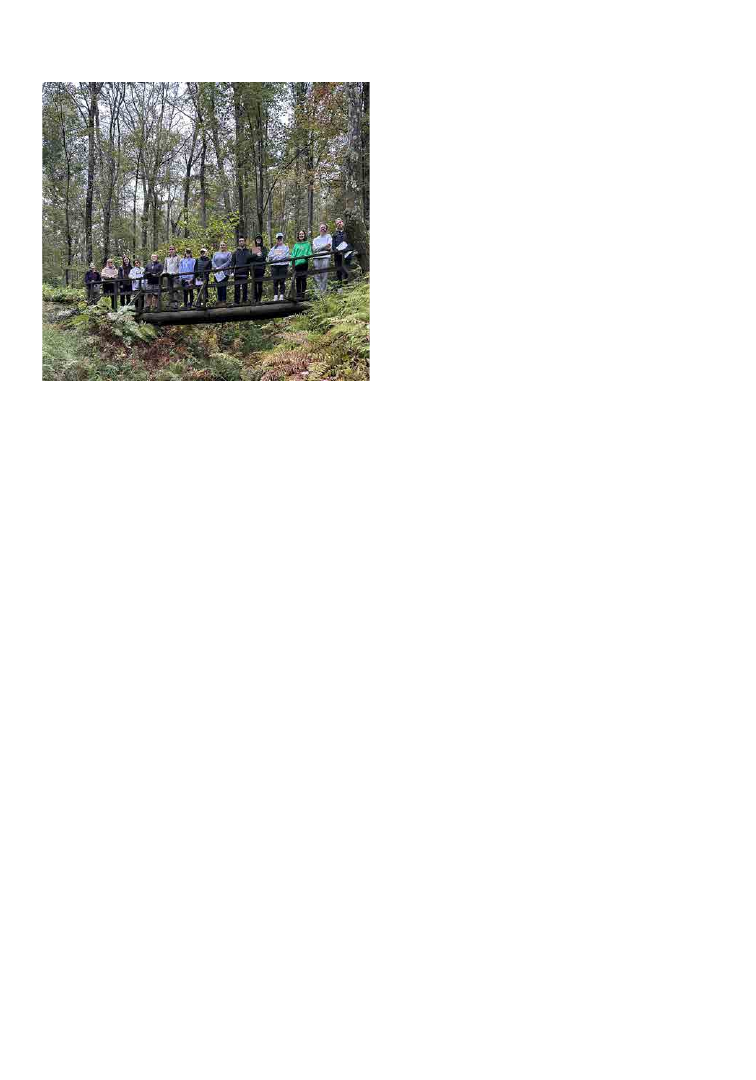
PSB 70 (3) 2024
228
for two government agencies I managed K-12
outdoor education programs and then, privately,
co-ran a few years of K-4 summer outdoor camps
with my wife, Rachel. And when I got my first
tenure-track job at SUNY Plattsburgh in 2006, I
immediately added Field Botany to the Biology
curriculum. At that point in time, the students I
was teaching had had childhoods a lot like mine.
Students who were 21 or 22 years old in 2006 were
born in the mid-1980s; they had dealt with idle
time free of constant smart phone access. They
were inherently aware of their surroundings much
of the time.
Yet by the time I arrived at Bucknell in 2012 and
developed a new version of Field Botany, I could
already tell things were changing. So could a
lot of people, as perhaps best evidenced by the
publication and popularity of Richard Louv’s Last
Child in the Woods in 2013—and the suddenly
widespread use of the phrase “nature deficit
disorder.”
Some would say things have only gone downhill
since then. Students who are 21 or 22 years old in
2024 were born around 2003. Everything about
their childhoods was different from mine. Smart
phones, tablets, laptops, constant connection…
and constant reasons for not being outside, or
taking long hikes, or camping or fishing or looking
up at the night sky. These students grew up over-
scheduled, over-managed, and overly focused on
extracurriculars and youth sports. Many spent
years of their lives outside—but on athletic fields,
not in the woods or down in the creek. Their
connection to nature has been mediated by screens
or experienced through enough filters to make
nature itself feel like artifice. The distance between
students and a comfortably broad understanding
of the biodiversity around them persists even after
heading off to university.
Upon arrival to college, Biology and similar
majors are often now plugged into courses with
integrative approaches that have become the way
we introduce biology at many institutions, with
current students not experiencing (for better or
worse) the same semi-exhaustive march through
general biology content that previous generations
faced. Case in point: Bucknell’s new four-course
introductory core sequence. Lauded on campus
for an approach focused on student retention,
skills-building, and accessibility, our content-
based courses consist of case studies that vertically
integrate subdisciplinary content. What was once
a 4-week unit on plant diversity and evolution
is now a 4-week module on “Milkweeds and
Monarchs” touching on topics including ecological
niches, interspecific competition, plant response
to herbivory, transport across membranes, neuron
structure and function, impact of mutations,
and predator adaptation. It’s all pretty great and
students gain a lot with this approach, learning to
understand the multi-dimensionality of biological
problems. But one trade-off is that they also
receive less traditional content, including a deep
primer on general botanical concepts. When these
students arrive as juniors or seniors in my Field
Botany class, they typically know little about the
life of plants unless they have learned it outside of
their formal education.
“Get off my lawn/front-yard-wildflower-meadow,”
cries the old-guy botanist.
Figure 1. Students enrolled in the 2024 edition of Field
Botany at Bucknell University on Pennsylvania’s Mid
State Trail, one of 20 locations the class will visit this se-
mester.

PSB 70 (3) 2024
229
I am (in this moment) not being that guy, however.
Because as much as the above items do present
a challenge, they also present an important
opportunity.
For proof, let’s return to the Mohn Mill Natural
Area, where my class spent time hanging
around a sphagnum-dominated mountain
“boglet” discussing glacial cycles and rates of
decomposition. A student later reflected that
they had heard about bogs in other classes, and
even learned the story of “Tollund Man” (the
ancient preserved body recovered from a bog in
Denmark), but they never imagined that they
might live anywhere near a similar sort of place—
let alone one they would someday visit IRL. To
be standing in an actual “bog,” feeling the give of
the peat, allowing the water to infiltrate your old
pair of sneakers and soak into your socks… to be
introduced to plants that grow nowhere else but in
these particular habitats and to understand why…
this completes the picture. This is the stuff you
now never forget.
When we teach field courses, we provide the
context to so much of what our students have
already learned and may learn later on; it is
integrative biology on steroids.
Increasingly, these courses are also providing the
first real opportunities for students to experience
nature in meaningful ways. As a baseline, even
before the content delivery and the graded
assessments, this is already enough to change the
way a person feels in the world and to spark an
appreciation for the life around them. This is why
field-based courses still matter, but not like they
used to. These days, they might just matter more
than they ever have.
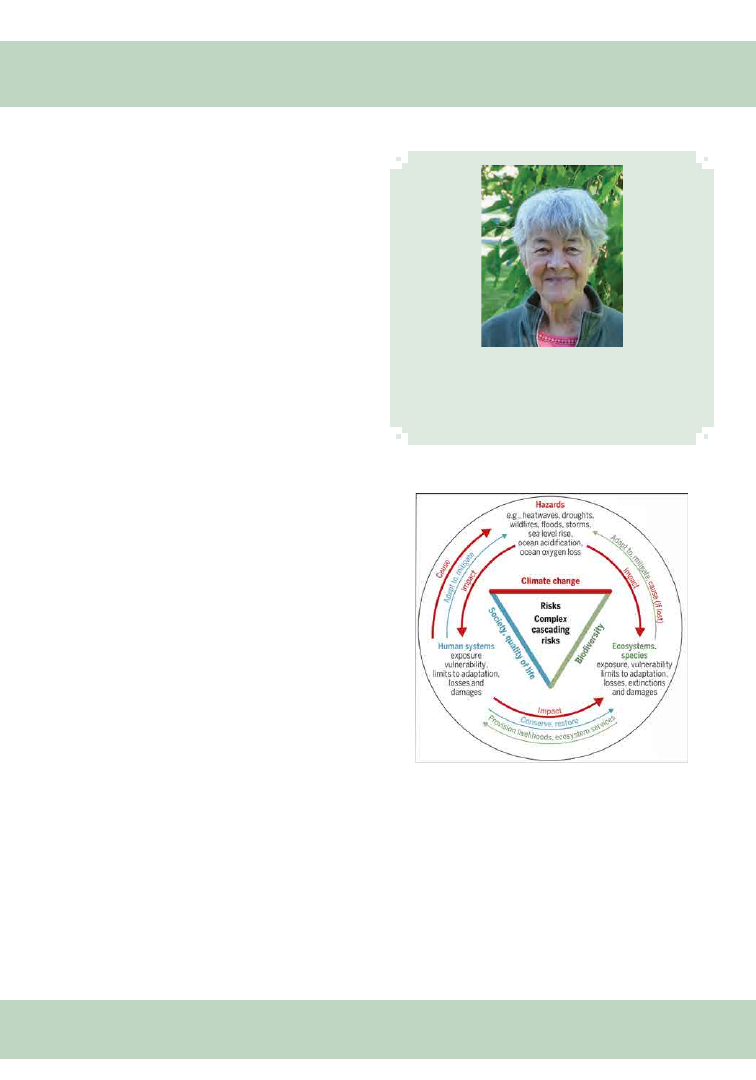
230
Bessey Award Winners Through the Years
A key feature in connecting students to nature
and the botanical world is to get them to “see” the
diversity of botanical textures in the green world
around them. Neo-natural history, where we take
a closer look at each plant, adds new dimensions
and wonder at the way we look at plants. It trains
the eye to recognize the importance of plant
diversity in scientific discovery and to understand
the critical role of plant diversity on our quality of
life. If we are to make progress in addressing the
two main environmental crises of climate change
and biodiversity loss (Figure 1; Pörtner et al.,
2023), an appreciation and understanding of the
multiple ways plants provide solutions is critical.
Plants are key in solving these dual environmental
crises (Griscom et al., 2017; Pörtner et al., 2023;
Zielinski et al., 2023). There is no more important
time than now for us to teach plant diversity both
to make new discoveries and to find creative
solutions to environmental problems.
Seeing the diversity of plants first hand in the
field and lab provides an indelible experience that
trains the eye to see, leads to new discoveries,
provides examples of the power of the comparative
approach, and gets students to recognize the
critical role of biodiversity in our environment.
With over 400,000 plant species globally (Enquist
et al., 2019), we as botanists are blessed with
having an almost limitless number of species to
explore and to fuel new discoveries. Almost every
plant has something unique or special. From the
seemingly simple morphology of bryophytes to
the extraordinary diversity of the most complex
flowers, fascination dominates. Here I highlight
Neo-Natural History:
Careful Observation and
Co-Discovery in Teaching
Botany
By Joan Edwards
Williams College
Figure 1. Plant diversity can provide solutions to the
twin environmental crises of climate change and biodi-
versity loss, which are coupled through human-caused
dynamic interactions. Each of the three factors on the
triangle (biodiversity, climate change, and society) im-
pact each other (red arrows). Humans have the ability
to improve our quality of life by mitigating the negative
impacts (blue arrows) and in return, restoring, or gaining
valuable services (green arrows). (Adapted from Pörtner
et al., 2023.)
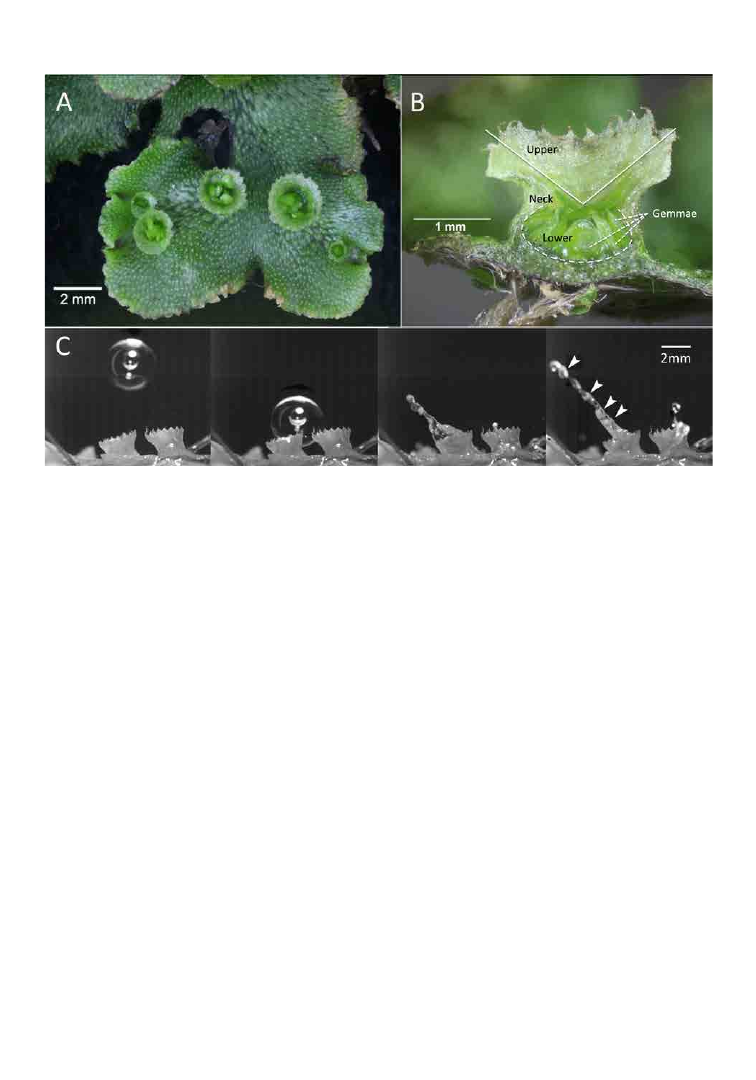
PSB 70 (3) 2024
231
two approaches. The first is to look in depth at
multiple features of a plant to highlight how they
persist and their role in the environment. The
second is to look at a plant over time to chart the
evolution of plant behavior. I describe easy-to-
access examples that may surprise, delight, and
inform.
Looking closely at the multiple dimensions of
a single plant creates a fuller picture of plant
function and its role in the environment. An
excellent example is close examination of
Marchantia (Figure 2A), a relatively easy to access
liverwort often growing at the base of buildings
(even in February), but also found as a “volunteer”
in greenhouses.
These small non-vascular plants are worth a close
look because they are relatives of the first land plants
(Qiu et al., 1999) and had a profound impact on
the environment. These early cryptospores were
responsible for lowering the atmospheric levels
of CO
2
and for triggering a mini–ice age during
the Ordovician over 400 mya (Lenton et al., 2012).
They are also responsible for the current levels of
oxygen in our atmosphere (Lenton et al., 2016).
There is almost a disconnect when students realize
these small, seemingly inconspicuous plants had
such a profound impact on our environment. If
small liverworts can impact climate, what about
the impact of eight billion people?
If we look at Marchantia’s relatively simple
morphology (Figure 1A), we see a dichotomously
branching ground creeper that can never grow
tall but can hopscotch across the landscape by
harnessing the power of raindrops to jettison
gemmae to new locations. The gemmae cups
(Figure 2B) provide an example of evolutionary
design where the urn shape provides a lower
chamber in which new gemmae are produced and
the top funnel shape serves as a launching site to
Figure 2. (A) Top view of the dichotomously branching liverwort,
Marchantia,
with mature and developing gemmae
cups extending from the surface. Individual cells, each with a central pore (white dots) are clearly visible. (B) Longi-
tudinal section of a gemmae cup shows a lower chamber that produces gemmae and a funnel-shaped upper chamber
that captures the energy of a falling raindrop and jettisons the gemmae. (C) Still frames from a video of a water drop
hitting a gemmae cup and transporting gemmae-filled droplets (arrows). Filmed at 3000
fps
with a 20-
ms
exposure.
Parts B and C are from Edwards et al. (2019).
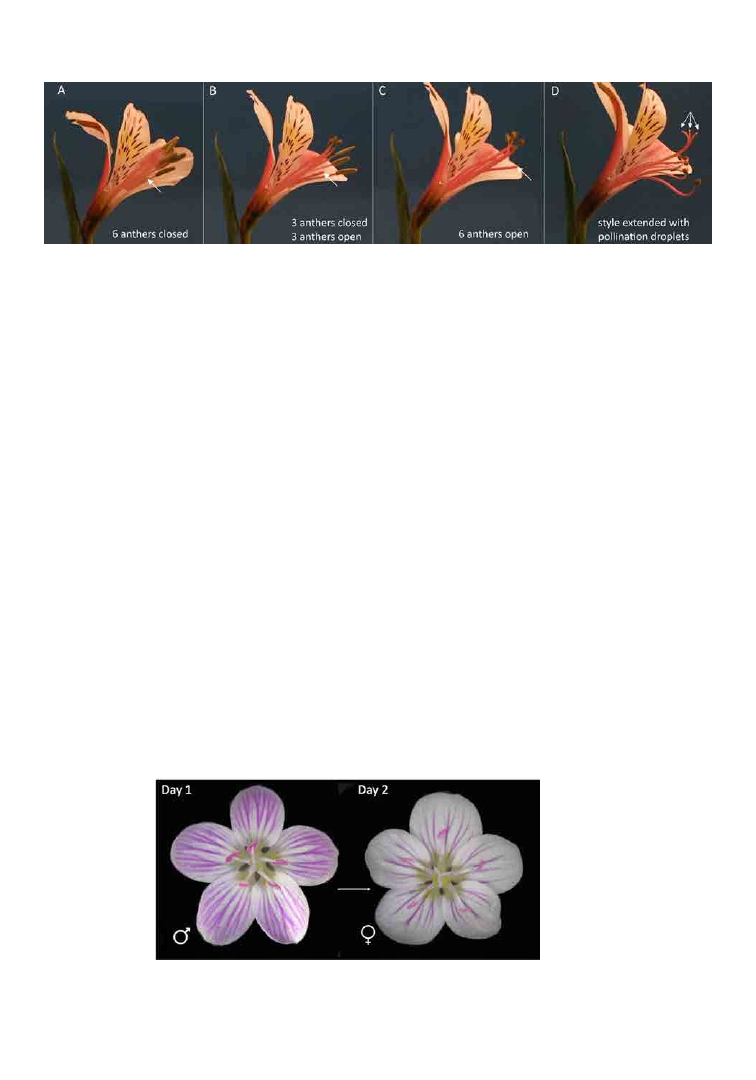
PSB 70 (3) 2024
232
Figure 3. Alstroemeria flowers are protandrous, starting as male and switching to female. (A) All six anthers
are still closed and the style is immature. (B, C) Male phase. Anthers mature in two groups. First, three anthers
curl up and dehisce (B) and then later the remaining three anthers curl upwards and dehisce (C). (D) Female
phase. The anthers have dropped down and the style has extended, curled upwards and split into three stigma
lobes each with a pollination droplet. Stills are from a time-lapse video filmed in the lab over nine days. The tip
of the style is indicated by arrows.
capture the energy of a falling raindrop to splash
and propel mature gemmae, which have risen to
the surface. Marchantia thus provides a lesson
in biomechanics and dispersal mechanisms for a
non-vascular plant.
If we follow a plant over time, we can document
movements in plant behavior and gain insight
in terms of floral design, breeding systems, and
maintenance of species in nature. Plants are
unexpectedly agile in their movements that range
from the explosive flowering in the bunchberry
dogwood (Cornus canadensis), which opens in
<0.5 ms (Edwards et al., 2005), to the more subtle
movements of phototropisms and geotropisms.
Here I highlight three examples of flowers that use
movement to switch from one sex to another.
The first example is Alstroemeria, a genus native
to South America, but almost always available in
florist section of local grocery stores. Alstroemeria
flowers are protandrous, where anthers dehisce
first; later, the style lengthens, curves upwards,
and splits into three lobes, each topped with a
pollination droplet (Figure 3). Using florists’
samples, students can observe these changes
directly in real time.
The second example is the flower of spring beauty
(Claytonia caroliniana), which is accessible in New
England for field observation in the early spring.
The flowers of Claytonia are also protandrous.
In a field population, flowers are typically in
different stages of development. On the first day
of flowering, stamens are held erect and dehisce
presenting magenta-colored pollen. On the
second day, stamens reflex back and the style splits
into three stigma lobes (Figure 4).
Figure 4
.
Claytonia caroliniana flowers are protandrous. On day one of flowering, the stamens are held upright and
dehisce, presenting pollen. On day two, the stamens bend back toward the petals and the stigma splits into three lobes.
By day three, most flowers begin to close.
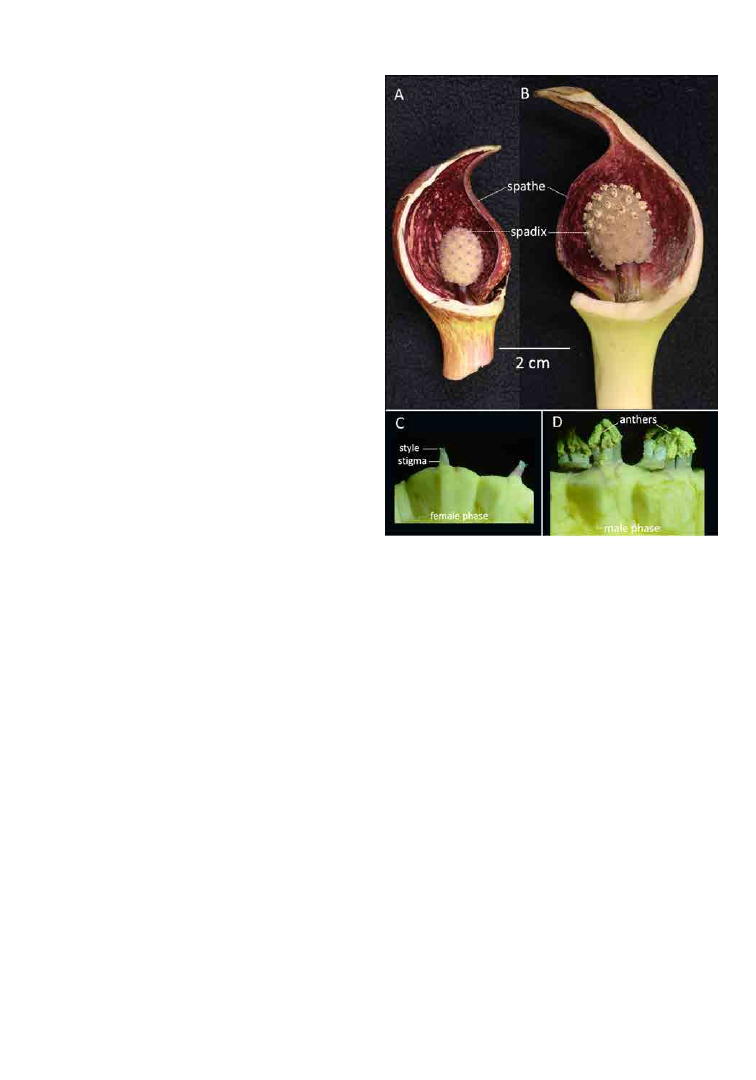
PSB 70 (3) 2024
233
Figure 5. Symplocarpus foetidus flowers are protan-
drous. (A) Spadix with flowers all in female phase. (B)
Spadix with flowers transitioning with the upper flowers
in male phase and the lower flowers still in female
phase. (C) Female phase flowers showing the stigmas
and styles just protruding from the petals. (D) Male
phase flowers with stamens, which have extended above
the petals and dehisced presenting pollen.
The final example is the flower of the iconic skunk
cabbage (Arisaema triphyllum), which, if available,
is well worth a field trip to observe the plants in
situ. This allows one to experience first-hand the
strong skunky odor, the wet swampy habitat, the
extraordinary structure of the spathe and spadix,
and the behavior of the flowers. Here in New
England, skunk cabbage is our earliest blooming
wildflower. It has protogynous flowers (Figure 5)
but is also amazing in heating up to 35ºC above
ambient air temperatures with a metabolism
equivalent to that of a small mammal (Knutson,
1974), producing a skunk-like odor, and having
specialized idioblast cells filled with double
pointed raphide crystals. When broken, idioblasts
shoot out these glass “spears” presumably as a
protection against herbivory (see video in Pickett-
Heaps and Pickett-Heaps, 1984).
Looking closely at plants both in the laboratory
and in their natural setting can be foundational,
can serve as a key part of teaching botany, and
can contribute richly to learning and discovery
in botany. Most students long remember visiting
skunk cabbage in its native habitat, or a visit
to a Sphagnum-dominated kettle-hole bog, or
even observing the self-digesting flowers of
Tradescantia, the unfolding and sexual switch
of an Alstroemeria flower, or the sparkle on a
Pelargonium petal. The list is endless. By providing
a full context for plant behavior and enriching
it with direct observation in both the field and
the lab, we can give students an entree into new
discoveries, train their eyes to “see,” and provide
them the tools to interpret plants and their role
no matter where they go. If we are to solve our
twin environmental crises of biodiversity loss and
climate change, a keen eye and a knowledge of the
diversity of plants is key.
REFERENCES
Edwards, J., D. Whitaker, S. Klionsky, and M. J. Las-
kowski. 2005. A record-breaking pollen catapult. Na-
ture 435: 164.
Edwards, J., M. Laskowski, T. I. Baskin, N. Mitchell, and
B. DeMeo. 2019. The role of water in fast plant move-
ments. Integrative and Comparative Biology 59: 1525-
1534.
Enquist, B. J., X. Feng, B. Boyle, B. Maitner, E. A. New-
man, P. M. Jørgensen, P. R. Roehrdanz, et al. 2019. The
commonness of rarity: Global and future distribution of
rarity across land plants. Sciene Advances 5: eaaz0414.
Griscom, B. W., J. Adams, P. W. Ellis, R. A. Houghton,
G. Lomax, D. A. Miteva, W. H. Schlesinger, D. Shoch, et
al. 2017. Natural Climate Solutions. Proceedings of the
National Academy of Sciences 114: 11645-11650.

PSB 70 (3) 2024
234
Knutson, R.M. 1974. Heat production and temperature
regulation in the Eastern skunk cabbage. Science 186:
746-747.
Lenton, T. M., M. Crouch, M. Johnson, N. Pires, and L.
Dolan. 2012. First plants cooled the Ordovician. Na-
ture Geoscience 5: 86-89.
Lenton, T. M., T. W. Dahl, S. J. Daines, B. J. W. Mills,
K. Ozaki, M. R. Saltzman, and P. Porada. 2016. Ear-
liest land plants created modern levels of atmospheric
oxygen. Proceedings of the National Academy of Sciences
113: 9704-9709.
Pickett-Heaps, J., and J. Pickett-Heaps. 1984.
Living
Cells: Structure, Function, Diversity [DVD]. Sinauer
(Oxford University Press).
Pörtner, H.-O., R. J. Scholes, A. Arneth, D. K. A. Barnes,
M. T. Burrows, S. E. Diamond, C. M. Duarte, et al.
2023. Overcoming the coupled climate and biodiver-
sity crises and their societal impacts. Science 380: 256.
Qiu, Y. L., Y. Cho, J. C. Cox, and J. D. Palmer. 1999.
The gain of three mitochondrial introns identifies liv-
erworts as the earliest land plants. Nature 394: 671-674.
Zielinski, C. et al. 2023. Time to treat the climate and
nature crisis as one indivisible global health emergen-
cy. British Medical Journal 383: 2355. [This editorial
was published in many journals.]

235
Bessey Award Winners Through the Years
By Marshall D. Sundberg
Roe R. Cross Distinguished Professor of
Biology – Emeritus, Emporia State University,
Emporia, KS
As a college sophomore in 1968, I was first
introduced to a novel way of instruction by my
botany professor, William Muir. Muir’s approach
was unique in many ways, starting with the fact
that he had just lost his sight as a complication
of diabetes. He lectured, without notes, and
drew sketches on the board using one hand as a
placeholder as he sketched—and then quizzed
us to be sure we understood what was being
illustrated. If you were the one called on, you
would have to carefully describe what you saw and
what it meant—carefully enough that someone
who could not see it (Dr. Muir) would understand
what you meant. For the rest of my career, this was
a tool I would use, particularly in lectures, whether
it be for small seminars or lectures of more than
300 students. Several examples are described
below, and many are also included in Uno et al.
(2013). (Copies of this book are still available from
the BSA office: https://crm.botany.org/civicrm/
contribute/transact?reset=1&id=8.)
A second unique approach was to critique the
textbook, as necessary, during the course of the
class. This was only done occasionally, and for
“big” things in the introductory course, but it
was a main component of upper division courses.
For the latter, this consisted of mimeographed
handouts of corrections, elaborations, or current
research, related to the chapter being discussed. I
still have many of these as folded chapter inserts in
undergraduate textbooks I’ve kept in my library.
I’ll give some examples below of the kind of
textbook “updating” I used in class. The “mimeo
Using Inquiry as a Tool to
Help Students Develop a
More Sophisticated
Understanding of Frequently
Misunderstood Concepts
handouts” remain the model I use when reviewing
manuscripts and textbooks.
The third characteristic that set Muir apart was
his philosophy of science. Virtually every science
teacher I ever had, including Muir, emphasized the
power of science in developing an understanding
of nature. But Muir also emphasized the limits of
science. The usual way of doing science emphasizes
finding a solution to a particular problem, but
this narrow focus often results in unintended
consequences that might have been avoided if a
broader perspective was used. Especially in applied
science, implementation is often dependent on
many different non-science constraints: economic,
legal, environmental, social, religious, and more.
Finally, the fact that science grows by building on
the foundation of existing knowledge (accretion)
makes it very difficult to accept any paradigm-
shifting innovation. I begin with my favorite
example of a paradigm shift that occurred during
my career.
Accepting a Paradigm Shift
Endosymbiotic Origin of Eukaryotic Cells
In the 1960s, it was just becoming accepted
that bacteria and blue-green algae were closely
related and shared features termed Prokaryotic.

PSB 70 (3) 2024
236
One taxonomic question was “Should at least
the bacteria be split out of the Plant Kingdom?”
The author of my textbook (Cronquist, 1961) put
them together in a single division separate from
the rest of plants. Regardless, everyone agreed that
blue-greens evolved from bacteria and the green
algae probably did as well. Both were the result of
repeated mutations, recombinations, and natural
selection over the course of millions of years. At
the start of my Plant Evolution course, Spring Term
1970, Muir made us aware that a young biologist,
Lynn Sagan [Margulis] had published a paper 3
years earlier suggesting eukaryotic cells arose via
symbiosis between pre-existing prokaryotic cells.
Two years later, as a rookie grad student, I listened
to her plenary address at the 1972 American
Institute of Biological Sciences Annual Meeting in
Minneapolis. It was in Northrup Auditorium with
several thousand biologists present. At the end of
her talk, half the audience was politely applauding,
but the rest were jeering! This was my introduction
to professional scientific meetings and thankfully,
I’ve never seen anything like it again. Evolution
by anything other than natural selection was
considered heretical. Endosymbiosis is one of
those paradigm shifts that is now well accepted,
and I’ve told this story every time I’ve taught it. I
approach this in class by presenting the traditional
interpretation, the new alternative, then asking
for what kind of evidence would be necessary to
support the alternative. Now, here’s the evidence
and we can move forward.
Primary Root Growth
This is an example where the lecture component
is covered in “Inquiring about Plants” (pp. 80-85).
Briefly, I present students with a macrophotograph
of a growing root tip and ask individuals to
describe different parts of the image and/or
speculate on the possible function of a particular
part. We finally focus on the “naked” tip and switch
to a photomicrograph of a longitudinal section
showing the root/root cap junction (Figure 1).
I tell students to make a sketch of the general
patterns they observe and to predict how cell
divisions might produce these patterns. Finally,
based on their interpretation, where would they
expect most cell divisions to occur? The patterns
suggest this should be near the arrow in the figure
and this, in fact, is what was in Cronquist’s (1961)
textbook. I then show the radiomicrograph and
explain how it was made (Figure 2). Onion roots
were grown for 24 hours in a tritiated thymidine
solution so that any nucleus that underwent
mitosis would pick up the radioactive tracer. The
dark spots cover nuclei that picked up the tracer.
The region we thought would have the highest
mitotic activity actually has the least: the quiescent
center. This was first proposed by Clowes (1950),
but it was 6 years before he confirmed his theory
using radioactive tracers as shown above. I then
challenge the students to devise an experiment
we could actually do in our laboratory, in a single
lab period, to confirm the presence of a quiescent
center. The hint is mitosis and we’ll see this below.
Some other paradigm shifts during my teaching
career include transposable elements modifying
the Central Dogma of DNA and the role of
epigenetics in producing “inheritance of acquired
characteristics”: a neo-Lamarckian, and even
neo-Darwinian “gemmules” concept. A possible
paradigm shift, in process during the last decade,
relates to consciousness and behavior in plants.
Schlanger (2024) provides a readable, well-
documented lay account of the current status of
this theory.
Challenging the Textbook
Primary Growth of Roots
Clowes (1950) first discovered the quiescent
center by looking at the distribution of mitotic
figures in longitudinal sections of root tips. This
is where I lead students in my question above.
However, what I’m interested in during this lab is
not just finding evidence of the quiescent center,
but in examining the relationship between cell
division and cell enlargement in the growth of the
root. For the latter, any old onion root tip slide will
do, but if you also want to identify the quiescent
center you must use a near-median section.
When I first developed this activity, I examined
every onion root tip slide in the department’s
collection for all courses. Out of more than 200
slides, only 22 were near median and I set these
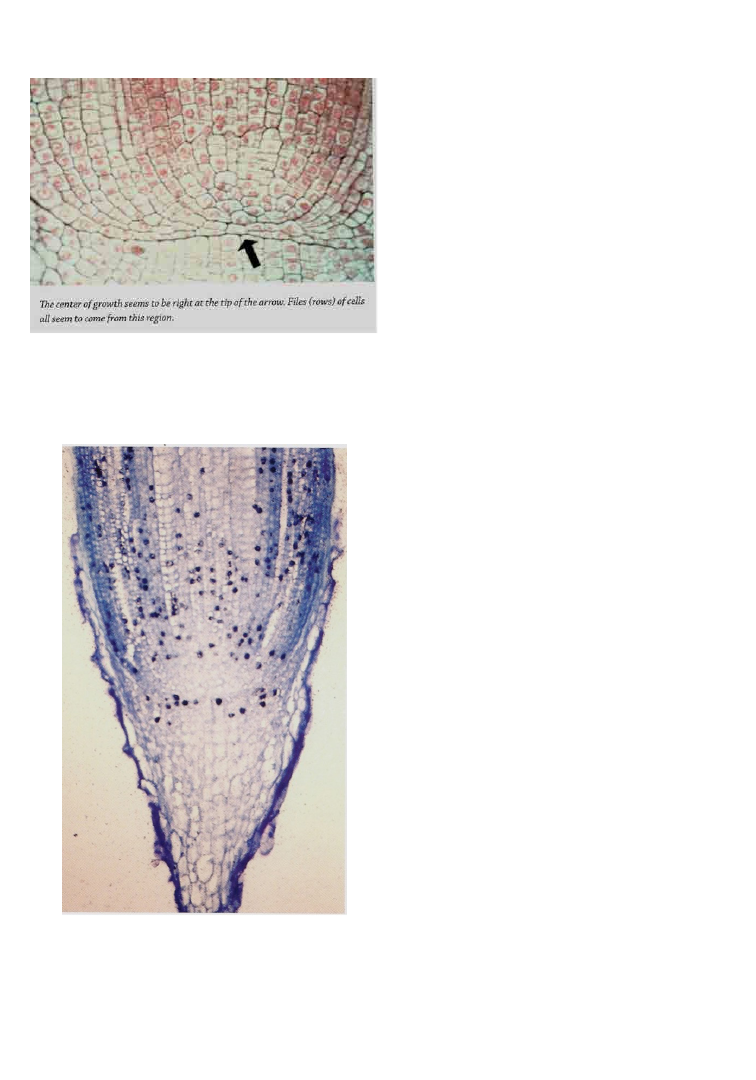
PSB 70 (3) 2024
237
aside specifically for this lab. The procedure for
this lab is detailed in Sundberg (1981). Students
observe four sequential fields of view, at 40X,
beginning with the intersection between the root
cap and root apical meristem at the bottom edge
of the first field. They must determine the average
cell length and width from median vertical and
horizontal files across the field. Estimate the total
number of cells in the field by dividing the area of
the field by the area of a single cell and calculate
the mitotic index (MI) (number of cells showing
mitotic figures / total number of cells) X 100.
(An additional benefit of this lab is the necessity
to do some basic mathematical computations.)
To indicate the presence of the quiescent center,
divide the total number of cells in the field by 3
and separately calculate MI for the estimated
bottom, middle, and top thirds of the first field of
view, centered just above the root cap (fields IA,
IB, and IC). When data collection is completed for
this field, move the slide so cells at the top edge
of the original field are now at the bottom of the
new field of view and observe and collect data
for the entire field II. This process is repeated for
fields III and IV. Plot the data as in Figure 3. In
general, as you move from the tip to the base of the
root, the average cell length increases and the MI
decreases. The low MI in field IA is an indication
of the quiescent center. These is the types of data
originally used by Clowes to predict its presence.
Finally, I ask students to make a sketch of the entire
longitudinal root they observed and then, based
on their data, label the zones of cell division, cell
elongation, and cell maturation as is often found
in textbooks. Figure 4A is from Campbell (Urry
et al., 2023) and 4B is from Raven and Johnson
(Raven et al., 2023). Do you see the difference
in the labelling of these zones? Which figure is
supported by the student data in Figure 3? (Hint:
Are the zones discrete or do they overlap?)
Monocot Stem Structure
One of my favorite examples of challenging
the textbook in lecture involves the structure
of monocot stems, and I feature it in “Inquiring
about Plants.” Most biology textbooks describe
Figure 1. Longitudinal section of a maize root at inter-
section between the root cap (below) and tip of the root
apical meristem.
Figure 2. Radiomicrograph of an onion root tip in medi-
an longitudinal section. Black covers nuclei that emitted
radiation by incorporating labelled thymidine into their
DNA following cell division.
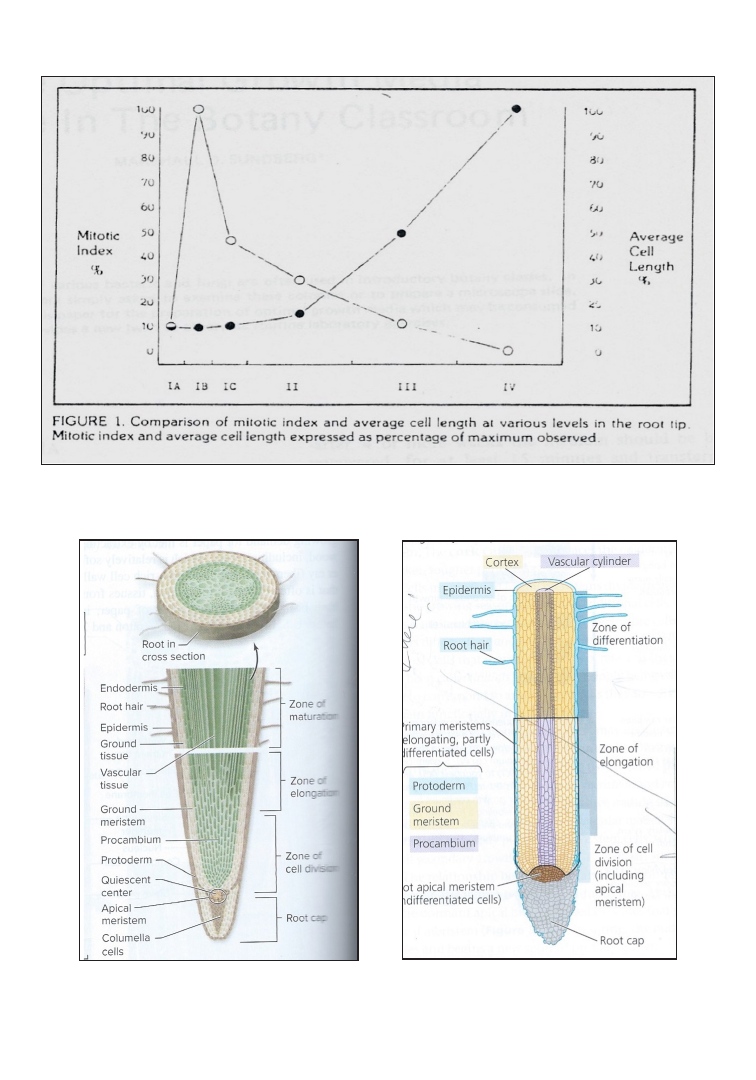
PSB 70 (3) 2024
238
Figure 3. Comparison of Mitotic Index (open circles) and Average Cell Length (closed circles) along root tip axis from
junction with root cap (IA) towards root hair region (IV).
Figure 4. Comparison figures of Zones of Cell Division, Elongation, and Differentiation in two popular
contemporary textbooks. (A) Urey et al., 2023. (B) Mason et al., 2023.
A
B
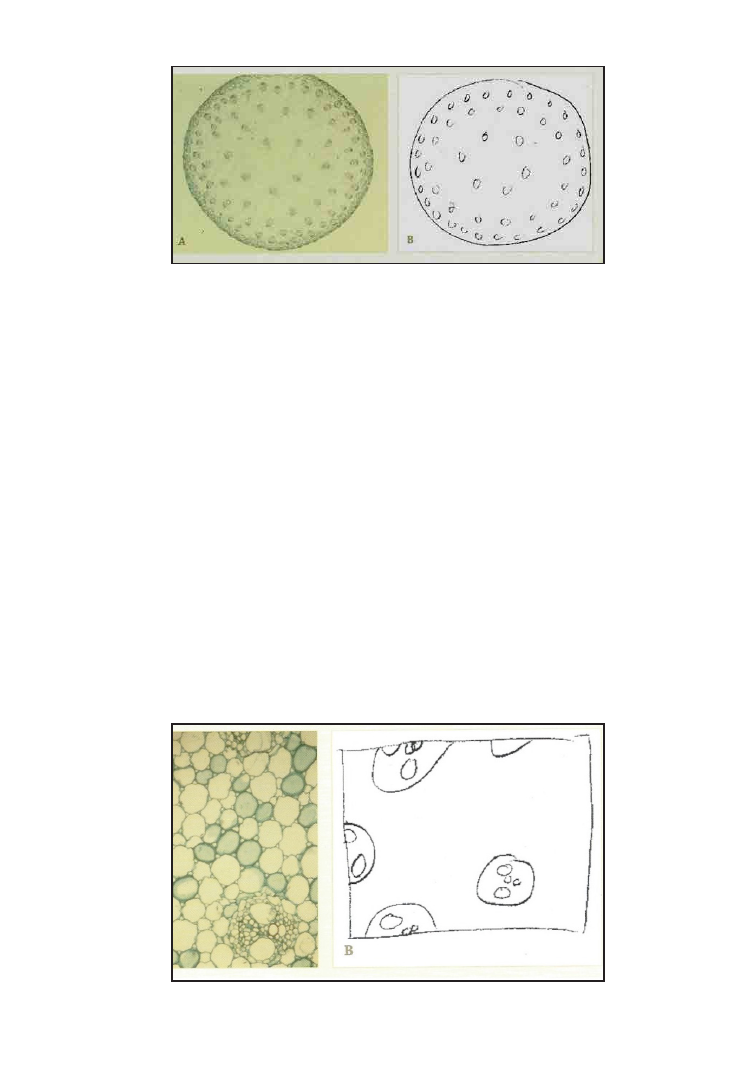
PSB 70 (3) 2024
239
the vascular bundles of monocots stems as being
“scattered throughout the ground tissue” (Urry
et al., 2023 [p. 768]; Raven et al., 2023 [p. 778]).
Figure 5A is a photomicrograph of a maize stem
that I put on the screen for the class. I then ask
them to observe it carefully and make a sketch,
filling a full page of their notebook, of the general
tissue regions they observe. I circulate through
the class with a blank overhead transparency
sheet observing the student sketches, but with no
comments. When I find one that clearly shows
some patterns, I’ll ask that student to trace her
sketch on the overhead sheet. Figure 5B is a
typical example. As a class we’ll then go through
the sketch noting any observed patterns, labeling
parts, and adding additional patterns observed by
other students.
Students often recognize at least six patterns: (1)
concentric rings of bundles, (2) bundle density
greater in outside rings than interior ones; (3)
bundle size greater in interior bundles than
outside ones, (4) bundles seem to alternate from
one ring to the next, (5) there is noticeable cell
differentiation within bundles, and (6) bundles
always orient in the same direction relative to
the surface, regardless of where they occur in
the stem. A close-up photomicrograph (Figure
6) makes it easier to see cell differences within a
bundle. A last question, which they’ll turn in on
a ¼ sheet of scratch paper, is: Which direction is
the nearest epidermis in Figure 6: left, top, right,
or bottom? How do you know? Students identify
definite patterns of bundles within the stem;
they are not simply “scattered.” In fact, they are
precisely arranged, and studies of serial sections
can predict which bundle of which leaf, up and
down the stem, every one of these stem bundles
will supply (Pizzolato and Sundberg, 2002).
Figure 5. (A) Cross-section of maize stem. (B) Student sketch of A.
Figure 6. (A) Magnification of portion of Figure 5A. (B) Student sketch of A.
A
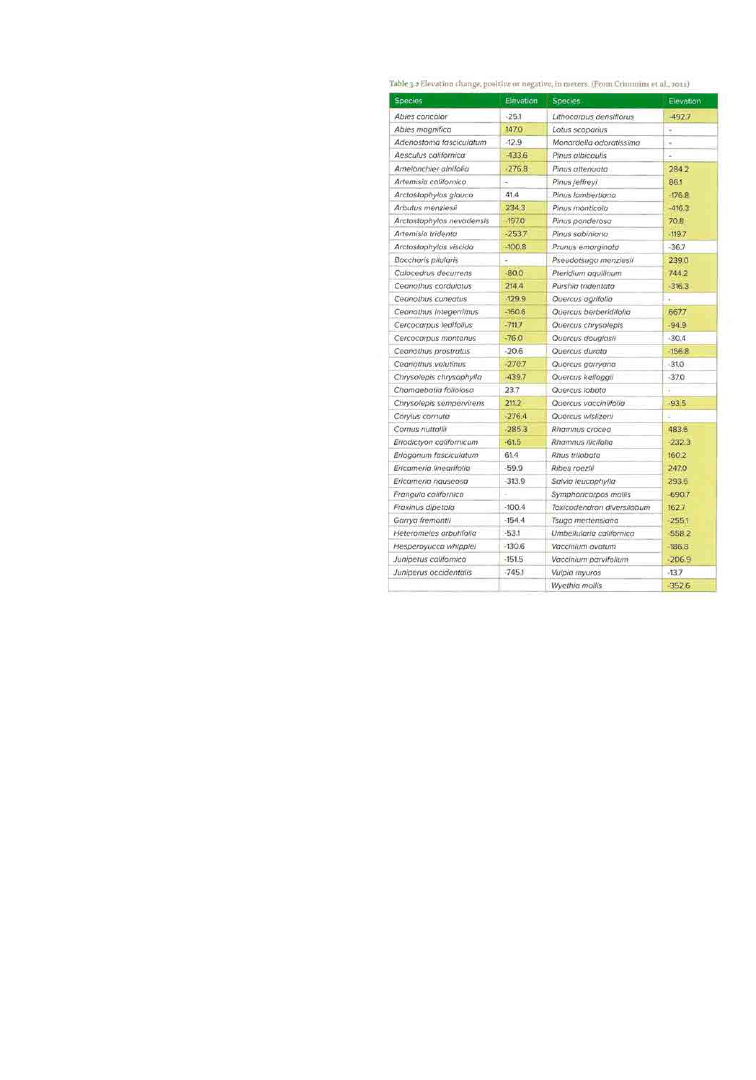
PSB 70 (3) 2024
240
Plant Migration on Mountains and
Climate Change
This is another example from “Inquiring about
Plants” (pp. 135-146). In brief, Humboldt
suggested that the change in plant communities,
as elevation increases in the mountains, is similar
to that observed with increasing latitude on Earth.
We also know that the combination of average
temperature and average precipitation in a region
allows us to predict the plant communities
(biomes) that will be present. Given the warming
associated with climate change, what would you
predict will happen, over time, to the various
plant communities occurring on the sides of a
mountain? It seems obvious that as the climate
warms, plant communities will migrate to higher
elevations.
The data in Table 1 show the average change in
elevation for 73 tree species in the Coast Range of
Northern California since the 1930s. Do the data
support your prediction for the effect of climate
change? Why or why not? What other factor
most likely accounts for the unexpected decreased
elevations in so many species? Hint: go back to the
two factors we know we can use to predict plant
communities/biomes we will find in an area.
Size and Distribution of Stomata in
Desert Plants
My final example is an extension of the stomata
section of “Inquiring about Plants,” where we
ask is there a relationship between the number
of stomata and the environment of the plant (pp.
45–47)? It seems logical to predict that there is
a decrease in stomatal density with increasing
drought and that stomata should be restricted only
to the lower surface of leaves in desert plants. One
of my early students in freshman botany tested
this for his independent class project and got
some unexpected results. I followed this up with a
grant to work at the Desert Botanical Garden near
Phoenix (Sundberg, 1986). In fact, three-fourths
of the 111 species examined were amphistomatic,
and only semi-woody xerophytes had a higher
frequency on the lower (abaxial) surface than the
upper surface (Table 2). Leaf and stem succulents
did have the lowest stomatal densities, but they
also, unexpectedly, had the largest stomata
(Figure 7). Some seasonally dehiscent desert trees
had more than 500 stomata/mm
2.
In summary,
classroom inquiry can not only improve students’
understanding of the scientific concepts we teach
but sometimes their naïve, unbiased, observations
can uncover new connections and expand our
understanding of science.
Ever since Bill Muir forced me to be an active
learner through inquiry, I have used this approach
in my own teaching and learning pedagogy. I
particularly focus on common misconceptions
held by many students (and the general public)
and challenge them with data supporting more
sophisticated understanding and a philosophy of
lifetime learning (Sundberg and Moncada, 1994).
Table 1. Change in elevation of 73 montane tree species
in the Coast Range of California. Highlighted numbers
are statistically significant changes.
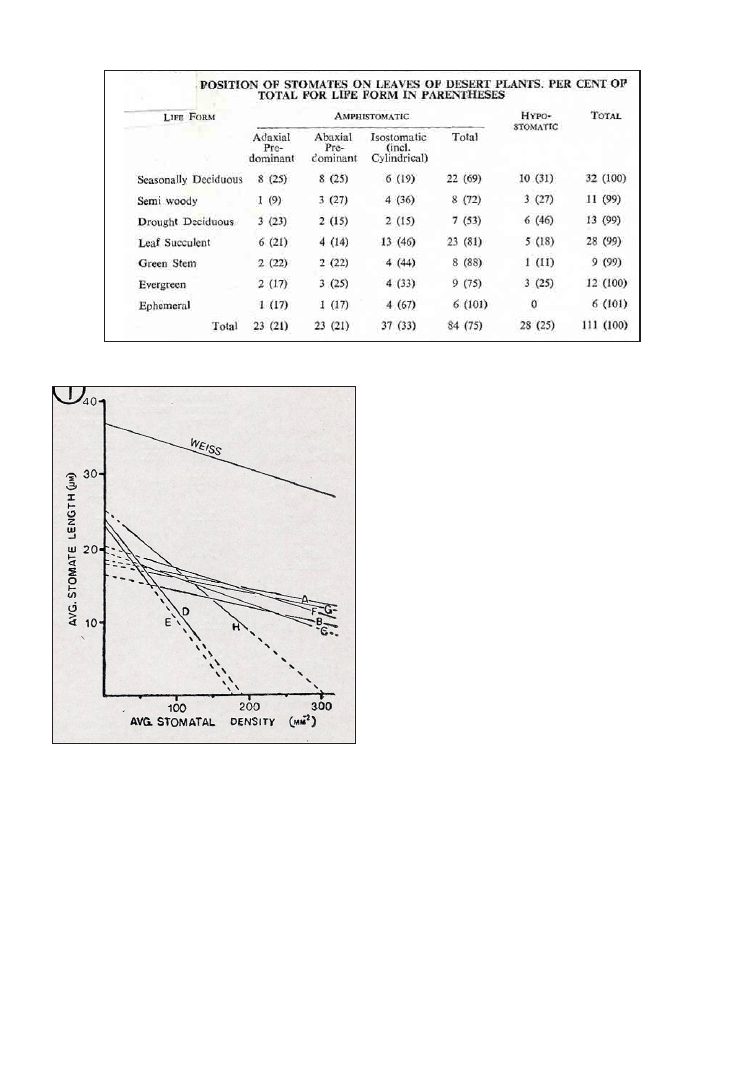
PSB 70 (3) 2024
241
REFERENCES
Clowes, F. A. L. 1950. Root apical meristems of Fagus syl-
vatica. New Phytologist 49: 248-268.
Cronquist, A. 1961. Introductory Botany. New York, Harper
& Row.
Table 2. Position of stomates on leaves of desert plants.
Figure 7. Trends of stomatal lengths on stomatal den-
sity for various life forms of desert plants: (A) Seasonally
deciduous; (B) Semiwoody,; (C) Drought deciduous; (D)
Leaf succulent; (E) Stem succulent; (F) Green stem; (G)
Evergreen; (H) Ephemeral. WEISS shows trend of tem-
perate mesophytic plants.
Pizzolato, T. D., and M. D. Sundberg. 2002. Initiation of the
vascular system in the shoot of Zea mays L. (Poaceae) II.
The procambial leaf traces. International Journal of Plant
Sciences 162: 353-367.
Raven, P. H., G. B. Johnson, K. A. Mason, J. B. Losos, and
T. Duncan. 2023. Biology, ed 13. New York, McGraw Hill.
Schlanger, Z. 2024. The Light Eaters: How the Unseen World
of Plant Intelligence offers a New Understanding of Life on
Earth. New York, Harper Collins.
Sundberg, M. D. 1981. Making the Most of Onion Root Tip
Mitosis. The American Biology Teacher 43: 386-388.
Sundberg, M. D. 1986. A comparison of stomatal distribu-
tion and length in succulent and non-succulent desert plants.
Phytomorphology 36: 53-66.
Sundberg, M. D., and G. J. Moncada. 1994. Creating effec-
tive investigative laboratories for undergraduates. BioSci-
ence 44: 698-704.
Uno, G. E., M. D. Sundberg, and C. A. Hemingway. 2013.
Inquiring About Plants: A Practical Guide to Engaging Sci-
ence Practices. St. Louis, Botanical Society of America. Fig-
ure 4A is from Campbell (Urry et al., 2023) and 4B is from
Raven and Johnson (Mason et al., 2023).
Urry, L. A., M. L. Cain, S. A. Wasserman, P. V. Minorsky,
and J. B. Reece. 2023. Campbell Biology, ed 11. New York,
Pearson.
Weiss, A. 1865. Untersuchungen uber die Zahlenund Gross-
verhaltnisse der Spatoffnungen. Jarbuch fur Wissenschafli-
che Botanik 4: 125-197.

242
Bessey Award Winners Through the Years
How can we encourage our students to look at
plants like Georgia O’Keeffe did? Slowing down,
taking time to really look at plants, being a careful
observer of the living world, appreciating their
beauty and instilling curiosity to look, notice, and
go back for more.
Unfortunately, we learn or are taught impediments
to learning and curiosity. Do you remember
the first time you made a drawing of a flower or
picked a bouquet of dandelions? Did you stop
drawing because you were not an artist? Did
you stop collecting dandelions because they
are “just weeds”? We urge teachers of botany to
both remember our roots, the joy of discovery,
the historical and contemporary importance of
drawing in teaching botany, and to further explore
fine-arts practices outside of traditional botanical
Don’t Forget Our Roots:
Learning with Drawing
By Stefanie M. Ickert-Bond
1
and Brett C. Couch
2,3
1
University of Alaska Museum of the North,
Herbarium, and Department of Biology and
Wildlife, University of Alaska Fairbanks,
1962 Yukon Dr., Fairbanks, AK 99775, USA
2
University of British Columbia, Depart-
ments of Botany and Zoology, 3156-6270
University Blvd, Vancouver BC V6T 1Z4,
Canada
Thesis and Philosophy
“’If one painted a flower the size it is, nobody would
look at it. When you take a flower in your hand
and really look at it,’—and she cupped a strong,
exquisite hand and held it close to her face—’it’s
your world for the moment. I want to give that
world to someone else. Most people in the city rush
around so they have no time to look at a flower. I
want them to see it whether they want to or not.’”
Georgia O’Keeffe
(in an interview with Mary Braggiotti [1946])
drawing. To rekindle curiosity and the excitement
of exploration of the botanical world, we propose
that students should be encouraged to value the
process not just the product: make it fun.
The use of drawing, painting, and illustration
has a long history in botany for a very good
reason; to draw or paint something, you need
to look carefully. Although Leonardo Da Vinci
is well known for his painting, Mona Lisa, he
also studied human anatomy and botany. His
approach to science was observational, and he
filled sketchbooks and journals with detailed
observations to understand the world he observed
such as his study of Ornithogalum sp. and other
plants (Figure 1A). His journals also illustrate how
he used drawing as part of his thought process as
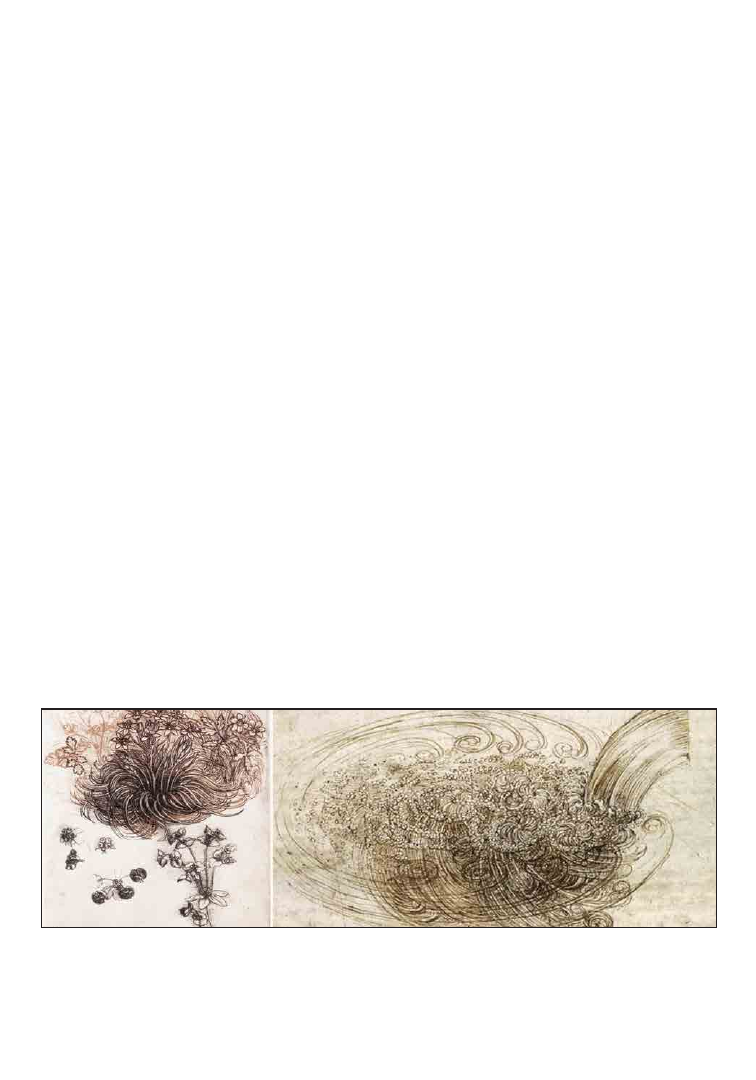
PSB 70 (3) 2024
243
an artist and inventor. In one example he created
analogies between the leaves of plants and the
forces of water in the water eddies (Figure 1).
Our philosophy is that students need to be trained
to look first and look again, again and again.
Discover the joy of looking and discovering;
handling and dissecting plants, exploring and
documenting local flora, and doing fieldwork
provides context for other observations. We
want students to develop observational skills as a
habit of mind. We want to train students to deal
with the reality that nature is messy and realize
that perfect drawings from a textbook rarely
capture the diversity they will encounter when
observing plants or other features of the natural
world. The challenges of observing nature and the
insights gained from careful observation are also
highlighted in Da Vinci’s study of moving water.
He observed and described the three-dimensional
nature of flowing water, and developed the idea
that turbulent flows consist of a range of co-
existing eddies, varying in scale from large to small
(Figure 1B)—but it was not until 1941 that this
concept was mathematically formalized by A. N.
Kolmogorov as the “cascade model of turbulence”
published first in Russian (1941) with an English
translation not appearing in print until 1991.
One of our classical mentors is Charles Edwin
Bessey, who created the first undergraduate
botanical laboratory in the United States, used
and encouraged drawing in teaching, and had
students draw from collected specimens in the
lab. His motto was “Science with Practice,” and
he expected students to learn for themselves. A
quote from his 1896 book The Essentials of Botany
illustrates how he expected drawing to be used as
part of learning about plants (Figure 2):
“In the use of this book I must urge that it
is intended to serve as a guide only to the
teacher and student. The student must
actually see as much as possible of what is
here brought to his notice. The book simply
marshals in logical order the objects to be
studied …. the young botanist should not
be content to obtain all his facts at second
hand; he must see with his own eyes all that
may be seen” (Bessey, 1896)
From here we hope to inspire you to explore
other approaches to using drawing in your
classes.
Figure 1. Drawings by Leonardo Da Vinci. (A) Star of Bethlehem Ornithogalum sp., and other plants c.1506-1512.
Wikimedia Commons. (B) Studies of water passing obstacles and falling, c. 1508-1509. Wikimedia Commons.
A
B
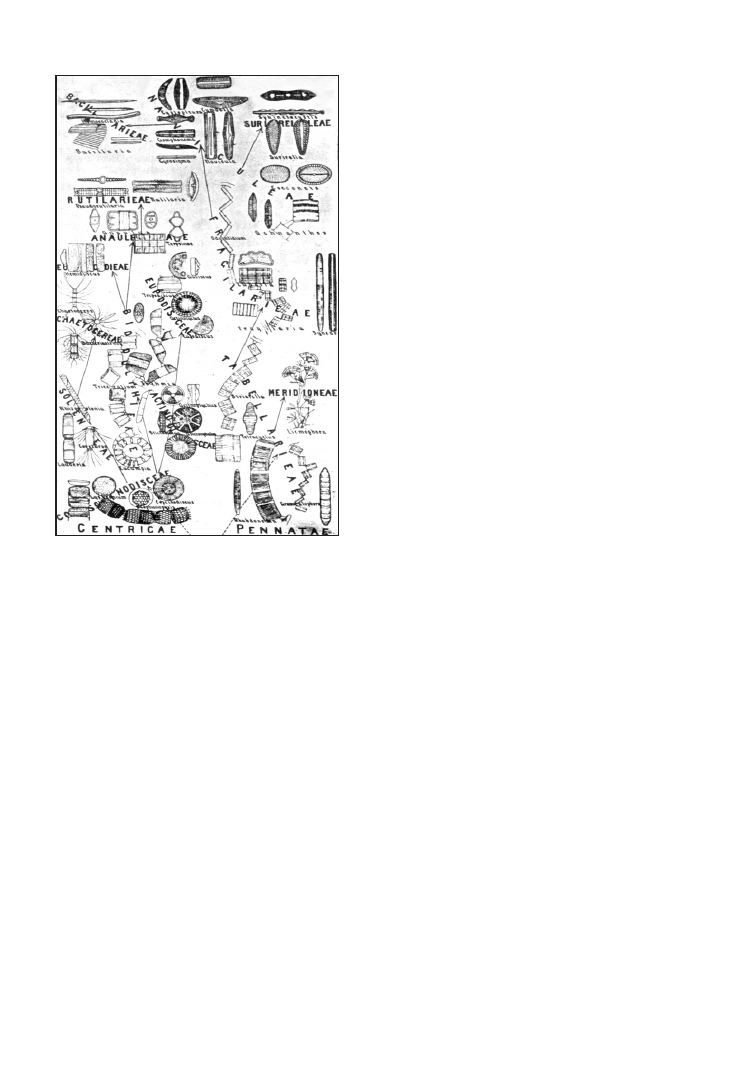
PSB 70 (3) 2024
244
How Instructors Use Drawing in
Teaching
From our own undergraduate education, we
enjoyed the instructors who gave us time to
appreciate botany, those who slowed down
instruction by using drawings, and those who
encouraged us to explore the subjects carefully
and record our observations. Lectures in our
undergraduate botany courses consisted of the
professor using vertical-sliding chalkboards
that were each filled with botanical drawings to
illustrate the lecture content and were available
to review after class. Unlike listening to a lecture
or viewing a static image—activities in which
students passively absorb information—these
interactive, progressive, drawings actively engage
students to record the lecture content. Today, we
continue this tradition, with some added tech;
as instructors we make use of drawings in our
teaching to illustrate plant structures and convey
information about taxonomically important
structures. We try to create classes that are both
engaging and foster slowing down and looking.
The Learning Glass or Lightboard platform is a
high-tech version of drawing on the blackboard,
but with a technological twist. It creates a visual
connection with the instructor who makes these
Learning Glass lectures particularly engaging.
During the use of the Learning Glass, a large piece
of glass ringed by LED lights, the instructor stands
behind the glass and uses fluorescent markers to
draw on the glass, and the ink catches the light
from the LED and glows clearly. The Learning
Glass software collapses the perspective of the
viewer and presenter into one shared perspective,
allowing students to view the instructor in real
time drawing and communicating with them,
while getting visual and textual reinforcement of
content (e.g., interactive progressive drawing).
Students presented with classes using the Learning
Glass had better knowledge retention over the
same timescale as content delivered through
PowerPoint (Hennige, 2020). Research has also
shown that making drawings or sketches increases
retention of information compared with taking
in class written notes (Fernandes et al., 2018;
Higley et al., 2024); in botany, which uses a lot
of specialized terminology, drawings paired with
terminology are particularly valuable for helping
students retain information presented. Drawings
need not be artistic—instead the drawing process
is the main educational benefit of drawing, which
Higley et al. (2024) elaborate on in their “Value
of Bad Drawing in Teaching.” We recorded many
Learning Glass lectures for BIOL195 - Introduction
into Flora of Alaska at the University of Alaska
(Ickert-Bond and Kaden, 2022) and have made
these available on Botany Depot (see Appendix)
and on our class website (https://introtoflora.
community.uaf.edu/module-1/).
Figure 2. Illustration of Bessey’s classification of diatoms
(Bessey, 1900).
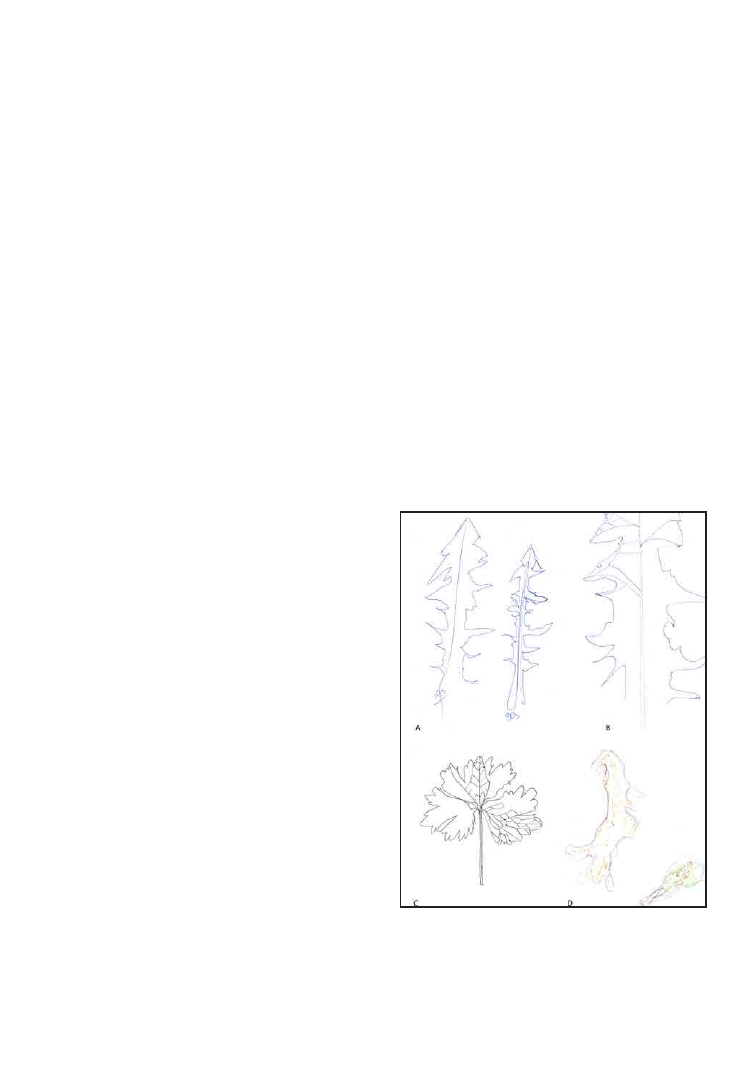
PSB 70 (3) 2024
245
What Do Students Do: Drawing in
Labs and in the Field (or “A Pencil Is
the Best of Eyes”)
The first step in learning to observe is to slow down
and take time. As Georgia O’Keeffe noted, people,
like our students, are busy and often don’t take time
to look. One approach we have found that sets the
stage for practicing slowing down and looking is
to take students out of their comfort zone of the
science lab and into an art gallery. Students are led
through a slow looking activity using the Visual
Thinking Strategies framework (Yenawine, 2013)
with artwork that is chosen specifically because it
is visually complex and something that students
haven't seen before. This puts all of the participants
on the same level in terms of experience with the
work and so they cannot easily draw on previous
knowledge or preconceptions. Students spend
approximately 30 minutes looking at a work and
responding to the prompts: (1) What do you
see? (2) What makes you say that? and (3) What
else do you see? This activity sets the tone for
the entire semester in the lab. Students are then
introduced to a variety of drawing and sketching
activities that are typical in studio arts classes and
that are intended to practice observing rather
than producing finished drawings. An example
is gesture drawing (Figure 3A–B). This is a very
fast, timed, drawing of a subject—typically 15 to
60 seconds. Students are given various objects
(pinecones, fern leaves, flowers) and given only 15
to 60 seconds to quickly capture as much of the
object as possible. The drawings often look like
scribbles; the purpose is not to capture a realistic
representation, but rather to practice seeing the
entire thing and recording some general features
or ideas. A second type of activity is blind contour
drawing, a slow looking activity. The idea here is to
take a longer period (10–30 minutes) and slowly
“trace” the contours (edges of a subject). The
observer needs to convince themselves that the
pencil is actually touching the edge of the object
as they slowly move the pencil over the paper to
draw the contour (Nicolaïdes, 1975). The catch
here is that the student is not to look at the paper
while they are drawing. The entire focus is on the
contour of the object. By design, the drawing
will not be a perfectly accurate representation of
the object being drawn—the drawings are often
rather funny—but the purpose is not a completed
drawing, but to practice focused observation.
Through the term, students will also practice
the manual dexterity skills required for making
drawings by doing simple doodles and activities
that focus on making different types of marks.
Each lab period begins with a doodle activity
and some activity that focuses on some specific
element of observation—layered drawings to show
movement or sequential observations (Figure
3D). (Couch et al., 2023). Students then apply
these skills to making sketches of microscopic
structures or organisms.
We see that the skills of summarizing, simplifying,
and observing, practiced with various drawing
activities, provide an inroad to further
development of visual literacy in students. For
Figure 3. Examples of different drawing and sketching
techniques by Brett Couch (2023). (A) Gesture draw-
ing of dandelion, (B) details added to part A, (C) detail
drawing of leaf venation, and (D) layered drawing of
amoeba.

PSB 70 (3) 2024
246
example, the ability to interpret and comprehend
visual information in the sciences like graphs,
figures, models, and diagrams increased by: (1)
using sketches to develop or communicate ideas,
and thinking through problems like diagramming
an experimental design, or making predictions
about patterns of data consistent with a particular
hypothesis; (2) using visual media to communicate
effectively in the form of figures or graphical
abstracts; and (3) providing a mechanism of
visualizing abstract concepts such as a gene on a
chromosome.
Multiple authors have recognized the value
of drawing across biology and STEM for
communication and learning (Waldrip et al.,
2010; Ainsworth et al., 2011; Landin, 2011; Tyler
et al., 2018). Landin (2013) summarized the
importance of drawing:
“It’s weird how much
visual information I miss until I draw an object.
Our brain just skips over details that don’t fit with
our preconceptions. When we draw, we have to
include everything—and that leads to learning.”
We encourage you to think about ways of creating
experiences for your students that engage them to
use drawing iteratively and repeatedly, and in ways
that promote curiosity, thinking, and learning—
to reveal the joy in slowing down and making a
flower, a leaf, or a whole plant their world for a
moment.
ACKNOWLEDGMENTS
The authors acknowledge the generous support
of a CITE fellowship (Chancellor’s Innovation
in Teaching & eLearning Program, UAF) to
S.I.B. for developing the asynchronous BIOL190
Introduction to Alaska Flora course and support
from eCampus, and the amazing instructional
designers, especially Christen Booth, eCampus
Creative Director, as well as support for Brandon
Corder, and Nkosi Evans (the University of
Wisconsin, Madison) and Todd Widhelm (The
Field Museum of Natural History) from the
United States National Science Foundation
(DBI-2001509) for the collaborative project,
Building a Global Consortium of Bryophytes and
Lichens: Keystones of Cryptobiotic Communities
(GLOBAL; https://globaltcn.utk.edu/) to support
the creation of the lichen and bryophyte learning
glass videos at UAF. Thanks also to Dr. Shelly
Rosenblum (Curator of Academic Programs
at the Morris and Helen Belkin Gallery, UBC),
Holly Schmidt (artist and educator), and the
Morris and Helen Belkin Gallery and for their
work in developing and hosting activities for
biology students at UBC. We also like to thank
the organizer of the symposium at Botany 2024,
“Bessey’s Legacy: Enthusiasm and Innovation
in Botanical Instruction,” for supporting our
participation and encouraging this submission
and the many mentors and teachers who have
shared their passion for teaching and drawing.
REFERENCES
Ainsworth, S., V. Prain, and R. Tytler. 2011. Drawing
to learn in science. Science: 333: 1096–1097.
Bessey, C. E. 1896. Essentials of Botany, ed 8. New
York: Henry and Holt Company.
Bessey, C. E. 1900. The modern conception of the
structure and classification of diatoms, with a revision
of the tribes and a rearrangement of the North Ameri-
can genera. Transactions of the American Microscopi-
cal Society 21: 61–86.
Braggiotti, M. 1946. Her Worlds Are Many. New York
Post (16 May 1946), 45.
Couch, B. C., H. Schmidt, and C. Goedhart. 2023.
Training a biologist’s mind through an artist’s eye. Ad-
vances in Biology Laboratory Instruction 43: 1–15.
Fernandes, M. A., J. D. Wammes, and M. E. Meade.
2018. The surprisingly powerful influence of drawing
on memory. Current Directions in Psychological Sci-
ence 27: 302–308.
Hennige, S. 2020. Learning glass: evaluating its use by
teachers and students for enhancing learning experi-
ence. Principal’s Teaching Award Scheme Report. The
University of Edinburgh. Website: https://www.docs.
hss.ed.ac.uk/iad/Learning_teaching/Academic_teach-
ing/PTAS/Outputs/PTAS_Learning_Glass_report_
April2020.pdf.
Higley, L. G., P. M. Higley, and T. Brosius. 2024. The
value of ‘bad’ drawing in teaching. The American Biol-
ogy Teacher 86: 136–142.

PSB 70 (3) 2024
247
Ickert-Bond, S. M., and U. Kaden. 2022. North to the
Future: A new asynchronous delivery of the classic
“flora class” at the University of Alaska Fairbanks.
Journal of the Botanical Research Institute of Texas
16: 343–356.
Kolmogorov, A. N. 1941. The local structure of tur-
bulence in incompressible viscous fluid for very large
Reynolds numbers. Doklady Akademii Nauk SSSR 30:
301–305 [in Russian]
Kolmogorov, A. N. 1991. The local structure of tur-
bulence in incompressible viscous fluid for very large
Reynolds numbers. Proceedings Royal Society London
A 434: 9–13.
Landin, J. 2011. Perceptual Drawing as a Learning
Tool in a College Biology Laboratory. Dissertation.
North Carolina University, Raleigh, North Carolina.
Landin, J. 2013. In J. Marien.
Drawing to improve
observational skills and understanding. ArtPlantae
blog, 1 September 2013. Website:
https://artplantae.
com/2013/09/01/drawing-to-improve-observational-
skills-and-understanding/
Nicolaïdes, K. 1975. The natural way to draw: a work-
ing plan for art study. Boston: Houghton Mifflin.
Tyler, R., V. Prain, and P. Hubberm. 2018. Represen-
tation construction as a core Science disciplinary lit-
eracy. In K.-S. Tang and K. Danielsson (eds.), Global
developments in literacy research for science educa-
tion, 301-317. London: Routledge.
Waldrip, B., V. Prain, and J. Carolan. 2010. Using
multi-modal representations to improve learning in ju-
nior secondary science. Research in Science Education
40: 65–80.
Yenawine, P. 2013. Visual thinking strategies: Using
art to deepen learning across school disciplines. Cam-
bridge: Harvard Education Press.
Appendix
I. Talk at the Bessey Symposium at Botany
2024 in Grand Rapids, Michigan
• The Google Slides can be found
at:
https://docs.google.com/presentation/
d/10YNrZVBC0pA2JLgRLYG-
cumqrZ5lVEIZsAUqt1ME7uU/
e
II. Learning Glass Lectures (LGLs)
• Most LGLs can be found on the BIOL190-
Introduction to Alaska Flora website,
under the individual modules, here are
those for module 1: https://introtoflora.
community.uaf.edu/module-1/
• Angiosperm life cycle: https://media.uaf.
edu/media/t/0_lxrrkn0o
• A complete listing of LGLs can be found
on Botany Depot https://botanydepot.
com/2020/03/13/online-course-intro-
to-alaska-flora-by-stefanie-ickert-bond/
Four new LGLs were completed in spring 2024:
• Bryophytes Versus Lichens Comparison
https://media.uaf.edu/media/
t/1_0k9hwi0o
• How to ID Mosses - https://media.uaf.
edu/media/t/1_d75j0o1k
• Life Cycles of Bryophytes and Lichens
https://media.uaf.edu/media/t/1_
b7j7ba5i
• Basic Lichen Biology - https://media.
uaf.edu/media/t/1_avubjnps
III. Virtual Herbarium
• https://www.thinglink.com/
scene/1406090479749038081

248
Bessey Award Winners Through the Years
By Bruce Kirchhoff
Emeritus and Adjunct Professor of
Biology, University of North Carolina,
Greensboro, NC
There are two aspects to great teaching: The first
and most important is to be yourself and to share
yourself with your students in ways that enhance
their learning. The second is to make sure that
your students do most of the work. Learning these
lessons took me almost 25 years of classroom
experience and resulted in several major teaching
awards, including the Bessey Award. I share my
insights here in the hope that it will not take you
quite as long for similar achievements.
The best way to share yourself in the classroom is
to present with enthusiasm. Let your students see
your love for your subject. Your enthusiasm will
reach them better than any content you deliver.
It sounds easy, but presenting with enthusiasm
without losing intellectual focus takes practice.
One thing that helped me to show my enthusiasm
was to begin each lecture with a joke related to my
course content. Since, at the end of my career, I
most frequently taught Plant Diversity and Plant
Systematics, all of my jokes were related to these
subjects. What worked best for me was to find
a visual joke related to the course content and
present it at the beginning of class, just before I
asked opening student-response questions. If I
could not find a joke that fit the class, I created
one. The jokes I chose were never wildly funny,
but they were entertaining. For instance, I found
this joke on the web: There is a picture of an
abandoned car that is covered with ivy with the
question, “Why are plants capable of consuming
cars?” I would enthusiastically ask the class “Well,
why?” After several wrong guesses, I would reveal
The Two Rules of Great
Teaching: Present with
Enthusiasm and Make Your
Students Do the Work
the answer on the next slide: “Because they are
auto-trophic.” Occasionally a student would get
this correct and I would react with joy, throwing
my arms up and almost shouting “YES!” and
maybe adding “Someone was paying attention in
Intro Bio!”
I would often continue this light-hearted teasing
during other parts of the class. For instance, my
quizzes and exams always included a question
on mitosis and miosis. Although I did not cover
these subjects in my classes, I felt that the students
should all have a basic understanding of the
difference between mitosis and meiosis before
they graduated. For some students these questions
provided free points, but more than half the class
regularly missed them. Right at the beginning
of the semester, during the first lecture, I would
say something like this: “You all learned about
mitosis and meiosis in introductory biology.
Some of you have had genetics, where you learned
about them again. How many of you remember
the difference?” (Maybe 2 people out of 24 raise
their hands.) “That is what I thought [said with
great humor]! Well, in this class you will have the
opportunity to test your knowledge because every
quiz, every test, and many clicker quizzes will
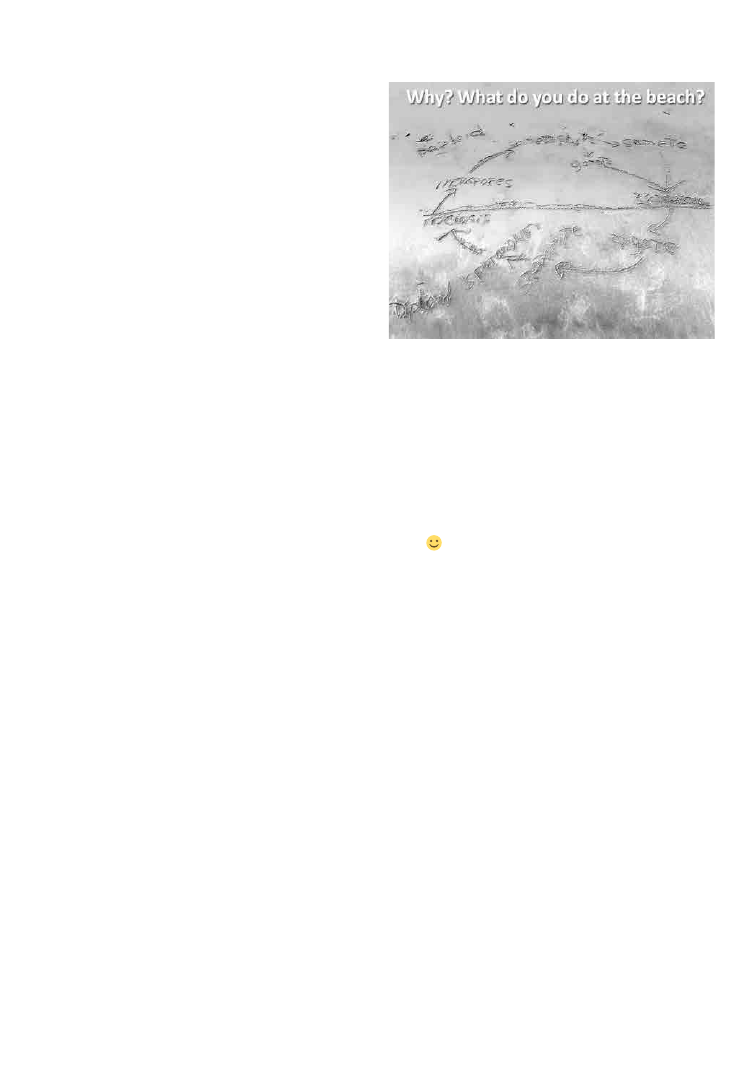
PSB 70 (3) 2024
249
have a question about mitosis and meiosis. For
some of you these will be free points [said with
enthusiasm]! That is great! I want to give you free
points! However, for some of you these questions
will be a source of never-ending frustration [said
with a hint of sadness]. You will always be asking
yourself, ‘How did I miss that AGAIN?!’ Take my
advice. Review the difference between mitosis and
meiosis so you are not pulling your hair out at
the end of each quiz [I mime pulling out my hair
and show them my bald head]. You see where this
leads!” By miming pulling out my hair, I show the
students that I am just as foolish as they are—that I
have made all the same mistakes. This, and similar
gestures throughout the class, gives the students
permission to accept their own mistakes with
grace, and even to laugh at them. I have found that
this attitude does much more to enhance learning
than any serious admonitions I might use.
Later in the class when I gave a clicker question
on mitosis or meiosis and 60% of the class got it
correct, I would enthusiastically congratulate them
and then speak to the 40% of the class that missed
the question. I might again mime pulling out my
hair and remind them that these are supposed to
be free points and that if they do not want to end
up like me (I tap my bald head) then they should
really review mitosis and meiosis. Then after class
I might post some links to good review sites. Some
students will continue to miss these questions no
matter what I do, but even if they never learn
the difference between mitosis and meiosis, the
class atmosphere that I create with these types of
interactions helps the students feel comfortable
and encourages them to work hard.
Let me give another example of how I used
enthusiasm and jokes to promote student learning.
One fall break I went to the beach for a few days.
While there I drew one of the life cycles we were
learning in the sand and took a picture of it. That
picture was the opening slide of the first lecture
after break. The caption read “Why? What do
you do at the beach?” (Figure 1). Although most
of my students worked at least half time and had
been working over break, this joke reminded
them that they should not forget the class material
just because they were otherwise engaged. Jokes
like this reminded them of the seriousness of the
material without hitting them over the head with it.
Although there are many other ways to present
with enthusiasm, I hope that these examples give
you some idea of how I approached my class. You
can see that there is a definite advantage to being
bald.
This brings me to my second point: Make the
students do the work. Presenting with enthusiasm
creates a class atmosphere that is conducive to
learning, but the students must still learn the
material. The only way to do this is for them to do
the hard work of learning. I believe that our task
as instructors is to make this hard work seem like
fun, at least as much as possible. I do not mean
to minimize the work that the students have to
do. I strongly believe that the only way to learn is
through hard work. However, if the students will
not do the work you assign, they cannot learn. An
example of what could be an extremely effective
learning method will make this clear. I call this the
White Paper Method.
The White Paper Method starts with a sheet of
blank paper, a pencil, and a copy of the material
that the student wants to learn. This can be their
lecture notes, notes provided by their instructor,
or their textbook. Once the student has identified
the material for their study session, they close
their notes and take out the paper and pencil. They
Figure 1. A life cycle drawn in the sand.

PSB 70 (3) 2024
250
then recreate, with as much detail as possible, the
material they want to learn. Let’s say that they
want to learn the life cycle of a vascular plant like
Pinus. On their blank piece of paper, they draw the
life cycle in as much detail as they can. It does not
matter if they can draw only a small portion of the
life cycle. Once they have done this as best they can,
they compare their work to their notes and correct
their work so that they have a perfectly drawn life
cycle. It is best if they do this in a different color
so they reinforce what they have yet to learn. Now
comes the most important part. They take their
corrected work and throw it away and take out a
blank piece of paper. On this paper they draw the
life cycle again. Since they just reviewed it, they
will do a better job. When they correct this version
as they did the first, there will be fewer corrections.
If they have not gotten it fully correct, they repeat
the White Paper process until they can draw the
life cycle perfectly from memory. That ends this
study session for this content. If they repeat this
process at least one more time before the exam,
they will ace any questions on this life cycle. The
White Paper Method is extremely effective! I have
had a student go from failing at midterm to a B
in the class by using this method. That means she
went from failing every test, to getting an A on
every test. This is an amazing accomplishment.
The problem with the White Paper Method is
that the students will not do it. The student I just
mentioned was a soccer player and if she had failed
my class she would have been kicked off the team.
She was successful because of this incentive and
because her coach made her use the White Paper
Method. Most students do not have this incentive
and, for whatever reason, will not use this method.
This is our conundrum as teachers. We must find a
way to get the students to do the work that they are
unable to do on their own. There are several ways
I approached this problem. Perhaps some of them
will appeal to you.
One of the most powerful ways of promoting
student learning is to create effective homework.
The archetype of effective homework is the White
Paper Method, but we already know that students
will not do this on their own. Can we fool them
into doing it with creative assignments? One way
I found to do this involves weekly in-class quizzes.
In my Plant Diversity class, I expected the students
to be able to draw even complex life cycles from
memory. To get them to do this, I would first
draw the life cycle with them in class, sometimes
asking them to draw it from memory during the
class period and then going over the life cycle with
them as they corrected it on their papers. You will
recognize this as the first iteration of the White
Paper Method. To get them to continue the process
at home, I would tell them which life cycles were
candidates for next week’s quiz. Early in the class
there were few choices, but late in the semester
there were so many that telling them that any life
cycle was fair game would overwhelm them and
they would do poorly. If I told them to expect one
of the following three life cycles on next week’s
quiz, they would make sure that they could draw
them from memory and the vast majority of the
students would get full credit. This made grading
very simple. I only needed to glance at a life cycle
to see that it was correct. Grading could be done
quite quickly. Over the course of a few weeks, I
could cover all of the required life cycles with
near-perfect performance. In this case I used in-
class quizzes to create the incentive for students to
do the work on their own.
As every teacher knows, one only really learns
the material when one has to teach it to others.
With this in mind, I began requiring my students
to present some of the lectures in my classes. In
Plant Systematics, the students presented almost
all of the plant families. I presented a few at the
beginning of the class to give them examples of
what I expected, then the students took over,
presenting the family characteristics for the rest of
the semester. I gave them very explicit instructions
on what to include (see links below), and most
students did very well. To my surprise they did
even better when they presented online during
Covid. I suspect that this was because I allowed
them to present with their cameras off, which
relieved much of their anxiety.
When I taught Biological Evolution, I presented
the first few lectures before turning the rest of the
material over to the students. My approach to this

PSB 70 (3) 2024
251
material was unusual in that I had the student’s
present chapters from The Origin
(1
st
ed),
and
a graduate text by Kemp, Fossils and Evolution.
I found that Darwin spoke to the students in
ways that contemporary texts could not. Darwin
was writing to an audience that doubted the
correctness of his theory. He wrote to persuade,
not to present facts. This approach was much
more meaningful to my students, many of whom
came from religious backgrounds where they were
encouraged to avoid any discussion of evolution.
A fuller description of my approach in this class
can be found at the following link: https://sites.
google.com/view/active-learning-in-use/ .
Another great way to get students involved in
a class is to have them take notes. For years I
wondered how I could do this without requiring
the students to turn in their notes, which would
require an inordinate amount of grading. The
Covid pandemic provided an opportunity to
try a new method, with good success. I was
teaching Plant Systematics when my university
closed. Since the students presented many of the
lectures in this class, I had to use synchronous
class time for these lectures. To accommodate
this, I decided to record my lectures and present
them asynchronously. In order to ensure that the
students were paying attention, I required them to
turn in their notes using our course management
system (Canvas). Most students took notes on
paper and photographed them using one of the
many phone apps created for this purpose. Many
of my students used Genius Scan. I used a three-
tier grading system for these notes: good (100%),
needs work (50%), no credit (0%). After a few
lectures I could show the students examples of
good notes (with the note-taker’s permission).
Soon 98% of the students were getting full credit.
This made grading very easy. In fact, I spent more
time waiting for the digital files to load in Canvas
than I did grading the student’s work. Some of
the notes were amazingly good. I still wonder
if it would be possible to get students to take
good notes in face-to-face lectures, but I never
succeeded in this before I retired. Perhaps some
variation on these procedures will work for you.
In closing, it would be remiss of me to fail to
mention my work creating visual learning
software. I will not go into detail about this
software here because it is described more fully
elsewhere (see links below). The software is free
and Open Source. I tested it in the classroom and
found it to be extremely effective (Kirchoff et al.,
2014). Stephanie Jeffries at North Carolina State
has created an online version and extension of this
software for use in teaching plant identification.
The links to her work are also below.
• Active Visual Learning Software: https://
sites.google.com/view/image-quiz/home
• Teaching materials for a course on Plant
Diversity: https://osf.io/69skm/
• Plant Life Cycle Diagrams:
http://planted.botany.org/index.
php?P=FullRecord&ID=578
• Recorded lectures on Plant
Diversity: https://www.youtube.com/@</p>
plantdiversity
• Recorded lectures on Plant Systematics: https://
www.youtube.com/@Plant_Systematics
• White Paper Method: https://youtu.be/
Gyu4KQPekx0
• Stephanie Jeffries ILEX (Identify-Learn-
Explore) online tool: https://sites.google.
com/ncsu.edu/ncstatedendrology/ilex-study-
tool?pli=1
REFERENCES
Kirchoff, B. K., P. F. Delaney, M. Horton, and R. Del-
linger-Johnston. 2014. Optimizing Learning of Scien-
tific Category Knowledge in the Classroom: The Case
of Plant Identification. CBE-Life Sciences Education
13: 425-436.

252
Bessey Award Winners Through the Years
Growing up in Detroit and attending public
schools, I thought I would become a doctor, lawyer,
or writer. At that time, I had never heard of doing
science for a career. But from my first Biology
lab course at the University of Michigan, going
on a walk outside looking at trees and insects, I
discovered the great outdoors. In the end, I chose
graduate school to let me continue doing just that.
Undergrad Days
My Botany education was fun and solid, with most
courses delivered in the standard lecture format.
The professors were talented lecturers, enthralling
us with subject matter and amusing us with their
personalities (Botany Professors Hiroshi Ikuma,
Herb Wagner, Ed Voss; Zoology Professor Dan
Janzen; Organic Chem with Professor Richard
Lawton). I was a very good student and excellent
note-taker, recording everything they said almost
verbatim. Writing it all down helped me commit
it to memory. Reading textbooks and papers,
solving problems, and reviewing notes helped
me succeed in almost every course. Some courses
were less conventional. Dan Janzen’s Habitats
and Organisms course consisted of non-stop
lectures, to a huge audience in a darkened room,
while showing us beautiful slideshows of animals
and plants from around the world. In John
Vandermeer’s Quantitative Ecology, we served
as guinea pigs for his early textbook/workbook
of problems (Vandermeer, 1981). Biochemistry
used the self-directed “Keller Plan,” taking tests
on every chapter complemented with lectures on
extra material. Field experiences in courses at the
University of Michigan Biological Station and as a
research assistant to Sally Kleinfeldt in the woods
The Evolution of an Educator
By Suzanne Koptur
Professor Emerita, Florida International
University
of New Hampshire let me see what research might
be like. Although I also worked as a nurse’s aide for
two summers (one in Detroit at Plymouth General
Hospital, the other at Mott’s Children’s Hospital),
which gave me a view of the medical world, I chose
the path that would be more fun, with perhaps less
job security and money, but more time outdoors
and doing things I loved.
I had work-study employment in the University
Herbarium, working with Dr. Robert Shaffer to
index the type collection of Fungi. I got some
research experience with Dr. Rogers McVaugh,
writing a Latin description of a newly discovered
species of Pedicularis from Mexico (my first
publication: McVaugh and Koptur, 1978). I
wrote a senior thesis about extrafloral nectaries
with a focus on aspen under the advice of Dan
Janzen. During my undergrad time, I was lucky
to be an assistant to Teaching Fellows (TFs as
they were called, and we were TAs) in Practical
Botany (taught at the Botanical Garden) and
Plant Systematics on campus. Though headed
in the Systematics direction, I shifted to Ecology
because it seemed there was an endless supply of

PSB 70 (3) 2024
253
interesting questions to investigate. I received a
Noble Fellowship from the Smithsonian Tropical
Research Institute, doing my first tropical field
work on Barro Colorado Island.
Graduate Studies in California: A
Whole New Flora! (And Then Some!)
Entering grad school at Berkeley in the Botany
Department as Teaching Assistants (TAs) in
General Biology, we were required to take a
weekly teaching seminar in addition to our twice-
weekly TA meetings for General Biology, a two-
quarter sequence directed by Dr. Bill Jensen.
In the TA meetings, we learned the content and
how to run the lab sessions, but in the seminar,
we learned about good practices in science
education. In my group of four TAs who all taught
labs at the same time, two were grad students in
the SESAME program (Search for Excellence in
Science Education), which held a great appeal for
me. Both suggested it might be best to stay in pure
science, since I could always move to their field of
science education later if I chose, but moving in
the other direction might be harder.
After Gen Bio, I was a TA (with many others) for
California Flora with Robert Ornduff, and a new
basic botany course with Don Kaplan (along with
fellow grad student Darlene DeMason). At Berkeley
we taught labs, but we were also required to attend
the corresponding lectures. I moonlighted as a
note taker for the lecture courses in which I taught
labs, for Black Lightning, a service run from a copy
store where notes were copied and made available
to subscribing students. I remember writing and
typing them on mimeo sheets! I was unaware that
this practice was controversial, as it evolved into
some professors selling their lecture notes, etc.
Nowadays (in fact, within the following decade), it
is more common practice to provide lecture notes
as part of the course materials for many professors.
I took some wonderful courses as a graduate
student at Berkeley, including Evolutionary
Ecology taught by Herbert Baker, who highly
valued teaching as a pursuit. In that course there
were students from many departments (Botany,
Forestry, Zoology, Entomology), providing
connections for all of us with other parts of the
university. Herbert’s lectures and demonstration
labs were full of information, letting us take as much
time as we wanted with his collection of articles,
books, plant and animal examples, artifacts, etc.
That was also the way he taught Economic Botany
(see Baker, 1978). We solved problems using basic
statistics and were expected to do a project of our
own design. The field experiment I carried out at
Tilden Park (taking the bus up into the Berkeley
hills each time) was material for my first solo
publication (Koptur, 1979). I learned a lot about
prioritizing projects and publishing from James
Hickman (thanks, Jim!), who had recently come
to Berkeley with his wife, Carol Hickman. I also
got to take the Organization for Tropical Studies’
Tropical Biology course in 1977, a full immersion
introduction to the neotropics, doing faculty-
led group and student-initiated field projects for
several months.
I then spent 2.5 years away from teaching as RA on
a grant received by my major professor, Herbert
Baker, and entomologist Gordon Frankie, to study
Phenology and Pollination in the Costa Rican
Cloud Forest, a wonderful time of my life (Koptur
et al., 1988). After the field work was done, I
returned to Berkeley to write up my dissertation
on the plant/animal interactions of Inga and was
again a TA, for Plant Systematics, and then was an
RA in the University herbarium. My final semester
I was asked to teach the Plant Ecology lecture and
lab because the regular professor (Rob Robichaux)
was on sabbatical. He graciously shared all his
notes with me, and I got my first insight into
preparing for lectures in the traditional way. With
Suzanne Morse as my TA, we had an adventurous
and very fun semester with lots of field trips and
field exercises in interesting places.

PSB 70 (3) 2024
254
Postdoctoral Work in the Midwest
and Across the Pond
Completing my Doctorate in spring, and after
unsuccessfully applying for many faculty positions
in 1982, I took a teaching postdoc at the University
of Iowa with Hank Howe, where I taught General
Zoology labs and was in the company of some
great tropical ecologists. This provided support
(both financial and intellectual) while I wrote and
published papers from my dissertation work and
helped me get a NATO postdoc where I worked
with John Lawton at the University of York,
another wonderful time of my life. During these
postdoc and early faculty times, I was also an
investigator in the Naturalist-Ecologist Training
Program during several summers at the University
of Michigan Biological Station, a great experience
for mentoring undergrads in independent research
projects while pursuing my own research. I co-
coordinated the Organization for Tropical Studies
course in the summer of 1985 with my old buddy
from undergrad days at the Michigan Biological
Station, Bob Marquis—my first year as an assistant
professor (see below).
Training Paid Off
All that teaching experience helped me get a job
as an assistant professor at a young state university
in Florida, Florida International University (FIU),
where I was hired as a population biologist in
1985. I initially taught Gen Bio 2 and a graduate
course in Evolutionary Ecology, as FIU was
working toward an independent MS program. I
later taught Introduction to Biological Research
in our new graduate program and started teaching
Ecology, then Plant Ecology in alternate years,
along with workshops in Pollination and Field
Techniques in Plant/Insect Interactions. I also
stepped into Introductory Botany when David Lee
and Jenny Richards moved on to other courses. I
got some great ideas from workshops I took at the
Botany meetings, including using portfolios in
non-majors’ courses (thanks, Joe Armstrong!) and
great hands-on materials for groups, passing out
sections of the same stem or tree branch (thanks,
Stokes Baker!). I also participated in Project
FIRST—Faculty Institutes for Reforming Science
Teaching Through Field Stations—and was part
of the FIU team for several iterations of this NSF-
funded project. I had previously arranged field
trips to Archbold Bio Station (Swain, 2019) for
some of my courses, but this brought together a
community of educators from different institutions
in Florida to learn new approaches and design
activities that could be used by all, especially in
the field.
Time for a Change
After 10 or more years of delivering material in
lectures, I was getting a little bored teaching in
the same old ways. Enticed by a workshop at the
annual Ecological Society meeting, I learned about
Innovative Methods in Large Lecture Courses
from two inspiring scientists and educators: Diane
Ebert-May and Carol Brewer. That workshop
was really life-changing for me! I learned how to
foster more interactions with students and among
students (Ebert-May et al., 1997). I realized that
average attention spans are short, so that after 12–
15 minutes of listening, most students were zoning
out. By introducing active learning breaks that
broke up the twice-weekly 75-minute classes into
three or more sections, the students were engaged
and got to talk and/or move around, breathing
new energy into the lecture hall. I accepted the
challenge and encouragement to transform my
lecture courses, but one lecture/day at a time, and
over several offerings of each course.
I was teaching Ecology every year, and so I took
their advice with transforming this required
course for all Biology majors. For three years I did
an experiment with a different topic to see if active
learning made a difference. The topics used in this
experiment were Energy in Ecosystems (Spring
2006), Biological Communities (Spring 2008),
and Adaptation and Natural Selection (Fall 2009).
The content was not assumed to be comparable
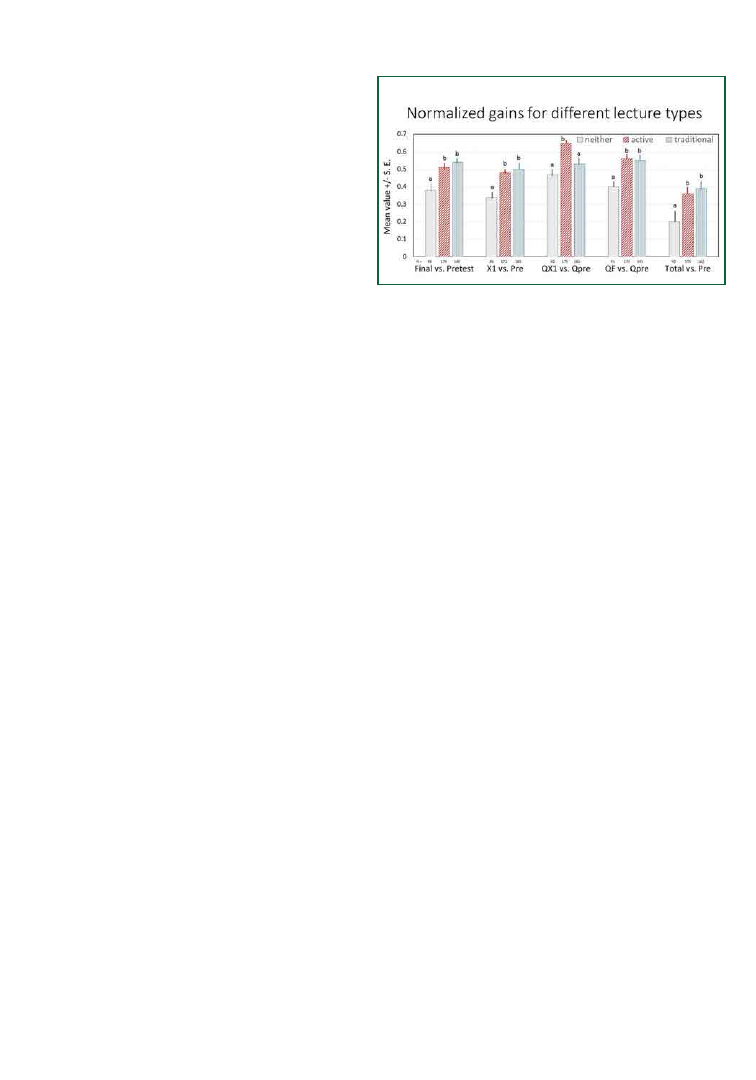
PSB 70 (3) 2024
255
among the topics, but each served as a vehicle for
the experiment. I had an ideal set-up for teaching
the same material two ways, as half the class went
to receive instruction from our science librarian
about finding articles in the scientific literature,
while the other half attended an Ecology lecture. I
taught the same topic twice each time, but in two
different ways.
To test the hypothesis that active student
engagement results in greater learning, I used the
following experimental design. All students in
the experiment were to read the same textbook
chapter and view the same material in the lecture
that I delivered (i.e., the same PowerPoint slides),
and each would write an in-class essay (“minute
paper”). Students in the Active Learning group
would have three in-class active-learning breaks
during the lecture, e.g. a “think/pair/share,”
making a categorizing grid, concept map making,
class modeling, human tableau, etc.—ideas I got
from a great resource, my favorite education
“cookbook,” Classroom Assessment Techniques
by Angelo and Cross (1993).
I could see which students attended the library
session on each day, and which ones were present
in lecture on the other day via the in-class essays
they turned in. By using data from relevant
questions on a pretest, from material on the topic
in the mid-term exam, and then in the final exam,
we saw that students who participated in the
Active Learning version of the topic learned more
and demonstrated this by better performance on
the relevant questions on the mid-term exams
(X1) than those students taught in the traditional
way (Figure 1). There were greater gains for
students in the Active lecture than for those in
the regular lecture in the mid-term results (QX1
vs. Qpre). This difference did not hold up long
term: performance on the final exam questions,
QF vs. Qpre, did not differ significantly between
those two groups. An interesting side result was
that students who attended either type of lecture
showed greater gains (by every measure except the
mid-term exam) than those who did not attend
lecture! I presented these results in a poster at a
Gordon conference (organized by Gordon Uno)
at Bates College, where it was energizing and
inspiring to meet with science educators from all
over. I continued to change my lectures in this
class, and in others, over the following years.
Changes at the University
FIU created a STEM Transformation Institute
(https://stem.fiu.edu/), in which I was one of a
group of founding faculty fellows. We participated
in many workshops on teaching and learning,
assessment, and different ways of engaging and
inspiring students. I learned more about active
learning methods, starting with lab activities—
presenting students with challenges and some
materials, then letting them explore to answer
problems. I learned about professors who
simply did not lecture in class, rather using the
lecture time to have students work together and
Figure 1. Summary of outcomes for students attending
traditional lecture (vertical striped bars) versus Active
Learning lecture (diagonal striped bars) and those who did
not attend lecture (empty gray bars). On the x-axis, Final
= score on final exam, Pretest – score on Pretest, X1 = score
on midterm exam in which the topic was covered, QX1 =
score on questions on the topic on the mid-term exam (a
specific part of X1), Qpre = score on questions on the topic
on the pretest, and QF = score on questions on the topic
on the final exam. Total = total score in course. Data are
combined for three different topics in three different trials
(semesters of the course), so normalized gain makes the re-
sults comparable among trials.
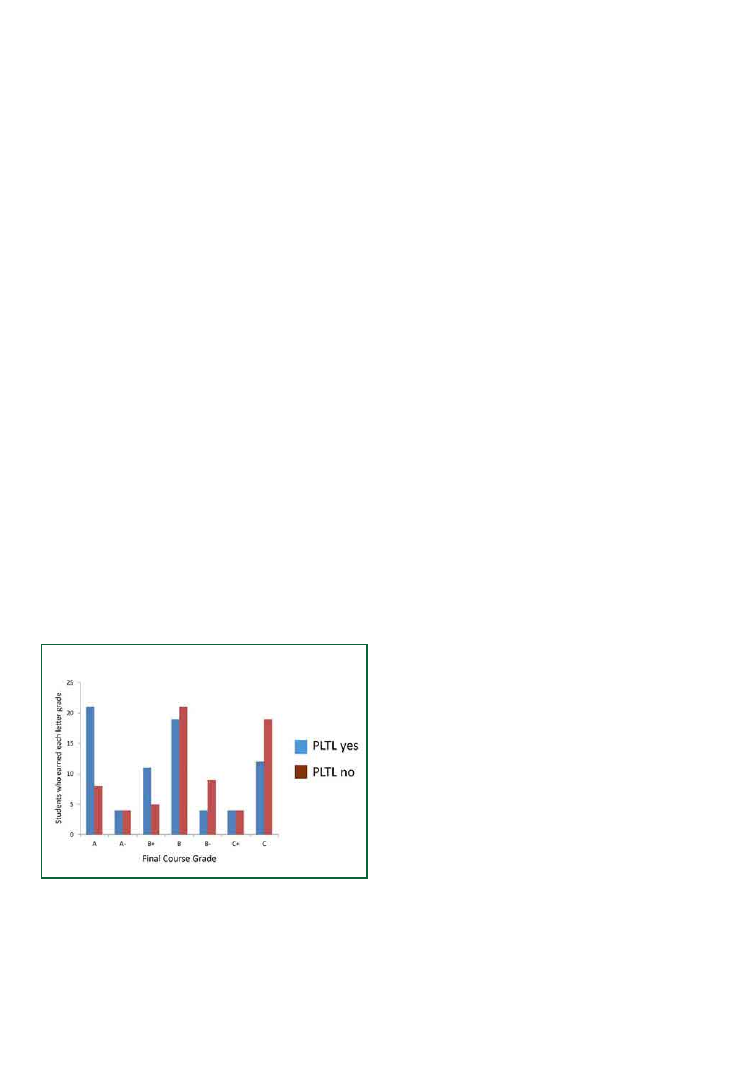
PSB 70 (3) 2024
256
independently on thinking and problem solving.
A Learning Assistant Program was started, and
grew, employing undergraduate students who had
previously taken a course to help the professor
manage group work in larger courses. We also
adopted Peer-Led Teaching and Learning (PLTL)
in many of the required majors’ courses, where
current students attend a weekly session led by a
student who has previously taken and done well in
the course. This intervention helped students do
better than those who did not have PLTL as data
from my Ecology courses show (Figure 2). Exam
averages were higher for students taking PLTL
along with the lecture course than those who did
not (78.5 vs. 73.3), and substantially more passed
the course as well (78.6% vs. 62.3). PLTL can help
students from marginalized groups succeed in
STEM majors (Sloane et al., 2021).
The Stem Transformation Institute also developed
a Discipline Based Education Research group
(DBER) that holds seminars biweekly throughout
the semester—a great chance to learn from
outside experts and others at FIU, and to interact
with faculty in one’s own and other departments.
It connected those of us teaching science classes
with science and math education colleagues and
fostered collaborations, leading to many projects
and publications. DBER meetings were enjoyable,
and it was great to get to know others across the
university who cared about teaching despite more
praise for research accomplishments.
Flipping Lecture: Fun and Beneficial
for Students and Faculty
I decided to flip my courses, and this was an
exciting time for me and the students (although
some pre-med students worried they would not
learn enough in my classes). Each class meeting
had active learning almost all the time, working in
groups with the supervision and help of Learning
Assistants (LAs), presenting to others, and using
white boards and other means of communication.
Students were to prepare for each class by reading
the assigned textbook chapter, listening to a
couple of short PowerPoint lectures I had pre-
recorded, and checking out (reading or listening
to) other resources I posted online, and taking a
quiz over the textbook chapter contents. We used
clickers in class to provide instant feedback on
multiple-choice questions, and then had students
discuss questions and answer again. I started
giving assessments (exams) in class using a two-
part system: first, students would take the exam
individually and turn in their answer sheets; then
with their group they would work through the test
and fill out IFAT (Instant Feedback Assessment
Test) bubble cards. Each person’s score was the
average of the two. Attendance was very good
because we always had activities and most of them
“counted” as part of the students’ grades.
Comparing student performance in my Ecology
courses over all the years I taught the traditional way
(lecture with no LAs) with the flipped course with
LAs (taught only in the spring semesters) shows
a marked improvement in course completion,
passing rate (Figure 3A), and distribution of final
course grades (Figure 3B). However, comparing
the performance of students in two summer
semesters of online Ecology (synchronous), one
with and one without LAs, showed no difference
(Figure 4); in fact, there were more high achievers
without LAs.
Figure 2. The difference Peer-Led Teaching and Learning
(PLTL) made in Ecology: participation of Ecology stu-
dents in PLTL vs. Final course grade earned. PLTL yes
= students who attended PLTL sessions; PLTL no = stu-
dents who did not attend PLTL.
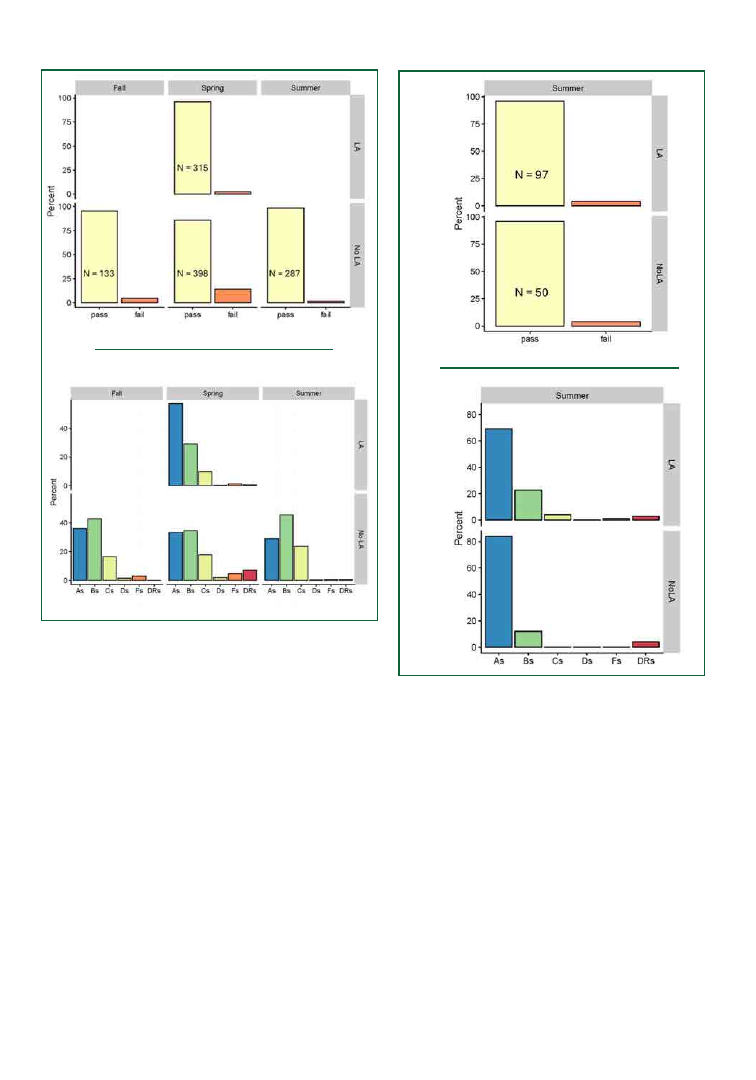
PSB 70 (3) 2024
257
Pre-Adaptation for Remote Teaching
When the pandemic struck and we switched
to synchronous online teaching via Zoom, this
flipped teaching format was easy to adapt, because
lectures and quizzes were already online and the
students were expected to go through the online
materials and take the chapter quizzes before class.
On Zoom, groups could work in breakout rooms
with each LA visiting a subset of the groups. The
groups (or a selected few of them) would then
summarize or present to the entire class.
To meet community demands and enhance
financial gain for the university, the College of
Arts and Sciences wanted to develop a Biology BA
degree fully online. Because I had taught Ecology
A
Figure 3. Comparisons of the Ecology course taught
flipped (with Learning Assistants, LA) versus traditional
lecture (No LA). (A) Passing rates: multiple offerings
over the years combined by semester, sample sizes for
each given in the yellow bars; (B) Grade distributions in
the same courses, including drops (DRs), sample sizes as
in (A).
Figure 4. Comparisons of the online synchronous Ecolo-
gy course taught in flipped style with Learning Assistants
(LA) versus more traditional lecture style without activi-
ties (No LA) over summer term offerings (initial summer
class size was 50; the next time it was 97). (A) Pass/fail
comparisons; sample sizes for each given in the yellow
bars; (B) Grade distributions, including drops (DRs).
A
B
B

PSB 70 (3) 2024
258
many times, I volunteered to develop Ecology for
this curriculum as asynchronous online. Each
topic was covered by short lectures, activities to
be done by one student, quizzes on each chapter,
and exams that could be taken twice. I developed
an online lab, using some SimBio resources and
creating one third of the labs myself with help
from the teaching assistants (thank you especially
to Cleo Pimienta and Andrea Salas Primoli!). This
course has become increasingly popular over time,
as have other online offerings of required courses,
allowing working students and parents of small
children to do this on their own schedule.
Community Education
Along with university activities, I have always been
willing to give talks and organize activities for the
public by lecturing and holding workshops for
plant societies, nature groups, elementary, middle,
and high schools. Some examples include the
“After School Gardening Gang” with elementary
students, project PRIDE (Pine Rocklands in
Dade Environments) at West Miami Middle
School (teacher Lisette Perez Munoz received
a Toyota Tapestry grant), and several projects
with the environmental magnet at TERRA
Environmental Research Institute. All have helped
me to communicate better, learning how to reach
students of different abilities at all levels. Working
in groups, the students help and teach each other,
with more positive results for all.
All of these changes have certainly transformed
my teaching and students’ learning over time.
Most of the changes were gradual (breaking
up the lecture with activities), but some were
extreme (flipping the lectures in all my courses).
This is kind of how evolution proceeds: gradual
versus punctuated equilibria. I have always liked
teaching and consider it an important part of a
professor’s job, even though FIU became more
and more research and funding oriented over my
decades there. Evolving my teaching by adapting
my methods to a changing clientele has helped me
retain my interest in and enthusiasm for teaching
for over 40 years.
REFERENCES
Angelo, T. A., and K. P. Cross. 1993). Classroom As-
sessment Techniques: A Handbook for College Teach-
ers, ed 2. San Francisco: Jossey-Bass.
Baker, H. G. 1978. Plants and Civilization, ed 3. Wad-
sworth Publishing.
Ebert-May, D., C. A. Brewer, and S. Allred. 1997. In-
novation in Large Lectures: Teaching for Active Learn-
ing. Bioscience 47: 601-607.
Koptur, S. 1979. Facultative mutualism between
weedy vetches bearing extrafloral nectaries and weedy
ants in California. American Journal of Botany 66:
1016–1020.
Koptur, S., W. A. Haber, G. W. Frankie and H. G. Bak-
er. 1988. Phenological studies of shrub and treelet spe-
cies in tropical cloud forests of Costa Rica. Journal of
Tropical Ecology 4: 323346.
McVaugh, R., & S. Koptur. 1978. A new species of
Pedicularis from Jalisco, Mexico. Contr. Univ. Mich.
Herbarium 11(5): 298-300.
Sloane, J. D., R. D. P. Dunk, J. J. Snyder, C. I. Win-
terton, K. M. Schmid, and J. R. Wiles. 2021. Peer-
Led Team Learning is Associated with an Increased
Retention Rate for STEM Majors from Marginalized
Groups. Proceedings of the 13th Annual Research
Symposium, National Association of Biology Teachers
2021, pp. 1-9.
Swain, H. M. 2019. All of life’s experiences count at a
biological field station. Frontiers in Ecology and Evo-
lution 17: 102-103.
Vandermeer, J. 1981. Elementary Mathematical Ecol-
ogy. Wiley, New York.

259
From the PSB Special Issue on Art in the Botanical Sciences
Within the past year, the Plant Science Bulletin has published two special issues in the special anthology,
Art and the Botanical Sciences: Past, Present, and Future (the Fall 2023 and Spring 2024 issues). These
issues grew out of our first workshop on botanical art at Botany 2022 in Anchorage, AK, and the collected
articles explored many facets of the importance of botanical arts.
We present two more articles that were unable to appear in those issues: “Illustrating Cretaceous Park:
First steps toward a botanical field guide for the Hell Creek Formation” by Kirk R. Johnson and Marjorie
Leggitt as well as “Reconstructing the botanical past: Art and paleobotany” by Edward J. Spagnuolo et
al. We hope you enjoy these articles and encourage you explore the past special issues at https://botany.
org/psbarchive/view/issues!
The SciArt Collective
Nicolette Sipperly, Stony Brook University • Rosemary Glos, University of Michigan
Kasey Pham, University of Florida • Patricia Chan, University of Wisconsin-Madison
Ashley Hamersma, University of Florida
SPECIAL SECTION
Art in the Botanical Sciences:
Past, Present, and Future

260
From the PSB Special Issue on Art in the Botanical Sciences
Illustrating Cretaceous Park: First
Steps Toward a Botanical Field
Guide for the Hell Creek Formation
By Kirk R. Johnson
1,
and
Marjorie Leggitt
2
1
National Museum of Natural History, Wash-
ington, D.C.
2
Boulder, CO
[All renderings and models
©Marjorie Leggitt]
ABSTRACT
Fossil plants provide unique data that can
lead to credible reconstructions of ancient
terrestrial landscapes and ecosystems. This paper
describes our process as we use art and science
to reconstitute the vegetation of the last North
American dinosaurs (with apologies to extant
birds). Our art-science toolkit includes geology,
sedimentology, palynology, precision excavation
and censuses of fossil plant sites, accurate tracing of
fossil leaves and flowers, comparative analysis with
modern plant relatives, articulated reconstruction
drawings of fossil material, construction of
schematics showing floral architecture and
phyllotaxy, application of traditional and not-so-
traditional artistic methods, and the completion of
botanical image plates. Scientifically accurate plant
species portraits are then combined with similarly
generated animal reconstructions, and geologically
constrained topography and geomorphology to
create plausible views of lost worlds.
The Dinosaur Renaissance began in the late 1960s
with John Ostrom’s discovery of Deinonychus, a
wolf-sized predatory dinosaur with claws on both
hands and feet, and Bob Bakker’s lively renderings
of agile and active dinosaurs. When Stephen
Spielberg’s Jurassic Park movie debuted in 1993,
Ostrom’s dinosaur was labeled Velociraptor and
the film portrayed terrifyingly realistic animals.
Paleoart had become “pop art,” but there were
other problems too. The paleobotanist played
by Laura Dern complained that the protagonists
needed the opinion of a paleobotanist, and she
was right. While the dinosaurs of Jurassic Park
were largely from the Cretaceous Period, the
surrounding vegetation was simply that of modern
Hawaii.
At the same time, as an artist-paleobotanist team,
we were working on actual fossils from the Hell
Creek Formation of North Dakota to reconstruct
a true Cretaceous Park. The resulting diorama in
the Prehistoric Journey exhibition that opened in
1995 at the Denver Museum of Nature & Science
included a walk-through forest foliated with more
than 24,000 plastic leaves, all of them based on
actual fossil leaves (Johnson, 1996; Leggitt and
Johnson, 1999). Never had a dinosaur diorama
been vegetated with plants that were collected
in direct association with the dinosaurs. The ten
plant species we reconstructed for this diorama
have gone on to be the plant palette for the Late
Cretaceous and have been featured in many
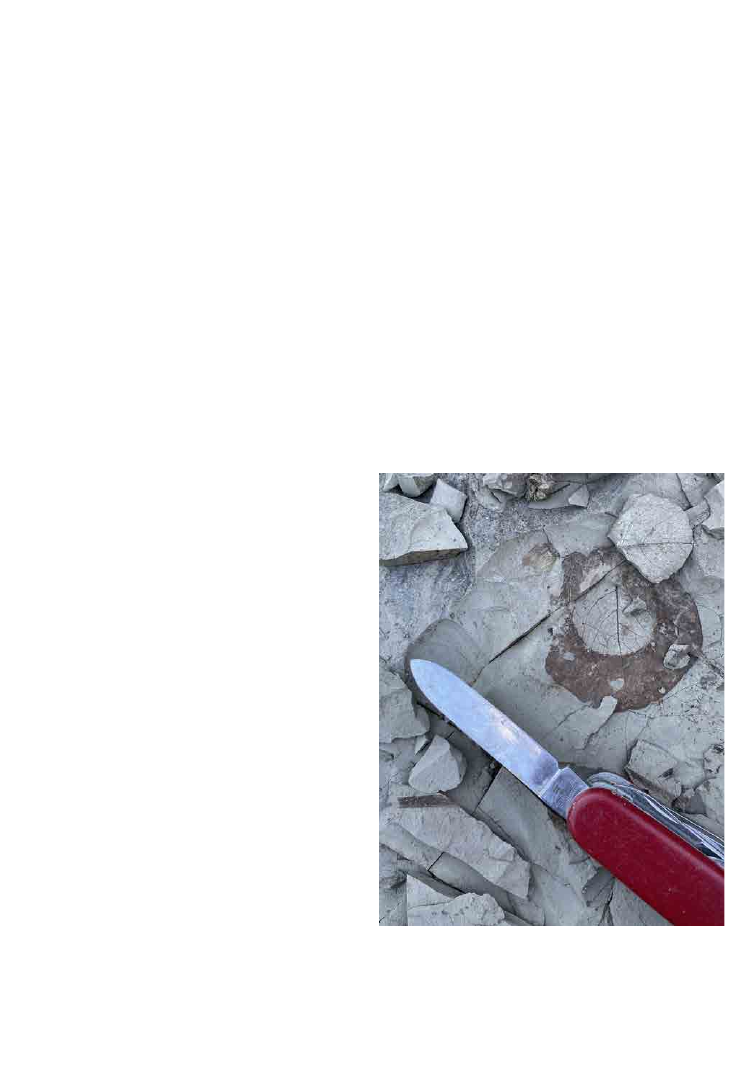
PSB 70 (3) 2024
261
subsequent paintings, books, cartoons, dioramas,
and video games. Continued excavation over the
last 30 years has yielded a remarkably diverse Hell
Creek flora with more than 300 species (Johnson,
2002)
We are now embarking on an effort to bring
botanical reality to the vegetation that was the base
of the food chain that produced Tyrannosaurus
rex, the planet’s greatest terrestrial apex predator.
We plan to do this by focusing on a suite of the
best Hell Creek Formation fossil leaf quarries
that we have collected over the last 30 years.
These quarries represent different stratigraphic
levels on the 100-m-thick formation and different
depositional settings including ponds, floodplains,
riverbeds, and levees. These quarries were chosen
because they have superb preservation, commonly
yield complete leaves, and show high plant
diversity. Each quarry will yield the data needed to
reconstruct a specific time and place from the last
1.5 million years of the Cretaceous. In this article,
we demonstrate how we reconstruct a single plant,
Cobbania hickeyi, using an example from the
“Licking Leaves” site, a pond deposit in Harding
County, northwestern South Dakota (Denver
Museum of Nature & Science locality 2703).
Materials and Methods
Leaves and other plant parts are typically buried
in clay, mud, or sand in or near rivers and ponds
and are preserved as compressions or impressions
in claystone, mudstone, or sandstone. Subsequent
uplift and erosion create the outcrops that are
the source of fossil plants. During fossilization,
original leaf organic matter is typically degraded
or destroyed, leaving a leaf-shaped void in the
rock. This fact is useful because the rock will break
along this plane of weakness to yield imprints of
both the top and the bottom of the leaf.
During fieldwork in 1994 in Dinosaur Provincial
Park, Alberta, and in southwestern North Dakota,
we collected two separate examples of a complete
floating aquatic plant with a rosette of leaves that
we interpreted to be inflated. Stockey et al. (2007)
described this plant, named it Cobbania corrugata,
and assigned it to an aquatic clade of the Araceae.
In this paper, we reconstruct the closely related
species, Cobbania hickeyi (Stockey et al., 2016),
which was based on one complete plant and
many loose leaves from the Licking Leaves quarry
(Figure 1).
Close collaboration between artist and scientist is
extremely important throughout the illustration
process, and for this plant we relied on our
colleagues Ruth Stockey and Gar Rothwell.
Reconstructing a three-dimensional plant from
a flattened and sediment filled fossil required
both mental and physical models. To do this, the
artist (M.L.) traced several leaf fossils, “restoring”
each in its entirety, and paying close attention to
shapes, margin, and venation (Figure 2A). She
used the drawings to create and arrange paper and
wire leaf models to view the plant from various
perspectives.
Figure 1. A single leaf Cobbania hickeyi as it was found
in the Licking Leaves quarry. The inflated part of the leaf
has lifted off to show the interior venation of the leaf.
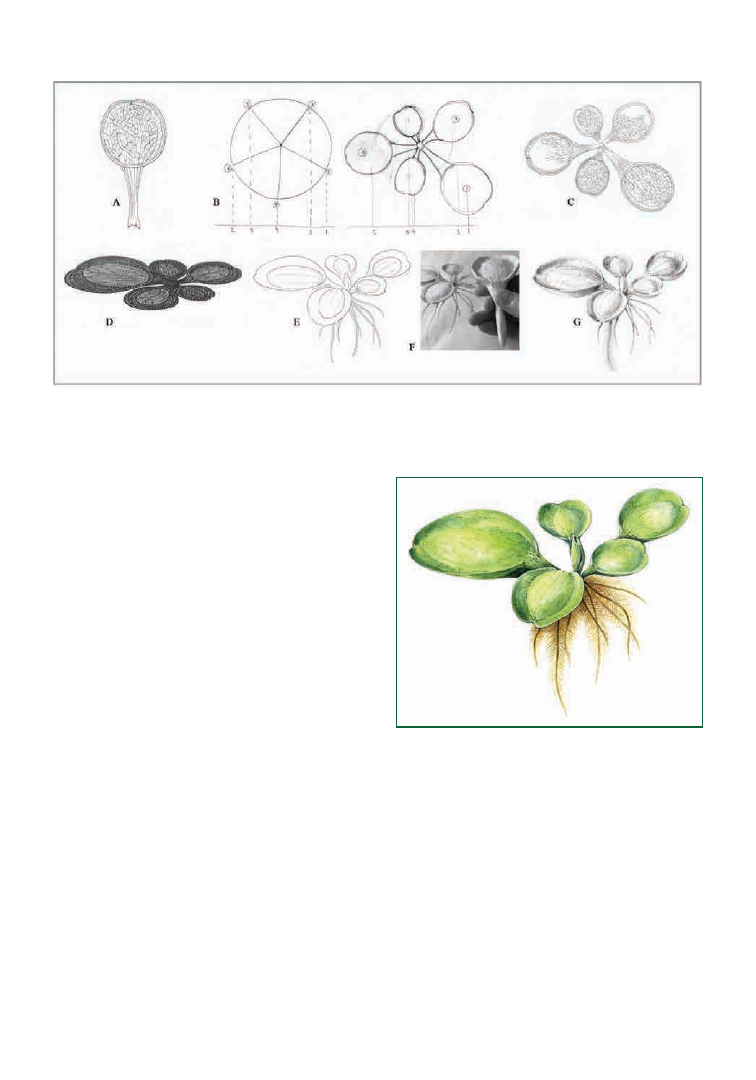
PSB 70 (3) 2024
262
The resulting top-down linear schematic illustrated
the plant’s spiral phyllotaxy, proper leaf size, and
arrangement (Figure 2B). Using this sketch and
referencing live specimens of Pistia corrugata, she
fleshed out a detailed rendering of a plant rosette
from above showing five leaves and a new leaf bud
(Figure 2C).
A low-angle photo of the top view rotated the plant
from a top view to a 3/4 view (Figure 2D), and the
resulting image portrays the altered shapes and
position of leaves in relationship to one another at
an oblique angle (Figure 2E). Because the Cobbania
leaves were inflated in life, it was useful to create a
clay model to understand how they would appear
while floating in water (Figure 2F). The clay
model provides a physical form that facilitated the
drawing of the leaves and petioles, both above and
below an imaginary waterline. Shining a light on
the clay models allowed the creation of a realistic
interpretation on light on form (Figure 2G). The
final drawing was transferred to watercolor paper
where the artist used a living relative, Limnobium,
for color reference to complete the painting
(Figure 3).
The dinosaurs of the Hell Creek Formation are
surely the most illustrated animals of all prehistory.
It is our goal to reconstruct the vegetation of their
world with precision and beauty, one species at a
time (Figure 4).
Figure 2. (A) Tracing and restoration of leaf fossil. (B) Linear schematic of spiral phyllotaxy. (C) Delineated render-
ing of rosette. (D) Low-angle photo of inked illustration. (E) Pencil sketch of plant in oblique angle perspective. (F)
Clay model helps to “see” how light falls on 3D leaves. (G) Value drawing with highlights and shadows to show form.
Figure 3. Full-color reconstruction of the Cobbania
hickeyi floating rosette.
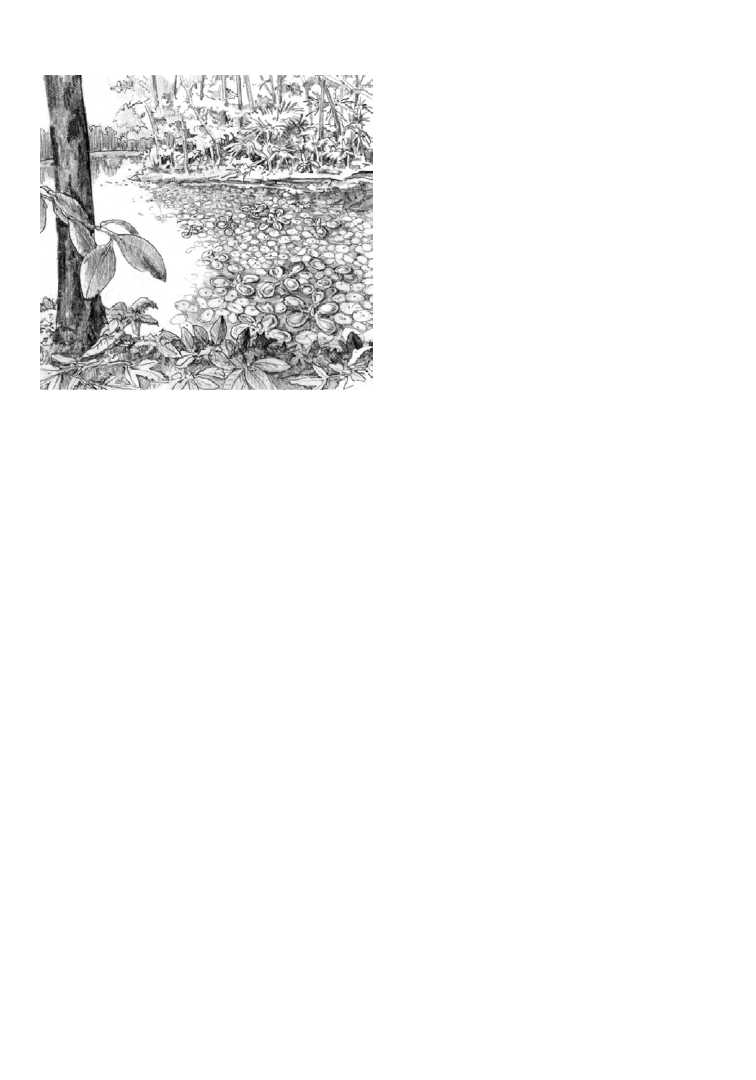
PSB 70 (3) 2024
263
Figure 4. Pencil study for a rendering of a Late Creta-
ceous pond environment with rosettes of Cobbania hick-
eyi floating in a shallow pond covered with of Brasenia
(watershield).
REFERENCES
Johnson, K. R., 1996, Description of seven common
fossil leaf species from the Hell Creek Formation
(Late Cretaceous: Upper Maastrichtian), North Da-
kota, South Dakota, and Montana. Proceedings of
the Denver Museum of Natural History, series 3, v.
3, p. 1-48.
Johnson, K. R. 2002. The megaflora of the Hell
Creek and lower Fort Union Formations in the
western Dakotas: vegetational response to climate
change, the Cretaceous-Tertiary boundary event,
and rapid marine transgression. In: J. Hartman, K.
R. Johnson, D. J. Nichols (eds). The Hell Creek For-
mation and the Cretaceous-Tertiary Boundary in the
northern Great Plains: an integrated continental re-
cord of the end of the Cretaceous. Spec Pap 361, pp.
329–392. Geological Society of America, Boulder,
CO.
Leggitt, M. C., and K. R. Johnson. 1999. From fossil
plants to scientifically-accurate dioramas: the fabri-
cation of prehistoric ecosystems. Journal of Natural
Science Illustration 3: 3-6.
Stockey, R. A., G. W. Rothwell, and K. R. Johnson.
2007. Cobbania corrugata gen. et comb. nov. (Ara-
ceae): a floating aquatic monocot from the Upper
Cretaceous of western North America. American
Journal of Botany 94: 609–624.
Stockey, R. A., G. W. Rothwell, and K. R. John-
son. 2016. Evaluating relationships among floating
aquatic monocots: A new species of Cobbania (Ara-
ceae) from the Upper Maastrichtian of South Da-
kota. International Journal of Plant Sciences 177:
706–725.

264
From the PSB Special Issue on Art in the Botanical Sciences
By Edward J. Spagnuolo
1,5
,
L. Alejandro Giraldo
1
, Mario
Coiro
2,3
, and Susannah Lydon
4
1
Department of Geosciences and Earth
and Environmental Systems Institute,
Pennsylvania State University, University
Park, PA, USA.
2
Department of Paleontology, University of
Vienna, Vienna, Austria.
3
Ronin Institute for Independent Scholarship,
Montclair, NJ, USA.
4
School of Biosciences, University of
Nottingham, Loughborough, UK.
5
Author for correspondence (email:
spagnuolo@psu.edu)
ABSTRACT
Paleoart is an important tool for paleobotanists
when reconstructing fossil plants and ancient
ecosystems, and communicating with diverse
audiences. Plants are fundamental components of
terrestrial ecosystems. Thus, accurately depicting
ancient plants in art is crucial for communicating
comprehensive knowledge about ancient life. Here,
we briefly review the history of paleobotanical
art, discuss the challenges when accurately
depicting plants in paleoreconstructions, and
highlight recent works that reconcile isolated
plant organs into scientifically accurate whole-
plant and landscape-level reconstructions.
Historically, paleoart has included plants as
Reconstructing the Botanical Past:
Art and Paleobotany
background elements in art featuring charismatic
vertebrates, resulting in poorly depicted plants and
ecosystems. Plant blindness—the phenomenon
in which humans are more inclined to detect
and appreciate fauna than flora—is a persistent
problem for science communicators, botanists,
and paleobotanists. Although plant blindness
is rampant in 20th-century paleoart, modern
paleoart that accurately incorporates and focuses
on ancient plants can increase plant visibility in
portrayals of the geologic past.
KEYWORDS
art, fossils, paleoart, paleobotany, plant awareness
disparity, plant blindness, plant fossils,
scientific reconstructions
Art is an important tool for scientists to engage
with both scientific and general audiences (Lesen
et al., 2016). Paleontological art—or paleoart—
has been used to reconstruct extinct organisms
and environments for almost 200 years and
has influenced many of our assumptions about
the past (Davidson, 2008; Stroud, 2008; Witton
et al., 2014; Clary et al., 2022b; Manucci and
Romano, 2022). Paleoart can also be useful to
better understand and advance paleontological
paradigms—most famously, the extensive
updated paleoart that accompanied the Dinosaur
Renaissance of the late 20th century (McDermott,
2020). Paleoart includes drawings and paintings,
museum reconstructions and sculptures, as well
as documentaries, movies, and even video games;
here, we will mostly reference drawings and
paintings, the most common form of paleoart.

PSB 70 (3) 2024
265
Plants are fundamental for ecosystems and
society, supporting biodiversity, terrestrial
biomass, ecosystem structure, and as critical
food and oxygen sources for humans and other
organisms. Unfortunately, general audiences,
policymakers, and other scientists are more likely
to recognize and appreciate animals compared
to plants. This disparity, termed plant blindness
(also known as plant awareness disparity in recent
years) has been attributed to reduced funding
for plant-related projects compared to animal-
focused research, as well as a global decrease in
plant-centered education, conservation, and
recognition (Wandersee and Schussler, 1999; Drea,
2011; Balding and Williams, 2016; Jose et al., 2019;
Margulies et al., 2019; Parsley, 2020; Brownlee et
al., 2021; Stagg and Dillon, 2022; Stroud et al.,
2022; Walton et al., 2023).
Paleontology is widely thought of as a “gateway
science” to other fields in science, technology,
engineering, and mathematics (STEM), and as a
way to teach broader audiences larger scientific
concepts such as evolution, mass extinctions,
climate change, and biodiversity (Moran et al.,
2015). Often, these education and outreach
initiatives include, or center on, paleoart (Burns
et al., 2003; Clary et al., 2022a; Lipps et al., 2022).
Additionally, plant fossils show how environments
have responded to climate change, and knowledge
of fossil history can be used as a rationale for
the direct conservation of plants and ecosystems
(e.g., the UNESCO World Heritage Gondwana
Rainforests of Australia; Young and McDonald,
1987; Burnham, 2001; Wilson et al., 2011; Ivory et
al., 2016; Lézine et al., 2019; Kooyman et al., 2020).
Accurately representing fossil plants in paleoart is
fundamental for conveying information about life
in the past.
Paleoart has tended to focus on animals, with
plants seen as a backdrop or scene-setting, rather
than as “central characters” (however, see Benca
et al., 2014; Sanders, 2014; Beans, 2022; Benca,
2022). Here, we discuss how plants have been
depicted in paleoreconstructions over time within
the context of plant blindness. We also consider
the challenges facing plant paleoart and present
promising trends for the future.
BRIEF HISTORY OF PLANT
PALEOART
Duria antiquior (“A More Ancient Dorset”),
painted by Sir Henry Thomas De la Beche in 1830
(Figure 1A), is widely considered the first example
of a new genre of art: the reconstruction of life in
the past based on scientific evidence (Rudwick,
1992, 2014; Lescaze, 2017). Although largely
a marine scene, this first paleoreconstruction
included palms and other less easily identifiable
vegetation on background landmasses. In the
lithograph versions, produced from De la Beche’s
work by George Scharf, fern-like and cycad-
looking plants are also recognizable (Rudwick,
1992; Sharpe, 2022; Sharpe and Clary, 2022).
The circulation of lithographic prints of
Duria antiquior began the proliferation of
paleoreconstructions as a means of conveying
information about life in the deep past to broad,
non-scientific audiences from the 1830s onwards
(Clary et al., 2022a), and these illustrations
frequently incorporated detailed plant
reconstructions (Vujaković, 2019; Manucci and
Romano, 2022). Christian Hohe’s final lithograph
for Georg August Goldfuss’ Petrefacta Germaniae,
produced in 1844, is an exquisitely detailed scene
from the Coal Measures with a key detailing the
plant taxa, demonstrating that Goldfuss expected
his audience to be as interested in them as in
animal fossils (Rudwick, 1992).
The importance and ubiquity of coal in people’s
everyday lives (Yuval-Naeh, 2019), combined
with popular interest in ferns and their allies
(Whittingham, 2012), meant that paleoart
focusing on Carboniferous plants was widespread
in the latter half of the 19th century (Figure 1B).
For instance, Carboniferous plants featured in
Franz Unger’s Die Urwelt in ihren verschiedenen
Bildungsperioden (“The Primeval World in Various
Developmental Periods”) published in 1851,
with artwork by Josef Kuwasseg, which inspired
Edouard Riou’s illustrations for Louis Figuier’s
La terre avant le deluge (“The Earth Before the
Flood”) in 1863 (Rudwick, 1992; Davidson, 2015;
Vujaković, 2019; Collins, 2022).
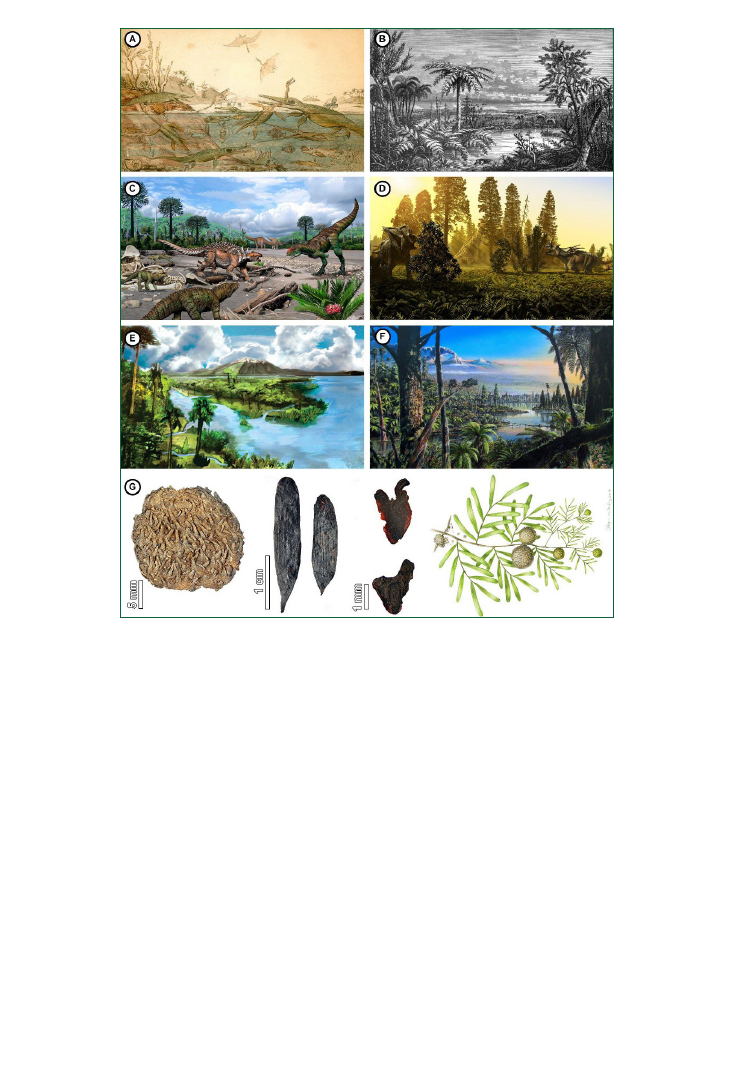
Figure 1. Representative examples of plant paleoart throughout history and modern plant-centered paleoart. (A) Henry De
la Beche’s Duria antiquior. Note palms on the middle-right and some less easily identifiable vegetation on the middle-left. (B)
Lycophyte, sphenophyte, and pteridosperm taxa from the Carboniferous of the United States depicted in Underwood (1896;
artist unknown), in turn based on Dana (1874). (C) Dinosaur-centered reconstruction of the Late Cretaceous of Argentina,
with some minor plant elements in the back (Araucaria) and front right (Zamuneria) (artist: Jorge Antonio González,
modified from Paulina-Carabajal et al., 2021). (D) Dinosaur-centered reconstruction of the Late Cretaceous of Canada,
with more prominent plant elements covering the ground (ferns), background (conifers), and with which the dinosaurs are
interacting (angiosperms) (artist: Julius T. Csotonyi, modified from Mallon and Anderson, 2013). (E) Paleoenvironmental
reconstruction of the Late Cretaceous of Argentina based on pollen data, which provides a more regional signature. Plants
depicted include ferns, palms, and conifers (artist: F. Guillén, modified from Barreda et al., 2012). (F) Paleoenvironmen-
tal reconstruction of the mid-Cretaceous of West Antarctica based on pollen, geochemical, sedimentological, and organic
biomarker data, providing a more accurate depiction of the landscape. Plants depicted included Cyathea (Cyatheaceae),
Podocarpaceae, and Araucariaceae (artist: James McKay, modified from Klages et al., 2020). (G) Fossil material and recon-
struction of the Early Cretaceous conifer Krassilovia mongolica and the associated leaf morphotaxon Podozamites harrisii.
From left to right: Articulated seed cones, leaves, winged seeds; and reconstruction of a branch of K. mongolica reconciling
all of the fossil elements including alternately arranged P. harrisii leafy shoots (artist: Pollyanna von Knorring, modified
from Herrera et al., 2020).
All images used here are either Public Domain or have full CC-BY 4.0 rights (https://creativecommons.org/licenses/by/4.0/).
(A) Duria Antiquior [https://commons.wikimedia.org/wiki/File:Duria_Antiquior.jpg] by Henry De la Beche, 1830. Pub-
lic Domain (B) Carboniferous Pteridophyta [https://commons.wikimedia.org/wiki/File:Our_Native_Ferns_-_Carbonifer-
ous_Pteridophyta.jpg#filelinks] by Lucien Marcus Underwood, 1896. Public Domain. (C) © 2021 Paulina-Carabajal et al.,
CC-BY-4.0 (Paulina-Carabajal et al., 2021). (D) © 2013 Mallon, Anderson, CC-BY-4.0 (Mallon and Anderson, 2013). (E)
© 2012 Barreda et al, CC-BY-4.0 (Barreda et al., 2012). (F) © 2020 Klages et al., CC-BY-4.0 [https://www.nature.com/
articles/s41586-020-2148-5/figures/3] (Klages et al., 2020) (G) © 2020 Herrera et al, CC-BY-4.0 (Herrera et al., 2020).

PSB 70 (3) 2024
267
The “Classic era of paleoart” began in the 1890s in
the United States with the hugely influential work
of Charles R. Knight (Milner, 2012; Witton, 2018).
Knight was famously commissioned to create
paintings and murals for some of the largest natural
history museums in the United States (including
the American Museum of Natural History and the
Field Museum). Often collaborating extensively
with vertebrate paleontologists, Knight’s murals
centered on the charismatic extinct vertebrates
at the forefront of paleontological discovery with
naturalistic, but often homogenous, vegetation
(Vujaković, 2019). However, Knight conducted
detailed research on the Gilboa forests of New York
and communicated with paleobotanist Winifred
Goldring to maximize the paleobotanical accuracy
of his plant-centered mural Devonian Forest (on
display at the Field Museum; VanAller Hernick,
2003). Meanwhile, in Europe, Czech painter
Zdeněk Burian painted lavish reconstructions
including flora from Devonian to Quaternary
times (Lavas, 2016; Witton, 2018).
Unfortunately, the paleoart of the mid-late 20th
century pushed plants into the background.
Dinosaurs and other charismatic vertebrates were
the centerpieces of most paleoart from this time,
and plants were rarely given much consideration.
Monkey puzzle trees (Araucaria), cycads
(Cycadales), Williamsonia (Bennettitales), palms
(Arecaceae), and tree ferns (e.g., Cyatheales)—a
very small fraction of the known fossil floral
diversity—made up the majority of paleoartistic
reconstructions of Mesozoic vegetation. The
majority of known Mesozoic seed plants were
rarely featured in dinosaur habitats and museum
reconstructions of the time (Philippe et al., 2009;
Sanisidro and Barrón, 2016; Herrera et al., 2020).
Dinosaurs were often reconstructed standing on
dry, lifeless earth with a handful of nondescript
monkey puzzle trees in the distance, a plant-blind
art style coined by Kirk Johnson as “monkey
puzzles and parking lots” (Johnson and Troll,
2007; Figure 1C).
The rise of the Internet and digital art at the
end of the 20th century enabled a paleoart
community to develop and thrive online (Witton,
2018). Although tetrapod-centered approaches
continued to dominate paleoart at the start of the
21st century (Figure 1D), some artists deliberately
flipped this orthodoxy, such as Robert Nicholls
in his reconstruction of the early Cretaceous
Antarctic Peninsula (McKie, 2011), and influential
practitioners such as Witton (2018) have
advocated for far greater consideration of plants
by paleoartists (Figure 1E–G).
CHALLENGES TO PLANT
PALEOART AND THE
POTENTIAL FOR SPECULATION
The fundamental challenge in paleobotany
and plant paleoart is creating whole-organism
reconstructions (Martine et al., 2019) given the
fragmentary nature of the plant fossil record
(Spicer and Thomas, 1986). The shedding and
differential preservation of various plant organs—
including leaves, wood, cones, flowers, spores or
pollen, as well as fruits and seeds—throughout
the plant life cycle result in a multitude of
disarticulated fossils produced by the same
plant (Dilcher, 1974; Kvaček, 2008; Wilf, 2008a;
Manchester et al., 2014; Cleal et al., 2021), and
whole-plant preservation is exceedingly rare
(e.g., Boucher et al., 2003; Zamaloa et al., 2006).
Additionally, these isolated fossil organs are often
named as separate species (or even genera), which
can be confusing for non-experts and paleoartists.
For example, a single Carboniferous lycopsid tree
could be the source of at least six separate fossil
species if found in isolation (Spicer and Thomas,
1986). Similarly, the use of morphotaxa—species
or genera representing a certain morphology
rather than a biological unit—can be confusing
for paleoartists (Figure 1G). For example, the
wood genus Araucarioxylon and the leaf genus
Brachyphyllum were produced by multiple conifer
groups (Philippe et al., 2009; Philippe, 2011) but
are often reconstructed as Araucaria, fueling their
overuse in paleoart.

PSB 70 (3) 2024
268
Although leaves are the most abundant plant
macrofossils, leaf morphology can be highly
variable and plastic, even on leaves of the same
plant; most paleobotanists today use caution
when taxonomically identifying isolated fossil
leaves (Dilcher, 1974; Doyle, 2007; Wilf, 2008a;
Spagnuolo et al., 2022). During the 19th and 20th
centuries, numerous angiosperm leaves from
the Cretaceous and Cenozoic were inaccurately
assigned to extant genera and families, largely
due to superficial similarities. This has led many
paleoartists, especially during the 20th century,
to include genera that were likely not present
(such as Quercus, Populus, Acer, and Salix) in
late Cretaceous and early Paleogene landscape
reconstructions. Although reproductive organs—
such as fruits, seeds, flowers, and cones—are the
basis for most modern fossil plant taxonomy and
identification, they are often more delicate and
produced at much lower abundances than leaves
(Gastaldo, 1992; Cleal et al., 2021).
When reconstructing ancient ecosystems,
paleoartists must also consider the scale at which
they are working. Compressed leaves have been
shown to mostly represent a snapshot of local
vegetation, with low levels of non-local influences
(Burnham, 1994, 1997; Wing and DiMichele, 1995;
Cleal et al., 2021). Conversely, pollen and spore
data can represent regional vegetation from many
habitats within a larger region (Behrensmeyer et
al., 2000; Birks et al., 2016). When combined, these
data can be used to accurately depict local (e.g.,
beside a pond) to regional (basin-level) vegetation
(Figure 1E and F; Opluštil et al., 2014; Costamagna
et al., 2018; Barreda et al., 2020; Wilf et al., 2022).
When depicting ancient landscapes, paleoartists
should also consult with scientists from other
geological disciplines (e.g., sedimentologists) to
understand the paleo-topography of the region
and how that would influence the distribution of
past vegetation.
While paleobotany deals with fragmentary
evidence, illustrations often require a well-
developed organismal concept, often based on
comparative morphology or nearest living relative
approaches (Witmer, 1995; Witton, 2018; Martine
et al., 2019). The nature of the plant fossil record
and the difficulties associated with reconstructing
whole plants (Bateman and Hilton, 2009) imply
a certain degree of speculation regarding the
reconstruction of most plant fossils. Although
the practice of representing “known unknowns”
has become an important part of vertebrate
paleoart (Conway et al., 2013; Nieuwland, 2020),
paleoartists seem to be more cautious with plant
reconstructions.
The reason for such caution could be a lack of
accessibility to botanical and paleobotanical
knowledge, as well as limited input from scientists.
Since the late 19th century, paleoart has been
driven by commissions, most often by vertebrate
paleontologists, not paleobotanists. Scientists
must provide artists with more paleobotanical
information when possible; however, this can be
a challenge because plants and animals require
different environmental settings to fossilize
and often are not found in the same rocks
(Behrensmeyer et al., 2000). Navigating the jargon-
rich botanical and paleobotanical literature can
be incredibly difficult for non-experts, especially
given the decrease in botanical education in
general curricula over time (Drea, 2011; Stroud
et al., 2022). Although botanical illustration is a
well-established field with a rich history spanning
centuries (Ben-Ari, 1999; Swann and Pye, 2019;
Bienvenue and Chare, 2022), paleoartists rarely
come from a formal background in botanical
illustration (Sutton, 2019; Dart and Coiro, 2022;
von Knorring and Coiro, 2022) and instead have
more varied professional stories (Orr, 2019).
The expansion of paleoart-focused education in
traditional botanical illustration curricula might
provide a way forward to better integrate these
two fields.
THE FUTURE IS BRIGHT FOR
PLANT PALEOART
Over the last 20 years, scientists have made
massive advancements in understanding plant
evolution and ancient ecosystems due to the

PSB 70 (3) 2024
269
advent of molecular data, mass digitization of
natural history collections, and new imaging and
statistical methods (Donoghue and Doyle, 2000;
Bebber et al., 2010; Amborella Genome Project,
2013; Page et al., 2015; Coiro et al., 2019; Leebens-
Mack et al., 2019; Bakker et al., 2020; Hedrick
et al., 2020; Romero et al., 2020; Johnson et al.,
2023). Plant paleoart has also made significant
strides in accurately reconstructing ancient plants
and paleo-landscapes (see art in Phillips and
DiMichele, 1992; DiMichele et al., 2007; Benca et
al., 2014; Hetherington et al., 2016; McElwain et al.,
2021; Beans, 2022; Benca, 2022). Fossil discoveries
worldwide have yielded additional fossil plants
with connected organs, allowing for more accurate
whole-plant artistic reconstructions (art in Sun
et al., 1998, 2002; Hermsen et al., 2009; Zhang et
al., 2010; Opluštil et al., 2014; Gomez et al., 2015;
Bodnar and Escapa, 2016; Rothwell et al., 2022).
Extinct plant lineages, which often lack whole-
organismal concepts, are being reconstructed
and properly included in landscapes (Philippe et
al., 2009; Barreda et al., 2012; Wang et al., 2012a;
Herrera et al., 2020). Cretaceous charcoalified
flowers, and their incredibly detailed artistic
reconstructions by Pollyanna von Knorring and
others, have provided an unexpected window into
early angiosperm evolution (Crepet et al., 2004;
Schönenberger, 2005; Crepet, 2008; Takahashi et
al., 2008; Friis et al., 2011). Fossil Lagerstätten,
amber deposits, and insect damage found on fossil
plants have been shown to document plant-insect
interactions, including pollination, herbivory and
palynivory, insect mining and galling, and insect-
plant mimicry (Wilf and Labandeira, 1999; Wilf,
2008b; see art in Wang et al., 2012b, 2014; Bao et
al., 2019; Correia et al., 2020; Cariglino et al., 2021;
Tihelka et al., 2021; Xiao et al., 2021; Prevec et al., 2022).
Plants are emerging from the background of
ancient ecosystems in modern paleoart. The
Ancient Colorado and Ancient Denvers murals
and related museum reconstructions accurately
reconstruct the history of the Denver Basin
based on decades of detailed stratigraphic,
paleontological, and paleobotanical research
and collaboration with artists and sculptors
(commissioned by Kirk Johnson and the Denver
Museum of Nature and Science, and brought to
life by artists Jan Vriesen, Donna Braginetz, and
Gary Staab; Johnson and Raynolds, 2006; Johnson
and Stucky, 2006). These murals reconstruct
ancient environments from specific fossil
localities, instead of broad summaries of entire
time periods that tend to depict plants and animals
in the same reconstruction that did not actually
coexist (common in 20th-century paleoart).
Some of the exceptional plant-centered artwork
of Smithsonian scientific illustrator Mary Parish
includes the floristic turnover of the Carboniferous
Rainforest Collapse and the vegetation of the
latest Cretaceous (Montañez, 2016; Sutton, 2019).
The murals of Jay Matternes expertly recreated
the ecosystems of North America throughout the
Cenozoic, detailing the diversification of modern
mammal lineages and the rise of grasslands
(Carrano and Johnson, 2019). By assembling
detailed geochemical, stratigraphic, and
palynological data, Klages et al. (2020) together
with artist James McKay illustrated the once-
diverse late Cretaceous polar forests of Antarctica
(Figure 1F). Even traditional vertebrate-centered
paleoart is often more conscious of the plant
constituents than similar art 20 years ago (Figure
1D). In recent documentaries, video games (e.g.,
Saurian, Urvogel Games), and comic books, the
vegetation is carefully considered to reflect the
fossil record of the time period and region (Ehret,
2019; Parker, 2021; Clements et al., 2022; Wings et
al., 2023).
Among the resources available for plant
paleoartists, the Extinct Plant Paleoart Database
(Jud, 2020) collects examples of published paleoart
in an accessible and continuously updated format.
The database currently includes 177 references
to plant paleoart, as well as a separate list of
plant paleoartists. Although the issue of paywalls
associated with scientific journals still hinders
full accessibility to paleoartists, this represents
an important first step to increase visibility of
available resources. We hope that these recent
scientific and artistic advancements encourage
paleobotanists to continue collaborating with
artists in their research and engagement to reduce

PSB 70 (3) 2024
270
plant blindness and inspire future generations of
paleobiologists to study extinct plants and animals.
ACKNOWLEDGMENTS
E.J.S. and L.A.G. thank Peter Wilf for in-depth
discussions on this topic as well as Cassandra N.
Nuñez Sanchez, Rebecca Horwitt, Linda Musser,
and the Pennsylvania State University Libraries.
E.J.S. and L.A.G. are grateful for the fruitful
discussions in the Pennsylvania State University
Paleobiology Seminar and Paleobotany course on
these topics. M.C. thanks Nathan Jud, Rebecca
Dart, Ida Kalsta, Julianne Kiely, and Dolev
Fabrikant for discussions on the topic. S.L. thanks
Chris Manias and the Popularizing Palaeontology
collective for an invaluable forum to discuss this
topic. We are also grateful for thoughtful feedback
and suggestions from two anonymous reviewers.
We acknowledge financial support from NSF
Grants EAR-1925755 (to E.J.S. and L.A.G.) and
DGE-1255832 (E.J.S.).
REFERENCES
A
mborella Genome Project. 2013. The Amborella ge-
nome and the evolution of flowering plants. Science
342: 1241089.
Bakker, F. T., A. Antonelli, J. A. Clarke, J. A. Cook,
S. V. Edwards, P. G. P. Ericson, S. Faurby, et al. 2020.
The Global Museum: natural history collections and
the future of evolutionary science and public educa-
tion. PeerJ 8: e8225.
Balding, M., and K. J. H. Williams. 2016. Plant blind-
ness and the implications for plant conservation. Con-
servation Biology 30: 1192–1199.
Bao, T., B. Wang, J. Li, and D. Dilcher. 2019. Polli-
nation of Cretaceous flowers. Proceedings of the Na-
tional Academy of Sciences, USA 116: 24707–24711.
Barreda, V. D., N. R. Cúneo, P. Wilf, E. D. Currano,
R. A. Scasso, and H. Brinkhuis. 2012. Cretaceous/Pa-
leogene floral turnover in Patagonia: drop in diversity,
low extinction, and a Classopollis spike. PLoS One 7:
e52455.
Barreda, V. D., M. del C. Zamaloa, M. A. Gandolfo, C.
Jaramillo, and P. Wilf. 2020. Early Eocene spore and
pollen assemblages from the Laguna del Hunco fossil
lake beds, Patagonia, Argentina. International Journal
of Plant Sciences 181: 594–615.
Bateman, R. M., and J. Hilton. 2009. Palaeobotanical
systematics for the phylogenetic age: applying organ-
species, form-species and phylogenetic species con-
cepts in a framework of reconstructed fossil and extant
whole-plants. Taxon 58: 1254–1280.
Beans, C. 2022. Artists join paleobotanists to bring
ancient plants to life—and pique viewer interest. Pro-
ceedings of the National Academy of Sciences, USA
119: e2201070119.
Bebber, D. P., M. A. Carine, J. R. I. Wood, A. H. Wort-
ley, D. J. Harris, G. T. Prance, G. Davidse, et al. 2010.
Herbaria are a major frontier for species discovery.
Proceedings of the National Academy of Sciences, USA
107: 22169–22171.
Behrensmeyer, A. K., S. M. Kidwell, and R. A. Gastal-
do. 2000. Taphonomy and paleobiology. Paleobiology
26: 103–147.
Ben-Ari, E. T. 1999. Better than a thousand words: bo-
tanical artists blend science and aesthetics. BioScience
49: 602–608.
Benca, J. P. 2022. Reconstructing lycopsids lost to the
deep past. In V. Bienvenue, and N. Chare [eds.]. Ani-
mals, plants and afterimages: the art and science of rep-
resenting extinction, 243–258. Berghahn Books, New
York, New York, USA.
Benca, J. P., M. H. Carlisle, S. Bergen, and C. A. E.
Strömberg. 2014. Applying morphometrics to early
land plant systematics: a new Leclercqia (Lycopsida)
species from Washington State, USA. American Jour-
nal of Botany 101: 510–520.
Bienvenue, V., and N. Chare [eds.]. 2022. Animals,
plants and afterimages: the art and science of repre-
senting extinction, 1st ed. Berghahn Books. New York,
New York, USA
Birks, H. J. B., V. A. Felde, A. E. Bjune, J.-A. Grytnes,
H. Seppä, and T. Giesecke. 2016. Does pollen-assem-
blage richness reflect floristic richness? A review of
recent developments and future challenges. Review of
Palaeobotany and Palynology 228: 1–25.

PSB 70 (3) 2024
271
Bodnar, J., and I. H. Escapa. 2016. Towards a whole
plant reconstruction for Austrohamia (Cupressaceae):
new fossil wood from the Lower Jurassic of Argen-
tina. Review of Palaeobotany and Palynology 234:
186–197.
Boucher, L. D., S. R. Manchester, and W. S. Judd.
2003. An extinct genus of Salicaceae based on twigs
with attached flowers, fruits, and foliage from the Eo-
cene Green River Formation of Utah and Colorado,
USA. American Journal of Botany 90: 1389–1399.
Brownlee, K., K. M. Parsley, and J. L. Sabel. 2021. An
analysis of plant awareness disparity within introduc-
tory biology textbook images. Journal of Biological
Education 57: 422–431.
Burnham, R. J. 2001. Is conservation biology a paleon-
tological pursuit? Palaios 16: 423–424.
Burnham, R. J. 1994. Patterns in tropical leaf litter and
implications for angiosperm paleobotany. Review of
Palaeobotany and Palynology 81: 99–113.
Burnham, R. J. 1997. Stand characteristics and leaf lit-
ter composition of a dry forest hectare in Santa Rosa
National Park, Costa Rica. Biotropica 29: 384–395.
Burns, T. W., D. J. O’Connor, and S. M. Stocklmayer.
2003. Science communication: a contemporary defini-
tion. Public Understanding of Science 12: 183–202.
Cariglino, B., P. Moisan, and M. B. Lara. 2021. The
fossil record of plant-insect interactions and associ-
ated entomofaunas in Permian and Triassic floras from
southwestern Gondwana: a review and future pros-
pects. Journal of South American Earth Sciences 111:
103512.
Carrano, M. T., and K. R. Johnson. 2019. Visions of
lost worlds: the paleoart of Jay Matternes. Smithsonian
Institution, Washington D.C., USA.
Clary, R. M., G. D. Rosenberg, and D. C. Evans. 2022a.
Drawing things together with paleontological art. In R.
M. Clary, G. D. Rosenberg, and D. C. Evans [eds.].
The evolution of paleontological art, GSA Memoirs,
1–8. Geological Society of America, Boulder, Colo-
rado, USA.
Clary, R. M., G. D. Rosenberg, and D. C. Evans [eds.],
2022b. The evolution of paleontological art. GSA
Memoirs 218. Geological Society of America, Boul-
der, Colorado, USA.
Cleal, C., H. S. Pardoe, C. M. Berry, B. Cascales-Mi-
ñana, B. A. S. Davis, J. B. Diez, M. V. Filipova-Mari-
nova, et al. 2021. Palaeobotanical experiences of plant
diversity in deep time. 1: How well can we identify
past plant diversity in the fossil record? Palaeogeogra-
phy, Palaeoclimatology, Palaeoecology 576: 110481.
Clements, T., J. Atterby, T. Cleary, R. P. Dearden, and
V. Rossi. 2022. The perception of palaeontology in
commercial off-the-shelf video games and an assess-
ment of their potential as educational tools. Geoscience
Communication 5: 289–306.
Coiro, M., J. A. Doyle, and J. Hilton. 2019. How deep
is the conflict between molecular and fossil evidence
on the age of angiosperms? New Phytologist 223: 83–99.
Collins, L. B. 2022. Franz Unger and plant evolution:
representations of plants through time. In R. M. Clary,
G. D. Rosenberg, and D. C. Evans [eds.]. The evolu-
tion of paleontological art, GSA Memoirs, 67–72. Geo-
logical Society of America, Boulder, Colorado, USA.
Conway, J., C. M. Kosemen, D. Naish, and S. Hart-
man. 2013. All yesterdays: unique and speculative
views of dinosaurs and other prehistoric animals. Ir-
regular Books.
Correia, P., A. R. Bashforth, Z. Šimůnek, C. J. Cleal,
A. A. Sá, and C. C. Labandeira. 2020. The history of
herbivory on sphenophytes: a new calamitalean with
an insect gall from the Upper Pennsylvanian of Portu-
gal and a review of arthropod herbivory on an ancient
lineage. International Journal of Plant Sciences 181:
387–418.
Costamagna, L. G., E. Kustatscher, G. G. Scanu, M.
Del Rio, P. Pittau, and J. H. A. van Konijnenburg-van
Cittert. 2018. A palaeoenvironmental reconstruction of
the Middle Jurassic of Sardinia (Italy) based on inte-
grated palaeobotanical, palynological and lithofacies
data assessment. Palaeobiodiversity and Palaeoenvi-
ronments 98: 111–138.
Crepet, W. L. 2008. The fossil record of angiosperms:
requiem or renaissance? Annals of the Missouri Botan-
ical Garden 95: 3–33.
Crepet, W. L., K. C. Nixon, and M. A. Gandolfo. 2004.
Fossil evidence and phylogeny: the age of major an-
giosperm clades based on mesofossil and macrofossil
evidence from Cretaceous deposits. American Journal
of Botany 91: 1666–1682.

PSB 70 (3) 2024
272
Dana, J. D. 1874. Manual of geology, treating of the
principles of the science with special reference to
American geological history, 2nd ed. Ivison, Blake-
man, Taylor and Co, New York, New York, USA.
Dart, R., and M. Coiro. 2022. Plant paleoartists: an in-
terview with Rebecca Dart. mariocoiro.blog. Website:
https://mariocoiro.blog/2022/06/28/plant-paleoartists-
an-interview-with-rebecca-dart/.
Davidson, J. P. 2008. A history of paleontology illus-
tration. Indiana University Press, Bloomington, Indi-
ana, USA.
Davidson, J. P. 2015. Misunderstood marine reptiles:
late nineteenth-century artistic reconstructions of pre-
historic marine life. Transactions of the Kansas Acad-
emy of Science 118: 53–67.
Dilcher, D. L. 1974. Approaches to the identification
of angiosperm leaf remains. The Botanical Review 40:
1–157.
DiMichele, W. A., H. J. Falcon-Lang, W. John Nelson,
S. D. Elrick, and P. R. Ames. 2007. Ecological gradi-
ents within a Pennsylvanian mire forest. Geology 35:
415–418.
Donoghue, M. J., and J. A. Doyle. 2000. Seed plant
phylogeny: demise of the anthophyte hypothesis? Cur-
rent Biology 10: R106–R109.
Doyle, J. 2007. Systematic value and evolution of leaf
architecture across the angiosperms in light of molecu-
lar phylogenetic analyses. CFS Courier Forschungsin-
stitut Senckenberg 258: 21–37.
Drea, S. 2011. The end of the botany degree in the UK.
Bioscience Education 17: 1–7.
Ehret, D. 2019. Botany as a state of flow: enhancing
plant awareness through video games. Plant Science
Bulletin 65: 19–27.
Figuier, L. 1863. La terre avant le déluge, 2nd ed. Li-
brairie de la Hachette & Cie, Paris, France.
Friis, E. M., P. R. Crane, and K. R. Pedersen. 2011.
Early flowers and angiosperm evolution. Cambridge
University Press, Cambridge, UK.
Gastaldo, R. A. 1992. Taphonomic considerations for
plant evolutionary investigations. Palaeobotanist 41:
211–223.
Goldfuss, G. A. 1844. Petrefacta Germaniae tam ea
quae in Museo Universitatis regiae Boruassicae Frid-
ericiae Wilhelmiae Rhenanae servantur quam alia
quaecumque in Museis Hoeninghusiano Muensteriano
aliisque extant iconibus et descriptionibus illustrata.
List & Francke, Dusseldorf, Germany.
Gomez, B., V. Daviero-Gomez, C. Coiffard, C. Martín-
Closas, and D. L. Dilcher. 2015. Montsechia, an an-
cient aquatic angiosperm. Proceedings of the National
Academy of Sciences, USA 112: 10985–10988.
Hedrick, B. P., J. M. Heberling, E. K. Meineke, K.
G. Turner, C. J. Grassa, D. S. Park, J. Kennedy, et al.
2020. Digitization and the future of natural history col-
lections. BioScience 70: 243–251.
Hermsen, E. J., E. L. Taylor, and T. N. Taylor. 2009.
Morphology and ecology of the Antarcticycas plant.
Review of Palaeobotany and Palynology 153: 108–123.
Herrera, F., G. Shi, C. Mays, N. Ichinnorov, M. Taka-
hashi, J. J. Bevitt, P. S. Herendeen, and P. R. Crane.
2020. Reconstructing Krassilovia mongolica supports
recognition of a new and unusual group of Mesozoic
conifers. PLoS One 15: e0226779.
Hetherington, A. J., C. M. Berry, and L. Dolan. 2016.
Networks of highly branched stigmarian rootlets de-
veloped on the first giant trees. Proceedings of the Na-
tional Academy of Sciences, USA 113: 6695–6700.
Ivory, S. J., R. Early, D. F. Sax, and J. Russell. 2016.
Niche expansion and temperature sensitivity of tropi-
cal African montane forests. Global Ecology and Bio-
geography 25: 693–703.
Johnson, K. R., I. F. P. Owens, and The Global Collec-
tion Group. 2023. A global approach for natural history
museum collections. Science 379: 1192–1194.
Johnson, K. R., and R. G. Raynolds. 2006. Ancient
Denvers: scenes from the past 300 million years of the
Colorado Front Range. Fulcrum Publishing, Golden,
Colorado, USA.
Johnson, K. R., and R. K. Stucky. 2006. Prehistoric
journey: a history of life on Earth. Fulcrum Publishing,
Golden, Colorado, USA.

PSB 70 (3) 2024
273
Johnson, K. R., and R. Troll. 2007. Cruisin’ the fossil
freeway: an epoch tale of a scientist and an artist on
the ultimate 5,000-mile paleo road trip. 1st ed. Fulcrum
Publishing, Golden, Colorado, USA.
Jose, S. B., C.-H. Wu, and S. Kamoun. 2019. Over-
coming plant blindness in science, education, and soci-
ety. Plants, People, Planet 1: 169–172.
Jud, N. A. 2020. Extinct plant paleoart database. Web-
site: https://github.com/PaleoNate/extinct_plants.
Klages, J. P., U. Salzmann, T. Bickert, C.-D. Hillen-
brand, K. Gohl, G. Kuhn, S. M. Bohaty, et al. 2020.
Temperate rainforests near the South Pole during peak
Cretaceous warmth. Nature 580: 81–86.
Kooyman, R. M., J. Watson, and P. Wilf. 2020. Pro-
tect Australia’s Gondwana rainforests. Science 367:
1083–1083.
Kvaček, Z. 2008. Whole-plant reconstructions in fos-
sil angiosperm research. International Journal of Plant
Sciences 169: 918–927.
Lavas, J. R. 2016. Zdeněk Burian and the golden age of
paleo-art. Prehistoric Times 119: 29–36.
Leebens-Mack, J. H., M. S. Barker, E. J. Carpenter,
M. K. Deyholos, M. A. Gitzendanner, S. W. Graham,
I. Grosse, et al. 2019. One thousand plant transcrip-
tomes and the phylogenomics of green plants. Nature
574: 679–685.
Lescaze, Z. 2017. Paleoart: visions of the prehistoric
past. Taschen, Cologne, Germany.
Lesen, A. E., A. Rogan, and M. J. Blum. 2016. Sci-
ence communication through art: objectives, challeng-
es, and outcomes. Trends in Ecology & Evolution 31:
657–660.
Lézine, A.-M., K. Izumi, M. Kageyama, and G.
Achoundong. 2019. A 90,000-year record of Afromon-
tane forest responses to climate change. Science 363:
177–181.
Lipps, J. H., A. Vartak, T. van Eijden, C. Rajshekhar,
S. Vaddadi, and R. Vartak. 2022. Paleontological post-
age stamps in art and education. In R. M. Clary, G. D.
Rosenberg, and D. C. Evans [eds.]. The evolution of
paleontological art, GSA Memoirs, 229–225. Geologi-
cal Society of America, Boulder, Colorado, USA.
Mallon, J. C., and J. S. Anderson. 2013. Skull ecomor-
phology of megaherbivorous dinosaurs from the Di-
nosaur Park Formation (upper Campanian) of Alberta,
Canada. PLoS One 8: e67182.
Manchester, S. R., L. Calvillo-Canadell, and S. R. S.
Cevallos-Ferriz. 2014. Assembling extinct plants from
their isolated parts. Boletín de la Sociedad Geológica
Mexicana 66: 53–63.
Manucci, F., and M. Romano. 2022. Reviewing the
iconography and the central role of ‘paleoart’: four
centuries of geo-palaeontological art. Historical Biol-
ogy 35: 1–48.
Margulies, J. D., L.-A. Bullough, A. Hinsley, D. J.
Ingram, C. Cowell, B. Goettsch, B. B. Klitgård, et
al. 2019. Illegal wildlife trade and the persistence of
“plant blindness”. Plants, People, Planet 1: 173–182.
Martine, A. M., F. Ricardi-Branco, and B. Beloto. 2019.
Descrição dos métodos paleoartísticos para reconstru-
ções de animais e vegetais fósseis. Terrae Didática 13:
101–112.
McDermott, A. 2020. Dinosaur art evolves with new
discoveries in paleontology. Proceedings of the Na-
tional Academy of Sciences, USA 117: 2728–2731.
McElwain, J., M. H. Donnelly, and I. Glasspool. 2021.
Tropical Arctic: lost plants, future climates, and the
discovery of ancient Greenland. University of Chicago
Press, Chicago, Illinois, USA.
McKie, R. 2011. When Antarctica was a tropical para-
dise. The Observer. Website: https://www.theguardian.
com/world/2011/jul/17/antarctica-tropical-climate-
co2-research.
Milner, R. 2012. Charles R. Knight: the artist who saw
through time. Abrams, New York, New York, USA.
Montañez, I. P. 2016. A Late Paleozoic climate win-
dow of opportunity. Proceedings of the National Acad-
emy of Sciences, USA 113: 2334–2336.
Moran, S., C. McLaughlin, B. MacFadden, E. Jacob-
be, and M. Poole. 2015. Fossil explorers. Science and
Children 53: 62–67.
Nieuwland, I. 2020. Paleoart comes into its own. Sci-
ence 369: 148–149.

PSB 70 (3) 2024
274
Opluštil, S., J. Pšenička, J. Bek, J. Wang, Z. Feng, M.
Libertin, Z. Šimůnek, et al. 2014. T0 peat-forming
plant assemblage preserved in growth position by vol-
canic ash-fall: a case study from the Middle Pennsyl-
vanian of the Czech Republic. Bulletin of Geosciences
89: 773–818.
Orr, D. 2019. The survey of paleoartists, second edi-
tion. Website: https://chasmosaurs.com/survey/.
Page, L. M., B. J. MacFadden, J. A. Fortes, P. S. Soltis,
and G. Riccardi. 2015. Digitization of biodiversity col-
lections reveals biggest data on biodiversity. BioSci-
ence 65: 841–842.
Parker, T. 2021. Saurian: a field guide to Hell Creek. H.
Meyers [ed.], Titan Books, London, UK.
Parsley, K. M. 2020. Plant awareness disparity: A case
for renaming plant blindness. Plants, People, Planet 2:
598–601.
Paulina-Carabajal, A., F. T. Barrios, A. H. Méndez, I.
A. Cerda, and Y.-N. Lee. 2021. A Late Cretaceous di-
nosaur and crocodyliform faunal association–based on
isolate teeth and osteoderms–at Cerro Fortaleza For-
mation (Campanian-Maastrichtian) type locality, Santa
Cruz, Argentina. PLoS One 16: e0256233.
Philippe, M. 2011. How many species of Araucarioxy-
lon? Comptes Rendus Palevol 10: 201–208.
Philippe, M., V. Daviero-Gomez, and V. Suteethorn.
2009. Silhouette and palaeoecology of Mesozoic trees
in Thailand. Geological Society, London, Special Pub-
lications 315: 85–96.
Phillips, T. L., and W. A. DiMichele. 1992. Compara-
tive ecology and life-history biology of arborescent ly-
copsids in late Carboniferous swamps of Euramerica.
Annals of the Missouri Botanical Garden 79: 560–588.
Prevec, R., A. Nel, M. O. Day, R. A. Muir, A. Matiwa-
ne, A. P. Kirkaldy, S. Moyo, et al. 2022. South African
Lagerstätte reveals middle Permian Gondwanan lake-
shore ecosystem in exquisite detail. Communications
Biology 5: 1154.
Romero, I. C., S. Kong, C. C. Fowlkes, C. Jaramillo,
M. A. Urban, F. Oboh-Ikuenobe, C. D’Apolito, and S.
W. Punyasena. 2020. Improving the taxonomy of fos-
sil pollen using convolutional neural networks and su-
perresolution microscopy. Proceedings of the National
Academy of Sciences, USA 117: 28496–28505.
Rothwell, G. W., M. T. Dunn, and A. C. Scott. 2022.
Reconstructing the Tetrastichia bupatides Gordon
plant; a Devonian–Mississippian hydrasperman gym-
nosperm from Oxroad Bay, Scotland and Ballyheigue,
Ireland. Review of Palaeobotany and Palynology 296:
104551.
Rudwick, M. J. S. 2014. Earth’s deep history: how it
was discovered and why it matters. University of Chi-
cago Press, Chicago, Illinois, USA.
Rudwick, M. J. S. 1992. Scenes from deep time: early
pictorial representations of the prehistoric world. Uni-
versity of Chicago Press, Chicago, Illinois, USA.
Sanders, R. 2014. Graduate student brings extinct
plants to life. Phys.org. Website: https://phys.org/
news/2014-04-student-extinct-life.html.
Sanisidro, O., and E. Barrón. 2016. Importancia de la
paleobotánica en las reconstrucciones paleoambien-
tales. In M. Ansón, M. Pernas Hernández, R. Menéndez
Muñiz, and P. A. Saura Ramos [eds.]. Líneas actuales
de investigación en paleoarte, 19–22. Madrid, Spain,
Publisher: Universidad Complutense de Madrid.
Schönenberger, J. 2005. Rise from the ashes – the re-
construction of charcoal fossil flowers. Trends in Plant
Science 10: 436–443.
Sharpe, T. 2022. Henry De la Beche’s 1829–1830 litho-
graph, Duria antiquior. Earth Sciences History 41: 47–63.
Sharpe, T., and R. M. Clary. 2022. Henry De la Beche’s
pioneering paleoecological illustration, Duria antiqui-
or. In R. M. Clary, G. D. Rosenberg, and D. C. Ev-
ans [eds.]. The evolution of paleontological art, GSA
Memoirs, 47–54. Geological Society of America,
Boulder, Colorado, USA.
Spagnuolo, E. J., P. Wilf, and T. Serre. 2022. Decod-
ing family-level features for modern and fossil leaves
from computer-vision heat maps. American Journal of
Botany 109: 768–788.
Spicer, R. A., and B. A. Thomas [eds.]. 1986. System-
atic and taxonomic approaches in palaeobotany. Clar-
endon Press, Oxford, UK.
Stagg, B. C., and J. Dillon. 2022. Plant awareness is
linked to plant relevance: a review of educational and
ethnobiological literature (1998–2020). Plants, Peo-
ple, Planet 4: 579–592.

PSB 70 (3) 2024
275
Stroud, J. P. 2008. The history of paleo-illustration.
Master of Arts in Illustration. Fashion Institute of
Technology, New York, New York, USA.
Stroud, S., M. Fennell, J. Mitchley, S. Lydon, J. Pea-
cock, and K. L. Bacon. 2022. The botanical education
extinction and the fall of plant awareness. Ecology and
Evolution 12: e9019.
Sun, G., D. L. Dilcher, S. Zheng, and Z. Zhou. 1998.
In search of the first flower: a Jurassic angiosperm,
Archaefructus, from Northeast China. Science 282:
1692–1695.
Sun, G., Q. Ji, D. L. Dilcher, S. Zheng, K. C. Nixon,
and X. Wang. 2002. Archaefructaceae, a new basal an-
giosperm family. Science 296: 899–904.
Sutton, R. 2019. Art talk with paleo artist Mary Par-
rish. National Endowment for the Arts blog. Website:
https://www.arts.gov/stories/blog/2019/art-talk-paleo-
artist-mary-parrish.
Swann, W., and M. Pye. 2019. Botany through the
looking glass: cognitive neuroscience and its role in the
use of art in botanical education. International Journal
of Innovation in Science and Mathematics Education
27: 10–22.
Takahashi, M., E. M. Friis, K. Uesugi, Y. Suzuki, and
P. R. Crane. 2008. Floral evidence of Annonaceae from
the Late Cretaceous of Japan. International Journal of
Plant Sciences 169: 908–917.
Tihelka, E., L. Li, Y. Fu, Y. Su, D. Huang, and C. Cai.
2021. Angiosperm pollinivory in a Cretaceous beetle.
Nature Plants 7: 445–451.
Underwood, L. M. 1896. Our native ferns and their
allies: with synoptical descriptions of the American
Pteridophyta north of Mexico, 2nd ed. H. Holt [ed.].
Leader Pub. Co, Bloomington, Indiana, USA.
Unger, F. 1851. Die Urwelt in ihren verschiedenen Bil-
dungsperioden. S. Minsinger, Vienna, Austria.
VanAller Hernick, L. 2003. The Gilboa fossils. 1st ed.
The New York State Museum, Albany, New York, USA.
von Knorring, P., and M. Coiro. 2022. Plant pa-
leoartists: an interview with Pollyanna von Knor-
ring. mariocoiro.blog. Website: https://mariocoiro.
blog/2022/03/19/plant-paleoartists-an-interview-with-
pollyanna-von-knorring/.
Vujaković, P. 2019. Battle of the giants: plants versus
animals in idealised landscapes of ‘deep time’. Plants,
People, Planet 1: 188–196.
Walton, G., J. Mitchley, G. Reid, and S. Batke. 2023.
Absence of botanical European Palaeolithic cave art:
what can it tell us about plant awareness disparity?
Plants, People, Planet 5: 690–697.
Wandersee, J. H., and E. E. Schussler. 1999. Prevent-
ing plant blindness. The American Biology Teacher 61:
82–86.
Wang, J., H. W. Pfefferkorn, Y. Zhang, and Z. Feng.
2012a. Permian vegetational Pompeii from Inner Mon-
golia and its implications for landscape paleoecology
and paleobiogeography of Cathaysia. Proceedings of
the National Academy of Sciences, USA 109: 4927–4932.
Wang, M., O. Béthoux, S. Bradler, F. M. B. Jacques, Y.
Cui, and D. Ren. 2014. Under cover at pre-angiosperm
times: a cloaked phasmatodean insect from the early
Cretaceous Jehol biota. PLoS One 9: e91290.
Wang, Y., C. C. Labandeira, C. Shih, Q. Ding, C.
Wang, Y. Zhao, and D. Ren. 2012b. Jurassic mimicry
between a hangingfly and a ginkgo from China. Pro-
ceedings of the National Academy of Sciences, USA
109: 20514–20519.
Whittingham, S. 2012. Fern fever: the story of pterid-
omania. Frances Lincoln, London, UK.
Wilf, P. 2008a. Fossil angiosperm leaves: paleobota-
ny’s difficult children prove themselves. Paleontologi-
cal Society Papers 14: 319–333.
Wilf, P. 2008b. Insect-damaged fossil leaves record
food web response to ancient climate change and ex-
tinction. New Phytologist 178: 486–502.
Wilf, P., and C. C. Labandeira. 1999. Response of
plant-insect associations to Paleocene-Eocene warm-
ing. Science 284: 2153–2156.
Wilf, P., X. Zou, M. P. Donovan, L. Kocsis, A. Brigug-
lio, D. Shaw, J. W. F. Slik, and J. J. Lambiase. 2022.
First fossil-leaf floras from Brunei Darussalam show
dipterocarp dominance in Borneo by the Pliocene.
PeerJ 10: e12949.

PSB 70 (3) 2024
276
Wilson, E., K. Stimpson, D. Lloyd, and W. E. Boyd.
2011. Promoting Gondwana: presentation of the Gond-
wana Rainforests of Australia world heritage area in
tourist brochures. Journal of Heritage Tourism 6: 297–308.
Wing, S. L., and W. A. DiMichele. 1995. Conflict
between local and global changes in plant diversity
through geological time. Palaios 10: 551–564.
Wings, O., J. Fischer, J. Knüppe, H. Ahlers, S. Körnig,
and A.-M. Perl. 2023. Paleontology-themed comics
and graphic novels, their potential for scientific out-
reach, and the bilingual graphic novel EUROPASAU-
RUS – Life on Jurassic Islands. Geoscience Commu-
nication 6: 45–74.
Witmer, L. M. 1995. The extant phylogenetic bracket
and the importance of reconstructing soft tissues in fos-
sils. In J. J. Thomason [ed.], Functional morphology in
vertebrate paleontology, 19–33. Cambridge University
Press, New York, New York, USA.
Witton, M. P. 2018. Palaeoartist’s handbook: recreat-
ing prehistoric animals in art. The Crowood Press Ltd,
Malborough, UK.
Witton, M. P., D. Naish, and J. Conway. 2014. State
of the palaeoart. Palaeontologia Electronica 17: 1–10.
Xiao, L., C. Labandeira, D. Dilcher, and D. Ren. 2021.
Florivory of Early Cretaceous flowers by functionally
diverse insects: implications for early angiosperm pol-
lination. Proceedings of the Royal Society B: Biologi-
cal Sciences 288: 20210320.
Young, P. A. R., and W. J. F. McDonald. 1987. The dis-
tribution, composition and status of the rainforests of
southern Queensland. In G. Werren, and A. P. Kershaw
[eds.]. The rain forest legacy. Australian national rain
forest study, 119–141. Australian Government Publish-
ing Service, Canberra, Australia.
Yuval-Naeh, N. 2019. Cultivating the Carboniferous:
coal as a botanical curiosity in Victorian Culture. Vic-
torian Studies 61: 419–445.
Zamaloa, M. del C., M. A. Gandolfo, C. C. González,
E. J. Romero, N. R. Cúneo, and P. Wilf. 2006. Casu-
arinaceae from the Eocene of Patagonia, Argentina. In-
ternational Journal of Plant Sciences 167: 1279–1289.
Zhang, J.-W., J.-X. Yao, J.-R. Chen, and C.-S. Li. 2010.
A new species of Leptocycas (Zamiaceae) from the
Upper Triassic sediments of Liaoning Province, China.
Journal of Systematics and Evolution 48: 286–301.

PSB 70 (3) 2024
277
277
SPECIAL FEATURES
In 2015, I finally decided to take a closer
look at The Fulbright Program (https://www.
fulbrightprogram.org/). Although I had known
about the Program for decades, I never considered
it as an option; I perceived it to be “too prestigious”
and “out of reach,” especially for someone working
at a predominantly teaching-focused university.
However, two colleagues from College of the
Atlantic (COA), a small liberal arts college on
the coast of Maine where I taught botany for 10
years, had received Fulbright U.S. Scholar Awards
a year or two before, prompting me to explore the
opportunity for an upcoming sabbatical. Now, nine
years after I mustered up the courage to take on a
Fulbright U.S. Scholar application, I have received
two Fulbright U.S. Scholar Awards (for visits to Sri
Lanka and South Africa), two Fulbright Regional
Travel Program Grants (for visits to India and
Madagascar), and a Fulbright Specialist Program
Grant (for a visit to South Africa). Most recently,
I have been appointed as a Fulbright U.S. Scholar
Alumni Ambassador to promote among botanists
The Fulbright U.S. Scholar
Program: Insights from a Fulbright
U.S. Scholar Alumni Ambassador
By Nishanta Rajakaruna
Professor of Plant Biology,
California Polytechnic State
University, San Luis Obispo,
CA 93407
and other professionals across the United States
(and beyond) the life-changing opportunities I
have had, thanks to the Fulbright Program.
Applying for a Fulbright U.S. Scholar Award is
one of the most exciting and rewarding challenges
I have taken on in my professional life, leading to
eight productive years of ongoing, collaborative
botanical research and teaching opportunities
abroad. The Fulbright Program has helped me to
build an extensive network of collaborators across
South Asia and southern Africa, to visit botanical
hotspots I would never have imagined possible,
to view Welwitschia mirabilis (a species I have
wanted to see since my first undergraduate botany
class; Figure 1) in the Namib Desert, to work
with diverse students from personal backgrounds
and education systems that are very different
from what I am used to, and to make lasting
and rewarding friendships that have enriched
my life immeasurably. In addition, students at
my home institutions, COA (first Fulbright) and
California Polytechnic State University (second
Fulbright), as well as my U.S.-based collaborators,
have also benefitted from my Fulbright travels
by participating in my research abroad, by
collaborating with my host country colleagues
and their students, by co-authoring resulting
publications and conference presentations, by
visiting to give seminars at my host institutions, and
by expanding their professional networks along the
way. For botanists, the Fulbright Program offers
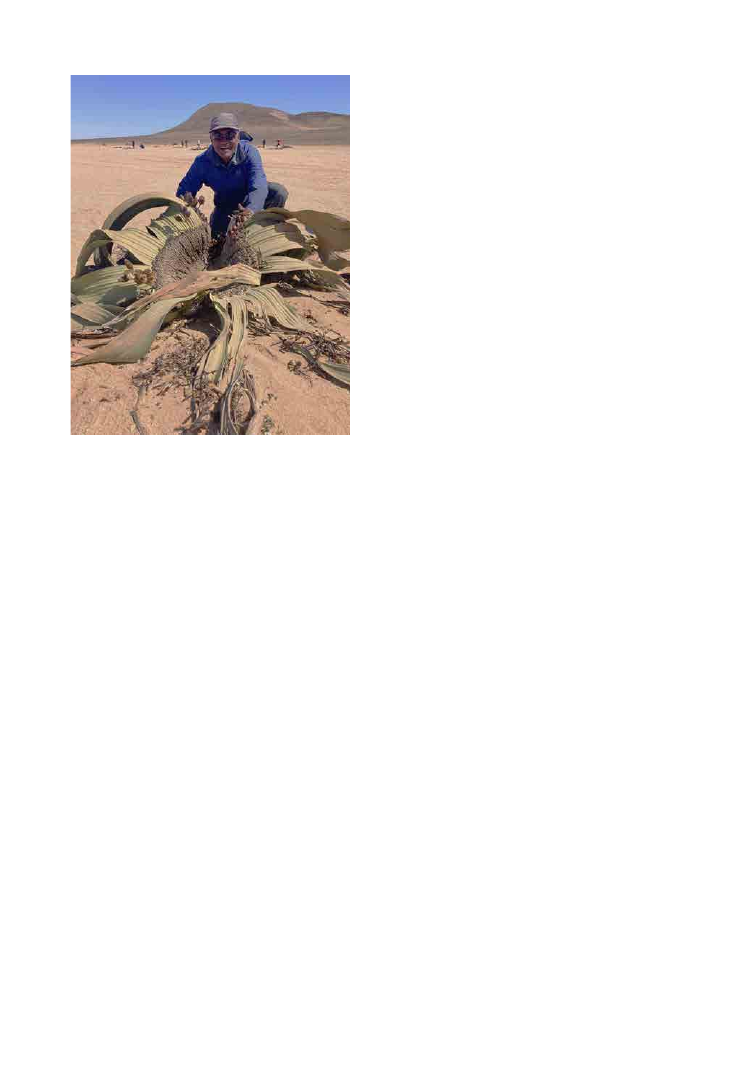
PSB 70 (3) 2024
278
an array of opportunities to teach and carry out
research at universities and botanical institutions
globally, including world-class herbaria, botanical
gardens, and arboreta. If you have a sabbatical
coming up or have just finished your doctoral
work and want to conduct postdoctoral research
abroad, consider applying for a Fulbright U.S.
Scholar Award (https://fulbrightscholars.org/
us-scholar-awards). A Fulbright can offer an
opportunity for cultural immersion with long-
lasting personal and professional benefits.
WHAT IS THE FULBRIGHT
SCHOLAR PROGRAM?
The Fulbright Scholar program is administered
by the Institute of International Education (IIE)
in collaboration with the U.S. Department of
State’s Bureau of Educational and Cultural Affairs.
The Fulbright Scholar Program offers more than
1700 fellowships for academics, educators, and
professionals each year in over 160 countries,
enabling 800 U.S. Scholars to go abroad and 900
Visiting Scholars to come to the United States. The
Fulbright U.S. Scholar Program is for academics
(including postdoctoral fellows), educators (from
community colleges and teaching- or research-
focused universities), and other professionals who
are U.S. citizens, offering 3- to 10-month awards
to teach, conduct research, or do a combination of
teaching and research abroad. Applicants should
have a Ph.D. (or terminal degree for the discipline)
and can include recent Ph.D. recipients, early-late
career faculty, or even retirees. You can also apply
for more than one Fulbright in your career, as long
as you have waited for two years after the date
of completion of the previous grant. However,
during each cycle, you can only submit one
application. For non-U.S. citizens, the Fulbright
Scholar Program offers several opportunities
to engage with U.S.-based academics and other
professionals, including the Visiting Scholar
Program, Scholar-in-Residence Program,
Enrichment Program, and Outreach Lecturing
Fund. Details on each of these opportunities
can be found on The Fulbright Scholar Program
website (https://fulbrightscholars.org/non-us-
scholars). One important fact to remember is that
Fulbright awards only cover a personal stipend,
including a monthly allowance (based on host
country and type of Fulbright Award: Teaching,
Research, Teaching and Research) as well as funds
for travel/relocation and living/housing expenses;
major funding for research has to be secured
through internal (home or host institution) or
external (grants through private, state, federal, or
international) sources. Research-focused grants
offer a modest book and research allowance, but
it may not be adequate to carry out extensive in-
country research. During my two Fulbright U.S.
Scholar Awards, I, along with my host and other
collaborators, secured funding through sources
such as the National Geographic Society, Explorers
Club, as well as host country institutional and
federal sources, to carry out the research proposed
for my Fulbright awards. The key is to start the
application process early and work closely with
your host to identify potential sources to secure the
necessary funding, especially if you are planning a
project that requires considerable support. If you
plan ahead, it can be done.
Figure 1. Celebrating Welwitschia mirabilis
subsp. namibiana during a visit to the Namib
Desert.

PSB 70 (3) 2024
279
MY BACKGROUND
I was born and raised in Sri Lanka and I came
to the United States in 1990, at the height of Sri
Lanka’s civil war, to pursue my undergraduate
education in Human Ecology (emphasis Botany)
at College of the Atlantic. Although I had gained
admission to the Faculty of Science, University
of Peradeniya, Sri Lanka, to pursue my studies in
biological sciences, with the goal of specializing
in botany, it was not meant to be. The plan to
return to Sri Lanka after my undergraduate degree
never materialized either and, after 10 more years
of graduate and postdoctoral work in North
America, I got my first faculty position at my
alma mater, College of the Atlantic, where I taught
botany for 10 years. Since then, I have taught
botany at two other predominantly teaching-
focused universities: San José State University (2
years) and California Polytechnic State University
(Cal Poly), San Luis Obispo (7 years +). I am a
geoecologist broadly interested in how lithology
and landforms shape diversity, both at the species
and community levels. My research focuses on the
ecology, evolution, and conservation of plants and
lichens of harsh substrates, particularly serpentine
soils. All my Fulbright awards have involved
international geoecological collaborations,
focusing on the ecology of plants, lichens, and
biocrusts of serpentine and other harsh substrates
as well as their conservation and the restoration
of their often-degraded habitats. Fulbright awards
have helped extend my research from North
America to South Asia and southern Africa and
set up long-term studies that continue to provide
opportunities for my hosts and their students, as
well as my U.S.-based students and collaborators.
MY FULBRIGHT JOURNEY
I applied for my first Fulbright U.S. Scholar Award
to return to my motherland, Sri Lanka, to carry out
research in geoecology at the National Institute of
Fundamental Studies, in collaboration with a plant
scientist working on (among other things) plants
of serpentine soils of Sri Lanka. With National
Geographic Society funding that a collaborator
in Australia and I received, and funding from the
host institution, we carried out descriptive and
experimental work on serpentine soil-plant-lichen
associations for nine months. I also visited all the
major universities on the island, including the
university I gained admission to in 1989 (yet never
attended a single lecture), several high schools
(including my own), and leading botanical gardens
and research institutions to present seminars,
discuss potential research collaborations, meet
with botanists and their students, and offer
my guidance to anyone interested in exploring
opportunities for higher education or academic
work in the United States. Most importantly, my
nine months in Sri Lanka helped me reconnect
with family, culture, landscapes, and biota I grew
up with and share my life and work in North
America with those I knew since my childhood as
well as new friends and colleagues I made during
the Fulbright Award. While I was in Sri Lanka,
I applied for and received a Fulbright Regional
Travel Program grant to visit the Department of
Botany, Aligarh Muslim University, India. That 14-
day visit, my first to neighboring India, was packed
with seminars and meetings, leading to a mutually
beneficial relationship that is still ongoing. My
second Fulbright, five years after my first, was to
the School of Biological Sciences, North-West
University (NWU), Potchefstroom, South Africa.
This time around, I decided to apply for a Teaching
and Research Award. My host, who I first met
as a fellow graduate student at an international
conference 23 years ago, and I designed a new class
titled Geoecology, which we co-taught during
my first semester at NWU. The second semester,
we carried out field research we had planned
together, and I visited eight universities and
botanical research institutes across South Africa
to give research seminars and meet with botany
students and faculty (Figure 2). These visits were
a highlight of my Fulbright experience, giving
me the opportunity to network with botanists
from across the country and serve as a mentor for
numerous South African students. I then applied
for a Fulbright Regional Travel Program Grant,
this time to visit the Missouri Botanical Garden
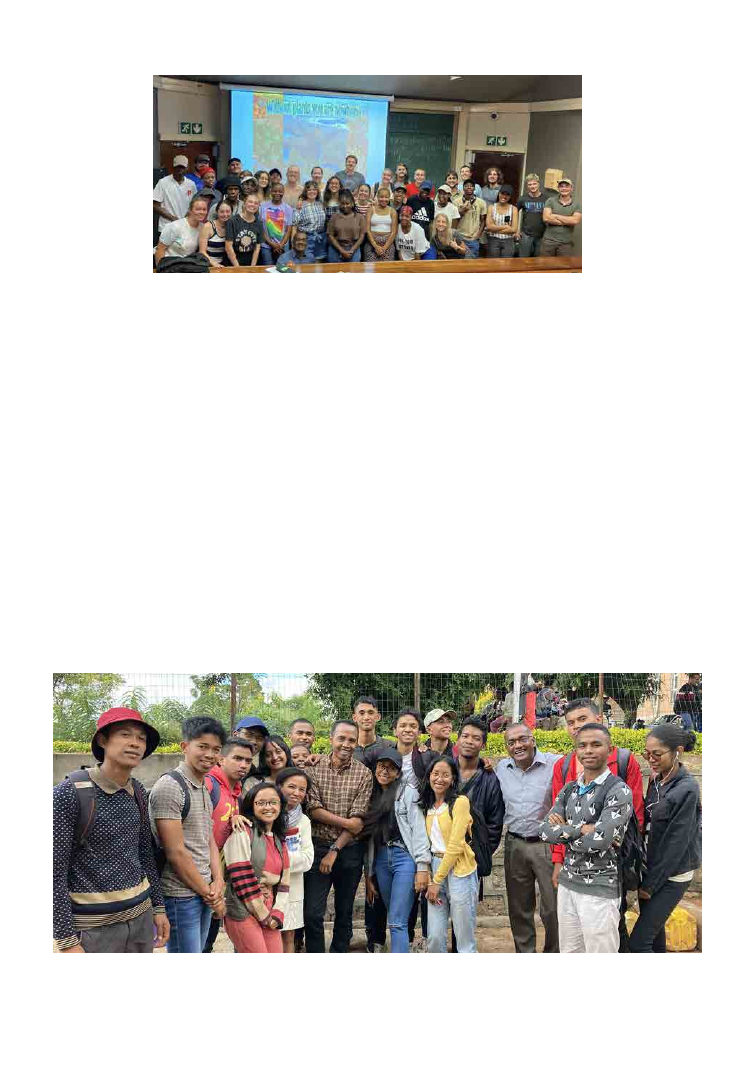
PSB 70 (3) 2024
280
of Madagascar. Visiting Madagascar had been a
life-long dream and I enjoyed every minute of my
14-day visit. I gave seminars (Figure 3), set up a
research agenda with my hosts for investigating
soil-plant-lichen relations of the unexplored
serpentine outcrops of the island, met with many
young botanists eager to make their mark, and
helped write grants to fund geoecological research
in Madagascar. The visit also gave me insights and
field experiences that I have incorporated into my
teaching of Biogeography, an upper division course
I continue to teach at Cal Poly. I was also fortunate
enough to receive a Fulbright Specialist Program
Grant to South Africa just this past summer. This
Program, administered by the World Learning
Organization, is another wonderful opportunity
Figure 2. With students after a guest lecture on geobotany at North-West University, Potchefstroom,
South Africa.
Figure 3. After a presentation to botany students at the University of Antananarivo, Madagascar.
for U.S. professionals, including academics, to
engage in short-term projects (up to six weeks)
with hosts from around the world. Please check
the Fulbright Specialist Program website (https://
fulbrightspecialist.worldlearning.org/) for the
application process. Since my awards, I have
found many ways to engage with The Fulbright
Program. I serve on the Fulbright U.S. Student
Program selection committee at Cal Poly, have
assisted in the discipline peer review committee
for the U.S. Fulbright Scholar Program on three
occasions, and, currently as a Fulbright U.S.
Scholar Alumni Ambassador, I help promote
Fulbright opportunities among U.S. academics
and other professionals interested in educational
and cultural exchange. I have thoroughly enjoyed

PSB 70 (3) 2024
281
the many opportunities I have had to promote
the Fulbright Program, to share my insights with
those applying for Fulbright awards, support
their passion and excitement for travel and global
exchange, and vicariously experience their joy
once they have embarked on their own Fulbright
journeys.
THE FULBRIGHT
U.S. SCHOLAR APPLICATION
The application deadline is mid-September
and the new cycle of Fulbright awards (for the
following academic year) goes online in February.
The application process can be lengthy, so
planning ahead can help promote success. The
application consists of short answer questions
on why you chose a particular host country, how
the proposed work fits your career trajectory,
your cultural adaptability and ambassadorship
and, if you are applying for an award with a
teaching component, how you plan to adapt to
a new teaching environment. Each answer has
a character limit; therefore, it can take time to
fine-tune your answers. In addition, there is a
3-page (for teaching only awards and research
only awards) to 5-page (for teaching + research
awards) Project Statement requirement to provide
your rationale for the proposed work in the host
country, your approach, the timeline, as well
as describing the benefits to you, your home
institution, and your host and country. There
are two required Letters of Recommendation
as well as a Letter of Invitation from the host or
host institution (for most awards). If you have
an ongoing international collaboration, want to
establish a new collaboration with someone you
have met along the way, or want to branch out to a
new area of research with an expert who is based
internationally, a Fulbright U.S. Scholar Award
can pave the way. To obtain a letter of invitation (if
your application requires one), you can reach out to
a prospective host with your idea for collaboration
and see if they are interested in hosting you as a
Fulbright U.S. Scholar. The answer, almost always,
will be an enthusiastic yes!
You can get plenty of guidance as you work
through your application, from attending
Fulbright Office Hours and online webinars, as
well as reaching out to an Alumni Ambassador like
myself. The Fulbright Scholar Directory (https://
fulbrightscholars.org/fulbright-scholar-directory)
is a valuable resource to find alumni by Fulbright
program, discipline, host country/institution,
and scholar name. “Fulbrighters” enjoy helping
prospective applicants, so never hesitate to reach
out to alumni who may have spent their fellowship
at an institution you may also be interested in
visiting. Their insights on the host country, host
institution, and available opportunities for cultural
and educational outreach can be extremely useful
in your application preparation. This year, I have
worked closely with half a dozen applicants,
answering questions about the application process
and reviewing project statements and short essays
to provide advice and insights. Personally, I found
the application process to be highly rewarding,
giving me the opportunity to reflect on my
research, including broader societal and global
impacts of the work I do, and even shape my
professional aspirations for the future. One thing
to note is that your Project Statement is not a grant
proposal to be submitted to a federal agency, such
as the National Science Foundation. The Fulbright
Program values cultural exchange as much as
discipline-related rigor. Strong statements balance
discipline-related content with descriptions of
desire for cultural immersion and exchange.
Describe opportunities you have for mentoring
students; giving guest lectures, seminars, and
workshops; engaging with others at the host
institution and outreach efforts, as well as your
commitment to represent the United States as a
cultural ambassador and your genuine interest to
learn about the host country, its people, and their
ways. I believe it is critical to prepare your project
statement in collaboration with your host or host
institution so that the work proposed, whether it is
research or teaching or a combination of the two,
reflects host institution interests and needs as well
as those of yours.

PSB 70 (3) 2024
282
FULBRIGHT OPPORTUNITIES
FOR STUDENTS
For students, please visit the Fulbright U.S. Student
Program (https://us.fulbrightonline.org) to explore
eligibility and program requirements for English
Teaching Assistant (post-undergraduate degree)
and Open Study/Research Awards (undergraduate
degree holders or current graduate students) and
reach out to your home institution’s Fulbright
Office or Fulbright Scholar Liaison for institution-
level assistance and application deadlines for
institutional review. You can also contact a
Fulbright U.S. Student Alumni Ambassador for
insights and guidance on the application process.
Similar to U.S. Scholars, students too have
access to a Fulbright Grantee Directory (https://
us.fulbrightonline.org/alumni/grantee-directory)
to find alumni they can reach out to for guidance.
Fulbright U.S. Student Program Awards, especially
the English Teaching Assistant Awards, are ideal
for those looking for an enriching cultural and
educational experience during a gap year or for
post-undergraduate studies. Securing a Fulbright
Award will make you a highly competitive
candidate for graduate study, medical or other
professional programs, and employment (locally
or, especially, internationally).
FINAL THOUGHTS
Personally, The Fulbright Program has been life
changing. Having moved from one country to
another since my early childhood, I have always
appreciated seeing the world through other
lenses. For those who love to travel, learn about
the world through cultural immersion, and
work collaboratively with persons from different
personal and academic backgrounds, there is no
better opportunity than that provided by The
Fulbright Program. Fulbright travels have given
me opportunities to experience a better work-life
balance and explore new hobbies that I have come
to thoroughly enjoy. During my Fulbright U.S.
Scholar Award to South Africa, I fell in love with
birding and wildlife photography (Figure 4), giving
me a lifetime of exploring to do. Professionally,
I have taken on new areas of research within
geoecology and my network has also grown
significantly, benefiting not just me, but my students
and collaborators as well. If I could, I would live
my life moving from one Fulbright destination to
another, learning about the world we call home,
through interactions with plants and people from
distant lands. If you decide to explore the Fulbright
U.S. Scholar Program for your upcoming sabbatical
or your postdoctoral work, please reach out to me
at nrajakar@calpoly.edu. I will be happy to help you
start your Fulbright journey so you too can extend
your botanical research and teaching interests
beyond the United States.
Figure 4. While photographing spring wildflowers of Namaqualand, South Africa, I witnessed a pair of
Blue Cranes, South Africa’s National Bird. This photograph of the cranes on a carpet of native wildflowers
has instilled in me a life-long passion for birding and wildlife photography.

PSB 70 (3) 2024
283
At Toolik Field Station (North Slope, AK),
things only work because there are 12 pounds
of duct tape on them. I stood on a rickety old
boardwalk watching a machine we lovingly
called “The Tram” beep its way across the tundra,
praying that this wasn’t the day the bungee cords
holding it together snapped. The Tram measured
relative NDVI (relative greenness), reflectance,
temperature, and canopy cover on the North Slope
of Alaska with multiple cameras unceremoniously
strapped onto a platform that hovered on cables
3 feet above the tundra. I was hired to help run
two of these machines in the Arctic, and when
our team managed to get both to run across and
back without missing an on-switch or something
coming unplugged, we deemed the day a “Big
Success.”
Watching this machine beep through the tundra
for multiple hours a day left me a lot of time to
contemplate the similarities between the robot
and my own body’s wiring issues. At 2 years old, I
was diagnosed with a brain condition that can best
be described as “my brain is too big for my head,”
which has caused significant pain and nerve issues
throughout my life. I have had corrective brain
surgery twice but still struggle to get my nerves to
properly communicate with the rest of my body,
much like the fraying wires in The Tram. I stood
Twelve Pounds of Duct Tape and
No Manual: Shifting Mindsets
on the boardwalk and asked myself, if The Tram
and I both had these “wiring” issues, how was it that
we ended up in the Arctic with little other than duct
tape to help?
I find a certain beauty in things that achieve goals
even in a round-about and inefficient way. Looking
into the control box of The Tram, you’ll likely find
a 15-year-old computer, an old car battery, and an
assortment of cables labelled with faded, barely
legible handwriting. Despite this, with enough
encouragement, extra batteries, restarting of the
software, and prayers to any and every entity
possible, it almost always completes the job it
was designed to do. I’ve recognized that with a
machine like The Tram, or in a body like mine,
it’s the time, care, and respect for its abilities that
will allow for the most productive outcome. Rainy
days often mean The Tram cannot run, which can
easily frustrate those of us whose jobs rely on it
beeping across the tundra. However, a simple step
back would show that these rainy days allow for
the scientists to download and begin analyzing
data and, more importantly, a period of rest for
software and human alike. This shift in mindset
has brought so much peace to my life, because I
have started appreciating days when my body says,
“Please not today,” rather than resenting the lack
of productivity.
Recognizing that “productivity” looks different
for everyone has been one of the most important
things I have done for myself, because it helps
me not compare my work ethic to that of my
peers. Graduate school has found me working
to dismantle my internalized ableism as I try
to be prouder of myself and all that I am able
to accomplish despite fighting my constant
headaches and nerve pain. I have been incredibly
lucky throughout my scientific career to have
understanding and accommodating advisors,
By Caroline Bose
PhD student,
University of Wyoming
Email: cbrose1@uwyo.edu

PSB 70 (3) 2024
284
and for that, I will always be grateful. I recognize
not everyone is as fortunate or might not feel as
comfortable sharing their disabilities or struggles
with peers or advisors, and it’s often difficult to
ask for help or an accommodation when they
aren’t aware of the situation. As someone with an
invisible disability, it can both be a blessing and a
curse to be able to easily hide what is going wrong
in my body. It is difficult to continually have to
remind people of the accommodations that I
might need because it is easy for others to forget
when it is not always obvious.
Within botany and academia as a whole, we need to
curate a more accessible culture by recognizing that
there are unseen factors that affect our colleagues’
lives and adjust our expectations for “productivity”
accordingly. For the last four BSA conferences,
there have been mixers for disabled botanists
and allies to help build community. I was lucky
enough to help organize and host this year’s event,
and the turnout was better than I ever hoped. Our
discussions of shared experiences and challenges
navigating a scientific career made me feel less
alone, as I imagine it did for the other attendees.
We had an incredibly productive discussion
about accessibility at scientific conferences and
in academia, and our suggestions and comments
were discussed with the BSA board shortly after.
A core emphasis of many of our conversations
was the importance of advisors and supervisors
understanding that disabilities are explanations,
not excuses. Asking for accommodations is how
we set ourselves up to be as successful as possible in
a system that is not built for us. As a continuation
of that conversation, this September we hosted a
Botany360 event as an affinity group and shared
experiences, ideas, and suggestions for the future.
As incredible as it is to meet up with other disabled
botanists and allies, this is only the first step. After
building our community within the field we must
also think about our visibility in the field more
broadly. Increasing visibility of disabled botanists
is important for younger scientists to see to help
them accept themselves.
Arguably one of the most stressful parts of field
seasons are when the Principal Investigators show
up and start checking to make sure everything is
running as they expected. When my boss arrived
at Toolik, he always had the keen ability to find
every machine we had and disassemble it before
leaving the lab in disarray and going to bed. It was
usually helpful, considering he was the only one
of us who could fix many of the major mechanical
problems we had with The Tram, but it always left
us a bit nervous that he might not know how to
put it back together, especially when there were
never any instruction manuals in sight. Seeing
pieces of the machines strewn across the table
allowed us to identify the inner workings that we
were otherwise too afraid to explore without a
reference image.
Seeing the parts of The Tram laid out was one of
the most eye-opening experiences I can remember,
especially since Toolik was where I did most of my
self-reflecting about my illness. One afternoon on
a day off, my co-workers and I were finishing a
hike down the side of a mountain when I was hit
with multiple difficult realizations at once. First,
and most pressing, I could not feel my legs—if
my balance shifted in the wrong direction, I was
headed down the slope with no ability to stop
myself. The other, more shocking realization was
the connection I made between being chronically
ill and the fact that I was going to have this
problem for the rest of my life. It sounds like a
simple connection, but my first surgery happened
when I was only 2 years old. I spent my childhood
considering my illness as something I “used to
have,” and I always assumed I would get back to
the point where I could put it in the past and move
on with my life like I had the first time. Struggling
my way down the side of this mountain made me
recognize that was no longer my reality, and it was
difficult to continue without any sort of reference
for how to move forward.
Reflecting on the adjustments I’ve made and
lessons I’ve learned throughout my life has left me
wishing there had been more disabled scientists

PSB 70 (3) 2024
285
I could look up to during my early career. I have
spent a significant amount of time trying to
ignore the realities of my chronic illness, instead
trying to convince the world (and myself) I was
no different than my peers. Only in recent years
have I found strength in recognizing that my
illness is not something that should make me
ashamed of myself. Despite there never being a
true instruction manual on how to navigate life
as a scientist, representation is one of the most
important things for young people no matter the
field or topic. To help with this, we are planning
to host a symposium at a future BSA conference
highlighting the research done by disabled
scientists at all career stages. We are here and
proud, and we hope that a symposium such as this
will allow a wider audience to think about how they
can create a more accessible environment. Shifting
our mindsets toward creating a more inclusive
future starts with productive conversations from
all sides, but cannot entirely rely on those of us who
are disabled. Working toward a more accessible
and inclusive field requires a collaborative effort
in which able-bodied allies are as loud as we are in
asking for change.
The reference manual for navigating a scientific
career is not meant to be written by a single
author—it should be a collage of stories and
experiences from every community. I hope
that this submission of mine into the chapter of
disabled scientists will help someone along the
way feel a little better about celebrating their
identity. Whether you are disabled, an ally, or
unsure what label to give yourself: come to our
mixers, contribute to the conversation, stand up
for yourself and others, and send us your feedback,
comments, and ideas on how to make our society
more inclusive.
If you have feedback, ideas, or want to join the
conversation, please email me at cbrose1@uwyo.
edu or visit BSA’s Accessibility webpage for the
link to a suggestion form.
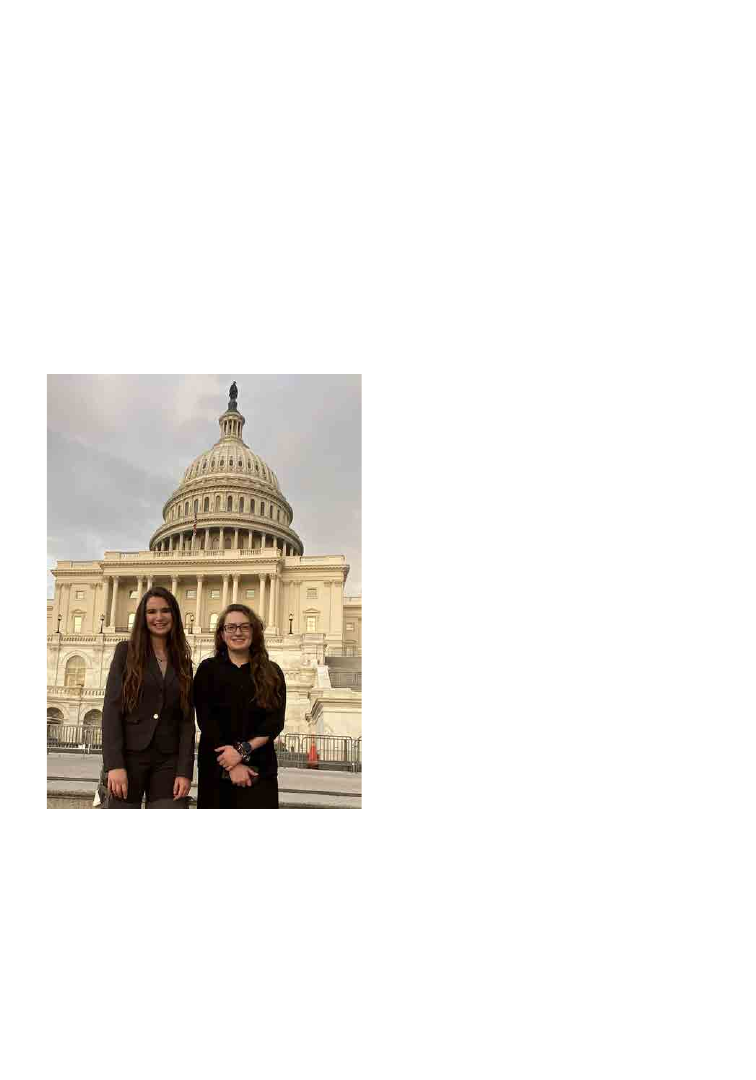
PSB 70 (3) 2024
286
Jenna Miladin’s Experience
My early interest in plant evolutionary biology
has led me to research various aspects of the role
a changing climate has on evolutionary patterns
in plants. During the completion of my Master’s
degree, I worked for the National Forest Service
and National Park Service, which allowed me
to complete various research, monitoring, and
restoration projects on federally protected public
lands. My experience during this time has led
me to think more broadly about the application
of science, and it allowed me to find parallels
between my academic research and my on-the-
ground conservation work. This has shaped my
commitment to research that uses evolutionary
biology methods to inform land management
and conservation practices. This is also how my
interest in public policy and the ways in which
it influences how we conserve both individual
species and landscapes was cultivated. Given the
increasing threat species and landscapes face
due to climate change, it is imperative not just
to understand the adaptation of plant systems
and patterns of biodiversity in the wake of these
pressures, but also to translate this type of work to
inform public policy.
The opportunity to attend Congressional Visits
Day with the American Institute of Biological
Sciences (AIBS) allowed me to expand my
REPORT FROM 2024
CONGRESSIONAL VISITS DAY
Each year, the BSA Public Policy Committee awards two early-career botanists the opportunity to
attend the American Institute of Biological Sciences’ Congressional Visits Day. This event is hosted by the
Biological and Ecological Sciences Coalition, and recipients obtain first-hand experience at the interface
of science and public policy. The first day includes a half-day training session on science funding and
how to effectively communicate with policymakers provided by AIBS. Participants then meet with their
Congressional policymakers, during which they will advocate for federal support of scientific research.
This article details the experiences of this year’s recipients: Jenna Miladin (University of Arkansas) and
Cael Dant (Northwestern University & Chicago Botanic Garden)
Jenna Miladin (left) and Cael Dant

PSB 70 (3) 2024
287
knowledge of how federal funding for science
operates and different ways scientists can interact
with policymakers to influence public policy.
This experience gave me training to interact with
those who make public policy and effectively
communicate scientific information to individuals
without a scientific background.
A crucial part of advocating for science funding
in this setting was learning how to convey your
message in a way that was both compelling and
connected to the goals of the audience. The AIBS
science communication bootcamp we attended
helped us practice communication techniques
as well as research who we were meeting with.
This event was an opportunity to experience the
importance of effective science communication in
order to convey the needs of communities and the
researchers advocating for them.
The AIBS bootcamp also introduced me to the
other scientists in attendance with similar goals
of reaching their own political audience members
and communicating the scientific needs of their
respective states. These scientists were incredibly
diverse in their backgrounds, skills, and fields of
study. It was incredibly beneficial to interact with
this group; I learned about a range of different
research occurring across the United States, as well
as the various types of community problems that
could benefit from scientific input. Additionally,
we gained invaluable insight from the experts in
scientific communication, journalism, and public
policy. These individuals have a lot of experience
conveying scientific messages to a wide breadth of
audiences and prepared us for our meetings.
On Congressional Visits Day, I teamed up
with a scientist from Texas where together we
attended meetings with the staff of three Arkansas
representatives and two Texas representatives. Our
goal was to both convey the impactful research that
is currently coming from our respective states that
was made possible by NSF funding and emphasize
the importance of our representatives’ support of
NSF funding. We advocated for $11.9 billion in
NSF funding to reach the goals of the Chips &
Science Act. The biggest challenge we faced was
connecting the objectives and accomplishments
of federally funded research with the goals of
our representatives to address community-level
problems our states face. It was important for our
representatives to both understand and relate to
our message.
The conversations we had with representatives
and their staff was an insightful and eye-opening
experience. Research coming out of Arkansas has
greatly benefitted from NSF support, and it was
encouraging to see how impactful these anecdotes
and statistics were to the representatives. This was
an opportunity to connect with our government in
a way that has the potential to positively influence
policy and funding.
Building on my previous work, my current
research aims to understand evolutionary
drivers of plant rarity and has implications for
the conservation and management of these
rare species. Collaboration with the IUCN Red
List and NatureServe is an integral part of my
dissertation, and understanding the ways in which
this type of work can influence public policy is
key to producing a scientific product that may
make a positive influence. My experience in the
communication bootcamp and on Capitol Hill
gave me the tools to interact with public policy
makers, and knowledge on what scientists can do
to inform public policy.
CAEL DANT’S EXPERIENCE
My interest in science policy grew out of a
nontraditional and interdisciplinary career path.
As an undergraduate at Indiana University, I
studied biology, Japanese language, and fine arts
while also working in medical research and plant
physiology labs and the university’s herbarium. I
knew I loved botany and wanted to pursue it long-
term, but with my feet planted in so many fields,
I struggled to envision my place in a traditional
scientific research trajectory. After graduating, I
transitioned out of academia and spent five years
working in the public sector in Japan, first as a

PSB 70 (3) 2024
288
translator and international relations specialist
for a local government and later as a program
coordinator at an international education
foundation. Working as a public servant and as
someone whose job was quite literally to facilitate
communication between parties who could not
otherwise understand each other showed me
what had been missing from my image of life as a
plant scientist: education, meaningful connection
with the public, and the opportunity to bridge
communication gaps.
In 2022, I joined the Plant Biology and
Conservation graduate program at Northwestern
University and the Chicago Botanic Garden, where
I am conducting research on carnivorous plant
ecophysiology and working as an administrator
for the Garden’s Research Experiences for
Undergraduates (REU) Program. Science policy
quickly clicked for me both as an intersection point
for my interests and as an opportunity to advocate
for the needs of the plant science community.
I was honored to receive one of two 2024 BSA
Public Policy Awards, and in April of this year, I
participated in the American Institute of Biological
Sciences (AIBS) Communication Boot Camp
and Congressional Visits Day in Washington,
D.C. While I felt accustomed to interacting
with policymakers and state officials from my
time in local government, that work was largely
apolitical and, crucially, focused on translating the
perspectives of others rather than communicating
my own. The training AIBS provided emphasized
strategies for conveying scientific research (both
our own and that of others) to non-scientists in
concise and easily understood ways, as well as
framing our asks in ways that aligned with the
priorities of our audience. On the first day, the
workshop participants—a group of students and
scientific professionals from incredibly diverse
academic and personal backgrounds—practiced
pitching our own research to one another as we
might to a policymaker in order to convey the
need for research funding, followed by individual
mock interviews in front of the group. We received
invaluable feedback and insights from experts
including lobbyists, policy researchers, active state
representatives, and science communication and
media professionals, and after two days of training,
we spent a full day on Capitol Hill meeting with the
offices of our state senators and representatives.
For the Hill visits, I was paired with one other
workshop participant, and together we met with
congressional staffers and, in one case, a serving
senator, from our home states of Ohio and
Indiana, to advocate for increased funding for
scientific research at the federal level. My partner
for the day was a neuroscience researcher, U.S.
Army veteran, and community college professor
seeking funding for scientific employment and
training programs through the National Institutes
of Health (NIH), whereas I was a civilian botany
grad student focused on National Science
Foundation (NSF) funding for plant science and
undergraduate research programs. We surprised
ourselves with our ability to present a cohesive
and sincere pitch to our representatives despite
our very different backgrounds, and we realized
that by focusing our message on improving
education, employment, and the competitiveness
of research in our respective states, and by sharing
personal stories from our own lives to supplement
fact sheets and statistics, we were able to have
genuinely productive conversations with the
offices we visited.
I am so grateful for both the training we received
and for everything I learned from my partner and
fellow participants, and I hope other current and
future plant biology graduate students will also
seek the opportunity to attend this workshop.
Inspired by my experience at this event, I have
since joined the Journal of Science Policy and
Governance Ambassador Program and the
board of Northwestern University’s Science
Policy Outreach Taskforce. Science policy affects
everyone and everything, from academia to
ecology to environmental justice, and I hope to
help amplify the voices of other researchers and
advocate for the needs of the community and the
ecosystem to those who have the power to effect
change most. Thank you to everyone at BSA who
made this experience possible!
PSB 70 (3) 2024
289
Follow us
nordicjbotany.org
;@NordicjBotany
facebook.com/nordicjbotany
;@nordic_j_botany
Ph
ot
o: Jānis Ruk
šāns
Bridging plant and fungal ecology
and taxonomy
•
High quality ecology and taxonomy in one place
•
Personalised, in-house experience from
submission to publication
•
Hybrid Open Access – OA agreements with
many institutions around the globe
•
Society-curated journal
NORDIC JOURNAL OF
BOTANY
A N I N T E R N AT I O N A L J O U R N A L F O R B OTA N Y A N D M Y C O L O G Y
Volume 2023 • January
NORDIC JOURNAL OF
BOTANY
A N I N T E R N AT I O N A L J O U R N A L F O R B OTA N Y A N D M Y C O L O G Y
Volume 2023 • January
NORDIC JOURNAL OF
BOTANY
A N I N T E R N AT I O N A L J O U R N A L F O R B OTA N Y A N D M Y C O L O G Y
Volume 2023 • January
NORDIC JOURNAL OF
BOTANY
A N I N T E R N AT I O N A L J O U R N A L F O R B OTA N Y A N D M Y C O L O G Y
Volume 2023 • January

PSB 70 (3) 2024
290
290
By
Amelia Neely
BSA Membership &
Communications
Manager
E-mail: ANeely@</i>
botany.org
MEMBERSHIP NEWS
On November 14-15, 2024, BSA held a two-
day virtual symposium with the theme, “Plant
Resilience and Conservation for a Changing
Climate.” Over 1100 people from across the world
registered for this free event, which was open to the
public, and an average of 300 people attended the
event each day. Each day had a unique theme, and
there were 6 featured speakers and 12 contributed
talks. At the end of each day a discussion session
allowed for attendees to enter breakout rooms,
make connections, discuss specific questions, and
report back to the main group.
To learn more about this event—including the
symposium overview, topics, daily schedule,
abstracts, featured speakers and their bios, and
a list of the contributed speakers—see https://
climatesymposium.botany.org/plant-resilience-
and-conservation-for-a-changing-climate. This
event was recorded and access to the recordings
can also be found on the event website.
Your BSA membership dues and donations made
this and other important programming possible.
Thank you!
BSA Virtual Symposium on
Climate Change:
Plant Resilience and Conservation for a
Changing Climate
SUPPORT GRADUATE
STUDENTS WITH YEAR-END
DONATIONS TO THE
GSRA FUND—DONATE TODAY!
Each year, BSA is proud to support graduate
students with $1500 awards to advance their
research through the Graduate Student Research
Awards (GSRA). These awards are funded by
membership dues revenue and by the generous
donations of BSA members. Professional members
can “opt in” to add an additional $25 GSRA
support fee during their membership renewal,
and all members are welcome to give to the GSRA
fund during their renewal, or anytime, at https://
crm.botany.org/makeadonation.
In 2024, we awarded 25 Graduate Student
Research Awards, including the prestigious J.S.
Karling Award. To increase this level of support
for 2025, we need your help. We are currently
behind last year’s donation total, and every gift—
no matter the size—makes a meaningful impact.

PSB 70 (3) 2024
291
As you plan your year-end giving, please consider
a donation to the GSRA fund to help us nurture
the next generation of botanical scientists through
these vital awards
HELP US REACH OUR GOAL OF
100 GIFT MEMBERSHIPS BY
DECEMBER 31!
With the year drawing to a close, we are still working
toward our goal of 100 gift memberships, but we
have a long way to go and need your support to help
us get as close as possible! Every $20 one-year gift
membership or $50 three-year gift membership
makes a real difference, helping us bring more
students and colleagues from developing nations
into the BSA community. Please consider giving
the gift of membership today—go to https://crm.
botany.org/ to get started!
You can also donate gift memberships by placing
an “X” in the recipient fields. Donated gift
memberships allow us to offer financial assistance
to students and colleagues from developing nations
who request aid throughout the year. The level of
support we can provide depends directly on the
number of donated gift memberships purchased,
so every donation makes a meaningful impact.
Please consider donating gift memberships today!
Need help? Email aneely@botany.org.
THREE-YEAR MEMBERSHIPS—
STAY CONNECTED AT A
DISCOUNT!
Have you considered a 3-year membership
with the Botanical Society of America? A
multi-year membership provides both savings
and convenience: enjoy discounted rates and
skip the annual renewal reminders. You can
also purchase the PSB print copy subscription
and join sections both for three years when
you renew. Plus, memberships that start now
will be valid through December 31, 2027!
The following memberships are available for
the 3-year option:
• Professional Memberships (save $20)
• Professional Family Memberships (save $50)
• Post-Doctoral Memberships (save $15)
• Student Memberships (save $15)
• Developing Nations Memberships (save $15)
For students and post-docs, there’s even more
flexibility—keep your 3-year membership at your
current rate even if you graduate or your position ends.
Do you know a student or a colleague from
a developing nation who could benefit from
extended access to BSA membership benefits and
the BSA community? Three-year memberships
can also be gifted or donated, providing a valuable
way to keep students and international members
connected and supported for a full three years.
To renew at the 3-year level or to purchase gift
memberships, go to https://crm.botany.org/.
BOTANY360 UPDATES
Botany360 (https://botany.org/home/resources/
botany360.html) is a series of programming that
connects our botanical community during the
360 days outside of Botany Conferences. The
Botany360 event calendar is a tool to highlight
those events. The goal of this program is to
connect the plant science community throughout
the year with professional development,
discussion sessions, and networking and social
opportunities. To see the calendar, visit www.
botany.org/calendar. If you want to coordinate
a Botany360 event, email aneely@botany.org.
Recent Botany360 event recordings:
• NFS Workshop for GRFP (September
26, 2024) https://www.youtube.com/
watch?v=uSVp279V7w0
• Applying to Grad School 2024 (Octo-
ber 3, 2024) https://www.youtube.com/
watch?v=la0z9yVu6n8

PSB 70 (3) 2024
292
BSA SPONSORSHIP
OPPORTUNITIES
Do you know a business or organization that would
benefit from being in front of over 3000 botanical
scientists from over 70 countries, and over 60,000
followers on social media? The BSA Business
Office has many opportunities for sponsorship
including:
• Sponsored Membership Matters newsletter ar-
ticles and footer ads
• BSA website banner ads
• Hosting Botany360 events
• Botany360 event logo advertisement during
event, a slide before/after event, or time to dis-
cuss product at beginning or end of event
• Sponsored social media ads
• Advertisement space in the Plant Science Bulletin
Here are the latest Spotlights:
• Benjamin Ajayi, Graduate Student, Florida State University, Biological Science
https://botany.org/home/careers-jobs/careers-in-botany/bsa-spotlight-series/benjamin-ajayi.html
• Vikas Garhwal, Graduate Student, Indian Institute of Science Education and Research, Kolkata,
India, Department of Biological Sciences
https://botany.org/home/careers-jobs/careers-in-botany/bsa-spotlight-series/vikas-garhwal.html
• Dennis Wm. Stevenson, Faculty, New York Botanical Garden, Science Department
https://botany.org/home/careers-jobs/careers-in-botany/bsa-spotlight-series/dennis-wm-stevenson.
html
Would you like to nominate yourself or another BSA member to be in the Spotlight Series?
Fill out this form: https://forms.gle/vivajCaCaqQrDL648.
BSA SPOTLIGHT SERIES
The BSA Spotlight Series highlights early-career and professional scientists in the BSA
community and shares both scientific goals and achievements, as well as personal interests of the
botanical scientists, so you can get to know your BSA community better.
Because we value our community, the above
opportunities are limited with the hope of
being informative without being intrusive.
Sponsorships will allow BSA to fulfill our strategic
plan goal of being financially responsible during
this time of economic shifts.
To find out more about sponsorship opportunities,
email bsa-manager@botany.org.
BSA STUDENT CHAPTERS
Did you know that there are over 20 BSA Student
Chapters? These chapters provide students with
valuable opportunities to network with peers
at their institution through engaging activities
and leadership experiences. Additionally,
members can take advantage of exclusive BSA
benefits, including a discounted $10 Student

PSB 70 (3) 2024
293
Membership and heavily reduced registration
fees for the Botany conferences each year! To
learn more about Student Chapters, including
how to start your own, go to https://botany.
org/home/membership/student-chapters.html.
The following are the current BSA Student
Chapters:
• Bartoo Botanical Society - Tennessee
Technological University - Student Chapter
• Botanical Society of St. Cloud State Uni-
versity - Student Chapter
• Bucknell University - Student Chapter
• Eastern Michigan University Student
Chapter
• Emory University - Student Chapter
• Idaho State University Botany Club - Po-
catello - Student Chapter
• IISER Bhopal Student - Chapter
• IISER Kolkata Plants - Student Chapter
• L.H. Baileys Botany Bunch - Cornell Uni-
versity - Student Chapter
• Northwestern University - Student Chapter
• Oklahoma State University - Student
Chapter
• Old Dominion University - Student
Chapter
• Otterbein University - Student Chapter
• South Dakota State University - Student
Chapter
• St. Louis Area - Student Chapter
• Texas Tech University - Student Chapter
• The Botany Club of Louisiana State Uni-
versity - Student Chapter
• The Gustavus Botanical Society - Student
Chapter
• University of Central Florida - Student
Chapter
• University of Hawai'i at Mānoa - Student
Chapter
• University of South Carolina - Student
Chapter
• Weber State University - Student Chapter

FROM THE
PSB
ARCHIVES
60 years ago
“The American Journal of Botany has accepted advertising for five years, but our advertising program has not really been
successful. Each year approximately $1,500 is derived from this source; however, this is considerably lower than it should be.
Such a program should realize about $5,000 a year.
Of course, our small circulation makes a poor impression on potential advertising customers. We do have, however,
one feature which should be attractive, i. e., every reader is a purchaser or an influencer of purchases. Every member is
responsible at one time or another for the ordering of research materials, books, classroom and laboratory equipment.
If every Botanical Society member, each and every time he orders or chats with a salesperson, points out the value to
the company of advertising in the Journal, income derived from advertising should increase. The idea that advertising
in the Journal will help the company is what we would like to get across. By no means should any kind of pressure be
considered.”
—Note on Advertising. PSB 10(1): 7
50 years ago
“Hardly a month goes by that I am not asked by my departmental chairman and other administrative officers if I couldn’t
provide funds from my research grant to subsidize what must be considered basic university functions. Requests range
from the costs of repairs of general equipment facilities to telephone and mail charges as well as contributions to graduate
student support. The scenario is a common one in state universities today and represents an increasing tendency to have its
staff members seek outside funds not only to pay for all costs of their research but also to pick up an increasing proportion
of the tab for basic university operations.
As a faculty member in a large state institution I have become bothered by these trends in university financing. I begin to
feel more like a pawn whose principal role is to attract extramural funds rather than to make basic contributions to teaching
and research. Since research is one of the most important elements of my job, it is the component which weighs most
heavily in my promotion and evaluation of my professional standing. Yet it is the element which receives the least support
from the university. This situation generates two basic questions: (1) What is the university’s responsibility to its faculty if it
expects research productivity as a key element of their performance? and (2) To what extent is it justified for the university
to expect faculty to generate grant funds to finance what should be covered by the university’s general support budget?”
—Kaplan, Donald R. 1974. Ask Not What the University Can Do for You But What You Can Do For the University. PSB
20(4): 47
40 years ago
“Harriet Creighton began her B.S.A. presidential address in 1957 with the paraphrased exhortation, ‘Botanists of the world
unite—and get going.’ This must be a winning phrase because I noted that Mildred Mathias, in her address last year, drew
upon that same call to arms.
Harriet allowed, in preparing for her talk by reading books and speeches, that almost everything she had planned to say
about botany in 1957 had been repeated for at least 50 years and some things for over 100! With such an assessment staring
at me, I can little hope to invigorate you with startling new revelations, or panaceas for successfully explaining low student
enrollments to your department chairman or dean; all I can say, is that the problems and opportunities we see are the very
same ones that have always been with us to a greater or lesser degree.
We are challenged today, though, as perhaps never before and we are forced, as botanists, with choices and decisions
that affect the very core of our profession and our science. This kind of statement is not new, nor are the lamentations
of the botanical doomsayers. We’ve heard them before. On the first page of the first issue of Plant Science Bulletin
in 1955, almost three decades ago, there is the statement, ‘On the whole, botany has not kept pace with the
expansion of the other sciences and in some cases there has been a decline if not an elimination of botany from the
curriculum.’ More than one of you has heard a similar statement within the past months, and perhaps, even more
than once. But, we are still here, still concerned with our future, still battling—I hope—to keep our profession and
science above water. Yet, the ocean seems ever deeper and the undertow ever stronger dragging at us. The fact is, as
departments, there are fewer of us than there were in 1955. Recent news has it that since 1978, seven botany
departments have gone under—submerged into some form of biological science unit. How to stem the tide?” *
—Stern, William L. Botany in a Changeable World 1984. PSB 30(5): 32-35.
*Editor’s note: This essay is a stirring call to arms with practical suggestions for promoting Botany as an academic discipline
that are still applicable today. I strongly encourage you to read it in its entirety in the PSB archives.

PSB 70 (3) 2024
295
295
SCIENCE EDUCATION
By Dr. Catrina Adams,
Education Director
Jennifer Hartley,
Education Programs
Supervisor
The PlantingScience team presented some
early results of our F2 research project at
the Society for the Advancement of Biology
Education Research (SABER) Midwest
conference in early October. This presentation
focused on one of several research questions:
How does online mentoring of student-
led investigations impact students’ views of
scientists?
One goal of the PlantingScience program is
to promote more expansive, less stereotypical
views of scientists. Students often have
limiting, stereotypical views of scientists.
Although many stereotypes students have
about scientists are positive (brilliant,
totally devoted to work), even these positive
stereotypes can be demoralizing if a
student doesn’t identify with a stereotyped
characteristic (Lockwood and Kunda, 1997;
Manke and Cohen, 2011). If students hold
broader, more multidimensional views of
Student Perceptions of Scientists:
Preliminary Results from
PlantingScience F2 Research Project
who botanical scientists are and what they do,
they may be more likely to believe that they
can belong in a field like botany (Nguyen and
Riegle-Crumb, 2021).
There are some techniques that scientist
mentor ‘role models’ can use to help motivate
students and to counter limiting stereotypes.
Establishing a connection with students,
relating to students, encouraging the team’s
autonomy in designing an investigation, and
recognizing when students show competence
in their work are important ways to motivate
students (Scogin, 2016). To counter stereotypes
it’s important for mentors to share details
about their lives as scientists (e.g., what they
do day-by-day, their scientific interests, career
path, and the importance of the research they
do). It’s also helpful to share some of what
they do outside of science (e.g., pets, family,
hobbies, music or sports interests). It can be
especially helpful to normalize experiencing
some difficulty, uncertainty, and adversity in
career pathways, and sharing stories about
how those difficulties were navigated and
overcome (Lockwood and Kunda, 1997).
Teachers can also encourage students working
with PlantingScience mentors to consider the
scientists they worked with across the class—
how this group of scientists were similar
and different from each other, and how they
compared with students’ initial expectations
about scientists. This type of reflection about
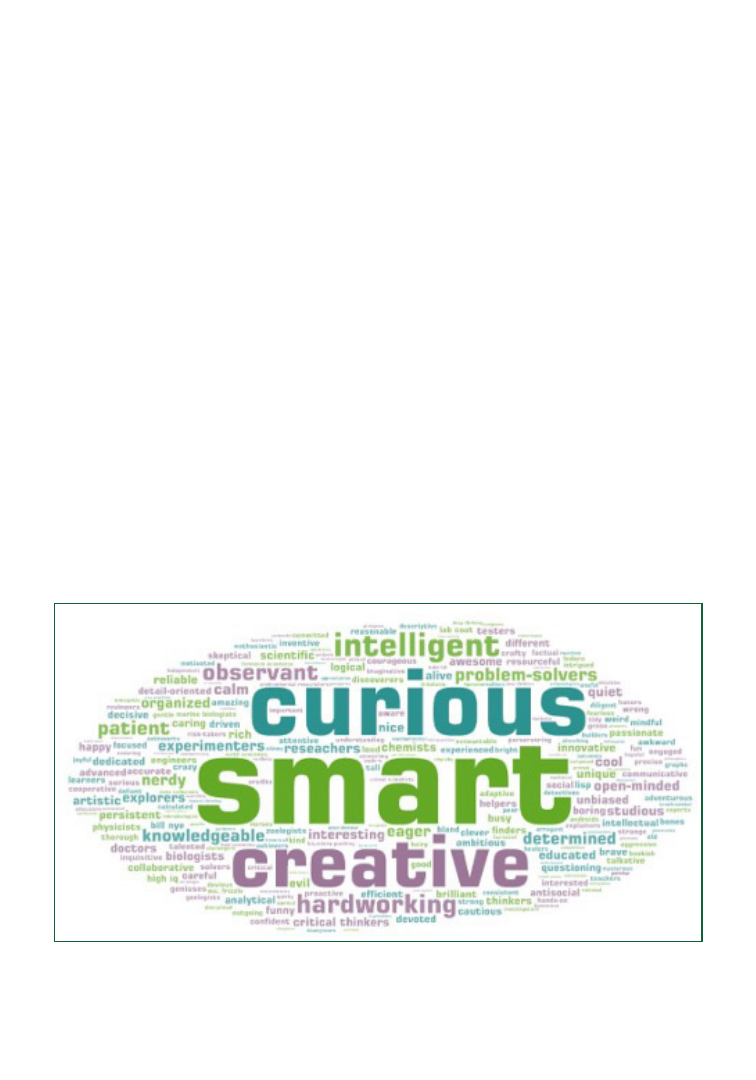
PSB 70 (3) 2024
296
direct experiences when done in a peer group
setting can be an effective way to counter
stereotypes (Palomba, 2017).
To better understand what students initially
thought about scientists (before working
with a scientist as part of the PlantingScience
program), we asked students to share with us
three words or phrases that describe the types
of people who are scientists, and three words
or phrases that describe the kinds of things
scientists do. These prompts are adapted from
an essay prompt “Perceptions of Scientists
Survey” developed and used by Schinske et
al. (2015, 2016). Student responses to these
prompts are shared as wordclouds here. The
results presented were gathered from our
first cohort of 680 participating high school
students from 24 different classrooms across
the U.S. who took part in the Power of
Sunlight module in Fall of 2023. We also asked
these students how well they were acquainted
with scientists before the intervention, and if
there are specific scientists (real or fictional)
who influenced their responses. A third word
cloud shows student responses to this prompt.
Almost three-fourths of the participating
high-school students had never met a scientist
before, and nearly one-fourth base what they
know about scientists on fictional characters
in the media.
To understand how mentoring with
PlantingScience impacts students’ counter-
stereotypical attitudes about scientists, we
gave 812 participating high-school students
a five-item instrument developed by Nguyen
and Riegle-Crumb (2021) as a pre-test before
starting PlantingScience and post-test after
finishing. We gave the same instrument to an
additional 750 students who were learning
photosynthesis and cellular respiration the way
their teachers normally taught these subjects,
without using PlantingScience or receiving
mentoring from scientists. Comparing post-
test results from treatment and control groups
gave us mixed results. Treatment students
expressed significantly higher agreement with
Figure 1. U.S. high-school student (ages 14–18) responses to the prompt: “Share with us 3
words or phrases that describe the types of people who are scientists.”
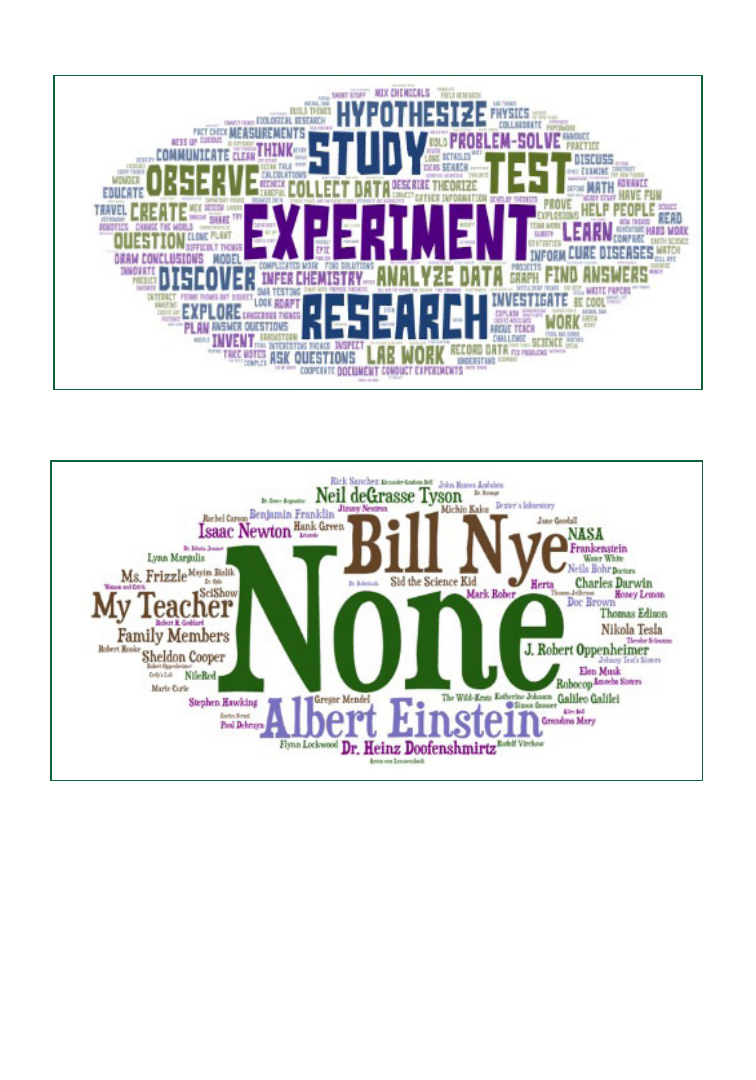
PSB 70 (3) 2024
297
the counterstereotypical ideas that scientists
can work in teams or groups and that they
are curious and creative people, but treatment
students also expressed significantly higher
agreement with the stereotype that scientists
are geeks or nerds than control students.
Figure 2. U.S. high-school student (ages 14–18) responses to the prompt: “Share with us 3 words
or phrases that describe the kinds of things scientists do.”
Figure 3. U.S. high-school student (ages 14–18) responses to the prompt: “Which specific scien-
tists (real or fictional) influenced your ideas about who scientists are and what they do?”
We are also collecting data from students
participating in PlantingScience at the end
of the experience to ask about how they felt
their projects went, and the extent to which
their scientist mentors met their expectations
about what scientists are like. We collected
795 responses to this survey. Over half of the

PSB 70 (3) 2024
298
students reported that communications with
their mentors went well or very well, with
about a quarter of students reporting that
their mentor communication went poorly
or not well. About half of students thought
that the scientist they worked with was close
to what they expected a scientist to be like.
More than a quarter were neutral about how
the scientist met their expectations, while less
than a quarter responded that the scientists
were not at all as they expected.
Free responses provide more context for these
categorical responses, and we plan to analyze
these data systematically in the future. A
few positive quotes from students who felt
the scientist mentor matched expectations
include: “They were able to collaborate with
us to create better science ideas”; “He behaved
like a normal person but had extra information
and knowledge about plants and the specific
scientific categories that he specialized in”; “I
thought scientists were nice, smart people who
love to learn and my mentor was just that.”
Unfortunately, some negative preconceptions
were reinforced as well: “They used a lot of big
words I did not know and then they typed way
too much for my brain to handle.”
The students who found that their mentor
surprised them often mentioned finding the
scientists surprisingly relatable: “I was ready
for them to have few hobbies due to how much
work they have to do”; “She was cool and knew
about hockey. I thought all scientists were
nerds”; “I expected scientists to be more stuck
up about knowing things but our mentor
was very hands on and encouraged us to do
our own research…” Other students were
impressed by the scientists’ deep interest in
their research topic: “I found their passion for
topics such as biology and botany intriguing.”
Some students who did not have satisfying
conversations with their mentor mentioned
disappointing surprises: “She honestly did
not sound like she was very happy to work
with us, she had an attitude.” Results from
these comments as well as an additional free
response with the prompt “What advice would
you give to scientist mentors?” will help us
improve our mentor training materials for the
program going forward.
Some insights from these preliminary data are
that students mostly express positive views
about scientists, even before the intervention,
but that many stereotypical views about
scientists are represented in responses.
Most high-school students have never met
a scientist, so online scientist mentors will
often make a big first impression (for better
or worse). Online mentoring may impact
students’ views of scientists, but changes
may not always be toward more counter-
stereotypical views. The open responses we
have collected but not yet analyzed are likely
to provide a lot of insight and context to the
quantitative data that we collected.
Our next steps include incorporating more
data from a second cohort of students
and their teachers collected this fall. We’re
planning to look more closely at some aspects
of the students’ experience and how that
relates to their responses to these questions.
In particular, we want to know how the
length and timing of their interactions
with mentors, the completeness of their
investigations, and how faithfully teachers
implemented classroom reflections and
discussions impact the students’ perceptions
of their scientist mentors. We will also take
a closer look at selected project dialogs to
see how the kinds of things scientists share
about themselves, and whether students and
scientists identified something they have in

PSB 70 (3) 2024
299
common, impacted the students perceptions
of scientists. We’re planning some exploratory
analysis of classroom context and student
demographics to try to determine for whom
the PlantingScience intervention works best.
And we are also looking at the mentor’s role
in meeting other program goals, like science
content and practice gains and students’
motivation to study plants.
Thanks so much to the BSA members and
other scientists who have served as mentors
and liaisons to the students and teachers
participating in this research project. The
project would not have been possible without
volunteer support and engagement from our
communities. We’ll provide more updates and
insights as the data analysis continues.
ACKNOWLEDGMENTS
PlantingScience F2 is a joint research project
led by BSA (Catrina Adams, Jennifer Hartley)
in partnership with BSCS Science Learning
(Jenine Cotton-Proby, Lisa Carey, Karen
Askinas, Anne Westbrook) and the University
of Colorado-Colorado Springs (Joseph Taylor,
Elizabeth Peterson). The project is supported
by the National Science Foundation under
Grant #2010556. Any opinions, findings, and
conclusions or recommendations expressed
in this material are those of the author(s)
and do not necessarily reflect the views of the
National Science Foundation. The project has
secured BSCS Science Learning IRB approval
for human subjects research and research
approval from each participating school
district. Student/guardian consent/assent
to participate in research was collected in
compliance with individual district policies.
REFERENCES
Lockwood, P., and Z. Kunda. 1997. Superstars and Me:
Predicting the Impact of Role Models on the Self. Jour-
nal of Personality and Social Psychology 73: 91-103.
Manke, K., and G. Cohen. 2011. More than Inspiration:
Role Models Convey Multiple and Multifaceted Mes-
sages. Psychological Inquiry 22: 275-279.
Nguyen, U. and C. Riegle-Crumb. 2021. Who is a sci-
entist? The relationship between counter-stereotypical
beliefs about scientists and the STEM major intentions
of Black and Latinx male and female students. Interna-
tional Journal of STEM Education 8: 1-18.
Palomba, R. 2017. How to undo stereotypes about sci-
entists and science. In Tintori, A. and R.Palomba [eds.],
Turn on the light on science, 19-49. Ubiquity Press,
London, UK.
Schinske, J., M. Cardenas, and J. Kaliangara. 2015. Un-
covering Scientist Stereotypes and Their Relationships
with Student Race and Student Success in a Diverse,
Community College Setting. CBE – Life Sciences Edu-
cation 14: 1-16.
Schinske, J., Perkins, H., Snyder, A., and Wyer, M. 2016.
Scientist Spotlight Homework Assignments Shift Stu-
dents’ Stereotypes of Scientists and Enhance Science
Identity in a Diverse Introductory Science Class. CBE
– Life Sciences Education 15: ar47.
Scogin, S. 2016. Identifying the Factors Leading to Suc-
cess: How an Innovative Science Curriculum Cultivates
Student Motivation. Journal of Science Education and
Technology 25: 375-393.

PSB 70 (3) 2024
300
MASTER PLANT SCIENCE
TEAM APPLICATIONS OPEN
FOR SPRING AND FALL 2025
The MPST is a unique opportunity for
early career scientists to engage even more
deeply with the PlantingScience program by
providing needed support to teachers! MPST
members serve as a liaison between teachers
and mentors and moderators of student
project conversations with their mentor.
With responsibilities ranging from assisting
teachers with class team setup to nominating
standout student projects, your contributions
will make a real difference.
Plus, as a thank-you for your dedication,
MPST members receive sponsored benefits
like Society membership discounts, a
PlantingScience T-shirt, and a certificate
for your professional portfolio. Don’t miss
the chance to grow your leadership skills,
connect with the plant science community,
and inspire the next generation—apply today
at plantingscience.org/getinvolved/joinmpst
!
HUGE PLANTINGSCIENCE
FALL SESSION
WRAPPING UP
The PlantingScience team is wrapping up
the Fall 2024 session. This has been our
largest session in five years, with 30 teachers
participating. Some were new additions to our
F2 research initiative, some were returning
from last Fall, and some were participating
outside of the research. It has been a crazy,
busy session, but we’ve seen some wonderful
interactions between students and their
mentors! In total we worked with 38 teachers
serving 1241 students. They completed
324 projects, most of which focused on
photosynthesis and cellular respiration.
Many thanks to the 150+ mentors and 30
liaisons who worked with us this session,
and to all who helped spread the word for
recruitment! Your help has made a real
difference in many students’ lives.
STATE-BY-STATE
RESOURCE UPDATE:
LIST OF
STATES/TERRITORIES STILL
NEEDED
What up-to-date flora or field guide would
you recommend to an early career botanist
that covers your state or region?
The BSA Education Committee continues to
receive recommendations for our update of
the BSA’s State-by-State Botanical Resources
area of the botany.org website. We are still
looking for resources (especially the most up-
to-date floras) from the following states:
Alaska, Arizona, California, Delaware, Idaho,
Kentucky, Louisiana, Maine, Maryland,
Mississippi, Nevada, New Hampshire,
New Jersey, New Mexico, New York, North
Carolina, North Dakota, Tennessee, Vermont,
Virginia, West Virginia, Wyoming, American
Samoa, Guam, Northern Mariana Islands,
Puerto Rico, Virgin Islands.
It should take less than 5 minutes to submit
your resource(s). To submit a resource,
please use this link: https://forms.gle/
VjpHPYM9pVKJ4dmh9
The Education Committee will compile these
resources on the botany.org website. We
are planning to release the new resource in
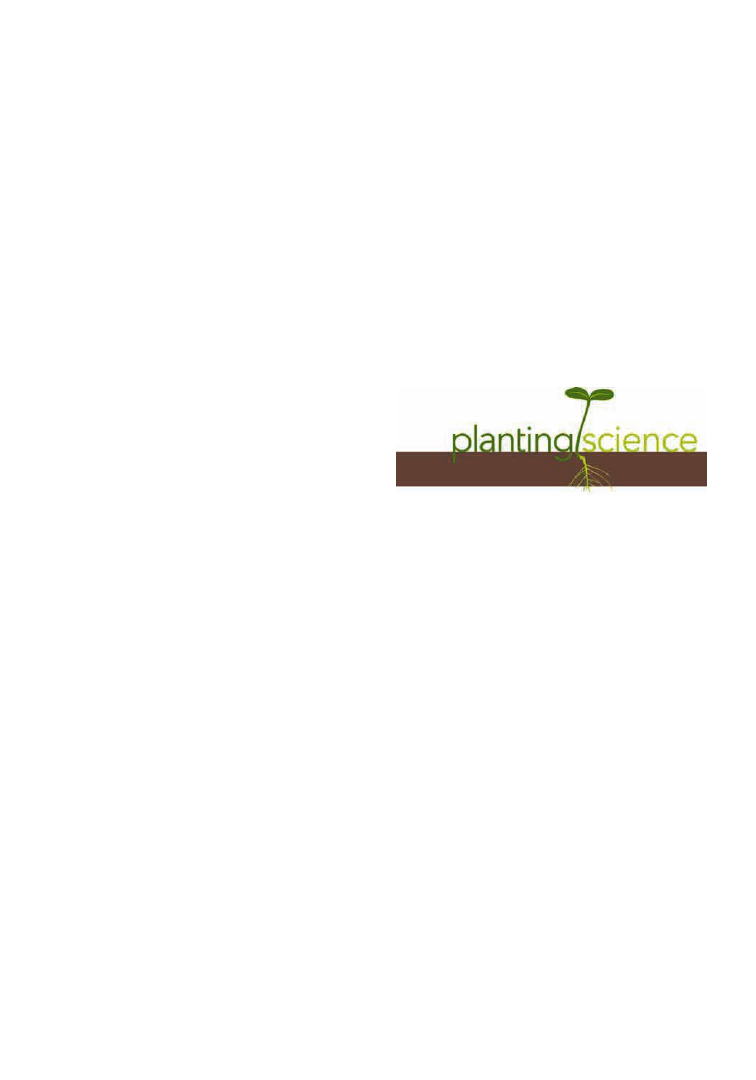
PSB 70 (3) 2024
301
time for the Botany conference this summer.
Thanks to everyone who has already submitted
a resource from your state or territory!
NOMINATIONS FOR
2025 BESSEY AWARD
Consider nominating an excellent BSA
educator for the 2025 Charles Edwin Bessey
Award. This annual award recognizes
outstanding contributions made to botanical
instruction. Ideal candidates are BSA
members who are enthusiastic about teaching
botany, are innovative in increasing student
and/or public interest in botany, and teach in
a way that increases the quality of botanical
education. More information about the award
and a list of past winners can be found on
the BSA website: https://botany.org/home/
awards/awards-for-established-scientists/
charlesebesseyaward.html
Official nominations are accepted starting
in early 2025, but students and early career
members who would like help putting in a
complete nomination packet can fill in on
online form (due by March 1) for assistance
in putting a packet together: https://forms.
gle/3WTbB481vZc3UHao9

PSB 70 (3) 2024
302
302
STUDENT SECTION
By Josh Felton and
Benjamin Aderemi Ajayi
BSA Student Representatives
It’s hard to believe that the Botany conference
in Grand Rapids was already six months ago!
We’re so grateful to all of you who took the
time to complete the post-conference survey.
Your feedback is invaluable and will help us
make Botany 2025 even better!
One of the changes we’re excited about
next year is a reimagined Careers in Botany
luncheon. We’re aiming for deeper discussions
and fewer transitions, allowing for more
meaningful connections. As always, keep
your eyes out for the student-led and focused
workshops, and we will work on organizing a
student workshop that caters to a wide range
of interests.
If you have suggestions for future student-focused
botany events or want to gain experience in
organizing a workshop, don’t hesitate to reach out
to Ben (aderemibenjamin@gmail.com) or Josh
(feltonjosh@icloud.com)—we’d love to hear from
you!
Botany 2024 Recap
GRANT OPPORTUNITIES
As the semester wraps up, it’s the perfect
time to explore funding and support for
your research! Ben and I have updated
a comprehensive list of opportunities,
organized into categories to make your search
for funding even easier. See https://tinyurl.
com/roundup-of-funding.
As always, BSA will share the society grant
and award announcements and information
through our social media channels, so be
sure to follow us on Facebook (Botanical
Society of America), BlueSky (@</p>
botsocamerica.bsky.social), and Instagram
(@botanicalsocietyofamerica).
GRAD SCHOOL ADVICE
Grad school can be a challenging yet rewarding
experience. Whether it’s navigating imposter
syndrome, balancing work and life, or managing
the steep learning curve, there’s always something
we wish we had known earlier. Some tips we often
hear include building a strong mentor support
system, setting boundaries early with your work
and colleagues, and remembering that it’s okay to
ask for help. One of our BSA members shared this
insight:
“Grad school is a roller coaster—find people and
activities that will support you through the highs
and the lows!” - Nora Mitchell

PSB 70 (3) 2024
303
If you could go back in time, what advice would
you give yourself during the first few years of
grad school? Maybe it’s a study/reading habit
that made a difference or something that helped
you stay grounded during tough times. Share
your wisdom with us at https://forms.gle/
D9iwA1o1juCBYMyX8, and we will feature your
advice in the next issue!
PAPERS TO READ FOR
FUTURE LEADERS
As student representatives, we’re optimistic about
fostering a healthier, more inclusive academic
culture in the botanical sciences. Below, we’ve
highlighted a few papers we believe are beneficial
reads for those who aspire to lead. If you have
papers you’d like us to feature, please reach out to us!
Brown, N., and J. Leigh. 2020. Ableism in Ac-
ademia: Theorising experiences of disabili-
ties and chronic illnesses in higher education.
London: UCL Press.
Cronin, M. R., S. H. Alonzo, S. K. Adamczak,
D. Nevé Baker, R. S. Beltran, A. L. Borker,
A. B. Favilla, et al. 2021. Anti-racist interven-
tions to transform ecology, evolution and con-
servation biology departments. Nature Ecol-
ogy & Evolution 5: 1213–1223.
Gin, L. E., N. J. Wiesenthal, I. Ferreira, I., and
K. M. Cooper. 2021. PhDepression: Examin-
ing how graduate research and teaching af-
fect depression in life sciences PhD students.
CBE—Life Sciences Education 20(3).
Hamilton, P. R., J. A. Hulme, and E. D. Har-
rison. 2020. Experiences of higher education
for students with chronic illnesses. Disability
& Society 38: 21-46.
Ramírez-Castañeda, V., E. P. Westeen, J. Fred-
erick, S. Amini, D. R. Wait, A. S. Achmadi,
and R. D. Tarvin. 2022. A set of principles and
practical suggestions for equitable fieldwork
in biology. Proceedings of the National Acad-
emy of Sciences 119: e2122667119.
Tseng, M., R. W. El-Sabaawi, M. B. Kantar,
J. H. Pantel, D. S. Srivastava, and J. L. Ware.
2020. Strategies and support for Black, Indig-
enous, and people of colour in ecology and
evolutionary biology. Nature Ecology & Evo-
lution 4: 1288–1290.
PSB 70 (3) 2024
304
304
ANNOUNCEMENTS
In December, the Bowdoin College Museum of
Art (BCMA), in collaboration with the Monhegan
Museum of Art & History (MMA&H), will present
an exhibition that looks anew at the history of
Monhegan Island, Maine. Titled Art, Ecology, and
the Resilience of a Maine Island: The Monhegan
Wildlands, the exhibition will illuminate the
Island’s extraordinary journey of environmental
transformation and resilience from the close of the
most recent ice age to the contemporary period, as
seen through the eyes of the artists who depict the
terrain and the scientists who study Monhegan’s
dynamic ecology.
ART, ECOLOGY, AND THE RESILIENCE OF A
MAINE ISLAND:
THE MONHEGAN WILDLANDS
Bowdoin College Museum of Art, December 12, 2024 - June 1, 2025
The exhibition will feature a wide range of
artworks—from early twentieth-century paintings
by modernist artists such as Rockwell Kent and
Edward Hopper, to contemporary panoramic
photographs made by Accra Shepp using his
4X5 view camera and woodcut prints created by
Barbara Putnam—alongside historical artifacts
such as bone harpoon points and other objects
created by Indigenous inhabitants, documents
from the Island’s history, and scientific research
on elements such as the human introduction, and
subsequent removal, of first sheep and then deer.
Samuel Peter Rolt Triscott, In the Woods, ca. 1900, watercolor, Monhegan Museum of Art and History

PSB 70 (3) 2024
305
The exhibition will open at BCMA on December
12, 2024, through June 1, 2025, followed by a
presentation on island at the MMA&H that
will begin July 1, 2025. An accompanying
catalogue by the same title is available from
Rizzoli Electa (https://www.rizzoliusa.com/
book/9780847836727/).
Located 10 miles off the coast of Maine, Monhegan
Island is just less than a square mile in size, with
a year-round population of around 60 residents.
Monhegan’s small scale has enabled the kind
of close study—by artists and scientists alike—
that reveals in intimate detail the changes in the
ecology of the forested landscape. Monhegan
forests have been permitted to follow their own
trajectory free from development thanks to the
exceptional conservation-mindedness of the
community. Fully three-quarters of Monhegan
Island—the Wildlands—is conserved in a land
trust where the prevailing stewardship ethos is to
let nature take its course.
While Monhegan has long been a canvas for
artists, it has been an equally enriching landscape
for scientists, offering a unique opportunity to
observe the mechanisms of forest succession
and resilience on a small scale. The exhibition
integrates the narratives of artists, ecologists, and
the community, and that so effectively relates
these instructive histories to the ongoing arc
of environmental stewardship on Monhegan
Island. Building on this experience, the exhibition
concludes with invitations for visitors to reflect
upon and express their own relationship to the
Monhegan Wildlands and wildlands elsewhere.
IN MEMORIAM
PIETER BAAS
(1944–2024)
The community of plant anatomists, especially
the wood anatomists, suffered a major loss on
April 29 of this year when Pieter Baas, BSA
Corresponding Member, died on the day after
his 80th birthday. Pieter earned his PhD from
Leiden University, The Netherlands, and spent
his entire career there, eventually becoming
Scientific Director of the Rijksherbariium. After
his retirement in 2005, he stayed active, being
one of those people you could describe as “failing
retirement.” His scientific output was impressive;
a full publication list provided by Van Welzen et
al. (2024). The publications he is best known for
are on ecological wood anatomy and classic wood
anatomical monographs, including his own PhD
on Ilex, and those prepared with his PhD students
(e.g., Sapindaceae with Rene Klaassen, Rosaceae
with Tony Zhang) and with visiting scholars (e.g.,
Cornaceae with Shuishi Noshiro, the Sophora
group with T. Fuji). Flora Malesiana was a major
project at the Rijksherbarium during Pieter’s
tenure as director and in addition to associated
administrative duties, he wrote synopses of the
anatomy of the families treated therein.
Pieter had contacts on all continents—that actually
is true—because he knew people who worked in
Antarctica. He had especially close ties with Kew,
beginning with a year spent there under the tutelage
of Professor Metcalfe. When relations improved
between China and western countries, Pieter was
an early invited visitor and subsequently hosted
Chinese visitors, co-authoring a series of papers
on the wood anatomy of Chinese trees and shrubs
during the 1980s–1990s. At most conferences
with sessions touching on wood anatomy, Pieter
would be an invited speaker and he could be relied
upon to give insightful and, when appropriate,
entertaining speeches. Moreover, he also could
be relied upon to always have a question or two

PSB 70 (3) 2024
306
for other speakers, so those awkward silences that
sometimes occur after a presentation ends were
avoided. Like many a Dutch academic, he was
multilingual; he was rather proud of his English
language skills and was a great fan of the daily
word jumble puzzle.
If you were interested in wood anatomy, it would
be on your bucket list to make a pilgrimage to
Leiden to visit Pieter and use the Leiden wood
collection, a collection whose well-being he was
keen to preserve. Anyone who visited Leiden
enjoyed Pieter’s hospitality and oftentimes
would be treated to a “spin” around the Dutch
countryside and a quite nice meal and glass of
wine afterwards. Pieter had an excellent baritone,
so you might also get taken to a performance of
a choir he sang in, one being the Bach Choir at
the church the Dutch royal family attended in The
Hague. A photo of Pieter showing then Queen
Beatrix about the Rijksherbarium had a place of
pride in his director’s office.
For decades Pieter was the face of the International
Association of Wood Anatomists (IAWA). Many
submissions to the IAWA Journal were from
authors who did not have English as their first
language. For those manuscripts with scientific
merit, he and Emma van Nieuwkoop (d. 2022)
guided the authors to acceptable papers and
thereby helped many establish their scientific
careers. At any meeting that had an IAWA social
hour, he used his baritone voice to good effect,
making toasts and offering thanks to organizers.
Once I heard him describing himself as shy,
which was more than slightly surprising given
considerable evidence to the contrary. Selling
IAWA publications and welcoming new members
to the association was one of his favorite activities
as anyone who ever attended an IAWA meeting
well knows.
One of his heroes was Rachel Carson, and
he supported efforts to conserve forests and
endangered tree species. This was an impetus
for him to be involved in International Union
of Forest Research Organizations (IUFRO) and
to help organize workshops in Ghana and Kuala
Lumpur for the Plant Resources of Tropical Africa
(PROTA) and the Plant Resources of Tropical
Asia (PROSEA), respectively. He was a major
participant in World Wood Day (March 21), which
celebrates and promotes the responsible use of
wood and highlights wood’s cultural importance.
Pieter traveled widely, and one of his travels
almost resulted in us losing him sooner. He was
on holiday in Sri Lanka in 2004 when the region’s
most powerful earthquake ever occurred, followed
by a devastating tsunami. Pieter said he heard
what sounded like a jet, which seemed odd as the
hotel was not near an airport, then he noticed
people running away from the ocean. He thought
it best to join them, grabbing his wallet on the way
out of his hotel room. Along with some others
he made it to the top of a shed, which thankfully
stayed put. Pieter’s exit from the disaster zone
was done in style (Pieter had style) as along his
walk toward Columbo, he was picked up by a nice
Indian family in a limousine and was driven to the
Dutch consulate. In his last year, his travels were
curtailed by the cancer that took his life.
Thank heavens for Zoom meetings becoming
commonplace because they made it possible
to visit with Pieter on a regular basis. Pieter,
Steve Manchester, and I enjoyed weekly “Woody
Wednesday” meetings to discuss fossil wood
projects. Out last meeting was the week before
he died. It is not nice to lose such a wonderful
and supportive colleague and friend; he is much
missed.
REFERENCE
Welzen, P.C. van, C. Lut, F. Lens, M. C. Roos, and D. J.
Mabberley. 2024. In memorium Pieter Baas, 80 years
old. Blumea 69: 1–10.
—Elisabeth Wheeler

PSB 70 (3) 2024
307
DR. ELISABETH ZINDLER-FRANK
Frau Dr. Elisabeth Zindler-Frank, a distinguished
German BSA corresponding member, elected in
1997, passed away on 22 July 2024 at the age of
91. She served on the faculty of the Universität
Konstanz, Konstanz, Germany for many years
before retiring to her family home in Marburg/
Lahn. Her area of research expertise dealt with
the physiology and anatomy of calcium oxalate
crystals in the Leguminoseae. She loved the
outdoors and led many field trips with her students
and local community groups.
Mögest du jetzt in Frieden ruhen
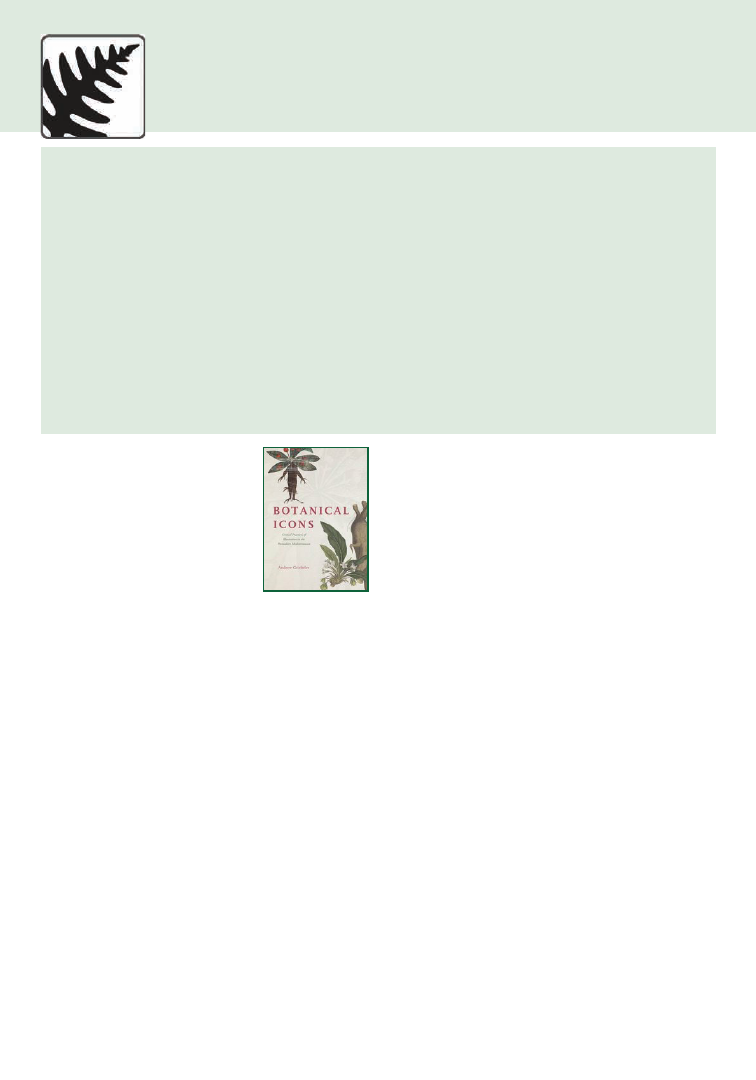
PSB 70 (3) 2024
308
308
BOOK REVIEWS
Botanical Icons: Critical Practices of Illustration in the Premodern Mediterranean
Darwin Online
From Chromosomes to Mobile Genetic Elements: The Life and Work of Nobel Laureate
Barbara McClintock.
The Gardener’s Guide to Prairie Plants
Natural Magic: Emily Dickinson, Charles Darwin, and the Dawn of Modern Science.
Roots of Power: The Political Ecology of Boundary Plants
Rowan
Things to Do With Plants: 50 Ways to Connect with the Botanical World
Transforming Academic Culture and Curriculum: Integrating and Scaffolding Research ....
Throughout Undergraduate Education
Trees and Forests of Tropical Asia: Exploring Tapovan
Unrooted: Botany, Motherhood, and the Fight to Save an Old Science.
Botanical Icons:
Critical Practices of Illus-
tration in the Premodern
Mediterranean
Andrew Griebeler
2024. ISBN: 9780226826790
US$54.99 (cloth); 334 pp.
University of Chicago Press
Andrew Griebeler’s Botanical
Icons follows the influential legacy of one book,
Dioscorides’ De materia medica, over nearly 1500
years of influence in Latin, Greek, and Arabic
pharmacological traditions, as it transitioned
from the original unillustrated text to illustrated
versions. The “botanical icons” of the title are
these images used to complement Dioscorides’
text. Beautifully reproduced in this book, they
represent many of the plants we treasure today
in our gardens and kitchens. Readers may not
know of their long history of pharmacological
and medicinal use.* The text reads like a detective
story as the author describes the “Critical Practices
of Illustration in the Premodern Mediterranean,”
the subtitle of the book, by piecing together
evidence from fragments and copies of illustrated
Dioscorides, e.g., the Vienna Dioscorides (early
6
th
century), the Naples Dioscorides (late 6th/early
7th century), the Morgan Dioscorides (10th), etc.
He writes, “Learning about plants from premodern
illustrations means seeing plants according to how
they were known and understood by people in the
past” (p. 50). Out of necessity, ancient peoples
accumulated “a vast botanical lore” (p. 1).
Griebeler notes in the introduction that the
Mediterranean basin was a hotspot of botanical
endemism with 24,000 plant species as opposed
to Europe’s 6000 species. Pedanius Dioscorides
of Anazarbus (c. 40–90 CE), a Greek physician
who traveled periodically with the Roman
army, is credited with establishing the practice
of pharmacology based mainly on these
Mediterranean plants. Dioscorides completed the
five volumes of De materia medica between 50 and
70 CE. He explains his methods in the preface to
De materia medica: “I know, on the one hand, from
personal observation [autopsia] in utmost detail
most items, and on the other hand, … I have a
thorough understanding of the rest from accounts
[historias] on which there have been unanimous
agreement and previous examination in each case
by locals….” (p. 36). He criticizes those who failed
to test drugs empirically and notes that he gained
additional experience during travels as a soldier-
physician, during which some presume he tested
preparations on the ill or wounded.

PSB 70 (3) 2024
309
At the outset Graebeler introduces Pliny the
Elder’s (23/24–79 CE) reservations about
botanical illustration. The passage from Pliny’s
Natural History, a work of 37 volumes completed
in 79 CE, which was illustrated, reads: “A picture
with so many colors is truly misleading, especially
in the imitation of nature, and the various hazards
of copying degenerates them greatly. Moreover,
it is not enough for them to be painted at single
moments in their lifetime since they change
their appearance with the fourfold variations of
the year” (p. 9). His criticisms have merit today
because field guides suffer from these problems,
it being too expensive and time consuming to
render a plant in all developmental stages and
different seasons. Line drawings, with arrows
pointing to particular features, as seen in Roger
Tory Peterson and Virginia McKenny’s A Field
Guide to Wildflowers, may be more helpful
than photographs in identification. Graebeler
frequently alludes to the “tension” between written
words and images. Pliny thought that names might
suffice for identification, but as botanists know,
synonyms arising for a variety of reasons can lead
to misidentification.
It is thought that pharmacological knowledge
was first initially transmitted orally, and later
written on scrolls, which participants took to
symposia to exchange methods and experience,
and that the extensive Greek practice of root-
cutting (rhizotomia) inspired the first illustrated
works. Fragments of a lost play by Sophocles titled
Rhizotomoi (5th century BCE) describes Medea
“‘naked, shrieking, wild-eyed,’ us[ing] brazen
implements to gather the noxious juice of a plant
called deadly carrot [thaspia]” (p. 17). One scholar
states that by the Hellenistic period, the “murkier
aspects of classical Greek rhizotomia” became
more “rational” (p. 17). Griebeler writes that
toxicological research went “hand in hand” with the
exercise of monarchic power” (p. 21). Campaigns
of conquest provided excellent opportunities for
collecting botanical specimens. The discussion
of the library of Mithradates VI, the Greek ruler
of the Kingdom of Pontus in Anatolia (120–63
BCE), reveals that Mithradates was particularly
interested in toxicology. Apparently fearing
poisoning from his many enemies, he wrote books
on the subject and devised antidotes, including
the “mithridatium”, sometimes called “the mother
of all antidotes” (p. 21). Elite Roman women, like
Empress Livia (died 29 CE), took responsibility for
treating the ills of their household. She devised “a
laxative,… and remedies for sore throat, chills and
nervous tension” (p. 23). Garden room paintings
from her villa at Prima Porta show a “staggering”
number of plants.
Griebeler demonstrates throughout that the
process of continuously correcting, updating,
and illustrating the original unillustrated text
through the centuries was dynamic. Illustrations
were a way for the viewer to have autopsia, direct
observational experience. Sometimes human
figures were added, like that of a little man
vomiting next to the illustration of a purgative.
Griebeler concludes his account with the story of
a Botanist Monk encountered during a botanical
expedition to Mount Athos in 1937 as recounted
by Arthur William Hill, director of Kew Royal
Botanic Gardens at the time. Traveling on foot
or by donkey, the monk searched for medicinal
plants while carrying a large black bag containing
four volumes of Dioscorides’ De materia medica,
which he had copied himself. Griebeler writes
that the world “needs Botanist Monks and others
like them to protect their preserves tirelessly. It
needs both global and local views of the botanical
world” (p. 232). Readers who are tempted to
admire the magnificent images in Botanical Icons
without paying close attention to the text will
miss the pleasure of the prose. Most importantly,
they will not have learned to see with the eyes of
antiquity. I advise reading this outstanding work
of scholarship from start to finish word for word.
*Pharmacological and medicinal are not
synonymous adjectives: pharmacological refers to
biomedical compounds that are often delivered in
preparations or drugs, whereas medicinal refers to
a range of healthy effects conferred through soaking,
poultices, etc.)
--Elizabeth Lawson
Email: winpenny.lawson@gmail.com; www.eliza-
bethwinpennylawson.com

PSB 70 (3) 2024
310
Darwin Online
https://darwin-online.org.uk/
EditorialIntroductions/van-
Wyhe_The_Complete_Library_
of_Charles_Darwin.html (includ-
ing a reconstruction of Charles
Darwin’s personal library: https://
darwin-online.org.uk/Complete_
Library_of_Charles_Darwin.html)
John van Wyhe
For more than 20 years, The Complete Work of
Charles Darwin Online (https://darwin-online.
org.uk/) by John van Wyhe has been the most
detailed, accurate, and reliable go-to source for
anything pertaining to Charles Darwin. Everything
is there: articles, biography, bibliography, books,
diaries, letters, manuscripts, illustrations (about
100,000), photographs (starting in 1865 taken
of Darwin annually or every other year except
for 1875-1877), and even a collection of postage
stamps (about 60 countries and regions from
Albania to Yakutia) as well as playing cards.
The Darwin Online numbers are staggering:
The site contains 240,000 searchable text pages,
127,800 pages of images, 118,800 scans of writings,
29 languages, 7500 PDFs, 50,000 illustrations
in books, a 7,000 records Darwin bibliography
and 78,000 manuscript records. In addition to
being the only place in the world with all of
Darwin’s publications, it contains his handwritten
manuscripts from over 80 institutions and
collections. It also contains a very large number
of items relevant to him, like 1700 reviews of his
works, the entire reconstructed library aboard the
Beagle and much more. Indeed, it may well be the
most comprehensive scholarly website regarding
any historical individual.
Altogether this is a site extraordinarily rich in
content, overflowing with details and excellent in
layout, management, clarity, and organization, all
of which are updated often. It is easily the most
informative site I have ever visited and used.
Access to the site is free and easy. No registration,
no log-in name, and no password are needed. All
one needs do is click and enjoy. An astonishing
number of visitors have done just that: 900 million
visits since 2006, according to
the title page of
the site.
I
t is possible to think that Dr. van Wyhe would
rest on his laurels after such a monumental
achievement. He did/does not. Recently he added
to the site a complete reconstruction of Darwin’s
library.
Charles Darwin owned “a vast personal
library” (https://darwin-online.org.uk/
EditorialIntroductions/vanWyhe_The_Complete_
Library_of_Charles_Darwin.html). After his
death, some parts of the library were preserved.
Other parts were scattered or lost. As a result,
Darwin’s library was often referred to as containing
1480 books because only that many were known
to survive in Darwin’s home (Down House) and
Cambridge University. It is now clear that this
was only 15% of the actual number of items in
Darwin’s library.
Dr. van Wyhe’s reconstruction of Darwin’s library
required nearly 20 years. It lists 7400 titles and a
total of 13,000 volumes. They are recorded in a
500-page catalog. There are over 12,000 links,
which make possible nearly effortless downloading
of many rare and hard-to-find books, articles, and
other writings as well as paintings, photographs,
and drawings. New links are being added
constantly. But this is not all.
Darwin read many more writings than he owned.
He “extended” the scope and size of his library
by using the libraries of the Linnean, Geological
and Geographical Societies, and the Atheneum
Club. What he read is of interest to students of
Darwin and his work because it influenced his
thinking and writing. Dr. van Wyhe “extended”
the reconstitution of Darwin’s library by listing the
libraries he used and by providing links to their
catalogs. This makes the reconstitution of Darwin’s
library a very powerful research tool. I used it to
better understand and explain a little-known letter
Darwin wrote to J. D. Hooker in 1863. That is why
I decided to write this review.

PSB 70 (3) 2024
311
Dr. John van Wyhe (b. 1971) is a British historian
of science at the National University of Singapore.
His main interests are Charles Darwin, Alfred
Russel Wallace, and evolution. I met him at the
World Orchid Conference in Singapore in 2011.
He gave an excellent lecture about Darwin’s work
with orchids.
—Joseph Arditti, Professor of Biology Emeri-
tus, University of California, Irvine
From Chromosomes to
Mobile Genetic Elements:
The Life and Work of Nobel
Laureate Barbara Mc-
Clintock
Lee B. Kass
2024.
ISBN: 9781032365329
(hard,cover), ISBN: 9781003332527 (e-book)
US$120.00 (hard cover) US$53.59 9781003332527
(e-book)
265 pp.; CRC Press, Boca Raton, FL
In this thoroughly documented study, Kass
provides a detailed biography of Barbara
McClintock that not only explains her position
at the forefront of cytogenetics, but also clarifies
the considerable mythology that has developed
around her. For instance, both Comfort (2001)
and Keller (1983) note in their biographies of
McClintock that her original given name was
Eleanor, but the family called her Barbara. Keller
leaves it at that. Comfort notes that Barbara’s father
officially changed her name on 18 June 1943 to
obtain a passport. Kass clarifies that the notarized
affidavit of name change was dated 27 May 1943,
and was probably for a passport renewal. These
minor discrepancies illustrate one of the strengths
of Kass’ research, which is evident throughout the
book. Both Keller and Comfort base their works
on oral interviews with McClintock and others,
after the fact. Kass uses these traditional sources
to search for and find documentary evidence to
support, elaborate on, or correct every part of the
story. This example, from Chapter 1, also fulfills
one of Kass’ objectives for the book: to document
McClintock’s family life and early schooling prior
to college.
The next five chapters provide the back story of
the development of genetics and breeding at
Cornell University, and particularly the Emerson
school of maize genetics, to which McClintock
became a critical contributor. She was not the
loner genius of some mythologies, but an active
collaborator within a stelar group of fellow
students, researchers, and mentors responsible
for the Golden Age of Corn Genetics and the
foundation of the Maize Genetics Cooperative.
In addition to published manuscripts, reports,
meeting programs, and interviews, throughout
the book Kass draws on correspondence between
all of the involved parties, including: Rollins
Emerson, Lester Sharp, Marcus Rhoades, George
Beadle, Charles Burham, Harriett Creighton, and
many others to provide the historical context in
which McClintock worked.
If you hear McClintock’s name, you probably
immediately think of transposable elements
(transposons, jumping genes) for which she won
the Nobel Prize. But arguably just as important was
her earlier identification of the 10 chromosomes
of maize and her demonstration of translocation
of chromosomes through crossing over during
meiosis. Although Morgan proposed the theory
of crossing over for Drosophila chromosomes
in 1911, it remained for McClintock to provide
proof for the proposed mechanism. In 1929 she
was able to identify the 10 chromosomes based
on their relative lengths, arm ratios, and the
position of dark-staining knobs. A mutation
stock, provided by Burnham, had a terminal knob
on chromosome 9 and resulted in 50% sterility
when selfed. In 1930 McClintock showed this was
associated with a segmental interchange between
chromosomes 8 and 9 and the following year
she and Henry H. Hill identified a linkage group
of 3 genes, C (colored aleurone), sh (shrunken
endosperm), and wx (waxy starch), also located
on chromosome 9. These provided the tools for
McClintock to design a set of experiments that

PSB 70 (3) 2024
312
explained the cause of sterility, allowed her to
determine the sequence of the three genes on
the short arm of chromosome 9 and, along with
Harriett Creighton, to demonstrate where and
how crossing over between chromosomes 8 and
9 occurred. Unfortunately, McClintock’s concise
writing was often not easy to follow. Readers
often had a difficult time understanding the logic
and subtleties of her arguments. Fortunately,
Kass (2013) has already edited and published an
electronic companion volume that includes not
only copies of McClintock’s original papers, but
also essays and perspective papers elaborating
on many of them, including the ones mentioned
above. Still, I had difficulty following the logic
of the original 1931 gene order and crossing
over papers, even with the help of the additional
resources Kass provided.
This difficulty in communicating her work was
highlighted in the last two chapters describing
McClintock’s nomination(s) for the Nobel Prize.
She was first proposed for a Nobel by Judson John
van Wyk in 1976, but this was unsuccessful—as
was a subsequent nomination by Adrian Srb and
Robert Rabson in 1980. In 1981 she was nominated
by Stanley Cohen and Howard Temin, and in
1982, Nobel Laureates Francis Crick and Joshua
Lederberg separately nominated McClintock, but
again were unsuccessful. Laureate Françios Jacob
expressed a reservation he had with supporting the
latter nomination: “It would be difficult to explain
McClintock’s work to the Swedish surgeons who
vote for the prize” (p. 229). The following year Ira
Herskowitz and Bruce Alberts were able to put
together a successful nomination and McClintock
was the sole recipient in 1983. (Perhaps a leading
textbook author could better understand and
summarize cutting-edge research than could
Nobel Laureates?)
By 1930, the maize group at Cornell was dispersing.
Beadle and Burnham were National Research
Council (NRC) Fellows at Cal Tech and in 1931
McClintock joined Burnham then working with
Ernst Gustaf Anderson. On the way to California,
she spent the summer at Missouri, working with
Lewis John Stadler on chromosomal irregularities
induced by x-rays and in California continued
her studies of the pairing of non-homologous
chromosomes in maize. With her NRC funding
ending in 1933, she applied for, and received, a
Guggenheim Fellowship to study with Curt Stern
in Berlin. Stern’s demonstration of crossing-over
in Drosophila was published only two months
after McClintock’s work in maize, but they met
the previous year at the International Congress of
Genetics at Cornell where both were presenters.
They were excited to collaborate, but it never
happened. Kass provides a detailed, documented
account of the impact of Chancellor Adolph Hitler
on botanical science, in relation to McClintock’s
research plans, during the lead-up to World War II.
After only a few months in Germany, McClintock
returned to Cornell to complete her Fellowship.
Emerson solicited two additional years of funding
from the Rockefeller Foundation, but this was not
a permanent job. However, the Foundation also
funded a new Genetics Institute at the University of
Missouri, and John Stadler invited her to become a
member. She ultimately spent six years at Missouri,
and a catalog of myths and legends has developed
about her time there and the reasons she left.
Kass devotes a chapter of fact checking to debunk
these myths and to provide “a more complete and
intriguing picture of the environment at Missouri
when McClintock was employed there between
1936 and 1942.” Contrary to some accounts, she
was not denied tenure, she was not fired, she did
not quit science, and ultimately, she did not leave
academe.
Similarly, there is legend and myth about
McClintock’s time at the Carnegie Institution of
Washington/Cold Spring Harbor (CIW/CSH). As
Kass notes, McClintock’s interest in transposition
can be traced back to her earlier work on linking
genes with chromosomes, during crossing over,
with maize chromosome 9. However, the focus of
research leading to the discovery of transposons
began with a contribution to the Maize Genetics
Cooperation News Letter during her first year
as a resident investigator at CIW/CSH. Again,
it involved chromosome 9, which, when broken,
was frequently being lost. By the late 1940s

PSB 70 (3) 2024
313
McClintock had identified a locus that would
initiate chromosome breakage by inserting into
a variety of gene loci. This culminated in a 1950
paper in PNAS that was largely ignored. This was
followed by a more-detailed paper submitted to
Genetics in April 1953—the same month Watson
and Crick published their paper in Nature—but
was not issued until January 1954. McClintock
recalled receiving only three reprint requests. It
was not because McClintock was not at a major
university or a well-respected researcher. She was
in constant contact and collaboration with many
of her colleagues at several universities and had
been elected to the National Academy of Sciences
and was Past-President of the Genetics Society of
America (and would receive the Merit Award [now
Distinguished Fellow] of the Botanical Society in
1957). Of course, it is also clear from the text that
sexual bias was present throughout her career,
and that she was aware of it. In response to an
invitation from Marcus Rhoades to spend some
time at Illinois, she declined, mentioning that
CSH “was the only place she had not had to face
the ‘anti-female bias’ most of the time” (p. 159).
Probably a major factor in the slow acceptance of
her theory was that she was conducting research
outside the expectations of the developing dogma
of molecular biology. She continued her research
even after officially retiring (mandatory at age 65)
in 1964. From 1965 through 1974, she served
as the first Andrew Dickson White Professor-at-
Large at Cornell while maintaining an affiliation
with CIW/CSH. She spent one or two weeks each
academic term presenting formal or informal
lectures and seminars and meeting with faculty
and students. This brings the cycle of the book
back to the introduction because, as a first-year
grad student, the author had her first of several
opportunities to talk about her research with
McClintock. “McClintock preferred visiting with
students in their labs and joining us for dinners,
and walks in the woods, rather than meeting
with faculty. She told us that students were
more receptive to new ideas, while faculty held
preconceived notions” (p. 3).
The impact of this personal relationship between
Kass and McClintock is apparent throughout the
book and makes it much more insightful for the
reader. The author draws on and expands her
more than 25 years of research, and more than
30 publishing articles, relating to McClintock
and her work. This is the definitive biography of
McClintock and belongs on the bookshelf of every
college library and every science historian.
REFERENCES
Comfort, N. C. 2001. The Tangled Field: Barbara Mc-
Clintock’s Search for the Patterns of Genetic Control.
Cambridge, MA: Harvard University Press.
Kass, L. B. (Ed.) 2013. Perspectives on Nobel Laure-
ate Barbara McClintock’s Publications (1926-1984):
A Companion Volume. Volumes I & II The Internet-
First University Press. Website: https://hdl.handle.
net/1813/34897.
Keller, E. Fox. 1983. A Feeling for the Organism: The
Life and Work of Barbara McClintock. New York: W.
H. Freeman and Company.
—Marshall D. Sundberg. Kansas Univer-
sity Affiliate and Roe R. Cross Distinguished
Professor of Biology – Emeritus, Emporia State
University.
The Gardener’s Guide to
Prairie Plants
Neil Diboll and Hilary Cox
2023. ISBN: 978-0-226-80593-1
US$35 (paperback); 644 pp.
University of Chicago Press
The Gardener’s Guide to Prairie
Plants contains a wealth of
information useful to anyone
interested in establishing, managing, or just
enjoying a planted prairie, from homeowners
looking to cultivate a small flower bed to those
overseeing larger areas. It includes not only a
field guide useful for identifying or selecting
prairie plants, but also several chapters devoted to
planting and caring for these plants and designing
gardens.

PSB 70 (3) 2024
314
This book begins with three chapters that provide
an overview of basic plant biology and a brief
introduction to the history and ecology of North
American prairies. The fourth chapter discusses
tips for planning and maintaining smaller prairie
gardens that might be found in yards or urban
plantings. These chapters are written for a general
audience and are divided into short, easy-to-
read sections. They include basic botanical and
ecological information, as well as practical tips
for things such as improving soils and converting
lawns to gardens.
Chapter five is the field guide to 148 prairie species,
which is divided into the sections “monocots,”
“dicots,” and “grasses and sedges.” This chapter
included 75% of the Nebraska prairie species I
currently grow in my own garden. Within each
section, species are organized alphabetically within
families. Each entry consists of a short summary
description of the plant, followed by habitat
information and suggested garden uses (e.g.,
butterfly garden, hummingbird garden). Entries
also include a list of distinguishing characteristics,
such as leaf texture, distinctive leaf shape, and
flower position, which are written for an audience
mostly unfamiliar with botanical terminology.
The number of described traits and their utility
for identification varies by species. Each entry also
includes a paragraph on look-alike plants to draw
the reader’s attention to potential alternative, with
page numbers for the relevant entry or entries
(if included in the book), which is a very helpful
feature.
The greatest strength of this book are the images
included with each species entry. The authors
include color photos of each plant in multiple life
stages, including seedlings, plants emerging in the
spring, and reproductive plants. Close-up images
of leaves, flowers, and seeds are also included. The
photos are clear and large enough to see detail
and the images of seedlings and emerging plant
are especially useful for identification when plants
are not in flower. The authors state that providing
these to help to gardeners who manage perennial
plantings was a primary impetus for the book.
Entries include a distribution map following the
standards of The Biota of North America Program’s
Plant Atlas; however, there was no key. I had to go
to www.bonap.org to remember what the colors
represented, which I was able to do only because I
was familiar with this type of map. This seems like
a lot to ask of an amateur botanist or gardener and
lessens the utility of the guide. Including a map
color key in the “How to Use this Book” chapter
(Chapter One) would easily fix this.
This field guide is of use for those interested in
identifying plants, but it is possibly even more
useful for those looking to select plants for a
garden. Each entry includes information pertinent
to gardening, such as habitat type, USDA hardiness
zone, soil types, root type, flower color, height,
propagation techniques, aggressiveness, and deer
palatability. This information is also summarized
in tables in the last chapter and having it all in
one reference is valuable. Of note, my edition
had a printing error in which pages 231–246 were
included twice. This is unfortunate, as the extra
pages were inserted right in the middle of the
entry for Hibiscus moscheutos (swamp rosmallow).
The first five chapters are likely sufficient for many,
if not most, gardeners who pick up this book. The
remaining chapters focus on topics relevant for
more intensive prairie management. Chapter Six
provides a guide for establishing a prairie meadow,
including how to select and prepare a site, choose
and perform different methods for seeding a
prairie, and control weeds. Chapter Seven discusses
best practices for prescribed burns. Chapters Eight
and Nine address methods for seed and vegetative
propagation, respectively. Together, these chapters
comprise a comprehensive manual for establishing
and managing a prairie. Techniques for tasks such
as harvesting, storing, and germinating seeds,
transplanting seedlings, and dividing roots are
clearly described with significant detail and, often,
accompanying images. Chapter Ten familiarizes
the reader with common insects found in gardens,
as well as the roles of small mammals, reptiles
and amphibians, canines, and ungulates in native
prairies. I thought that this chapter might better
belong in the introductory chapters before the

PSB 70 (3) 2024
315
field guide, because it is of general interest to
anyone who spends time in a prairie.
The last two chapters consist solely of tables. In
Chapter Eleven, the authors provide information
about seed mixes (e.g., a northern shortgrass seed
mix with dry soils; northern butterfly prairie mix
for medium soils). Chapter Twelve contains 30
tables useful for quickly identifying plants with
a particular trait or for a particular purpose.
For example, one table lists plants by height and
includes information on flower color and bloom
time among many other traits. Another table
includes only plants that grow in dry soils, and
a third table includes plants that produce blue
and lavender flowers. I used these tables as I was
designing a small garden to plant in the spring.
It was easy to scan for potential species based on
traits such as sun requirements, plant height, and
bloom time. Since there are so many tables that run
across multiple pages, a list in the table of contents
or at the beginning of the chapter would have been
extremely helpful. I spent 10 minutes searching
this chapter for the table of semi-shade plants I
had glanced while initially flipping through it.
This book included much more information about
the act of gardening with prairie plants than I was
expecting when I picked it up. I was originally
interested in this book for its utility as a field guide,
and I believe that the photos alone make this a
welcome addition to my collection. However, the
how-to chapters are a useful reference and inspired
me to try my hand at more active management
at home and to perhaps illustrate some of these
techniques in my botany lab. I am glad to have this
book on my bookshelf.
—Mackenzie Taylor, Department of Biology,
Creighton University, Omaha, Nebraska,
USA
Natural Magic:
Emily Dickinson, Charles
Darwin, and the Dawn of
Modern Science
Renée Bergland
2024. ISBN: 9780691235288
(hardback), 9780691235295 (e-
book)
US$32.00 (hardback), US$22.40
(e-book); 418 pp.
Princeton University Press, Princeton, NJ
In the late Middle Ages, Bergland explains,
“Natural Magic” described attempts to explain
unexplainable phenomena. It evolved into Natural
Theology, the search for a Christian God to explain
nature, and Natural Philosophy, the attempt to
deduce general laws from nature. From 1500 to
1600 the terms Natural Philosophy and Natural
Magic were interchangeable. During the 19
th
century, scientific objectivity gradually replaced
more subjective methods, and the enchantment of
mystery lost its appeal with the expectation that
the natural world could eventually be explained
mechanistically—a process termed “disenchanting
the world” by sociologists. In this dual biography,
Bergland compares the lives of naturalist Charles
Darwin with the contemporary poet Emily
Dickinson because during their lifetimes, both
were affected by society’s move from “enchanted
by nature” through disenchantment. Although
Darwin was a generation older than Dickinson,
their experiences were in near synchrony as 19th
century industrialism and modernization in
England occurred about a decade ahead of that in
the United States.
Both Charles and Emily grew up in small country
towns, the children of educated parents of some
means. Darwin inherited considerable wealth
from both sides of his family and Dickinson’s
family was influential in the establishment
of Amherst College. As children, both were
frequently outdoors and both were enchanted
by plants and other living things. Their school
experiences, however, were complete opposites
all the way through college. Darwin disliked the

PSB 70 (3) 2024
316
classroom and even in college did just enough to
“get by.” Dickinson loved school and was at the
head of her class at Amherst Academy (which also
allowed its girls to take classes at Amherst College),
and Mt. Holyoke Female Seminary (later College).
Whereas Darwin’s formal curriculum included
Latin, Greek, and mathematics, Dickinson was
able to study geology, botany, chemistry, and
astronomy. Ironically, these disciplines were
not yet “professionalized” and were considered
particularly appropriate for girls. As a result,
Dickinson’s formal training in science was much
more complete than Darwin’s.
Both Darwin and Dickinson shared a fascination
with the works of Alexander von Humboldt.
Darwin brought a copy of Humboldt’s (1822)
“Personal Narrative of Travels…” on the Beagle
voyage, which he annotated heavily. Based on
Humboldt’s description, Darwin was anxious
to visit Teneriffe, but they were unable to land
because of a quarantine. Nevertheless, in his
journal he describes the beauty of sunrise over
the island. Dickinson’s “Ah, Teneriffe – Receding
Mountain –” describes an equally beautiful sunset.
Both had an interest in botanizing, collecting and
preserving plant specimens. Darwin’s collection
from the Beagle voyage was pressed quickly, and
not always carefully—one specimen per sheet
and sent to Henslow, at Cambridge, where they
are still stored. A decade later Dickinson was
carefully drying specimens and mounting them
in artistic arrangements—multiple specimens
per page, in a large bound book, now housed in
the rare books collection of Harvard. Neither was
anxious to publish their written works and both,
particularly Dickinson, tended to be reclusive.
Darwin’s delay in publishing “The Origin of
Species” is well known. Only 10 of Dickinson’s
poems were published in her lifetime. They shared
a sense of wonder with nature and an appreciation
of its interconnectedness, even as other naturalists
around them became scientists, siloed in their
disciplines. Science and literature were splitting
into The Two Cultures later described by C. P. Snow
(1969). Science was becoming professionalized,
and as such, no longer appropriate for young
women.
Darwin and Dickinson never met, but two of
Darwin’s acquaintances, Charles Lyell and Harriet
Martineau, visited Amherst during Dickinson’s
school days and it is possible she heard their
lectures. Martineau, who “dated” Darwin’s brother
and discussed Malthus with Darwin in London
the year before he married, commented on the “40
or 50 girls” she saw attending an Amherst College
Geology lecture in 1838. Three years later Lyell
visited Amherst specifically to see fossil “turkey
[dinosaur] tracks.” It is unclear if he visited any
classrooms or met any students. Dickinson likely
learned of Darwin and natural selection through
the Atlantic Monthly book review of Origin of
Species written by Asa Gray in January, 1860.
Although Darwin and Dickinson did not know
each other personally, they did share at least
one personal acquaintance: Thomas Wentworth
Higginson. Higginson, an essayist for the Atlantic
Monthly who defended abolition and women’s
education, and was an early American champion of
Darwin, wrote “Letter to a Young Contributor” in
the April, 1862 issue of the magazine encouraging
young women to become writers. Dickinson
responded to him with a short note and four of
her poems. He responded encouragingly and they
struck up a long correspondence that continued
until weeks before her death. This was conditional
that he not publish her poems. He visited her for
the first time in 1870 while he was in Amherst,
and they talked for hours. Higginson was one of
the few Americans writing prose about Darwinian
natural science and in 1872 he visited Darwin at
Down House. The following December he was
back in Amherst where he and Emily discussed
poetry and women authors she should read. One
last time, in 1878, Higginson returned to Down
House. He later commented on Darwin’s declining
health—although during the visit Darwin
continued to get up early, walk the grounds, and
tend to his experiments. Darwin died four years
later on April 19, 1882; Dickinson died four years
after that on May 15, 1886. Higginson returned to
Amherst, at Dickinson’s request, to read an Emily
Brontë poem at her funeral.

PSB 70 (3) 2024
317
The format of “Natural Magic” is chronological
biography with alternating chapters devoted
to Darwin and Dickinson. Bergland does a
good job of fleshing out the personal and social
influences affecting both during their lives. She
places Darwin in the context of societal changes
during Victorian England and Dickinson into the
American changes leading up to and following the
Civil War. I enjoyed these historical perspectives
and the parallels between the lives of these two
very different notable individuals. This would be a
great book to use in a first-year experience college
seminar or honors course to promote dialogue
between students inclined toward the sciences
and those interested in the humanities and social
sciences. I’d also recommend it for college and
high school faculty to foster better understanding
of “the other” culture.
REFERENCES
Humboldt, A. von. 1822. Personal Narrative of a Jour-
ney to the Equinoctial Regions of the New Continent dur-
ing the Years 1799 – 1804. Volume 1. Website: https://
www.biodiversitylibrary.org/page/45734727
Snow, C. P. 1969. The Two Cultures. Cambridge,
Cambridge University Press.
—
Marshall D. Sundberg. Kansas University Af-
filiate and Roe R. Cross Distinguished Professor of
Biology – Emeritus, Emporia State University.
Roots of Power: The Politi-
cal Ecology of Boundary
Plants
Michael Sheridan
2023. ISBN: 9781032411408
(hardcover) ISBN:
9781032411422 (paper) ISBN:
9781003356462 (ebook)
US$160.00 (hardcover); 275 pp.
New York, Routledge.
Boundary plants are much more than witness
trees to mark geographic property boundaries,
although they may certainly do that. They
may also mark a sacred space; inspire social
organization; assign resources; serve as a peace
symbol; or be used to promote justice, fairness, and
sustainability. It ties together the contemporary
anthropological concept of political ecology with
more traditional ethnobotany.
The author uses the first two chapters to develop
the anthropological concepts of political ecology
and boundary plants that form a scaffold to build
five case studies illustrating these ideas. The
studies are all from the tropics: two in Africa, two
in the Pacific, and one in the Caribbean. They
primarily involve two plant genera: Dracaena in
Africa and the related Cordyline in the Pacific
and Caribbean. Interestingly, Cordyline was first
classified by Linnaeus as a Dracaena, and it was
brought to the new world by European colonizers.
With similar appearance, both monocots are
easily propagated by vegetative stem cuttings,
which is important for their selection as boundary
plants by the indigenous cultures who use them.
In Africa, the two study sites, Mt. Kilimanjaro
in Tanzania and Cameroon, are on the east and
west extremes of the traditional Bantu lands. In
the Pacific, Papua New Guinea and the Society
Islands (Tahiti) are on the west and east extremes
of the Polynesian expansion. On the island of St.
Vincent in the Caribbean, African slaves (familiar
with Dracaena) were introduced to Cordyline,
brought from Tahiti by Captain Bligh to protect
breadfruit plants in transit. The case studies
illustrate remarkable similarities in the roles
of boundary plants in these disparate cultures
while at the same time highlighting distinctive
differences.
Three plants define the cultural landscape of
the Chagga people on the mid-elevation zones
of Mt. Kilimanjaro: bananas, coffee, and masale
(Dracaena frangrans). A masala hedge surrounds
each homestead where bananas, coffee, maize,
and beans are intercropped. Here masale
represents customary law, defining property and
social relations within the family and within the
neighborhood. Should a dispute arise between
neighbors, the aggrieved party presents a knotted
masale leaf to the instigator to initiate peaceful
discussion to resolve the problem. The leaf

PSB 70 (3) 2024
318
expresses permanence and agency and it does so
because “it never dies.” Simply plant a cutting
and you’ve extended its life, indefinitely. To the
Chagga, masale has a selfhood and individual
agency, similar to Pollan’s “plants eye view” of
economic plants (Pollan, 2001).
European colonialization (both German and
English) promoted coffee as a cash crop grown
in surveyed, rented fields in the next zone down
the mountain, but it was also allowed to be
produced in the family gardens. The Chagga are
a patrilineal society, and the oldest son inherits
most of the fields while the youngest son inherits
the homestead and cares for his elderly parents.
Commercialization of coffee and population
growth during the 20
th
century has fragmented the
land and driven many in the younger generations
to move to urban areas and pursue upward social
mobility. Nevertheless, the Chagga polycultural
gardens and their Dracaena boundary plants
persist and actually prove more resilient to climate
change than the commercial farms at lower
elevation managed under British Common Law.
Dracaena frangrans (nkeng) is also a hedge,
boundary marker, and peace symbol among the
several hundred small indigenous kingdoms of the
anglophone Grassfields region of Cameroon, but
it is not considered to have a self-hood. This rural
area is also high on the slopes of a volcanic chain
and has an economy based on maize, potatoes,
kola nuts and honey. Sheridan’s study involves
the Oku Kingdom, one of several mid-elevation
kingdoms on Mt. Oku. Also a patriarchal society, it
is vertically structured with a hierarchy of families
below the king. In addition to the boundary
functions, found among the Chagga, here the
plant is also important for cleansing and healing
rituals and protection from evil and witchcraft.
This area of Cameroon was relatively unaffected
by slavery or European colonial powers, but since
independence there has been a near constant
power war among French- and English-speaking
factions in the country. “Compared to ineffective
and corrupt state institutions, the entangled
governmentality of nkeng is an efficient and
emotionally satisfying meshwork for many people
in Oku” (p. 105).
On Papua New Guinea, dozens of varieties of
Cordyline fruticose (tanget plants) are used as
boundary plants, depending on location and for
particular uses. Agriculture involving taro and
bananas independently evolved in the New Guinea
highlands about 7000 years ago while Cordyline, a
native of Southeast Asia, arrived as a “canoe plant”
carried east from island to island beginning 5200
years ago. Unlike Dracaena, Cordyline has a large
edible tuber, so it arrived in New Guinea already
with multiple uses. Agriculture in localized areas of
the island also included yams, sweet potatoes and
sago palms. The different planting methods and
uses of these plants contributed to the development
of fiercely independent family units—but with all
sharing tanget to mark boundaries and to promote
intercultural communication. Different varieties
are also used for daily wear and for ceremonial
costume. Some varieties are associated with
witchcraft and death whereas others boost garden
fertility, control weather, or are simply used for
decoration.
Three varieties of Cordyline—Auti má ohoi uta
(dark green and most common), Auti má ohoi
raro (light yellow-green), and Auti má ohoi tapa
(green with yellow stripes—were carried east to
the Society Islands by the Oceana mariners, along
with taro, coconut, and bananas. Here Auti má
ohoi became part of an intensely hierarchical
social-ecological system with low species diversity
and high species endemism. Cordyline (ti-plant)
served many of the functions of boundary plants
in New Guinea except rather than for small family
land claims, it was for large, stratified House
Societies. Unfortunately, Europeans learned early
on that the leaves made good animal feed and
alcohol could be made by fermenting the tubers.
This, and European diseases, quickly depopulated
the islands and devastated their ecology.
Twentieth-century tourism has stimulated a
reinvention of post-colonial ti-culture including
firewalking (“cordyline
oven”) and dancing
ceremonies wearing ti -“grass” skirts.

PSB 70 (3) 2024
319
Aesthetics is overtaking ethnics. Sheridan says
that in these islands, Cordyline “…is now more an
index of change than a marker of continuity and
tradition.” (p. 171).
The final case study, on the island of St. Vincent,
is one of recent historical construction. European
discovery decimated the native population
through imported disease and warfare. European
commercial enterprise mostly destroyed the
native floral and fauna. The slave trade brought
in subjugated West Africans, and Captain Bligh’s
successful second voyage to Tahiti unintentionally
introduced C. fruticose. The Africans recognized
Cordyline as their (Dracaena) boundary plant,
and it became a ubiquitous boundary marker but
with little role in kinship and society because slave
families were broken up upon sale. Cordyline has
been taken up as a religious symbol and is the heart
of the Red Dragon resistance movement today.
“Roots of Power” is a scholarly anthropological
volume that will introduce the reader to a relative
new subfield of Political Ecology. For those
interested in ethnobotany, it provides a useful
example of the importance of plants to human
culture beyond economic uses and chemical
interactions on human. The boundary plants
that are the focus of this study are curious in the
similar interactions that developed between two
morphologically similar plants in indigenous
cultures half a world apart. In both cases the
relatively large, attractive leaves, on a moderate-
sized herbaceous “shrub,” was a compelling
attraction, along with their intensely green color,
shiny surfaces, and flexibility in the wind or in a
dance. In both cases, a key to their use was their
permanence (immortality) because of their ease
of vegetative propagation. And in both cases,
this led to their use as living markers for their
respective societies, marking boundaries, sacred
spots, places of danger, and peacemaking. Finally,
in both cases, these indigenous cultures were
exposed to European colonizers, but the European
influence had dramatically different results on the
ability of the plant to retain its “power” in each of
the five case studies examined.
REFERENCES
Pollan, M. 2001. The Botany of Desire. New
York: Random House.
—Marshall D. Sundberg. Kansas Univer-
sity Affiliate and Roe R. Cross Distinguished
Professor of Biology – Emeritus, Emporia State
University

PSB 70 (3) 2024
320
Rowan
Oliver Southall
2023. ISBN: 978-1789147124
US$27 (Hardcover); 248 pp.
Reaktion Books
I
n Rowan, Oliver Southall
profiles the rowan, a small
tree notable for its scarlet
berries and haunting persistence, often as lone
individuals, in craggy, high-elevation habitats.
Many cultures have described such areas as
“numinous,” thresholds to other worlds, which
may account for its presence in stories of myth and
magic dating back for centuries. The rowan of this
book is Sorbus aucuparia, the sole representative
in Europe and Eurasia of a genus that includes
over 90 species forming a hybrid complex in the
mountainous regions of southeast Asia.* Southall,
a poet living in West Sussex, UK, is the author of
Borage Blue (2019), which uses borage as a focal
point for plant-attentive prose and poetry. Images
posted on X (@oliversouthall_) of lichens, slime
molds, the green-eyed flower bee and the like
indicate his ecological awareness. Although rowan
is planted horticulturally, it is the wild rowan that
has wielded symbolic power under many names:
quickbeam, quicken tree, Witchwand, Lady of the
Mountain, Delight of the Eye, and more.†
Southall states in the Introduction (“Thresholds of
Nature and Culture”) that “this is a book about the
‘mythology’ of rowan in the expanded sense” (p.
30). The unfolding of his narrative takes readers
on many adventures beginning with druidical
sagas and continuing with stories from Irish and
Scandinavian folklore previously unknown to
this reader. In medieval Ireland the exploits of a
fantastical leader of “a nomad war-band” known as
Fionn Mac Cumhaill (Finn McCool) took written
form in the 12th century. Southall writes, “In the
Finn cycle, the rowan is especially associated with
adventures known as bruidhean (hostel or banquet-
hall) tales: stories in which Finn and his men are
lured into a parallel dimension through the fairy-
tale device of some attractive residence in a remote
place” (pp. 44–45). In the Bruidhean Chaorthainn
(“The Hostel of the Rowans”), the banquet hall is
surrounded by quicken trees and fastened “with
tough quicken tree withes.’” “Ambiguous spiritual
beings” populate these places, testing McCool and
his men in dire ways. Another saga, “The Siege of
Knocklong,” contains “some amazingly over-the-
top Druidical rowan magic,” while “The Siege of
Etain” in which a jealous wife lays a curse with
“a wand of scarlet rowan” reveals the rowan’s
association with fire, blood, and beauty. Southall
introduces Icelandic rowan lore with a description
of Edda, a 13th-century text written by Snorri
Sturlson, a Christian scholar living in Iceland, and
Finnish rowan lore with creation stories from the
Kalevala, a collection of epic poetry. In the latter,
rowan twigs added to a fire had the power to
predict war or peace.
In the chapter “Magic and Medicine,” Southall
considers the role of rowan in the lives of ordinary
people in northern Europe, Ireland, Scotland,
England, Wales, the Baltic, and northern Russia.
Its protection and aid were sought for everyday
concerns, such as fertility, of people and livestock,
and malicious mischief caused by unknown
beings. Southall writes that “the churning of milk
into butter was marked with more supernatural
associations than any other activity” (pp. 89–90).
Protective practices included using rowan wood in
the cowshed and tying rowan berries to the ends
of cows’ tails. Symbolic importance was attached
to the scar, a vestige of the fallen calyx, at the base
of the berry, which takes the shape of a pentacle or
five-pointed star. Sorbus belongs to the Maloideae,
and as such the “berry” is botanically a pome, or
little apple.
Other chapters take us into the modern world
with stories of how the rowan became symbolic
in political and literary movements (“Arts of
Nationhood”), and how the rowan appeared in
famous paintings of the romantic period becoming
the “anti-picturesque” tree (“Romantic Ecologies”).
Interestingly, rowan was “unmentioned” by
Shakespeare, Milton, or Pope, but figured greatly
in the work of Russian writers like Boris Pasternak
and the dissident Marina Tsvetaeva (“Other
Russias”). The chapter “Uprootings” takes as its
theme how rowans resonate in the work of writers
who have witnessed “emptied spaces,” particularly
in Scotland. The writers include Gavin Maxwell,
known for portraying life with otters in Ring of

PSB 70 (3) 2024
193
Bright Water, and Kathleen Raine, his friend
and poet who had mystic visions of rowans. One
particularly evocative image in this chapter is Andy
Goldsworthy’s work of ephemeral art from 1987
titled “Rowan leaves laid around a hole/collecting
the last few leaves/nearly finished/dog ran into the
hole/started again/made in the shade on a windy,
sunny day,” (p. 188), which beautifully represents
the rowan as a portal to other worlds. Autumn-
tinted rowan leaves, arranged in sequential circles
from dark red to orange to golden, surround a black hole.
The conclusion tells the story of one tree—a “quite
ordinary” rowan called the Survivor—that was
nominated for “European Tree of the Year” in
2021 by the Borders Forest Trust (BFT). Already
Scotland’s favorite tree of 2020, it resides in
Carrifran Valley, a glen in the Southern Uplands of
Scotland. Photographs show it perched “on a steep
tussocky bank” against a vast, treeless landscape.
The BFT purchased Carrifran and began ecological
restoration, the Carrifran Wildwood project,
with the John Muir Trust as partner, eventually
planting 750,000 trees. Southall writes, “The
Survivor rowan, then … is a threshold messenger
for botanical life of all kinds…” (p. 207) including
birds, who have always depended on the rowan,
and other fauna like specialist aphids, rare wood
ants, tree slugs, mite galls, and moths (p. 202).
The 103 illustrations (84 in color) alongside the
text equally persuade readers of the rowan’s star
power. This beautifully produced book is one to
read closely and then reread often—and pass
down as a treasured volume on the bookshelf.
* The native sorbus of North America is Sorbus
americana, usually called the mountain ash.
Sorbus aucuparia, however, was introduced as an
ornamental to North America and has naturalized
there. Long hairs that cover the twigs, bud scales,
and undersides of leaves distinguish S. aucuparia
from its cousin.
† See “Witch Tree, Quicken Tree, Delight of the Eye”,
www.eldrum.co.uk.
—
Elizabeth Lawson
Email: winpenny.lawson@gmail.com ; website:
www.elizabethwinpennylawson.com
Things to Do with Plants:
50 Ways to Connect with
the Botanical World
Emma Crawford
2023. ISBN-13: 9781842467794
US $25.00 (Hardcover); 168 pp.
Kew Publishing, London, UK
As a passionate botanical
artist and relatively new to
the world of botany by volunteering at the
Friesner Herbarium at Butler University, I was
eager to review Things to Do with Plants: 50
Ways to Connect with the Botanical World. It
was published by the Royal Botanic Gardens,
Kew, one of the finest institutions for the
preservation, documentation, illustration,
and education about the world of plants. As
stated in the Introduction, “[w]e all have a
relationship with plants, members of a vast
kingdom of organisms, consisting of 390,000
species at last count” (p. 6). The author’s
purpose is to make the plant world accessible
to everyone and to demonstrate what we can
do universally and individually to contribute
to the continued growth and vitality of plants,
even in the midst of climate change. Her
focus is on using plants “in ecologically sound
ways” (p. 8). The author’s credentials speak to
her love of horticulture and her activities as a
gardening journalist.
Things to Do with Plants is divided into
seven sections: Save the World; Build a
Community; Clothe and Comfort; Green
Up a Garden; Stimulate and Soothe Mind
and Body; Supply the Kitchen; and Inspire
Creativity, each with a set of activities. For
example, within the section Inspire Creativity
are making furniture, rope, cordage, perfume
and paper, pressing and preserving flowers,
weaving baskets and floor mats and painting
or drawing plants. Instructions are clear,
accompanied by photographs or diagrams for
321

PSB 70 (3) 2024
194
each step. The section Build a Community
includes ways to use plants to reduce noise,
establish boundaries, reduce pollution, and
solve crimes. Although climate change is a
politically charged topic, the author avoids
speculating about future scenarios, instead
focusing on what we can do right now to
mitigate the situation at the universal as well as
individual level. Even the cover art contributes
to the overall cheerful and optimistic spirit of
this book.
The book provides a nice balance between
history and facts about plants with activities
that range from simple to complicated.
Each section is in a separate color, making
information easy to find. In addition to lovely
photographs (often presented in circles) and
drawings, there are color-coded action plans
and small colored icons that correspond to
each section. The book is printed on thick
paper with a natural feel. A page of printed
and website resources is provided, along with
a two-page index.
In conclusion, Things to Do with Plants will
be appealing to a wide variety of audiences.
It includes enough information to educate
people of all ages and backgrounds in the
science and use of plants while providing
hands-on activities that are fun, creative, and
practical. Although it sounds cliché, there is
“something for everyone” in this book. It will
inspire and encourage readers to think about
their reliance on plants and ways that they can
promote, even through small changes, a better
environment for all living things.
—Sara Anne Hook, Affiliate
Friesner Herbarium, Butler University,
Indianapolis, Indiana
Email: shook@butler.edu
Transforming Academic
Culture and Curriculum:
Integrating and Scaffold-
ing Research Throughout
Undergraduate Education
Mitchell R. Malachowski, Eliza-
beth L. Ambos, Kerry K. Karukstis,
Jillian L. Kinzie, Jeffrey M. Osborn
2024. ISBN-13: 9781032581675
Paperback, US$42.95; 282 pp.
Routledge, New York, NY, USA
From inclusive teaching practices to
community-based and active learning
strategies, campuses across North America
are working to transform educational
practices in higher education to maximize
student retention, learning, experiences,
graduation rates, and career success. Many
educators are also now realizing the value
of undergraduate research, scholarship, and
creative inquiry as a pedagogical approach
that builds relationships between students
and mentors, helps students develop critical
thinking and problem-solving skills, teaches
students about research methods in a hands-
on way, and prepares students for their future
careers or graduate school.
Transforming Academic Culture and
Curriculum is a new book on ways to
transform undergraduate education through
research experiences by Drs. Malachowski,
Ambos, Karukstis, Kinzie, and Osborn, as
well as 19 other consultants who contributed
to writing the chapters. Individually and
collectively, these editors and authors have
remarkable qualifications, from being
associate or full professors in their respective
fields to past presidents or officers of the
Council on Undergraduate Research (CUR).
This comprehensive guidebook to enhancing
undergraduate curriculum via research
experiences is the result of a six-year study
of educational transformations within 24
322

PSB 70 (3) 2024
195
departments over 12 institutions. The book is
organized into two parts and 12 total chapters.
As a bonus, it includes a detailed preface,
references sections at the end of each chapter,
and an appendix and index at the end of the
book.
Part One of the book focuses on transformation
at many levels, ranging from individual student
success to the overall culture of undergraduate
education. The eight chapters within this first
part of the book walk the reader through
different levels of change, starting with
Chapter One, which focuses on institutional
transformation. This chapter sets up the
reasoning behind and process used within
the Council on Undergraduate Research
Transformation Project, summarizes decades
of enlightening research on undergraduate
research as a high-impact pedagogical practice,
and ends with how the book is structured and
should be used by everyone. It seems like
a choose-your-own-adventure book, with
suggestions to start with “chapter x” if you are
a faculty member or “chapter y” if you are an
administrator. The second chapter delves into
the importance of cultural transformation
within departments and institutions, with
sections on John Kotter’s eight-stage process
for organizational change that ranges from
“Establishing a sense of urgency” (step 1;
probably the most important step, given how
slow academia works) to “Anchoring new
approaches in the culture” (step 8). Each step
is discussed in detail to provide background
information on the step and some examples of
how the step was implemented at institutions
that participated in the project.
This second chapter is vital for many of
the other chapters, such as Chapter Three
that focuses on scaffolding development
of research skills throughout a program
to transform curriculum. Chapter Four
focuses on disciplinary transformation in
biology, chemistry, physics, psychology,
and non-STEM disciplines, and forces the
reader to think deeply about learning and
assessment goals, course sequencing, program
accreditation, and other potential roadblocks
prior to navigating these transformational
waters. Chapter Five is focused on using
research on faculty and student success to
drive evidence-based practice and curriculum
change, while the sixth chapter digs into the six
institutional factors that drive change, ranging
from institutional mission and identity to
resources and institutional dispositions (e.g.,
faculty workload/recognition, risk tolerance,
shared governance). Chapters Seven and Eight
wrap up study results with a focus on theory
of change that bridges theory to practice, links
it to strategic planning, discusses Kotter’s
strategies in the context of theories on higher
education change, and, finally, summarizes
many of the opportunities and challenges that
arise when pursuing transformative work.
Part One concludes and transitions to
Part Two, which provides a toolkit for the
transformation of curriculum and culture.
The remaining chapters, nine through
twelve, introduce the toolkit, discuss when a
department knows they are ready for change
and how to make goals, establish steps for
transformation, and provide direction on
how to assess progress. This part includes
many examples of how to use the tool from
teams and consultants that used the tool in the
study. Given that a diverse array of colleges
and universities participated in the project,
any individual from any given college or
university in North America should be able
to find information that is relevant to them
in this toolkit. The last major component of
the book includes an Appendix section with
323

PSB 70 (3) 2024
196
an overview of the Council on Undergraduate
Research Transformation Project, including
how participants were recruited and selected,
the elements that accelerated systematic
change and were utilized by all participants,
and research methods.
Undoubtedly, the drive for institutions to use
evidence-based teaching practices is essential
to improve learning outcomes and faculty and
student success. The CUR and other similar
organizations are helping to drive the changes
necessary for college and university success in
this matter, but this Transformation Project
and toolkit can help many colleges and
universities take a much bigger leap in the right
direction. The editors of the book indicate that
the book is oriented toward faculty members,
department chairs, undergraduate research
program directors, administrators, and
those who are interested in studying higher
education and change theory. Although
change can begin at the bottom and work its
way up (as is mentioned in the book), some
change must also occur from the top down.
Curriculum overhauls and transformations of
this magnitude will certainly require a lot of
support from administrators, but also program
accreditation organizations, university
stakeholders, graduate employers, and many
other entities. Change, especially in academia,
does not occur overnight, but we can take
some small steps today (i.e., establishing a
sense of urgency) to create meaningful change
that will improve our programs and benefit
our children and grandchildren.
—A.N. Schulz, Department of Forestry, Mis-
sissippi State University, Starkville, Mississippi,
USA
Unrooted: Botany, Mother-
hood, and the Fight to Save
an Old Science
Erin Zimmerman
2024. ISBN: 978-1-68589-
070-4 (hardcover) ISBN:
978-1-68589-071-1(ebook)
US$28.99. (hardcover); 262 pp.
Brooklyn, NY, Melville House
Part way into her undergraduate career as a
budding physics major, Erin Zimmerman
realized she really wanted to study plants.
Within a year she was working in her new
undergraduate advisor’s lab, learning to make
botanical discoveries with a microscope at
the university of Guelph. Unfortunately, this
was a time when the Botany and Zoology
Departments underwent a forced merger
to become an animal/molecular–oriented
Integrative Biology Department. She quickly
realized there would likely be few academic
opportunities for plant anatomists in the
future, especially for a female. She asked her
advisor what were her chances to succeed in
this field? He candidly replied, “You just have
to be the best.” That’s what she set out to do.
Much of the first half of the book can be
viewed as an advisor’s manual for how to
support your (particularly female) advisees
in pursuit of their passion and career. As
an undergrad at Guelph, Zimmerman was
the only female student in the lab, but her
advisors treated her as a valuable colleague
and encouraged her to pursue her interests
in botanical light microscopy. Her research
was published, and her advisors encouraged
her to broaden her experience and contacts
by pursuing a doctorate at another university.
She joined a productive lab at the Institut de
recherche en biologie végétale (University
of Montreal/Montreal Botanical Garden)
where her supportive female major professor
encouraged her to design a systematics project
324

PSB 70 (3) 2024
197
of her own on a group of primitive legumes
and to look for opportunities to build her
research tool box beyond what was available at
the Institut. Zimmerman uses these enriching
experiences to introduce the reader to many
of the tools in the modern morphologist’s
toolbox. Her lab focused on DNA sequencing,
so the molecular tools produced a major part
of her dissertation, and she describes for the
reader the principles and processes involved.
But she also visited Kew to learn and apply
scanning electron microscopy (SEM) to
examine floral development in members
of her group, including Androcalymma
glabrifolium, thought to be extinct in the
wild. This provided her an opportunity to
inform the reader about the critical role plant
collections in herbaria continue to play in
our studies of biodiversity and evolution.
She did a “morphological bootcamp”
learning descriptive taxonomy at the Chicago
Botanical Garden, where her mentor, Pat
Herendeen, also provided a practical example
of how to be a productive botanist and raise
a family at the same time. (Zimmerman was
raised as an only child by a widowed father
on a small farm in rural Ontario.) She spent
a month on a collecting expedition in the
Guyanese rainforest and uses this opportunity
to introduce the reader to some historic plant
collectors (Humboldt and Wallace, among
others) and describe how collections must
be prepared and documented in the field for
both morphological and molecular studies.
This also allowed her to argue for including
careful sketches and illustrations of plants
being collected, in addition to photo images,
as a way of learning to see.
Back in Montreal, one of her lab mates,
another motivated and ambitious female
scientist, had her first child. She was a role
model—a senior grad student in the lab who
seemed to be able to “do it all.” Yet, after her
maternity leave (this is Canada!), she seemed
to become less ambitious and competitive—
and then vanished. An undercurrent through
the book to this point was the leakage of
talented women from science pipeline.
Here was Zimmerman’s first experience of
this phenomenon in her own career: “I felt
betrayed and self-righteous.” Nevertheless,
she maintained her focus and drive to finish
in the next year.
That summer Zimmerman presented at the
Botany 2013 meeting in New Orleans. One
of the highlights for her was the workshop
on botanical illustration, which reaffirmed
her interest in producing accurate botanical
sketches to document her research. But
the real highlight came the day after the
meetings while she and her boyfriend were
playing tourists for a day and a half before
flying home. Newly engaged, they found a
pair of botanically themed wedding rings
in an uptown New Orleans antique store.
These were put to effect the next year, a few
months after she successfully defended her
dissertation. Her husband had shifted from
a PhD in biochemistry to ophthalmology to
avoid having to find dual academic careers,
so that summer they returned to her father’s
farm in southern Ontario where they were
married; he could work in the nearby town
and she could look for a post-doc. Within a
month she was pregnant. Later that summer
she was invited to interview for a post-doc at
a nearby government research lab. The project
involved isolating and sequencing RNA gene
products regulating root development. Here
was another opportunity to explain some
biology—how loss of function mutations is
used to determine the role of genes, and how
mRNA is involved in the process. Although
she worked with DNA for her dissertation,
325

PSB 70 (3) 2024
198
RNA is more difficult to work with and
she lacked background in transcriptomics.
Nevertheless, her new supervisor was sure
she “could pick it up” as she worked. She
was offered the position, and her supervisor
was also unconcerned that she would be
taking maternity leave only four months after
beginning.
As usual, she applied herself to learning the
new techniques where timing was essential
working with large numbers of plants. The
day she began plating the hundreds of seeds
required for her first experiment was when she
realized you cannot sit comfortably for hours
in front of a laminar flow hood. It turned into
a late night. Finally, she was ready to start
maternity leave a few days before her due
date. Her supervisor delivered a bunch of new
research papers she could read while off and
suggested that she start writing up some of her
work so far for future publication. Here was
another opportunity to explain to the reader
what it’s like to work as a post-doc, especially
a female one.
A few weeks before the end of her leave, now a
mother of a young daughter, she contacted her
supervisor, reminding him of her impending
return and suggesting that perhaps she could
slightly change her work schedule from 9–5 to
7–3 to make it easier to work out childcare.
His response was a mild rebuke that leading a
project was not just showing up for a certain
number of hours. When the day came for her
to return to work, he was not there and would
be gone for a week. He forgot she was coming
back. Any accommodation at work became
hard to come by. “I can’t remember the exact
moment when I knew I was done, but by the
time the days started to lengthen noticeably
and I hit my one-year mark at the lab, I know
I wouldn’t be putting myself through another
winter of this” (p. 196). Later, when she told
him she would not be continuing, he was
“shocked”: “But you’re doing a great job!
You’re getting good results! You can’t stop
now”—but she did.
Her transition was from professional botanist
to “a botanist at large.” Originally this involved
freelance ghost-writing for other scientists, but
then she moved into citizen science, working
with the public to promote collections,
herbaria, and the importance of digitizing
specimens. Her last chapter highlights many
of the opportunities available to engage the
public in doing science.
Zimmerman’s memoir seamlessly blends
advocacy for the continued importance of the
traditional, and often de-emphasized, fields
of morphological and taxonomic research
with an account of her own experiences with
gender bias in the course of her botanical
education and research. Together, these two
stories are compelling. Zimmerman’s deep
appreciation for the “wonder” of botany and
botanical research is made more poignant by
the fact that she ultimately decides to leave the
research she values because of gender issues.
Uprooted makes an original and thought-
provoking contribution to the literature about
women in science and the struggles they face.
This is a book I would have required in my
honors biology course (M.D.S.) and women’
history course (S.B.S.). It would be a valuable
addition to school and university libraries.
—Marshall D. Sundberg, Kansas University
Affiliate and Roe R. Cross Distinguished Pro-
fessor - Emeritus, Emporia State University.
and
—Sara B. Sundberg, Professor of History
Emeritus, University of Central Missouri.
326
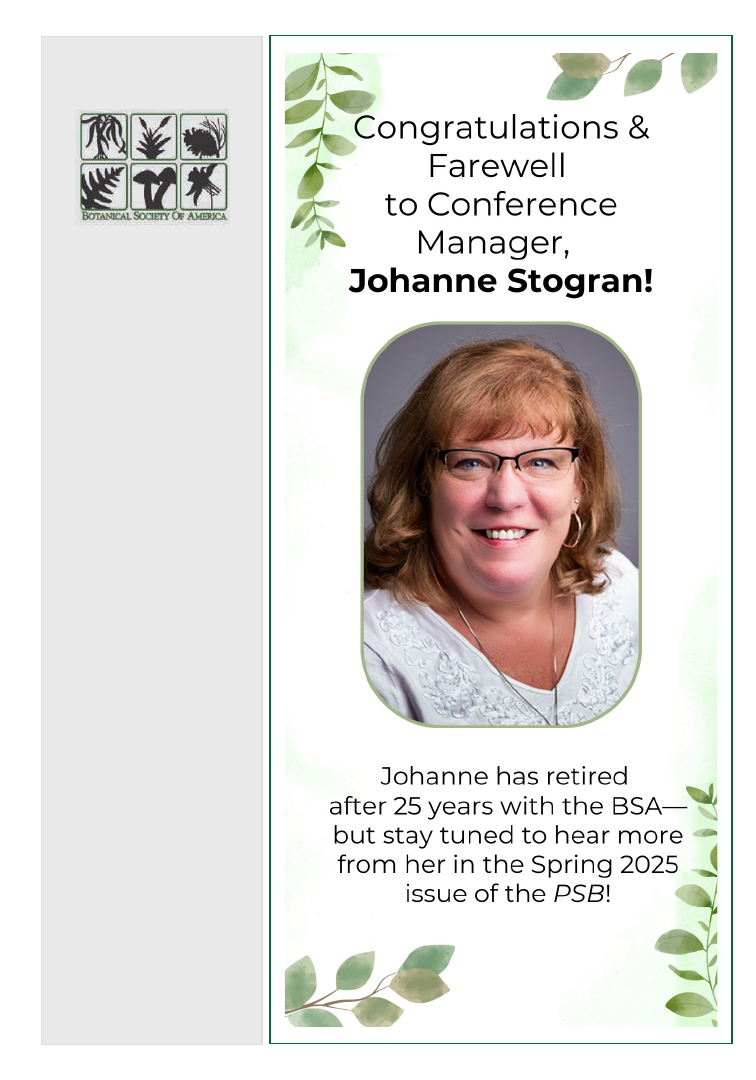
The Botanical Society of
America is a membership soci-
ety whose mission is to: pro-
mote botany, the field of basic
science dealing with the study
& inquiry into the form, func-
tion, development, diversity,
reproduction, evolution, & uses
of plants & their interactions
within the biosphere.
ISSN 0032-0919
Published 3 times a year by
Botanical Society of America, Inc.
4475 Castleman Avenue
St. Louis, MO 63166-0299
Periodicals postage is paid at
St. Louis, MO & additional
mailing offices.
POSTMASTER:
Send address changes to:
Botanical Society of America
Business Office
P.O. Box 299
St. Louis, MO 63166-0299
bsa-manager@botany.org
Address Editorial Matters (only) to:
Mackenzie Taylor, Editor
Department of Biology
Creighton University
2500 California Plaza
Omaha, NE 68178
Phone 402-280-2157
psb@botany.org
Plant Science Bulletin

Explore new solutions for climate change mitigation,
soil health, and crop yield and disease investigation.
Join Us
Invited keynote speakers
Selected talks with panel discussions
Hands-on workshop and demonstrations
Poster sessions
Optional local field trips
A global conference featuring:
Early registration rates are
available until December 1, 2024.
February 24-27, 2025
Tucson, Arizona, USA
licor.com/connect
Register Now
 View on Issuu.com
